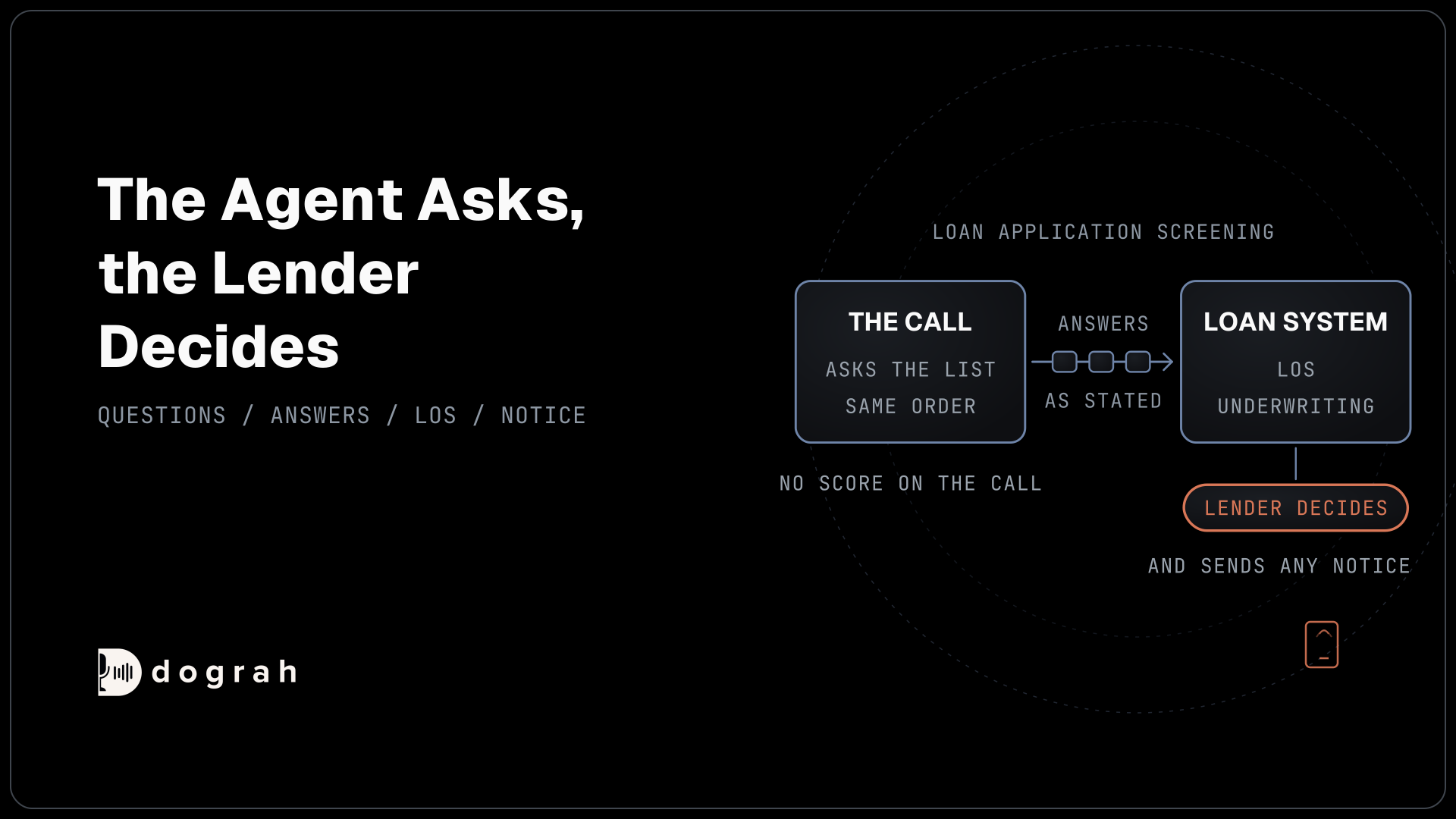

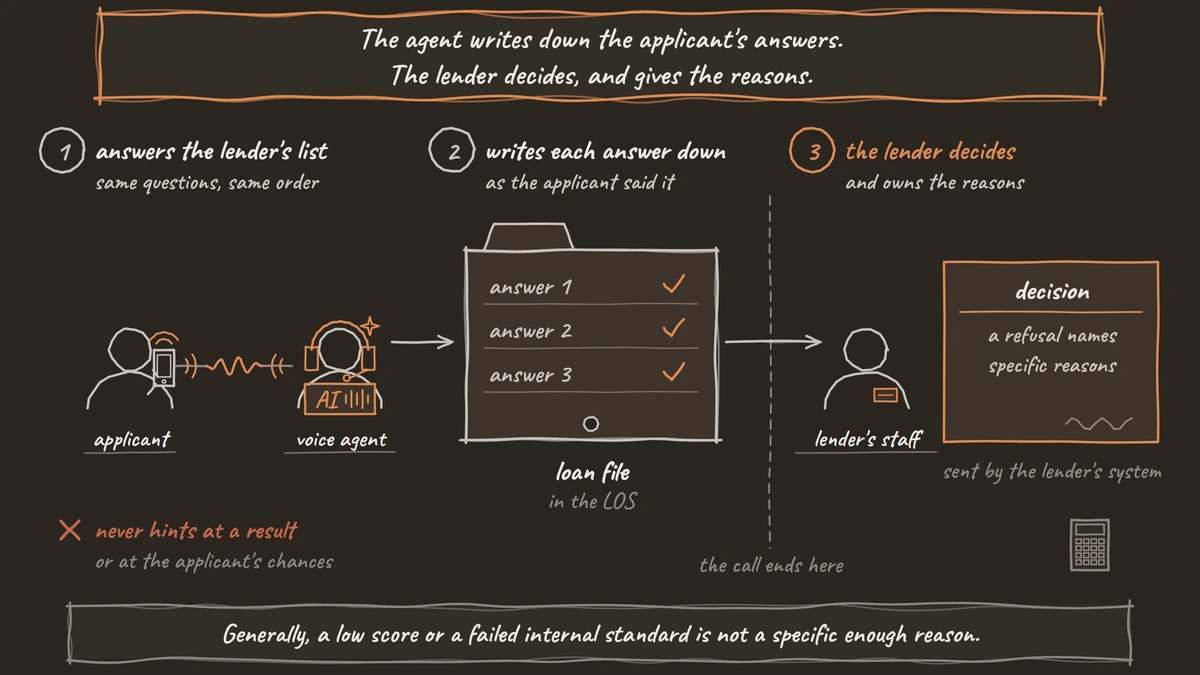
AI voice agents for loan application screening ask applicants the lender's approved questions and write each answer to the loan origination system exactly as stated. They never approve or decline anyone or comment on an applicant's chances. The lender's credit system and staff decide and send any adverse action notice Regulation B requires.
Key Takeaways
- The lender writes the question list. The agent asks nothing else.
- Answers go to the loan system as stated. Nobody gets a score.
- Regulation B's 30-day notice clock is why the missing-item call matters.
This post is part of our guide to AI voice agents for fintech and lending. Below, we cover why the agent records and the lender decides. Then we build the question list and the missing-item call in Dograh, the open-source AI voice agent platform we build.
Why the agent records and never decides
A screening agent gathers what the application needs, and the decision, and the reasons for it, belong to the lender. There are plenty of applications to gather. TransUnion's Q2 2026 credit industry report counted 6.4 million new unsecured personal loans in the first quarter of 2026, up 19.5% on a year earlier. Each one started with an application, and many with a phone call about it.
AI credit tools are often sold as agents that approve or decline on their own, or flag disqualifying answers on the call. We keep the voice agent out of that. Under Regulation B, the rule that carries out the Equal Credit Opportunity Act (ECOA), the lender owes the applicant a notice of its decision, and a refusal must come with specific principal reasons. Regulation B's notice rule also says that naming a failed internal standard or a low score is not enough.
A voice agent that hints at a refusal on the call has given a reason nobody can stand behind. One that only records answers has given none, and the lender's own system, which can explain its decision, sends the notice.
The question list comes from the lender
The lender writes the questions, and the agent asks those and nothing else, in the same order for every applicant. Regulation B's limits on what a lender may ask rule out questions about race, color, religion, national origin or sex. It also limits questions about a spouse or former spouse, about marital status for individual unsecured credit in most states, and about whether income comes from alimony or child support, unless the applicant is first told they need not reveal it. It bars questions about plans to have children, though the number and ages of dependents may be asked.
So the prompt carries the approved list, and it adds one more rule. If the applicant volunteers something sensitive, the agent moves past it politely and does not record it. The same rule against discouraging applicants applies to anything the agent says, so it never comments on the applicant's chances or on what other applicants were told. For home loans, the same design appears in AI voice agents for mortgage lead qualification.
Regulation B covers business credit too, with its own notice rules for businesses, so a small-business lender writes the same kind of list, and has counsel confirm it before the first applicant call.

Open Source Alternative to Vapi / Retell
Self-hosted voice agent platform — no per-minute fees
dograh-hq/dograh
Star on GitHub
How the screening call runs
The screening call opens with the lender's name, asks the list, writes the answers to the LOS and closes with a fixed line.
The Greeting Text is fixed text Dograh speaks word for word as the call connects, so it names the lender exactly as its license does. If you want to tell applicants they're speaking with an automated assistant, or your location requires it by law, write it there along with the lender's name.
For an inbound caller asking about an application already in progress, the agent verifies before it names anything from the file, using an approved check such as date of birth. A phone number finds the application. It does not prove who is calling.
Each answer is captured by variable extraction, an AI step that pulls the answer into a named field as the applicant stated it. The transcript and recording stay the exact record. An HTTP API tool writes the answers to the loan origination system (LOS) during the call, or the webhook sends them afterwards. Because recordings and transcripts keep every word, the list never asks for a full Social Security number. The lender collects that through its own secure form.
The call ends the same way every time, with a line saying the lender will review the application and reply. Play that line as Transition Speech or a recorded clip, so the model never rewords it into a promise. Also rename Dograh's default "qualified" call outcome under "Configure options" to something like application_complete, so nobody reads it as a credit result.
Missing items and the notice clock
The outbound completion call names the one item the file is waiting on, because a deadline is already running. Regulation B gives the lender 30 days after a completed application to tell the applicant its decision. For an incomplete application, the lender has 30 days to act on it or send a notice of what is missing. A call early in that window can turn an incomplete file into a complete one.
Pre-Call Data Fetch loads the open condition from the LOS as the call connects, such as a recent bank statement. After the check, the agent names the item and why it is needed, then the agent asks the lender's portal to send its secure upload link. Dograh sends no texts itself and collects no documents on the call.
A call about an application the person started is generally a service call. Add any offer to it, such as a larger amount, and it becomes a sales call that needs written consent. AI voice agents for loan renewals covers that consent check.
When a loan officer takes over
Any question about rates, terms or the applicant's chances goes to a loan officer, not the agent. Transfer Call works on Twilio, Telnyx, Plivo, Cloudonix and Asterisk ARI. Dograh calls the loan officer first and connects the applicant only when someone answers. No summary goes with the call by default, so the agent writes the answers to the LOS before the transfer. On Twilio, a short spoken introduction can play to both people. If nobody answers within the 30-second default, the applicant stays with the agent, so the prompt offers a callback and writes the request to your system.
Run quality assurance (QA) on a sample of live calls. QA scores the agent's conduct at each step, such as whether it kept to the list, and never scores the applicant. Self-hosted Dograh has no per-minute platform fee (servers, model keys and phone minutes still cost). Dograh Cloud has a 1¢-a-minute platform fee.
Self-hosted, every applicant's answers and recordings stay on the lender's own servers.
Join the Dograh Community
Dograh is an OSS alternative to Vapi. Join our Slack community for queries, releases, best practices & community interactions.
Glossary
- Adverse action notice
- The notice a lender sends when it refuses credit or offers worse terms. Under Regulation B it must give the specific principal reasons, which is why the decision and the notice come from the lender's system, never from the call.
- Prohibited basis
- A trait Regulation B bars lenders from using against an applicant, such as race, sex, marital status or age. The question list leaves these out, and the agent never comments on them.
- Completed application
- An application with all the information the lender regularly gathers for that kind of credit. The 30-day decision clock starts when it is complete, which is why the missing-item call names the exact item.
- Variable extraction
- Dograh's AI step that pulls each answer into a named field as the caller stated it. It is not a word-for-word copy. The transcript and recording are the exact record.