
AI voice agents for payment reminders in banking call members before a loan or card payment is due. The TCPA's bank exemption does not cover reminders, so each call needs the member's prior consent. After verifying the member, the agent reads the amount and due date from the core, and the bank's own system sends the payment link.
Key Takeaways
- The TCPA's bank exemption covers fraud alerts, but payment reminders need consent.
- Name the amount only after the member passes the bank's check.
- The bank's system sends the payment link, so nobody reads a card number.
This post is part of our guide to AI Voice Agents for Banking and Credit Unions. Below, we cover why a payment reminder is a service call that needs consent first. Then we set up the consent check, the call and opt-outs in Dograh, the open-source AI voice agent platform we build.
Why banks call before the due date
A reminder before the due date reaches the member who simply forgot, while the payment is still current. Late payments are creeping up. NCUA's quarterly credit union data put the delinquency rate at federally insured credit unions at 96 basis points in the second quarter of 2026, up 6 basis points from a year earlier. The average outstanding loan balance was $19,906, so most of these reminders are about car loans, cards and personal loans.
Most reminders do not need a call. The core or the bank's messaging system already sends its own text or email. The call is the second step, for members with a payment still open a few days before the due date, or for a new loan's first payment, where a short check that the member knows the date and the payment method catches problems early.
A call works where a text gets ignored, because the member can answer back. They can name the day they will pay, or ask for the payment link there and then.
The bank exemption does not cover reminders
A payment reminder generally needs the member's prior express consent, even when the bank is calling about its own loan. Banks do have an exemption under the Telephone Consumer Protection Act (TCPA), and it is narrow. The FCC's TCPA rule lets a financial institution call a customer's mobile number without prior consent only about fraud or identity theft risk, a possible data breach, steps to prevent harm after a breach, or a pending money transfer. Those calls may not include debt collection or marketing.
A loan or card payment reminder is none of those topics. So the usual rule applies, and a call with an artificial voice to a mobile number needs prior express consent. In its February 2024 declaratory ruling, the FCC confirmed that AI-generated voices count as artificial voices under the TCPA.
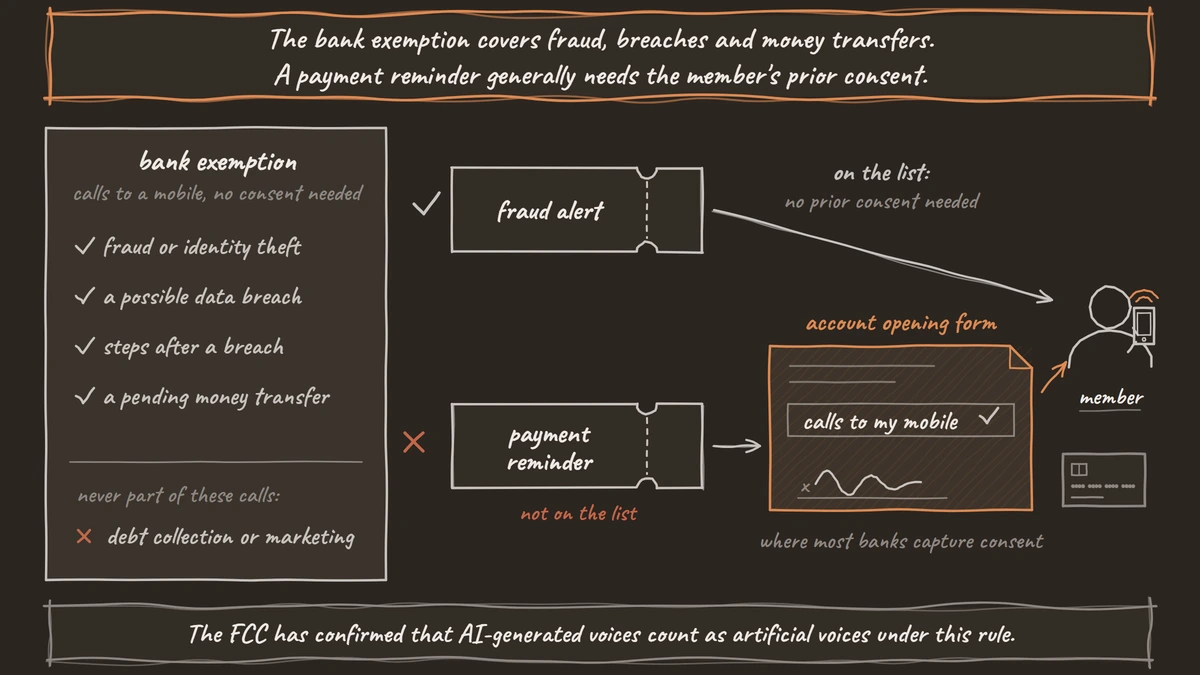
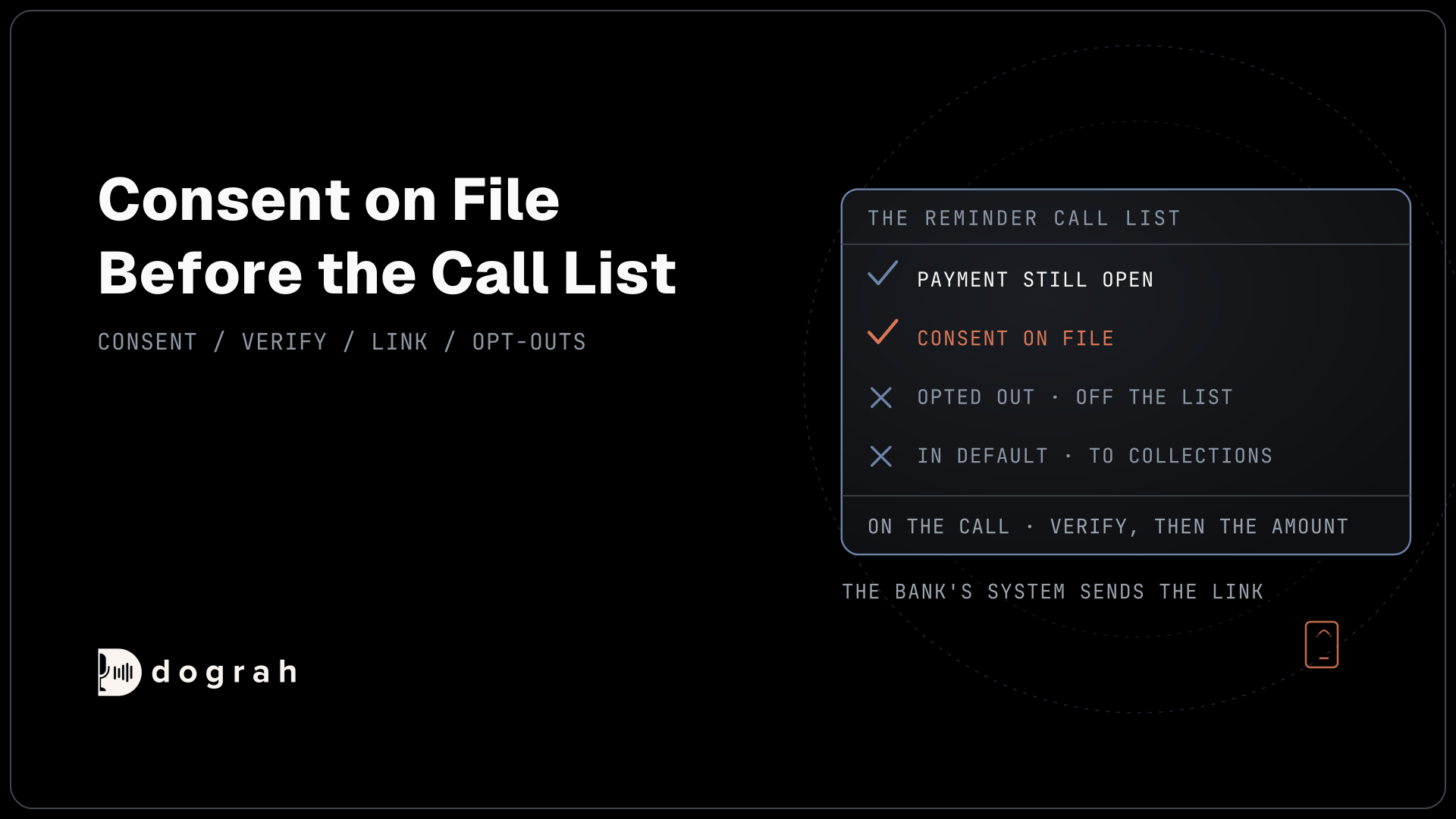
Most banks and credit unions capture consent when the account or loan is opened, with the mobile number the member gives. Before a member goes on the call list, check that record and confirm with counsel that it covers AI-voice calls.
How the reminder call runs
The call runs greet, verify, then disclose, and every figure in it comes from the core. It opens with Greeting Text, the fixed line Dograh speaks word for word as the call connects. It names the bank or credit union exactly as the member knows it. A creditor that collects under another name can fall under the Fair Debt Collection Practices Act (FDCPA), so the name is a fixed line, never one the model writes. If you want to tell members they're speaking with an automated assistant, or your location requires it by law, write it in the Greeting Text too.
Next, the agent asks for the member by name, then for an approved check, such as date of birth and the last four digits of the account number. A name only finds the right person. It does not verify them. If the check fails, or someone else answered, the agent leaves the bank's name and says nothing about the loan.
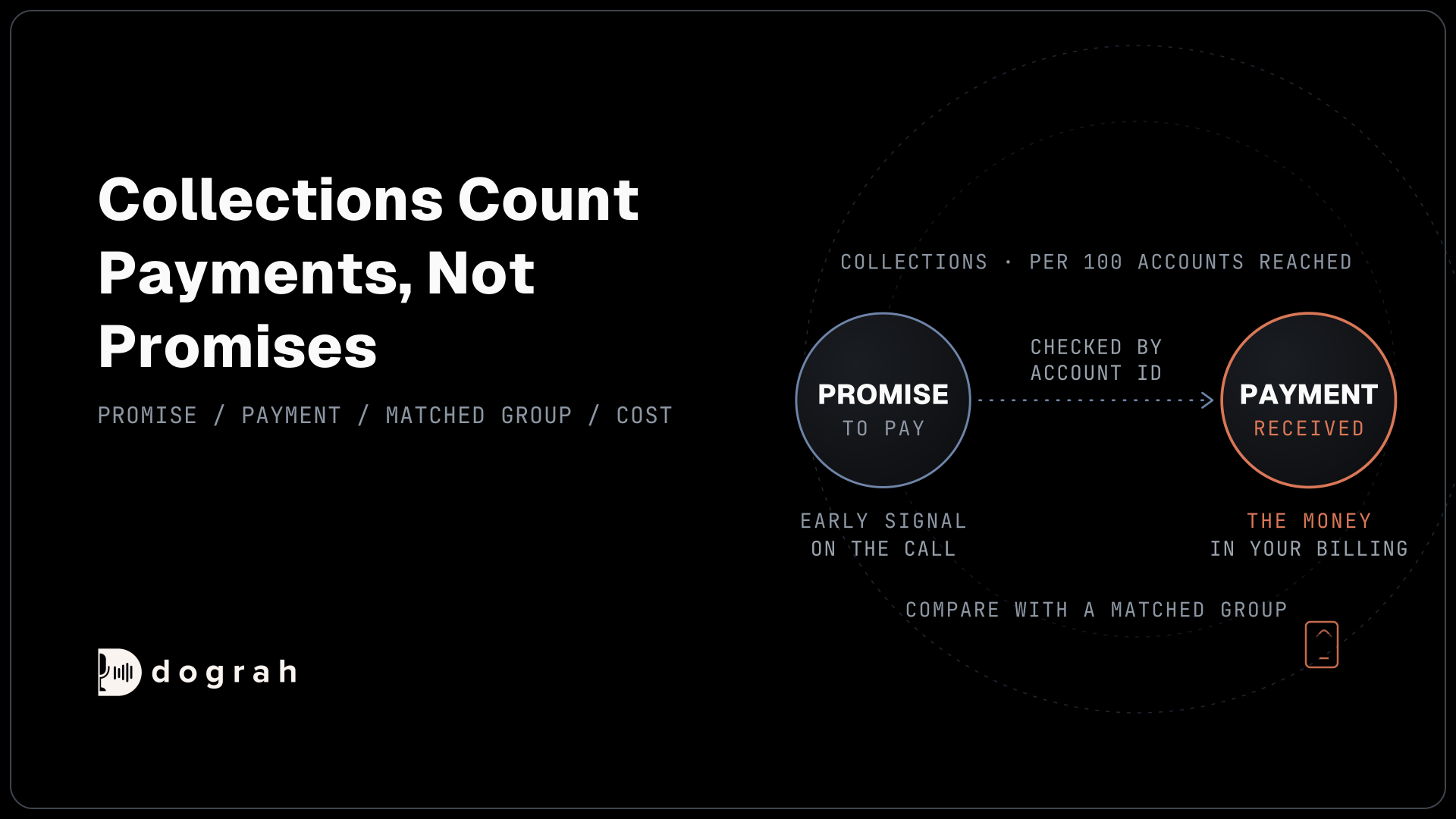
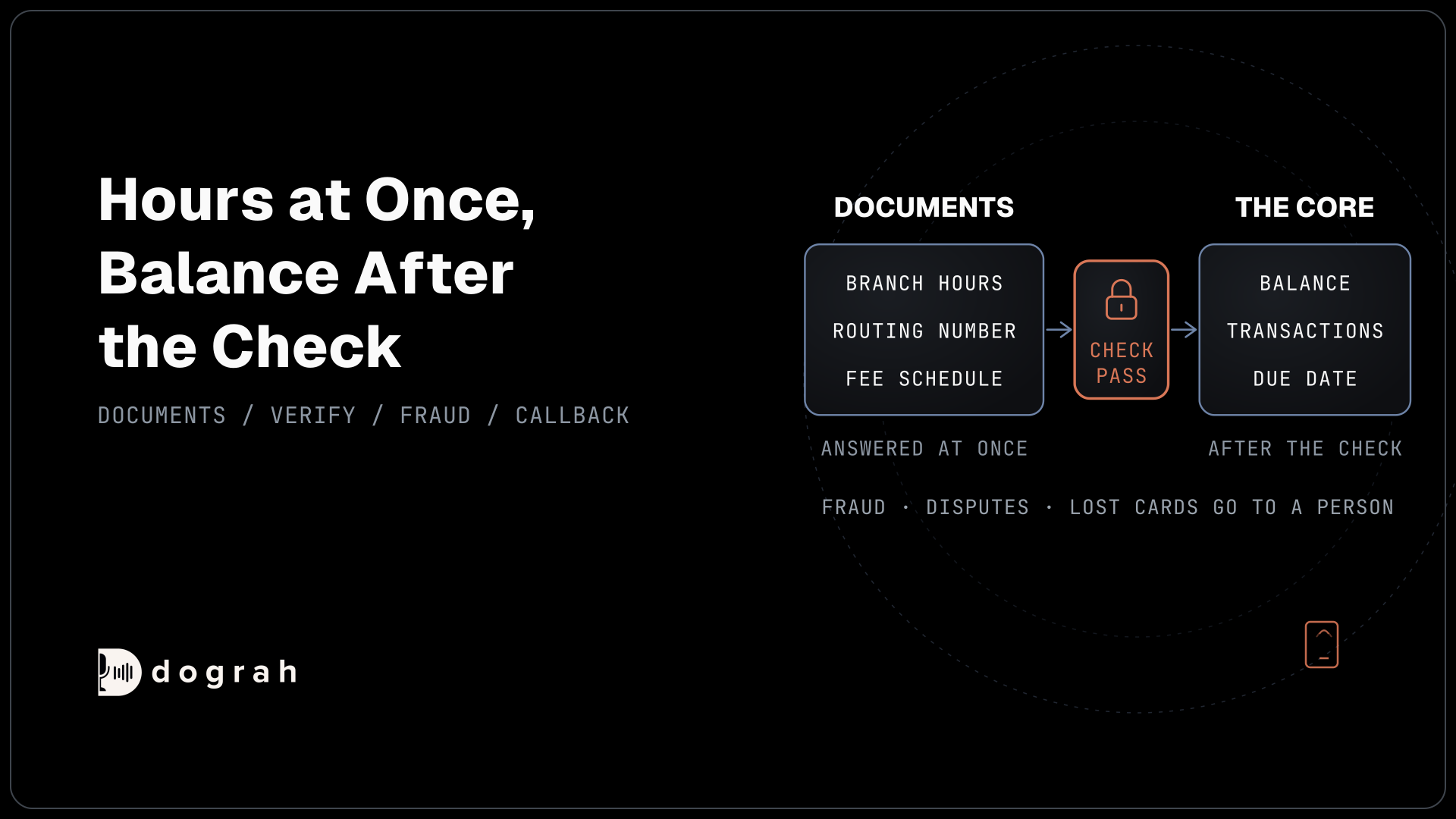
Only after the check does the agent read the amount and the due date. They can come from the campaign row or from a lookup as the call connects, and the prompt tells the agent to speak none of it until the check passes. The agent asks whether the member plans to pay by the due date and records any promise-to-pay date as the member stated it.
If the member wants to pay now, an HTTP API tool asks your system to send its secure payment link by text or email. Dograh has no keypad (DTMF) tool and no feature for taking payments on a call, so nobody reads a card number aloud. Handling Payment-Sensitive (PCI) Calls in a Voice Agent Safely explains why that matters.
When a member says a charge on the statement is wrong, the call has become a dispute, so route it the way AI voice agents for inbound support in banking describes.

Open Source Alternative to Vapi / Retell
Self-hosted voice agent platform — no per-minute fees
dograh-hq/dograh
Star on GitHub
Who gets called, and when
The call list comes from your core, filtered by your consent and opt-out records, never from Dograh. Export the members with a payment still open and consent on file, then upload the list as a CSV to Campaigns. Each extra column, such as the loan type or the due date, becomes a variable the agent can use. Or start each call from your own system through the API Trigger, which dials at once. Campaigns run the same way on both versions. Self-hosted Dograh has no per-minute platform fee (servers, model keys and phone minutes still cost). Dograh Cloud has a 1¢-a-minute platform fee.
Campaign calling hours are set by weekday in one time zone per campaign, so split a member list by time zone. Retries run from 0 to 10, 2 by default, with a delay between 30 seconds and an hour. There is no per-member call cap, so your own list sets how often anyone is called, or retries are set to 0.
A contact cannot be removed from a running campaign, which can only be paused and resumed. To skip members who pay after the upload, upload smaller lists closer to the due date, or use the API Trigger, so your system checks the balance just before each call.
Voicemail handling is off by default. If you set it to "Leave a message", keep the message to the bank's name and a request to call the number on the back of the card or on the bank's website. Never leave the amount, because anyone in the household can play it.
Opt-outs, hardship and the default line
A member who says "stop calling me" is opting out, and that answer belongs in your own list. Dograh keeps no do-not-call list. It can tag the call do_not_call, but that never blocks a future call. So an HTTP API tool writes the opt-out to your system during the call, and those numbers come off before the next upload.
A member who mentions hardship, or asks for a payment plan, needs a person. Transfer Call hands the call over on Twilio, Telnyx, Plivo, Cloudonix or Asterisk ARI. Dograh calls the destination first and connects the caller only when someone answers. On Twilio, it can play a short spoken introduction to both people. No summary goes with the call by default, so the agent writes the request to your system first. If nobody answers within the 30-second default, the member stays with the agent, which offers a callback and writes it down.
Reminders stop once a payment is in default. Past that point, collections staff and their own rules take over, as AI Voice Agents for Debt Collection covers. For the same reminder in other industries, see AI Voice Agents for Payment and Bill Reminders.
Join the Dograh Community
Dograh is an OSS alternative to Vapi. Join our Slack community for queries, releases, best practices & community interactions.
Glossary
- Prior express consent
- The member's agreement, given before the call, to be called at a number, usually captured with the mobile number at account or loan opening. Calls with an artificial or AI voice to a mobile number need it unless an exemption applies.
- Bank exemption (TCPA)
- The FCC rule that lets banks and credit unions call a customer's mobile number without prior consent about fraud or identity theft, data breaches and pending money transfers. Payment reminders fall outside it.
- Promise-to-pay date
- The date a member says they will pay, recorded during the call as the member stated it and written to the bank's system. Later reminders and staff work from it.
- Delinquency rate
- The share of loans with a payment past due, often given in basis points (hundredths of a percent). NCUA reported 96 basis points at federally insured credit unions in the second quarter of 2026.