
AI voice agents for banking and credit unions answer member questions, place payment reminders and route fraud, dispute and lost-card calls to staff. Every account answer comes from the core banking system, and only after the caller passes the bank's own check. Card and account numbers stay off the call, and the bank's system sends its payment link.
Key Takeaways
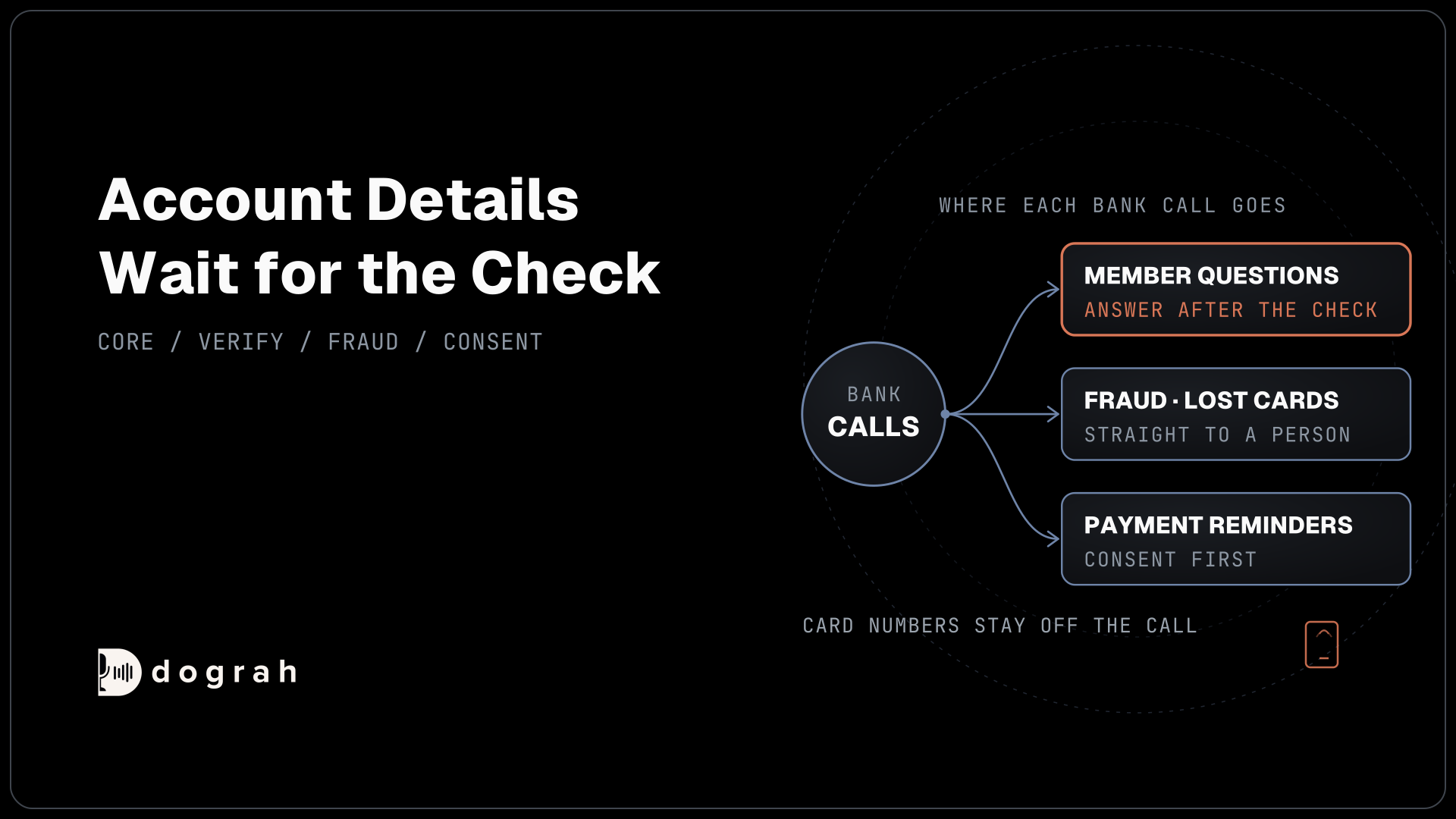
- Account details wait until the caller passes the bank's own verification check.
- Fraud, disputes and lost cards go straight to a person, details written first.
- Every company that hears a member call is a service provider you oversee.
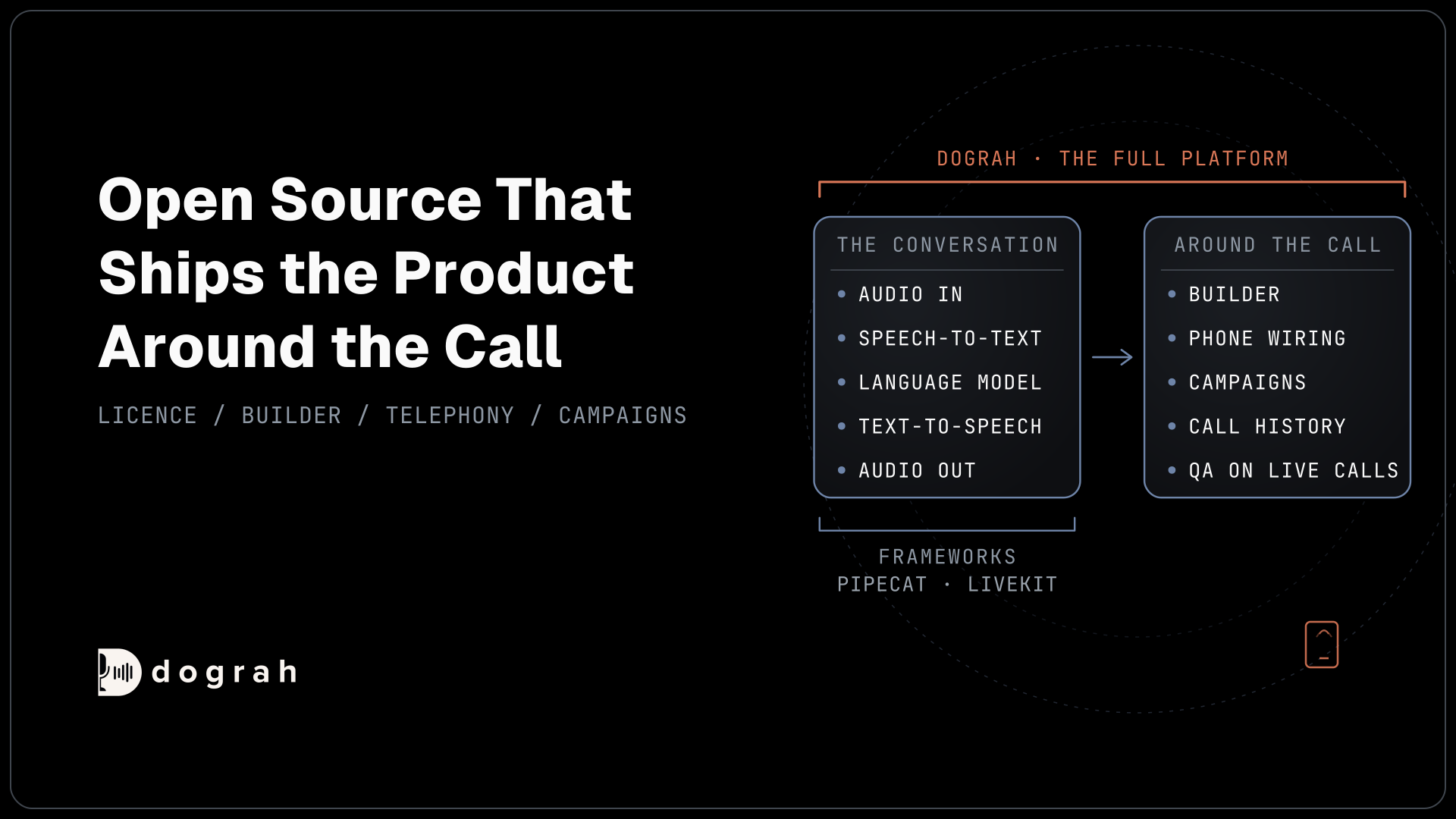
This guide covers each call a bank or credit union can automate and the rules every one follows. We show how each runs in Dograh, the open-source AI voice agent platform we build, which reads your core banking system. You can self-host it or run it on Dograh Cloud.
Every answer comes from your core banking system
A member call is only as good as the data behind it, and in a bank that data lives in the core.
Most of the institutions taking these calls are small. NCUA's quarterly credit union data for the second quarter of 2026 counts 4,214 federally insured credit unions with 146.1 million members, and only 748 of them hold more than $500 million in assets. Their phone lines hear the same short list every day, such as a balance, a recent deposit, a payment due date, a routing number, branch hours.
The voice agent should never answer any of those from memory. During the call, an HTTP API tool asks your core, or the middleware in front of it, for exactly what the call needs, and the agent says only what comes back. A second tool writes back what the member asked for. Each tool waits 5 seconds by default and does not retry, so a slow lookup gets a Custom Message (a typed line or a recorded clip) that plays once, just before the tool runs.
Pre-Call Data Fetch can load the member's record by phone number once the call connects, before the greeting. The caller hears ringing while it runs. Nothing from it is spoken until the caller passes the check in the next section. After the call, the Webhook node sends the outcome to your system and retries a temporary failure. To start an outbound call when something happens in the core, your system calls the API Trigger. There is no built-in core connector, so each of these points at an API your core or middleware already offers.
Some answers need no account at all. Branch hours, fee schedules and the routing number can come from the Knowledge Base, so the agent answers them before any check.
Verify the caller before any account detail
Every bank call runs greet, verify, then disclose, because a phone number finds a record but does not prove who is calling.
Call centers are where attackers try first. The FFIEC guidance on authentication warns that threat actors frequently use social engineering to deceive call center and help desk staff into resetting passwords and other credentials. It adds that reliable verification methods "generally do not depend solely on knowledge-based questions." A voice agent is one more call center seat, so it uses the checks the bank already runs on its phone line.
In practice, the agent collects the answers and the bank decides. The caller gives, say, a date of birth and the last four digits of the account number, and a lookup tool asks your system whether they match. For riskier requests, your system can text a one-time code to the number on file and check the code the caller reads back. The agent only ever hears pass or fail.
Prompts are not the guard here. Tools attach to each step of the call flow separately, so attach the balance and transaction tools only to the step after the check. A caller who fails the check never reaches a step that can look anything up.
Some requests stay with staff whatever the check says. The agent never resets a password or online banking login, and never changes a phone number, email or mailing address, because those are the changes account takeovers depend on. It transfers those callers to a person. AI voice agents for inbound support in banking covers which questions the agent answers after the check and which it hands over.

Open Source Alternative to Vapi / Retell
Self-hosted voice agent platform — no per-minute fees
dograh-hq/dograh
Star on GitHub
Fraud, disputes and lost cards go to a person
Suspected fraud, a disputed charge and a lost or stolen card skip the agent's own logic and go straight to staff.
Fraud is where bank calls carry the most risk. The FTC's data on imposter scams in 2025 found that people reported losing nearly $1 billion to business impersonators, with the highest reported losses to bank impersonators. A member who calls to describe a suspicious call or text needs your fraud team.
The hand-off has a fixed shape. The agent plays a fixed line in Transition Speech, such as "I'm connecting you to our card team now." The agent writes the caller's own words and the time of the call to your case system. Then Transfer Call hands the call over on Twilio, Telnyx, Plivo, Cloudonix or Asterisk ARI. Dograh calls the destination first and connects the caller only when someone answers. On Twilio, it can play a short spoken introduction to both people before connecting them. No summary goes with the call by default, which is why the details are written first.
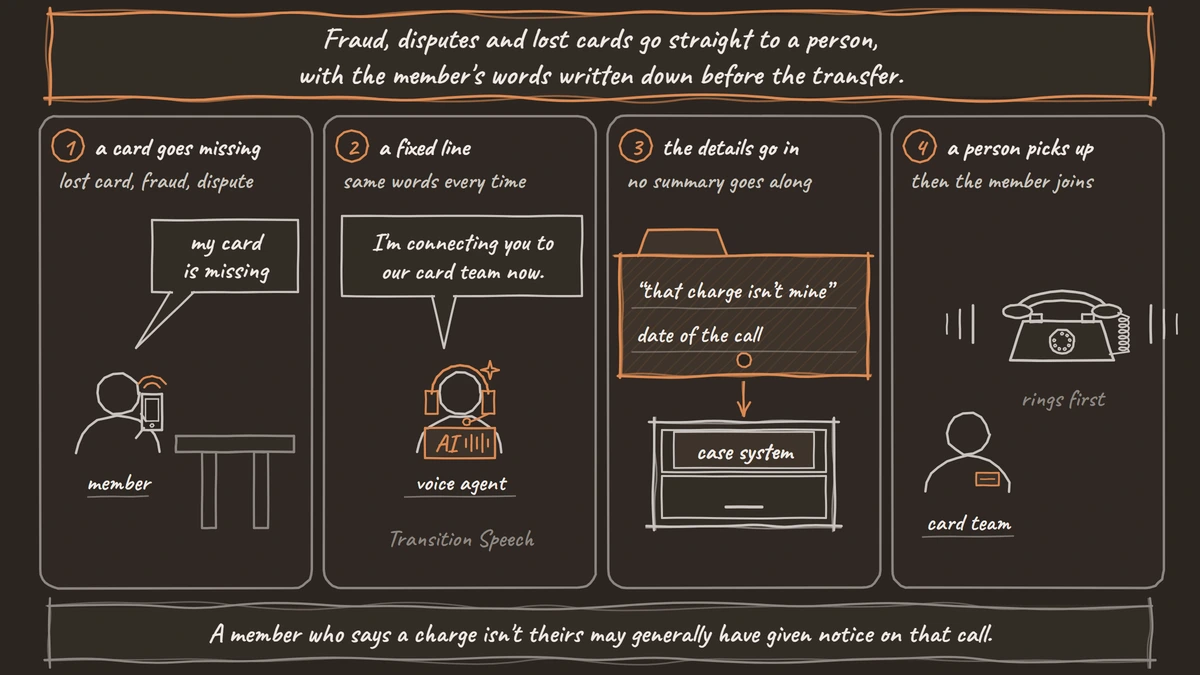
If nobody answers within the 30-second default, the member stays with the agent. Tell it in the prompt to offer a callback and write that request, with the lost-card or dispute details, to your system.
Writing the time down matters for disputes. Under the Electronic Fund Transfer Act's Regulation E, a notice of error can be oral as well as written, per Regulation E's error resolution rule. A member who tells the agent "that charge isn't mine" may generally have given notice on that call, so the call's date belongs in your system the same day. Outbound fraud alerts, where the bank calls first, follow their own rules in AI voice agents for fraud-alert callbacks.
Payment reminders need consent first
A payment reminder is a service call, and it needs the member's consent before the first dial. Banks have a narrow exemption under the Telephone Consumer Protection Act (TCPA). The FCC's TCPA rule lets a financial institution call a customer's mobile number without prior consent only about fraud or identity theft risk, a possible data breach, steps to prevent harm after a breach, or a pending money transfer. Those calls may not include debt collection or marketing. A loan or card payment reminder is none of those, so it generally needs the member's prior express consent, which most banks capture when the account is opened.
The call itself is short. The Greeting Text names the bank or credit union exactly as the member knows it. Then the agent verifies, reads the amount and due date from the core, and records any promise-to-pay date as the member stated it. If the member wants to pay now, the agent asks your system to send its secure payment link by text or email.
Voicemail is off by default. If you turn on "Leave a message", keep it to the bank's name and a request to call the number on the back of the card or on the bank's website, with no amount. Campaign calling hours run in one time zone, so split a member list by time zone. Opt-outs go to your own list, because Dograh keeps no do-not-call list.
The reminder stops at default. Once a loan is in default, collections staff take over, and AI Voice Agents for Debt Collection covers that call. AI voice agents for payment reminders in banking covers the consent check, the call and opt-outs in full.
Card and account numbers stay off the call
No bank voice agent call should ever carry a full card number, account number or Social Security number. Dograh has no keypad (DTMF) tool, no feature for taking customer payments on a call, and no redaction of recordings or transcripts. Every recording and transcript keeps what the caller says. So the agent never asks for a full number, and a short check, such as the last four digits, does the job.
When a member wants to pay, the bank's own system sends its secure payment link by text or email when the agent asks. A member who insists on paying by phone goes to your existing payment line through Transfer Call. Self-hosted, recording can be switched off only server-wide, and transcripts are still saved.
Callers sometimes start reading their card anyway. Add a rule to the prompt that the agent stops any caller who starts reading card digits and offers the link instead. Whatever was said before that is in the transcript, so your team deletes it from your own storage. Handling Payment-Sensitive (PCI) Calls in a Voice Agent Safely covers why pausing the recording does not fix this.
Every vendor on the call is a service provider
For a bank or credit union, the safest voice agent is the one with the fewest companies on the call. Credit unions follow NCUA's guidelines for safeguarding member information. Banks follow the federal banking agencies' Interagency Guidelines Establishing Information Security Standards, which set the same duty. Both ask the institution to choose service providers with care, require safeguards from them by contract, and, where its risk assessment calls for it, monitor them by reviewing audits, test results or similar evaluations.
On a hosted platform, a member call is heard by the voice platform, a speech-to-text company, a language model company, a voice company and the phone carrier. Generally, each one that hears member calls is a service provider you have to oversee. Bringing your own keys (BYOK) to a hosted platform changes whose contract covers the models, not where the audio goes.
The count only drops when the platform and the models run on servers you control. Self-hosted, Dograh never receives your call data. It is the orchestration layer that runs the call flow, tools and telephony, and the speech and language models are a separate layer you choose. To keep the audio in-house, run open-weight models on your own servers, such as Qwen3.8 27B for language, Parakeet TDT 0.6B v2 for speech-to-text and Magpie TTS for the voice. The phone carrier stays on the call either way, and so does your cloud provider if the servers run in one.
Open code also helps with the monitoring duty, because your security team can read the platform's own code. The self-hosting guide covers the install, and our page on on-prem voice AI for banks and fintechs shows the setup, which your counsel can check against these rules.
Join the Dograh Community
Dograh is an OSS alternative to Vapi. Join our Slack community for queries, releases, best practices & community interactions.
Building the agent in Dograh
The first agent most banks build is one inbound line, made of a few steps in the visual workflow builder. The Start Call step greets the caller with the bank's name and looks up the record without speaking any of it. A Verify step collects the answers and asks your system for pass or fail. An Account step, the only one with the balance and transaction tools, answers after the check. A separate pathway with fixed Transition Speech writes the report and transfers fraud, dispute and lost-card calls. A Webhook node posts every call's outcome to your system.
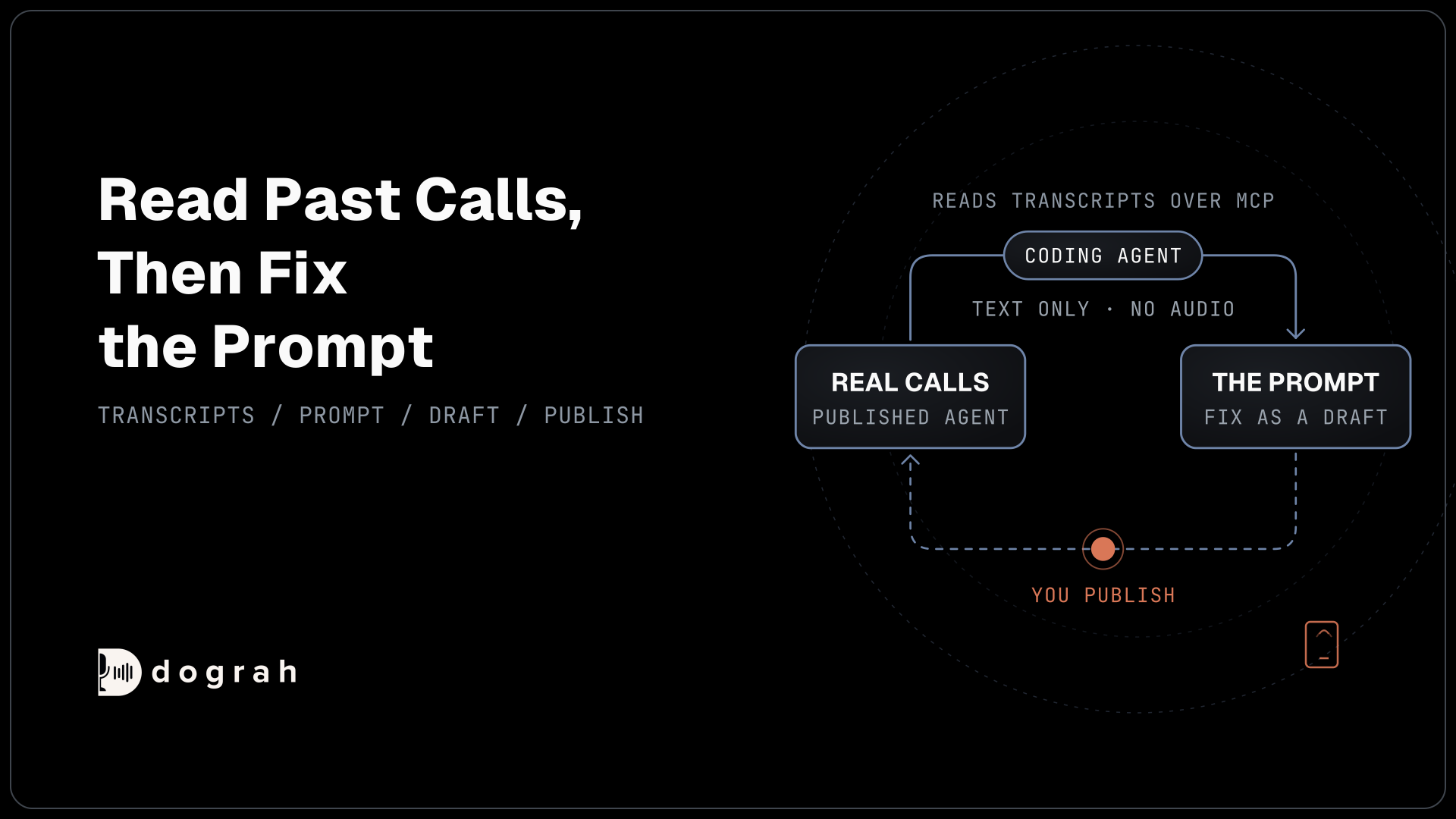
Two details decide whether it works on a real line. Add the bank's product names and terms such as "routing number" and "ACH" to the agent's Dictionary, so speech-to-text spells them right. Then test on a real phone number, because most phone calls still reach the agent as 8 kHz audio, while a browser test runs at 16 kHz, and browser tests cannot run Transfer Call. Once live, run quality assurance (QA) on a random 5 to 10% sample of calls.
How to Build a Voice Agent for Banking builds this agent click by click.
Choosing a platform for bank calls
Six tests separate platforms for bank calls. They check how a platform verifies callers, where fraud and lost-card calls go, how card data stays off the call, how many companies hear the audio, how it connects to the core, and what it costs as volume grows. Dograh is open source under the BSD-2-Clause license and runs on your own servers, so call audio can stay inside the bank.
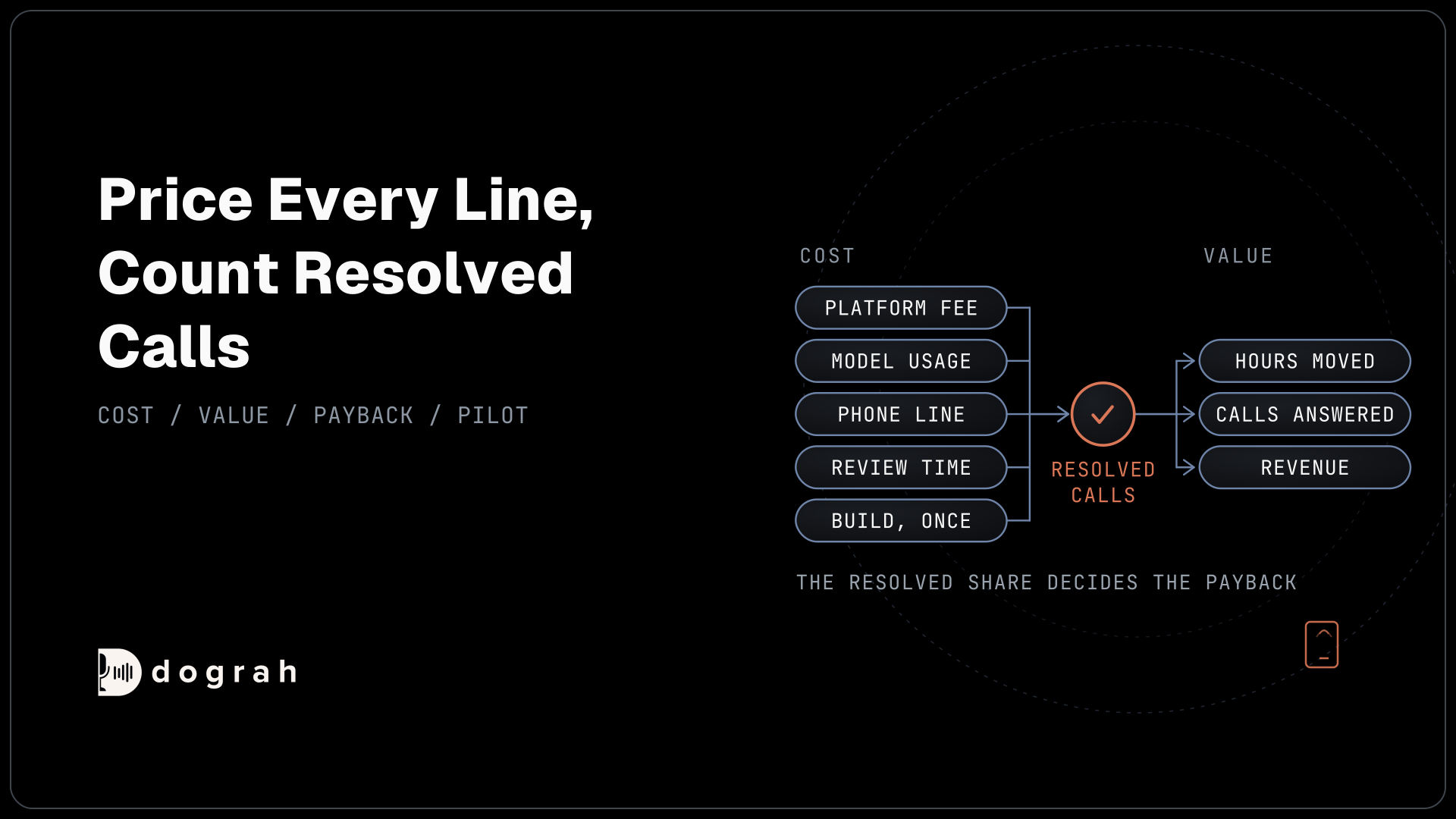
Self-hosted Dograh has no per-minute platform fee (servers, model keys and phone minutes still cost). Dograh Cloud has a 1¢-a-minute platform fee. Both start at 10 calls at once, and self-hosted teams can raise that limit themselves.
Best AI Voice Agents for Banking applies the six tests to the platforms banks and credit unions shortlist. Lenders outside the deposit world, such as fintech and online lenders, have their own guide in AI Voice Agents for Fintech and Lending.
Which bank call to automate first
Start with inbound calls that need no account at all, such as hours, fees and the routing number from the Knowledge Base. Then add balance and recent-transaction questions behind the check, with fraud, dispute and lost-card routing tested on a real line. Outbound payment reminders come last, once your consent records and opt-out list are clean.
Each part of this guide has its own deep dive:
- AI Voice Agents for Payment Reminders in Banking
- AI Voice Agents for Inbound Support in Banking
- How to Build a Voice Agent for Banking
- Best AI Voice Agents for Banking
Glossary
- Core banking system
- The bank's or credit union's system of record for accounts, balances, transactions and loans. Every account answer a voice agent gives should be read from it during the call, through an API the core or its middleware offers.
- Knowledge-based questions
- Questions only the real customer should be able to answer, such as a date of birth, used to check a caller. FFIEC guidance says reliable methods "generally do not depend solely on knowledge-based questions", so banks add checks such as a one-time code sent to the number on file.
- Notice of error (Regulation E)
- A consumer's report of an error on an electronic fund transfer, such as a charge they did not make. It can be oral or written, so a member's words on a voice agent call may generally count, and the call's date belongs in the bank's system.
- Service provider
- A company that handles member information for the bank or credit union. NCUA's safeguarding guidelines and the Interagency Guidelines ask the institution to choose service providers with care, bind them by contract and monitor them. Any company that hears or stores member calls generally counts as one.