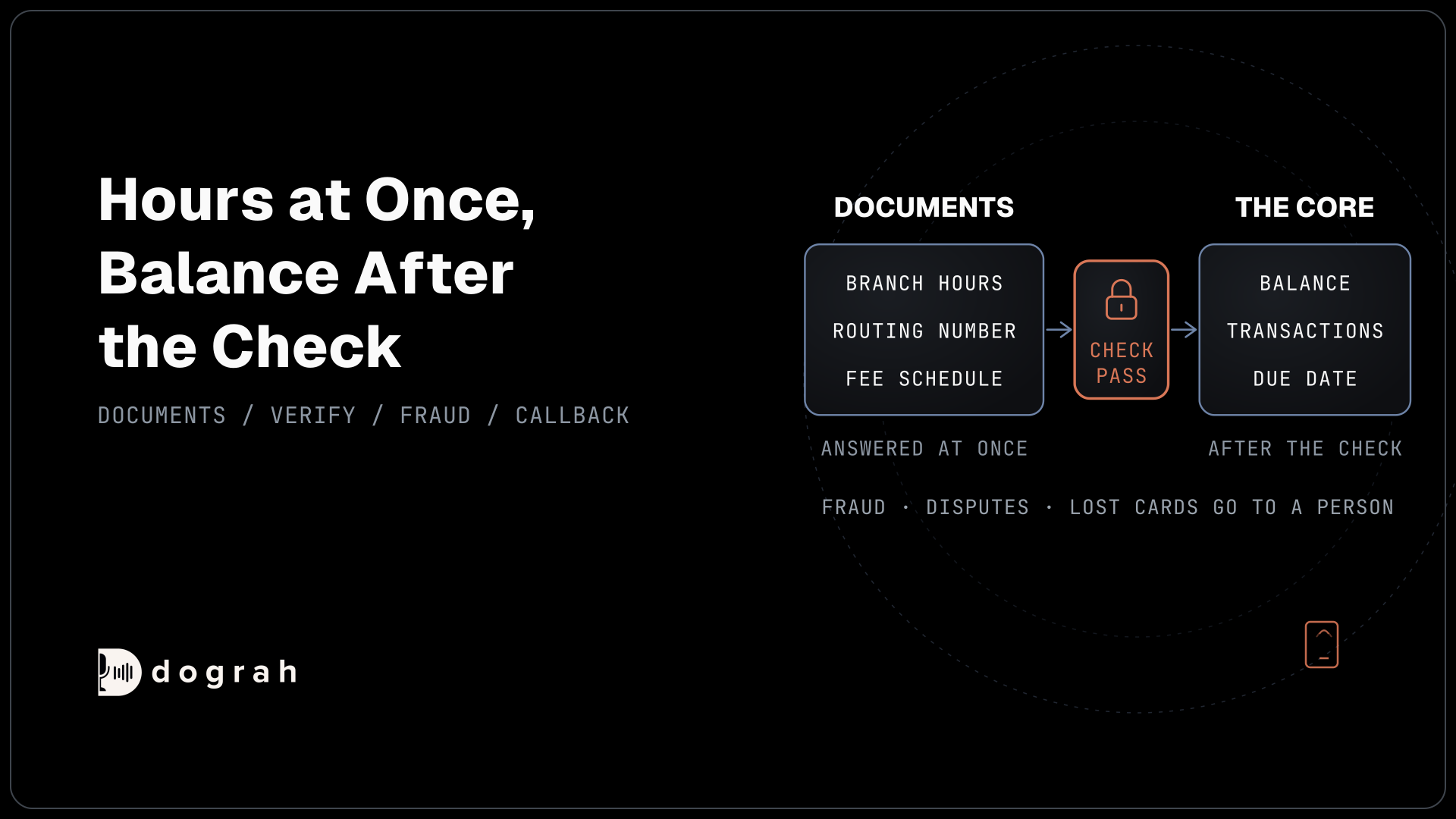

AI voice agents for inbound support in banking answer branch hours, fees and routing numbers at once, and account questions only after the caller passes the bank's own check. Suspected fraud, disputed charges and lost cards go straight to a person, with the caller's words and the time written to the bank's system first.
Key Takeaways
- Document answers need no check, but account answers wait for the bank's check.
- Attach account lookup tools only to the step after verification.
- Fraud, disputes and lost cards reach a person, report written first.
This post is part of our guide to AI Voice Agents for Banking and Credit Unions. Below, we cover the full inbound member line, from the first question to the hand-offs for fraud, disputes and lost cards. Then we run it in Dograh, the open-source AI voice agent platform we build.
Two kinds of answers on a bank's line
Every question a member asks the agent comes from one of two places, and only one of them needs a check.
The first is your documents. Branch hours, the routing number, fee schedules, card limits and holiday closures are the same for every caller. Upload them to the Knowledge Base as PDF, DOCX, DOC, TXT or JSON files of up to 5 MB, and the agent answers from them on any call, before any check.
The second is the account. A balance, the last few transactions, a payment due date or whether a deposit has cleared belong to one member, so the agent reads them from the core only after that member passes the bank's check. The same split runs through any support line, as AI voice agents for inbound customer support shows across industries.
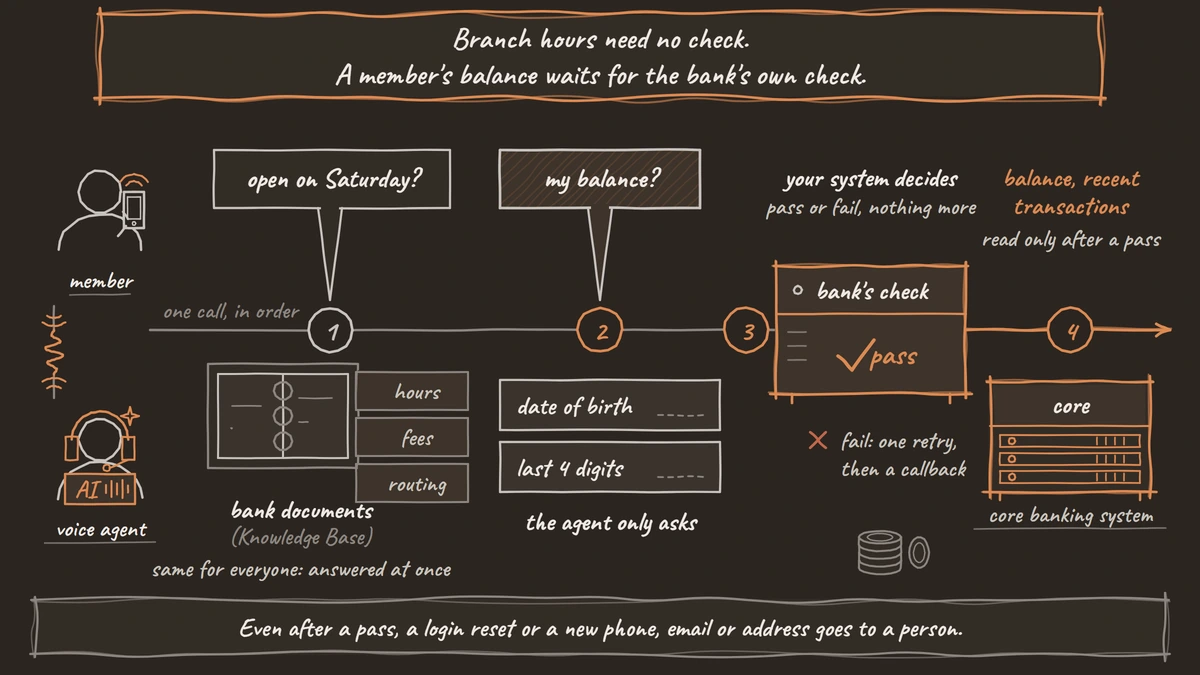
A third group never gets an answer from the agent at all. That covers fraud, disputes, lost cards and changes to login or contact details. Those go to a person, as the next sections cover.
Verify the caller before any account detail
The agent reads nothing from the account until the caller passes a check your bank already uses. A phone number finds the member's record, but it does not prove who is calling, and neither does a name. Call centers are a known target. The FFIEC guidance on authentication warns that threat actors frequently use social engineering to deceive call center and help desk staff into resetting passwords and other credentials. It also says reliable verification methods "generally do not depend solely on knowledge-based questions."
So the agent collects and the bank decides. It asks for the bank's approved check, such as date of birth and the last four digits of the account number. An HTTP API tool sends the answers to your system, which replies pass or fail. For riskier requests, your system can text a one-time code to the number on file and check the code the caller reads back. The agent never sees which answer was wrong, and never says so.
Do not rely on the prompt for this. In Dograh, tools are attached to each step of the call separately, so the balance and transaction tools sit only on the step after the check. A caller who fails never reaches a step that can look anything up. Allow one retry, then offer a callback.
Some requests stay with staff even after a pass. The agent never resets a password or online banking login, and never changes a phone number, email or mailing address, because those are the changes an account takeover needs. It hands those callers to a person.

Open Source Alternative to Vapi / Retell
Self-hosted voice agent platform — no per-minute fees
dograh-hq/dograh
Star on GitHub
Fraud, disputes and lost cards skip the agent
Suspected fraud, a disputed charge and a lost or stolen card go straight to a person, whatever stage the call has reached.
Fraud is the call bank impersonators feed on. The FTC's data on imposter scams in 2025 found that people reported losing nearly $1 billion to business impersonators, with the highest reported losses to bank impersonators. A member who calls to ask whether a call or text "from the bank" was real needs your fraud team.
Draw a pathway from each step to a hand-off step, with a condition such as "the caller reports fraud, a suspicious call, a charge they don't recognise, or a lost or stolen card". Choosing the pathway is the model reading that condition, so test it with many phrasings. On the pathway, Transition Speech plays a fixed line word for word, such as "I'm connecting you to our card team now." The agent then writes the caller's own words and the time of the call to your case system.
Then Transfer Call hands the call over on Twilio, Telnyx, Plivo, Cloudonix or Asterisk ARI. Use two Transfer Call tools, one for the fraud line and one for card services, each with its own number. Dograh calls the destination first and connects the caller only when someone answers. On Twilio, it can play a short spoken introduction to both people. No summary goes with the call by default, which is why the report is written first.
Writing the time matters for disputes. Under the Electronic Fund Transfer Act's Regulation E, a notice of error can be oral as well as written, per Regulation E's error resolution rule. A member who tells the agent "that charge isn't mine" may generally have given notice on that call, so the date it happened belongs in your system that day, and counsel can confirm how your bank handles spoken notices. When the bank calls the member first about a flagged charge, see AI voice agents for fraud-alert callbacks.
When nobody picks up
An unanswered transfer should still leave a written record behind. If nobody answers within the 30-second default (settable from 5 to 120 seconds), the agent is told the transfer did not connect, and the member stays on the call with it. Tell it in the prompt to say so plainly, offer a callback and write the callback request to your system. There is no built-in callback task, so your system owns the follow-up.
For a lost card, the report written before the transfer is the important part. It holds the member's words and the time, so your card team can act on it from the queue even if the call never connected. After hours, the same pathway can skip the transfer and only write the report, if your card line is closed. AI Voice Agents for Human Handoff Routing covers handover patterns across industries.
Test the routing before members call
Routing errors only show up on real phone calls, so test every exit there before launch. Browser test calls cannot run Transfer Call, and most phone calls still reach the agent as 8 kHz audio, while a browser test runs at 16 kHz. Call your number from a phone. Say "someone used my card" three different ways, then "I lost my wallet", then "I want to change my address", and check each one takes the hand-off pathway and writes a report with the time.
Once live, add a QA Analysis node with a Sample Rate of 5 to 10% so a random sample of calls is scored step by step. Read every call that ended in a transfer or a failed check. How to Build a Voice Agent for Banking builds this line click by click. Self-hosted Dograh has no per-minute platform fee (servers, model keys and phone minutes still cost). Dograh Cloud has a 1¢-a-minute platform fee.
Start with document answers alone for a week, then switch on the account step once the fraud and lost-card routing has passed on a real line.
Join the Dograh Community
Dograh is an OSS alternative to Vapi. Join our Slack community for queries, releases, best practices & community interactions.
Glossary
- Approved check
- The verification your bank already uses on its phone line, such as date of birth with the last four digits of the account number, or a one-time code sent to the number on file. The agent collects the answers, and the bank's system decides pass or fail.
- Notice of error (Regulation E)
- A consumer's report of an error on an electronic fund transfer, such as a charge they did not make. It can be oral or written, so a member's words on a voice agent call may generally count, and the time of the call belongs in the bank's system.
- Account takeover
- Fraud where someone gains control of a member's account, often by persuading a call center to reset a password or change the phone number or email. That is why the agent never makes those changes.
- Transition Speech
- A fixed line, typed or recorded, that Dograh plays word for word when the call moves along a pathway. The hand-off line for fraud and lost cards goes here, because a line the model writes can drift.