
AI voice agents for loan renewals call existing borrowers whose written consent to sales calls is on file. After verifying the borrower, they read eligibility and the renewal terms from the loan management system, never inventing a rate. Signing happens in the lender's own e-sign flow, and any stop request is written to the lender's list.
Key Takeaways
- Asking a borrower to renew is a sales call that needs written consent.
- An existing loan is not consent. Check the record before the list goes in.
- Terms come from the loan management system. The agent never invents a rate.
This post is part of our guide to AI voice agents for fintech and lending. Below, we cover why a renewal offer counts as a sales call. Then we follow that call from the consent check to the e-sign link in Dograh, the open-source AI voice agent platform we build.
Why a renewal offer is a sales call
Asking a borrower to renew a loan or take a top-up encourages them to buy more credit, so the call is generally telemarketing.
The book of borrowers to call is large. TransUnion's Q2 2026 credit industry report put US unsecured personal loan balances at a record $281 billion, up 9.6% in a year. Many of those borrowers will be eligible to renew at some point, and a call is the natural way to tell them.
The FCC's calling rule under the Telephone Consumer Protection Act (TCPA) defines telemarketing as a call made to encourage a purchase, and the FCC treats AI-generated voices as artificial voices. An artificial-voice telemarketing call needs the person's prior express written consent, meaning a signed agreement that clearly authorizes the lender to make those calls to that number.
An existing loan does not count. The FDIC's TCPA examination guide notes that since 2012 telemarketers can no longer rely on an established business relationship to skip consent. Paying on time makes a borrower a good prospect, but it does not count as consent.
The same logic stops an offer from riding along on a service call. A payment reminder is generally a service call, but add "you're also eligible for a top-up" and the call becomes telemarketing, so have counsel confirm your scripts before the first offer call.
Build the call list from consent records
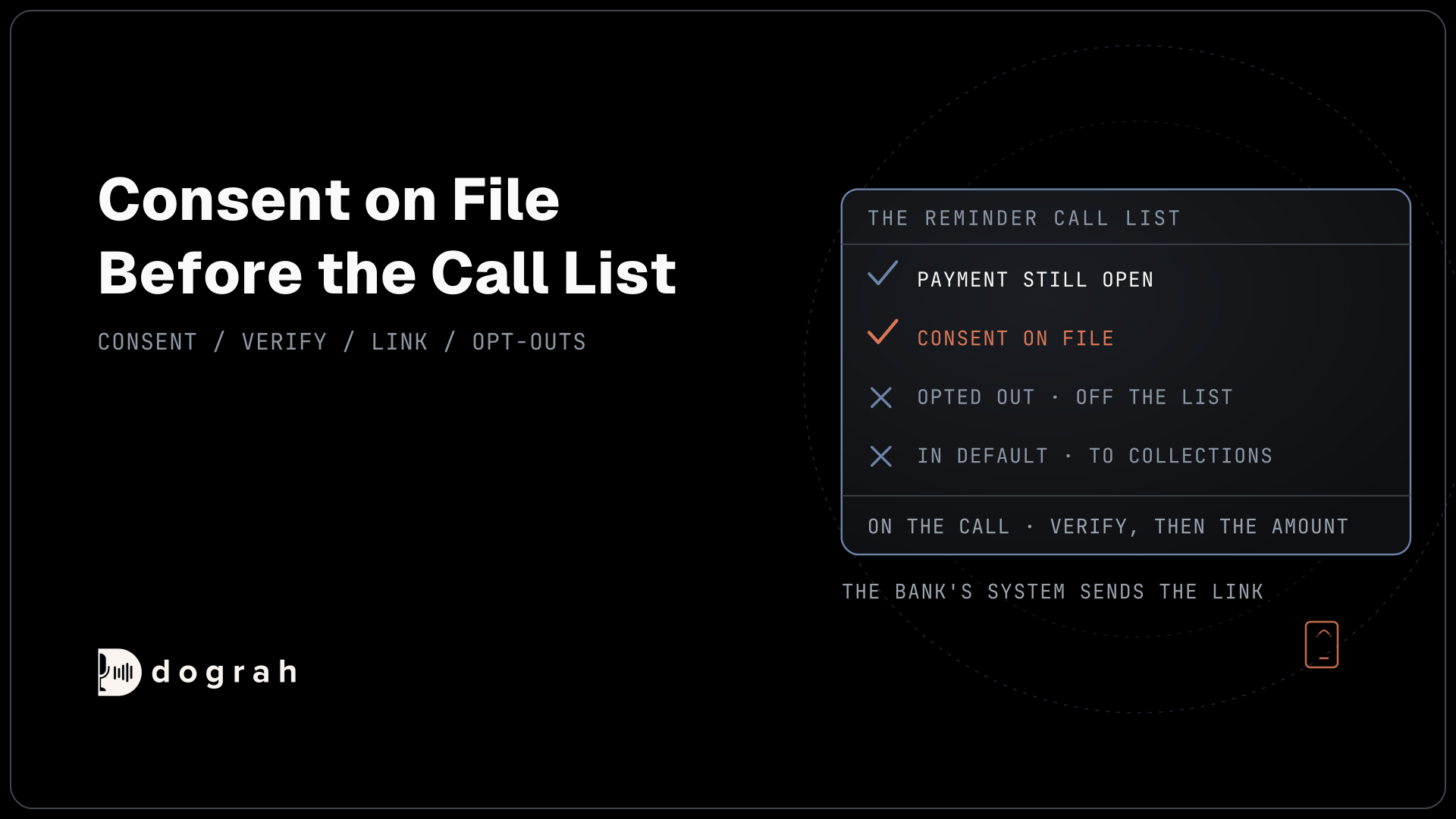
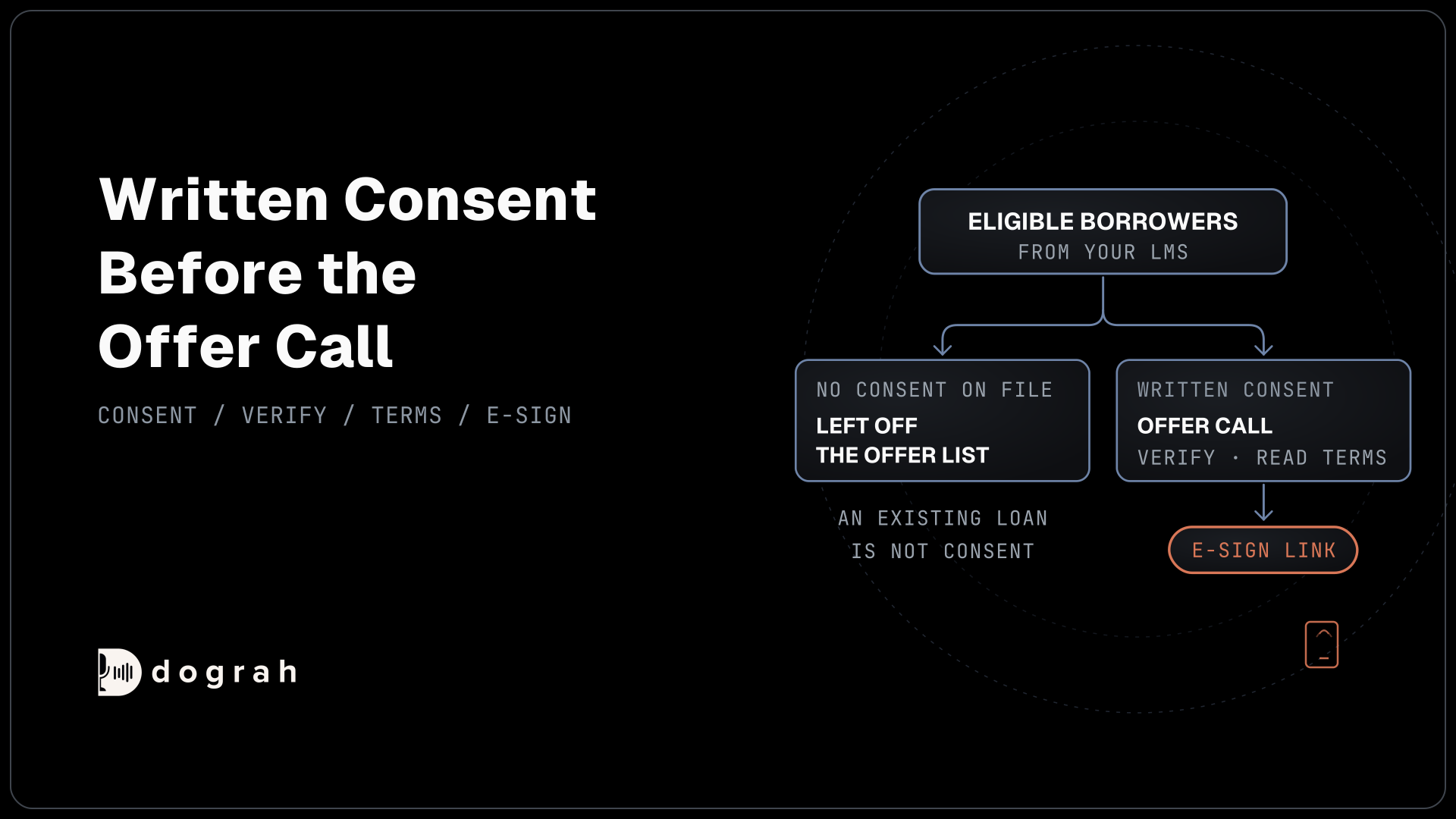
The consent check happens before the dial, in your own systems, because Dograh stores no consent record. From your loan management system (LMS), pull the borrowers who are eligible to renew and have a signed consent to offer calls on file. Leave out anyone who has asked not to be called. Then upload the list as a CSV to Campaigns, where each extra column, such as the product name, becomes a variable the agent can use. Or start each call from your own system with the API Trigger, so your system decides who is called at that moment.
Campaigns set calling hours by weekday, in one time zone per campaign, so split the list by time zone. Retries run from 0 to 10, 2 by default. There is no per-borrower call cap, so your own list decides how often anyone hears an offer, or retries are set to 0.
A renewal notice that only states when a line expires is the other half of this call, and it needs no offer at all. AI voice agents for renewals and retention covers how the notice half and the offer half split. Home loan refinance calls follow their own rules in AI voice agents for mortgage rate and refinance callbacks.

Open Source Alternative to Vapi / Retell
Self-hosted voice agent platform — no per-minute fees
dograh-hq/dograh
Star on GitHub
How the renewal call runs
The renewal call verifies the borrower first, then reads the offer exactly as the LMS returns it. The Greeting Text is fixed text Dograh speaks word for word, so it names the lender exactly. It can carry the borrower's first name with a fallback, written as {{first_name | there}}, so a missing value never leaves a gap. If you want to tell borrowers they're speaking with an automated assistant, or your location requires it by law, write it there too.
Before naming any loan detail, the agent asks for an approved check, such as date of birth or the last four digits of the loan number. A phone number finds the account. It does not prove who answered. If the check fails, the agent leaves the lender's name and a number and says nothing about the offer.
Pre-Call Data Fetch loads the borrower's eligibility and the renewal terms from the LMS once the call connects, with the mode set to "Outbound calls only". The greeting waits for it. After the check, the agent reads the amount and rate as returned and never invents or rounds a figure. If the borrower asks about a term the LMS did not return, the agent says a loan officer will cover it.
If the borrower wants to go ahead, an HTTP API tool asks the lender's system to send its e-sign link by text or email. Dograh takes no signatures or payments on a call, so the renewal is signed in the lender's own flow, with its own disclosures.
Stop requests and handing over
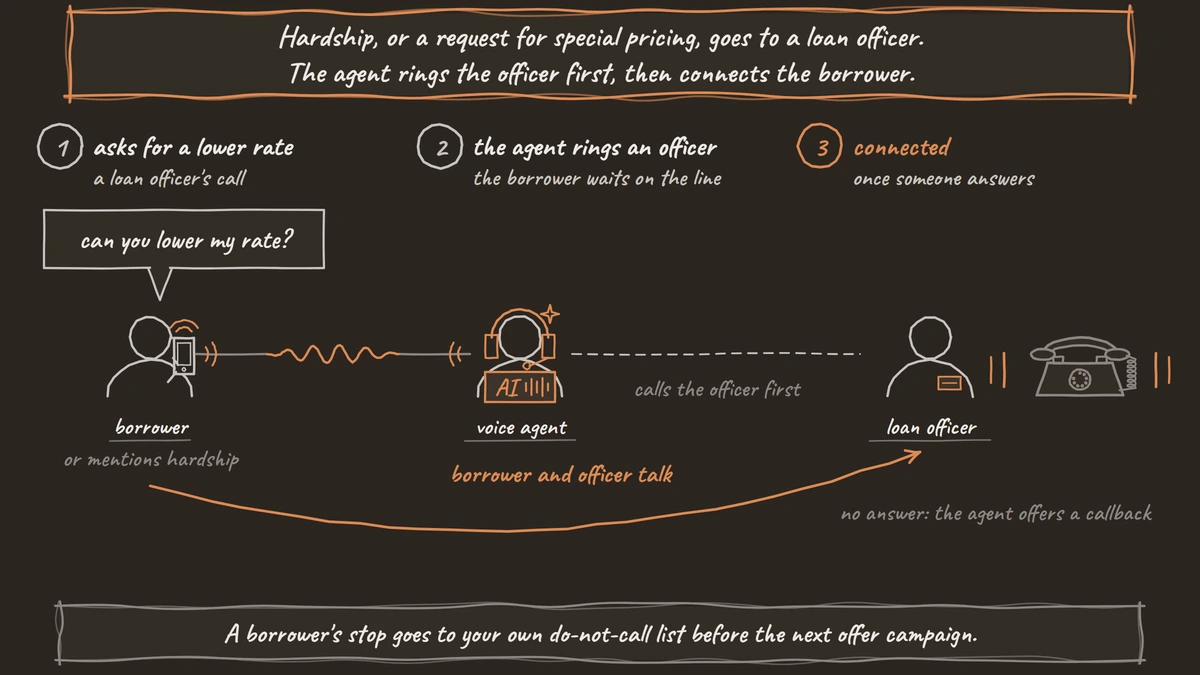
A borrower who says "stop calling me" has withdrawn consent, and that request belongs in your list during the call. Under the FCC's rule, a person can revoke consent in any reasonable way, and saying so on the call is one. Dograh can tag the finished call do_not_call as its outcome when "Extract call disposition at the end of the call" is on, but that tag never blocks a later call. So the prompt tells the agent to write the request to your own list through an HTTP API tool, and those numbers come off before the next upload. A running campaign's list cannot be edited. Pause it and start a new one from a corrected list.
Requests for special pricing, and any mention of hardship, go to a loan officer. Transfer Call works on Twilio, Telnyx, Plivo, Cloudonix and Asterisk ARI. It calls the loan officer first and connects the borrower only when someone answers. No summary goes with the call by default, so the agent writes the request to your system first. On Twilio a short spoken introduction can play to both people. If nobody answers within the 30-second default, the borrower stays with the agent, which offers a callback. Self-hosted Dograh has no per-minute platform fee (servers, model keys and phone minutes still cost). Dograh Cloud has a 1¢-a-minute platform fee.
Before scaling, listen to a sample of calls and check every quoted figure against the LMS record for that borrower.
Join the Dograh Community
Dograh is an OSS alternative to Vapi. Join our Slack community for queries, releases, best practices & community interactions.
Glossary
- Telemarketing
- Under the FCC's TCPA rule, a call made to encourage someone to buy goods or services. Offering a borrower a renewal or top-up generally counts.
- Prior express written consent
- A signed agreement that clearly authorizes a seller to make telemarketing calls to a number with an artificial or prerecorded voice. An existing loan does not replace it.
- Established business relationship
- A prior customer relationship. Since 2012 it no longer lets a telemarketer skip consent for prerecorded or artificial-voice calls, so a current borrower still needs a signed consent for an offer call.
- Loan management system (LMS)
- The lender's system of record after funding. The renewal call reads eligibility and terms from it as the call connects, and writes the borrower's answer back.