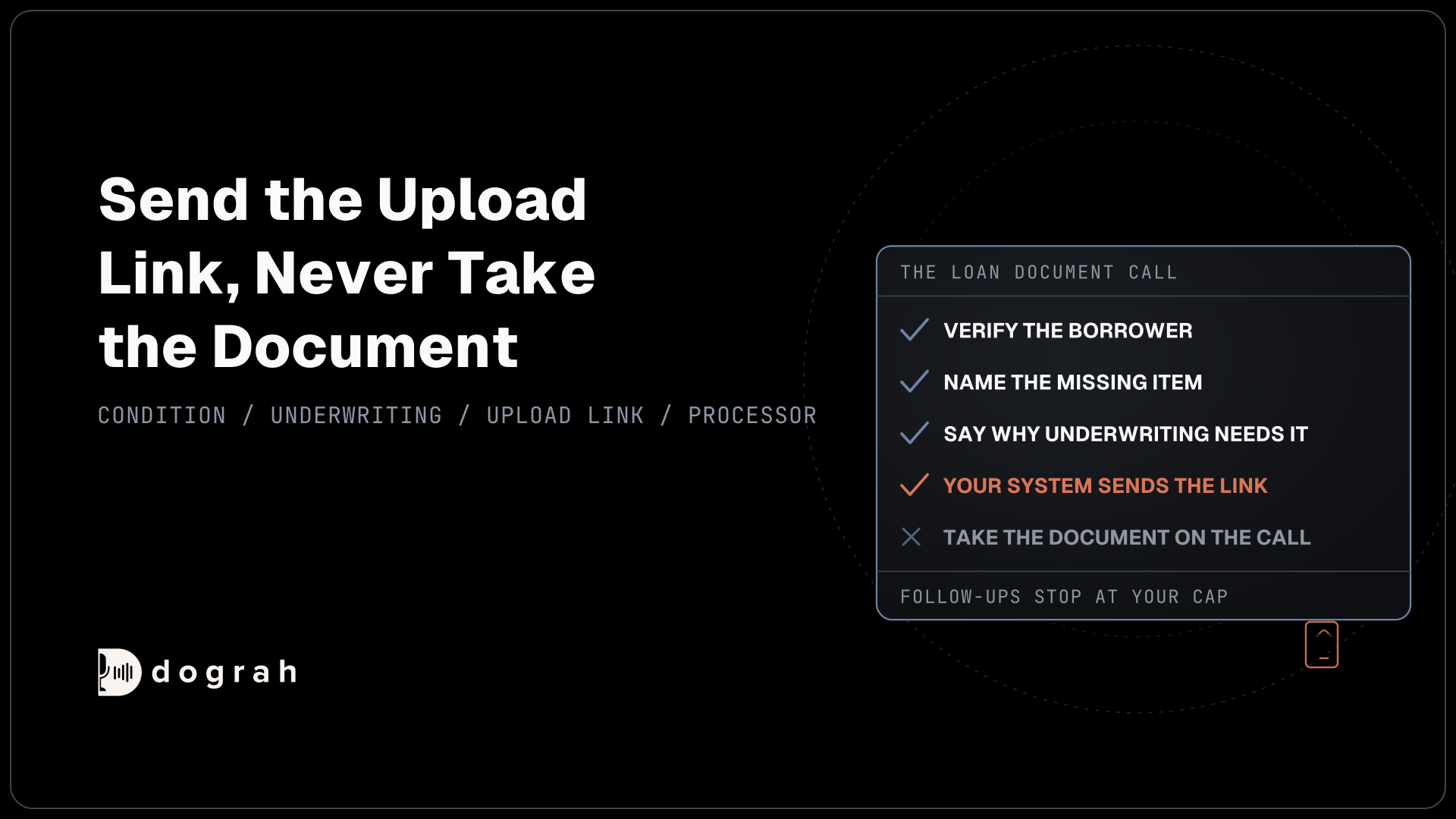

AI voice agents for loan document collection call borrowers whose file is waiting on a document. After verifying the borrower, they name the missing item from the loan origination system and say why underwriting needs it. The lender's own system sends a secure upload link, so nothing is collected on the call. Follow-ups stop at a set cap.
Key Takeaways
- Name the exact missing item and why underwriting needs it, after verifying.
- Your own system sends the upload link, so the call never collects documents.
- Cap follow-ups in your own list, since campaigns have no per-borrower limit.
This post is part of our guide to AI voice agents for mortgage and home loans. The guide's section "While the loan is in process: documents and status" sums up this call in one line: it names the missing item and why it is needed, and never collects the document on the call. Here is that call in full, run in Dograh, an open-source, self-hostable voice agent platform.
Why borrowers miss documents
Borrowers rarely hold a document back on purpose. They miss it because nobody told them clearly which one is needed and why, so a vague email asking for "updated financials" sits in their inbox for a week.
Those days count. ICE's May 2026 Mortgage Monitor found the average purchase loan closed in 36.8 days in March. The typical loan went from application to rate lock in 11 days, then took another 26 days from lock to closing. Every open condition has to clear inside that second stretch, and a pay stub that arrives a week late uses up a week of it.
A call fixes the vague part. The borrower hears the name of the document and the reason for it, and can ask a question on the spot. We set the same rules for insurance in AI Voice Agents for Claims Document Collection in Insurance, and they carry over to mortgages almost word for word.
Name the condition, then say why
The call runs greet, verify, then disclose. The open condition is part of the loan, so the agent names nothing until the borrower passes an approved check, such as date of birth or the last four digits of the loan number.
Pre-Call Data Fetch can load the open conditions from your loan origination system (LOS) once the call connects. On outbound calls it runs after the person answers. Write the prompt so the agent uses none of it until the check passes. Then the agent reads the open condition and the processor's one-line reason, one item at a time: "your most recent pay stub, because underwriting needs to see current income", or "a short letter about the deposit on the 3rd, because the lender has to show where the money came from".
This is clerical work, and the agent stays there. The SAFE Act's definition of clerical tasks includes "communication with a consumer to obtain information necessary for the processing or underwriting of a residential mortgage loan." Generally, collecting the facts a loan officer needs is clerical work under the SAFE Act; taking the application and offering terms is the loan officer's job. Confirm your position with counsel.
So a borrower who asks about the rate or whether the loan will be approved gets the loan officer. A borrower who asks where the loan stands is answered by the status call in AI voice agents for mortgage application status updates.

Open Source Alternative to Vapi / Retell
Self-hosted voice agent platform — no per-minute fees
dograh-hq/dograh
Star on GitHub
Send the upload link, never take the document
A voice agent should never collect sensitive documents inside the call. It sends a secure upload link instead. The call talks about the document, and the upload link carries it.
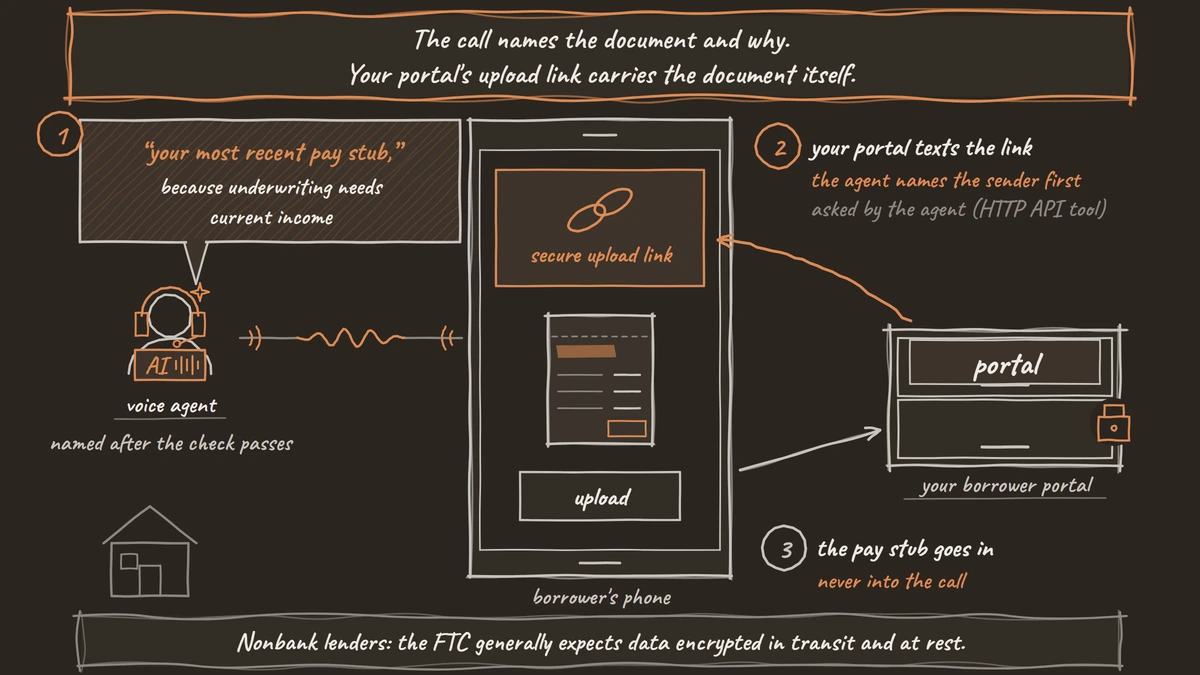
Reading a bank statement aloud puts account numbers and balances into the recording. Recordings and transcripts keep whatever is said, so the call never asks for a full account, card or Social Security number; use a short check such as the last four digits.
Dograh has no SMS tool and sends no texts itself. During the call, an HTTP API tool asks your LOS borrower portal or your messaging provider to send its secure upload link by text or email. Tell the agent in the prompt to announce the link first: which number or address it comes from, and that it opens the portal the borrower already uses. The page should ask only for the document named on the call, and the prompt should tell the agent never to ask for a password or a code.
The portal is also where the security duty sits. For nonbank lenders and brokers, the FTC's Safeguards Rule says to "Protect by encryption all customer information held or transmitted by you both in transit over external networks and at rest." Banks follow the federal banking agencies' Interagency Guidelines instead. Generally, a document that goes straight into your encrypted portal is easier to protect than one read out on a recorded call. Confirm your position with counsel.
Cap the follow-ups
Follow-up calls need a sensible cap, so document chasing never starts to feel like debt collection. Set the cap in your own list, because the platform will not set it for you.
Campaigns have no per-borrower call cap. Their retries run from 0 to 10, 2 by default, with a delay between 30 seconds and an hour. So your LOS or CRM decides how often a borrower is called about one condition, and the file for each campaign holds only borrowers still under that cap. Calling hours run in one time zone per campaign, so split the file by time zone.
The cleaner pattern lets the LOS start the call, and it suits lists that change daily. When a condition opens, your system calls the API Trigger, and when the document arrives, your system stops calling. That way your system, not the campaign file, decides who is called. To stop calling someone mid-campaign, pause the campaign and start a new one from a corrected list.
For voicemail, turn on "Enable voicemail and screening handling" in the agent's Settings, choose "Leave a message" under "When voicemail is detected" (it works on outbound calls, on agents with separate speech and language models), and keep the message to the lender's name and a number to call back. A missing "letter about a deposit" tells anyone in the household something about the borrower's money. Tax and accounting firms face the same chase in document-collection reminders in accounting.
When the processor takes over
After the last capped call, or as soon as a borrower is stuck, the file goes back to a person, and the agent's job is to leave the processor a clear record.
After each call, the Webhook node sends the outcome to your LOS: the condition discussed and any date the borrower gave, with the transcript link. It retries a temporary failure on its own. The processor sees which borrowers have hit the cap and calls them personally.
A borrower who wants to talk to someone now goes to a person. Transfer Call works on Twilio, Telnyx and Asterisk ARI. It passes no summary by default; on Twilio it can play a short spoken introduction to both people. Write the details to your system with an HTTP API tool before the transfer. If nobody answers within the 30-second default, the borrower stays with the agent; tell it in the prompt to offer a callback. Web calls cannot transfer, so test this on a real phone line.
Self-hosted Dograh has no per-minute platform fee (servers, model keys and phone minutes still cost); Dograh Cloud has a 1¢-a-minute platform fee.
Join the Dograh Community
Dograh is an OSS alternative to Vapi. Join our Slack community for queries, releases, best practices & community interactions.
Glossary
- Underwriting condition
- An item underwriting needs before a loan can close, such as a recent pay stub or a letter explaining a deposit. The agent reads open conditions from the LOS and names one at a time.
- Secure upload link
- A link to the lender's own encrypted borrower portal, sent by the lender's system by text or email during the call. The document goes there, never into the call.
- Follow-up cap
- The most calls a borrower gets about one condition before a processor takes over. Dograh campaigns have no per-borrower cap, so the lender's own list enforces it.
- Clerical task (SAFE Act)
- Under 12 U.S.C. 5102, work such as communicating with a consumer to obtain information needed for processing or underwriting. A document reminder call generally sits here, outside loan origination.