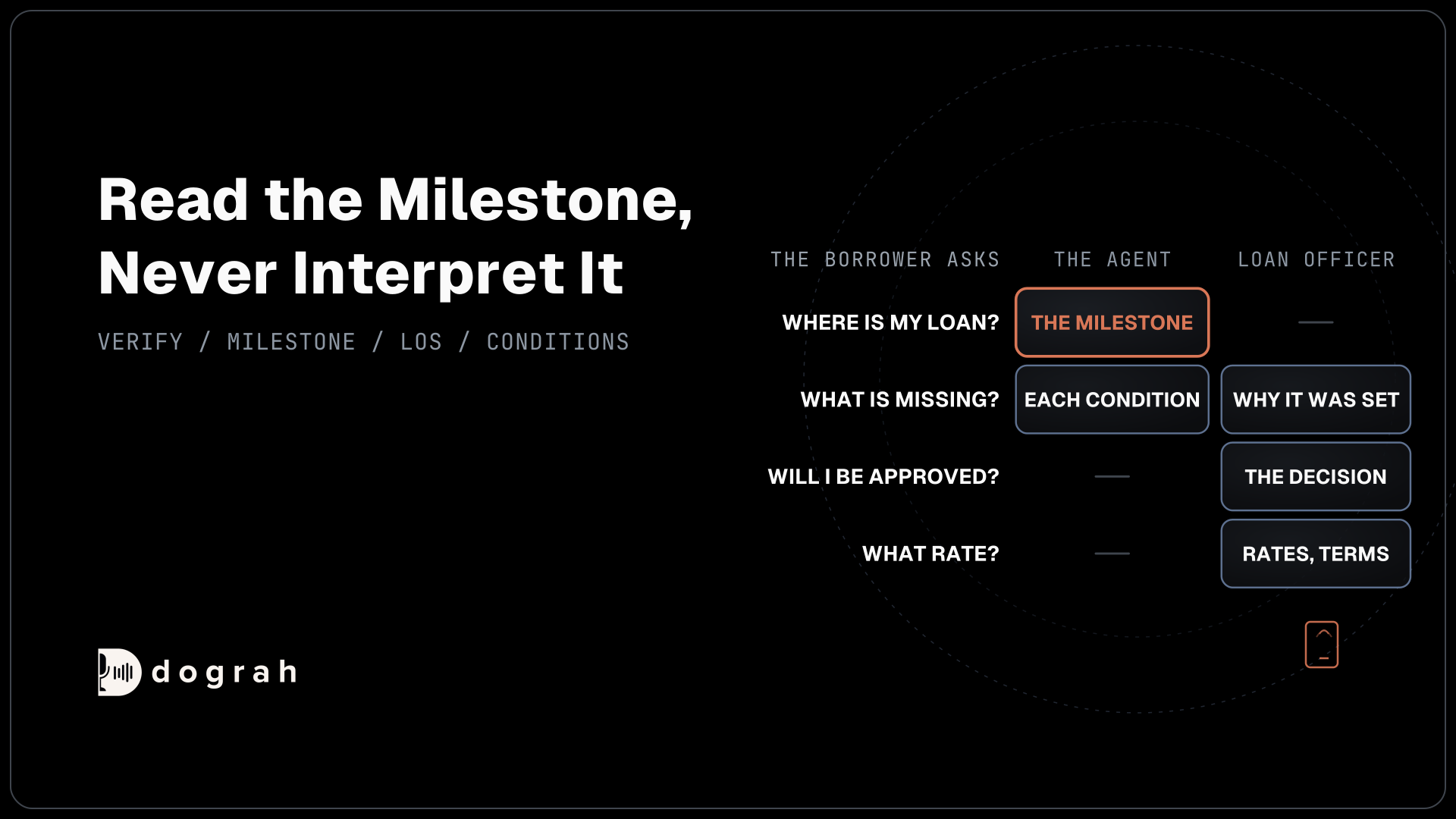

AI voice agents for mortgage application status updates answer and place calls about where a loan stands. After verifying the borrower, the agent reads the current milestone from the loan origination system during the call and says only that. It never predicts approval or explains a denial, and every other question goes to the loan officer.
Key Takeaways
- Verify the borrower before naming any milestone. A phone number only finds the file.
- Read the milestone live from the LOS, and never predict approval or explain a denial.
- Real estate agents and family hear status only with authorization on file.
This post is part of our guide to AI voice agents for mortgage and home loans. The guide's section "While the loan is in process: documents and status" sums up this call in one line: it "reads the milestone from the LOS and never interprets it." Here is that call in full, inbound and outbound, run in Dograh, an open-source, self-hostable voice agent platform.
Why borrowers call to ask where the loan is
Between the application and the closing, most borrower calls ask where the loan stands. Each one pulls a processor away from a file, and a borrower with no answer starts to worry.
Communication is what moves satisfaction here. J.D. Power's 2025 mortgage origination study put overall satisfaction at 760 out of 1,000, up 33 points, and J.D. Power tied the rise to "improved communication and reliability."
A prompt answer from an agent that can actually read the file builds trust, even when the news is only "still in underwriting." The call runs both ways: borrowers call in, and the lender calls out when a milestone changes.
Verify the borrower before any loan detail
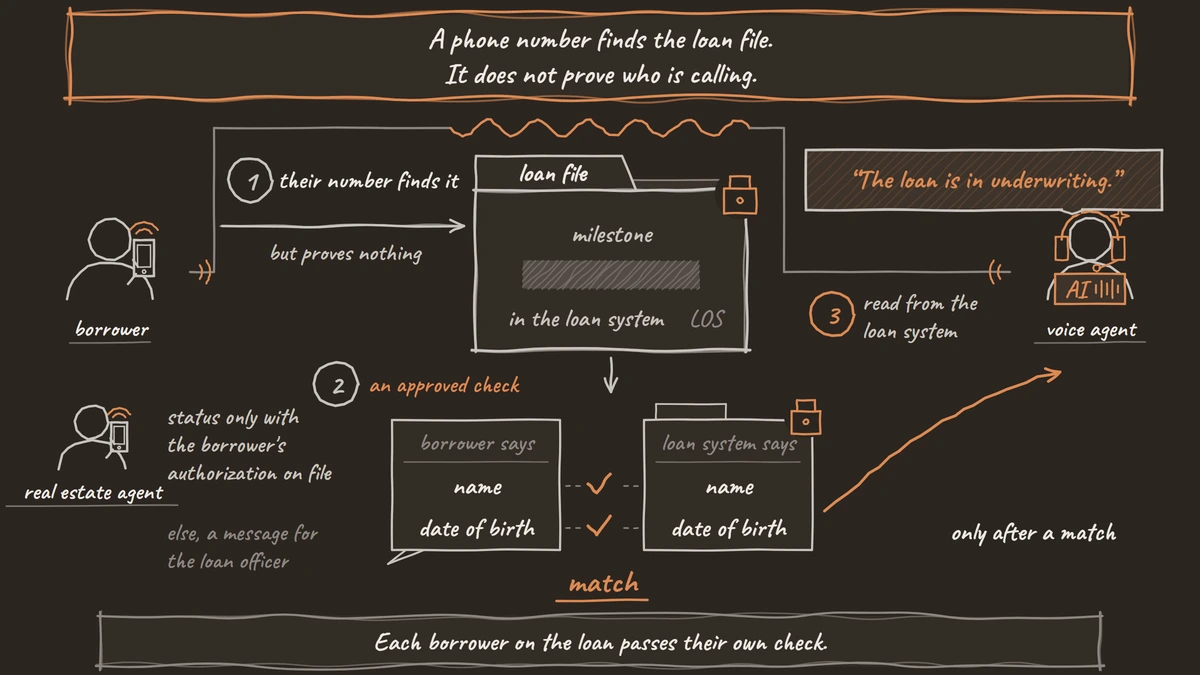
The agent confirms who is calling before it says a word about the loan. On inbound calls, Pre-Call Data Fetch, set to "Inbound calls only" at the bottom of the Start Call node, sends the caller's number and the number dialled to your loan origination system (LOS) once the call connects. The greeting waits for it, up to 10 seconds, and the caller hears ringing meanwhile.
That finds the file, but anyone can call from a borrower's phone. So the agent asks for the borrower by name, then for an approved check, such as date of birth or the last four digits of the loan number. Tell it in the prompt to say nothing from the file until that check passes, and to end politely with the lender's number if it fails.
For nonbank lenders and brokers, the FTC's Safeguards Rule asks for access controls that "Authenticate and permit access only to authorized users". Read for a phone line, that generally means the agent checks identity before it reads anything from the file. This is our reading, not legal advice; confirm your position with counsel.
Each borrower on the loan passes their own check. A real estate agent, a family member or anyone else not on the loan hears status only when the borrower's authorization is on file in the LOS, and the record that comes back says so. Without it, the agent takes a message for the loan officer and writes it to the LOS. The same verify-then-tell order runs our post on order status in logistics.

Open Source Alternative to Vapi / Retell
Self-hosted voice agent platform — no per-minute fees
dograh-hq/dograh
Star on GitHub
Read the milestone, never interpret it
The agent reads the milestone the LOS returns and stops there. During the call, an HTTP API tool asks the LOS for the loan's current milestone and any open conditions. Its Custom Message (text or a recorded clip) plays once, just before the tool runs, such as "One moment while I open your file." The tool waits 5 seconds by default and does not retry, so tell the agent in the prompt that if the LOS does not answer, it says it cannot reach the file and offers a callback.
| Milestone in the LOS | What the agent says | What goes to the loan officer |
|---|---|---|
| Application received | The application is in and in processing | Questions about rate or terms |
| In underwriting | The loan is in underwriting | When a decision will come |
| Conditions outstanding | Each open condition, as the LOS lists it | Why a condition was set |
| Clear to close | The loan is clear to close | Closing costs and figures |
| Closing scheduled | The date, time and place the LOS holds | Any change to the closing |
| Suspended, declined or counteroffer | The loan officer will be in touch | Everything else |
Tell the agent in the prompt never to predict approval ("you should be fine") and never to give a date the LOS does not hold. Why a decision was made is never the agent's to say. Regulation B sets its own process for a denial: under 12 CFR 1002.9(a)(2), "A notification given to an applicant when adverse action is taken shall be in writing", with "A statement of specific reasons for the action taken" or the right to one. Generally, that notice comes from your own process and the loan officer, never from the status call. Confirm your position with counsel.
When the milestone shows an open condition, the agent names it, such as a recent pay stub, and hands the chase to the document process in AI voice agents for loan document collection. When the loan is clear to close, booking the date belongs to AI voice agents for mortgage closing scheduling and reminders.
Outbound calls when a milestone changes
The lender can call first. Your LOS calls the API Trigger the moment a loan moves, say to "clear to close", and Dograh dials at once with the loan ID in the request. Pre-Call Data Fetch can re-read the loan when the call connects. On outbound calls it runs after the person answers.
The API Trigger suits this call better than a campaign, because milestones change one loan at a time. For a weekly batch of status calls as a campaign, note that calling hours run in one time zone, so run one campaign per zone.
The greeting names the lender and asks for the borrower by name, and the milestone waits for the verify step. If the call reaches voicemail, turn on "Enable voicemail and screening handling" in the agent's Settings and choose "Leave a message" under "When voicemail is detected". "Disconnect the call" is preselected once it is on, and the setting works on outbound calls, on agents with separate speech and language models. Keep the message to the lender's name and a number to call back.
A call about the borrower's own loan sells nothing, so it is generally outside the TCPA's definition of telemarketing in 47 CFR 64.1200(f)(13), "the initiation of a telephone call or message for the purpose of encouraging the purchase or rental of, or investment in, property, goods, or services". An AI-voice call to a mobile still needs prior express consent, which a borrower who gave the number for the loan has generally given. Confirm your position with counsel. Dograh keeps no do-not-call list. When a caller opts out, an HTTP API tool writes it to your own list, and you remove those numbers before the next campaign upload. The do_not_call call tag records the request but never blocks a later call.
When the call needs the loan officer
Some calls need a person, such as a question about the rate or a request to change the loan.
Transfer Call works on Twilio, Telnyx and Asterisk ARI. It passes no summary by default; on Twilio it can play a short spoken introduction to both people. Write the details to your system with an HTTP API tool before the transfer, so the loan officer sees the caller's question as the call arrives. If nobody answers within the 30-second default, the borrower stays with the agent; tell it in the prompt to offer a callback and write the request through an HTTP API tool. Web calls cannot transfer, so test this on a real phone line, where most calls still reach the agent as 8 kHz audio.
Recordings and transcripts keep whatever is said, so the call never asks for a full account, card or Social Security number; use a short check such as the last four digits. Once live, run QA on a random 5 to 10% sample of calls and look for any milestone wording that did not come from the tool. Our post on claim status updates in insurance runs the same pattern in another long wait.
Self-hosted Dograh has no per-minute platform fee (servers, model keys and phone minutes still cost); Dograh Cloud has a 1¢-a-minute platform fee.
Join the Dograh Community
Dograh is an OSS alternative to Vapi. Join our Slack community for queries, releases, best practices & community interactions.
Glossary
- Loan milestone
- The stage the LOS shows for a loan, such as in underwriting or clear to close. The status agent reads it during the call and says only that.
- Underwriting condition
- An item the underwriter needs before the loan can move on, such as a recent pay stub or a letter explaining a deposit. The status call names it; the document process chases it.
- Clear to close
- The milestone at which underwriting has signed off and the loan can be scheduled for closing. The status call reports it; booking the date is a separate call.
- Borrower authorization
- The borrower's permission, recorded in the LOS, for a named third party such as a real estate agent to hear the loan's status. Without it, the agent takes a message instead.