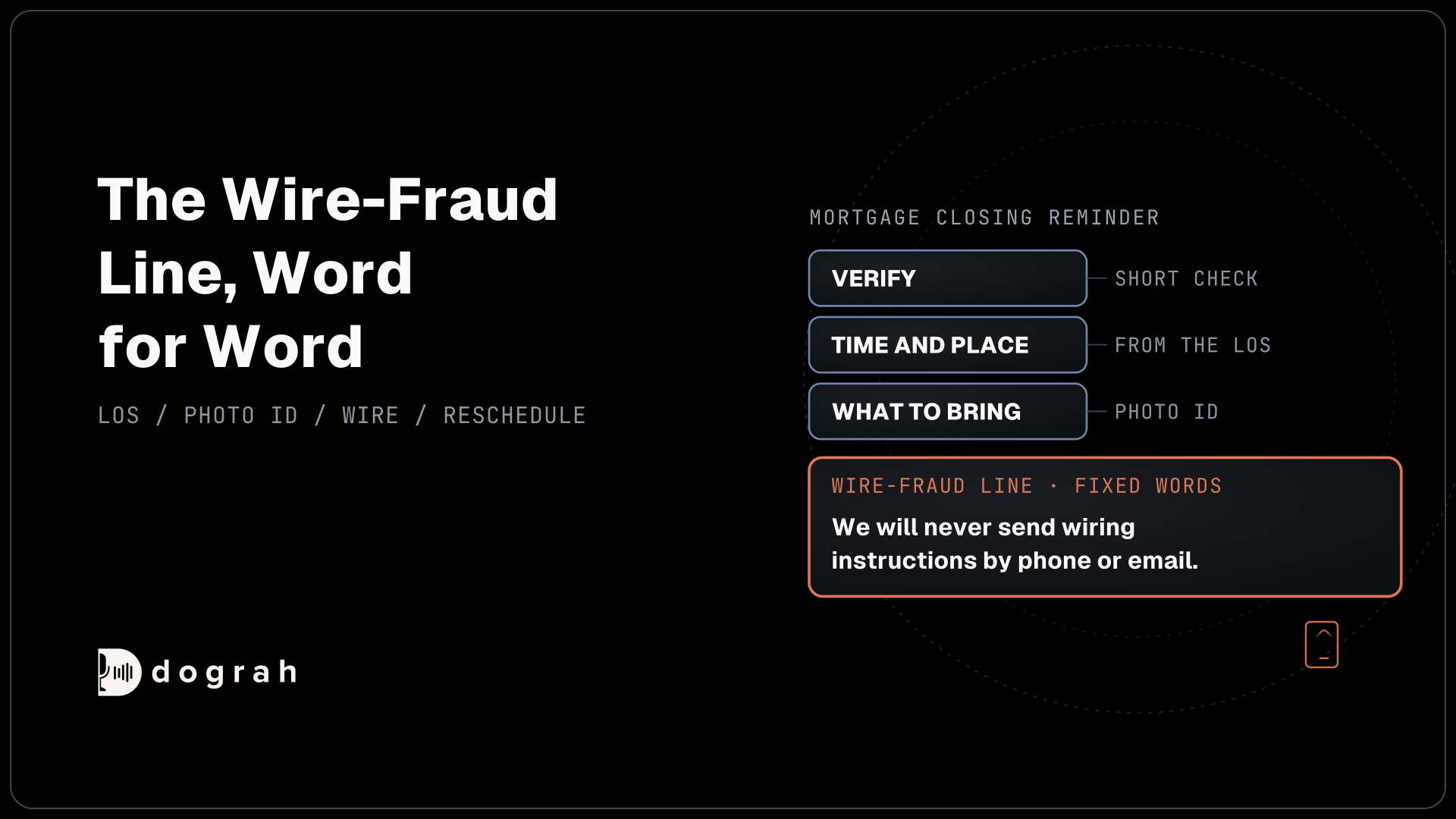

AI voice agents for mortgage closing scheduling and reminders book the closing from slots the closing calendar returns, once the loan system shows the date fits the Closing Disclosure's three-business-day window. The day before, the agent verifies the borrower, confirms the time and place, says what to bring and plays one fixed wire-fraud warning.
Key Takeaways
- Offer only closing slots that fit the Closing Disclosure's three-business-day window.
- The wire-fraud warning plays as fixed words, never as a line the model writes.
- The agent never reads out or confirms wiring details.
This post is part of our guide to AI voice agents for mortgage and home loans. The guide's section "Closing day: reminders and the wire-fraud warning" sums up this call in one line: it "books the date, reminds the borrower the day before and gives one fixed warning about wire fraud." Here is each part in full, run in Dograh, an open-source, self-hostable voice agent platform.
Why wire fraud makes closing calls different
Closing is when criminals impersonate the people a borrower trusts, so a lender's call at this moment has to be the safest call in the loan. The FBI's 2025 internet crime report describes one case from August 2025: "The individuals were closing on a home when they received an email impersonating their legitimate attorneys. A wire was submitted at their bank for over $449,000". The FBI's Recovery Asset Team got the receiving bank to freeze the account, with the full amount still in it.
The CFPB's advice on mortgage closing scams is blunt: "Never follow instructions contained in an email." It tells buyers to confirm wiring details with their trusted representatives in person or "by using the phone number you previously agreed to". So the closing call books and confirms the closing, and repeats one warning in the same words every time.
Book a date the Closing Disclosure allows
The agent offers only closing dates your loan origination system (LOS) has cleared against the Closing Disclosure rule. Under Regulation Z, the creditor "shall ensure that the consumer receives the disclosures" "no later than three business days before consummation." A disclosure that is not handed over in person counts as received "three business days after they are delivered or placed in the mail."
A new three-business-day period applies after certain changes, such as an APR that becomes inaccurate or a switch to a different loan product. Generally, that means the earliest allowed date is a calculation for your LOS and closing team, never for the agent. Tell the agent in the prompt never to count days itself and never to offer a date the system did not return. Confirm your position with counsel.
During the call, an HTTP API tool asks your system for the earliest allowed date and the open slots on the closing calendar, in the LOS or the title company's calendar. Dograh has no built-in calendar integration, so the tool calls that system's own API. Tell the agent in the prompt to offer two slots and read the chosen one back with its place (or remote signing). A second HTTP API tool writes the booking.
A booking can be sent twice, for example if the agent calls the tool again after a slow reply. Add a Preset Parameter to the booking tool: name workflow_run_id, type Number, value {{initial_context.workflow_run_id}}, Required on. Dograh adds no idempotency header of its own, so your system uses that ID, with the slot, to keep one booking.

Open Source Alternative to Vapi / Retell
Self-hosted voice agent platform — no per-minute fees
dograh-hq/dograh
Star on GitHub
The day-before reminder call
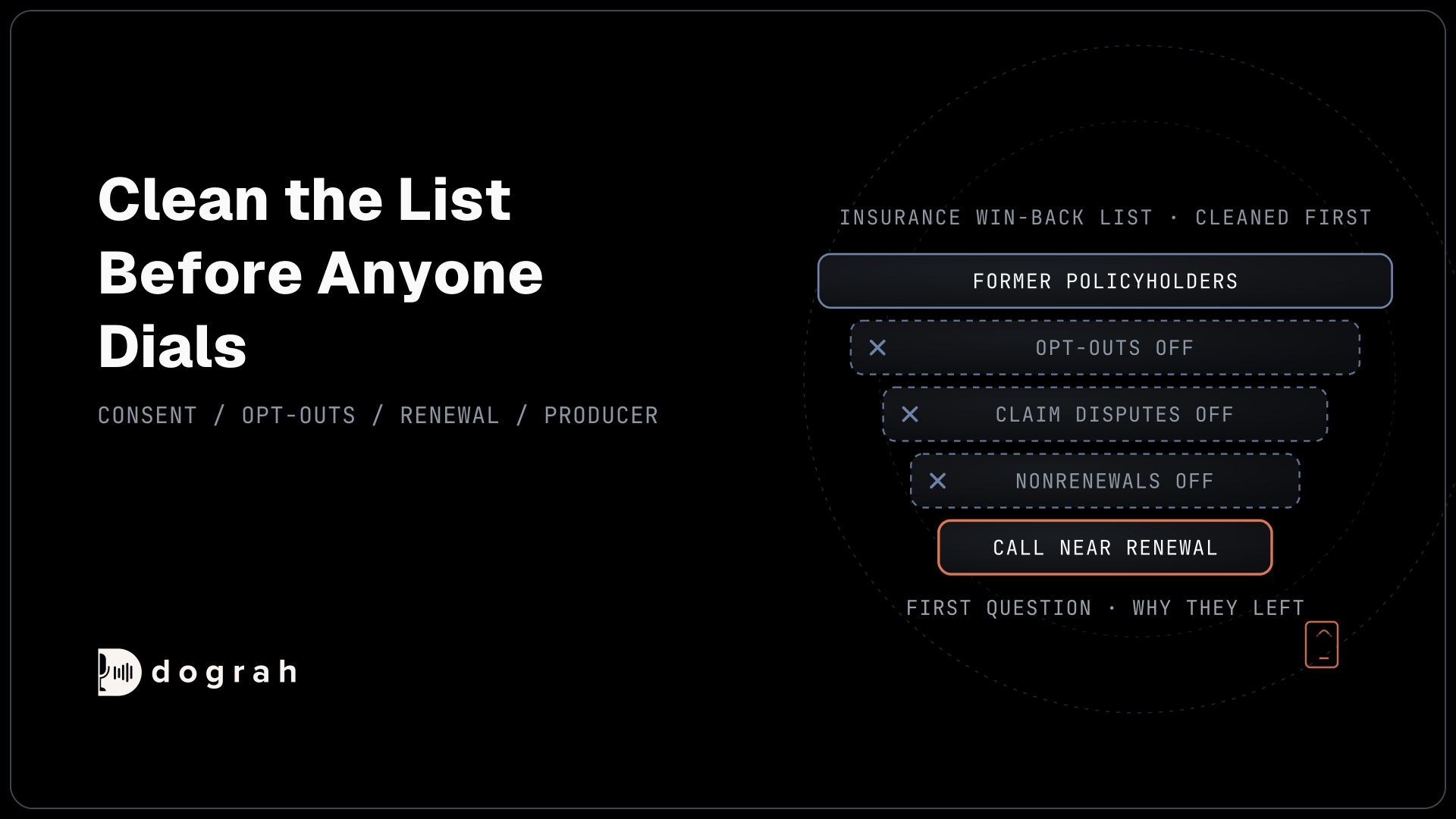
The reminder goes out the day before and confirms the closing after the borrower is verified. Export tomorrow's closings from the LOS and upload them to Campaigns as a CSV, or start each call from your system with the API Trigger. A campaign's calling hours run in one time zone, so split the list and run one campaign per zone.
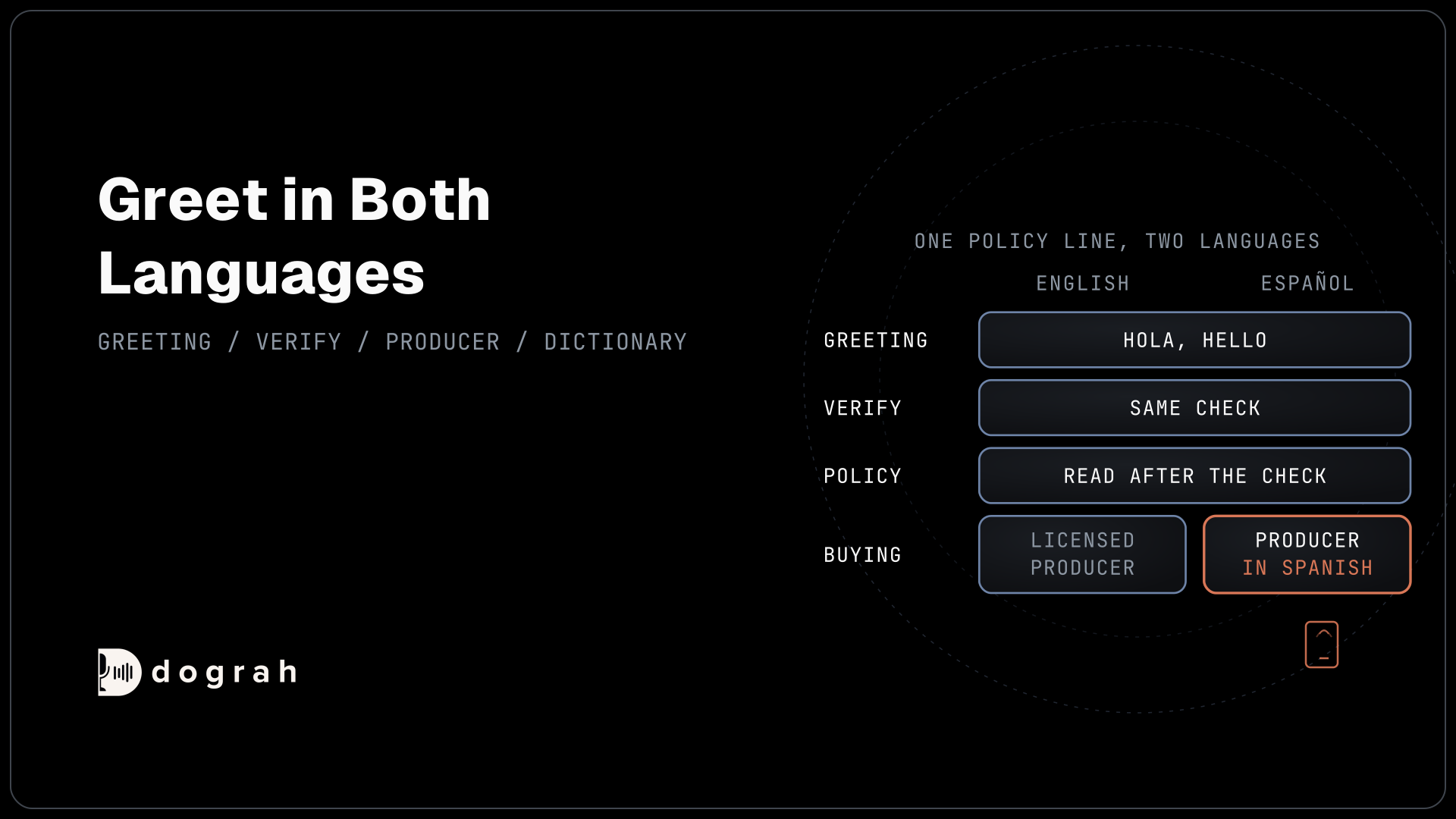
A fixed greeting per contact, as text or a recorded clip, can come from the campaign file; contacts without one hear the agent's normal greeting. The greeting plays before the borrower is verified, so keep it to the lender's name and the borrower's name. If you want to tell borrowers they're speaking with an automated assistant, or your location requires it by law, write it there too.
After an approved check, such as date of birth or the last four digits of the loan number, the agent reads the closing time and place from the LOS. Then it says what to bring: a government-issued photo ID, plus anything your closing checklist in the LOS names. Tell it in the prompt never to explain figures on the Closing Disclosure or state an amount to bring. The loan officer or closing agent does that.
If the call reaches voicemail, turn on "Enable voicemail and screening handling" in the agent's Settings, choose "Leave a message" under "When voicemail is detected" (it works on outbound calls, on agents with separate speech and language models) and keep the message to the lender's name and a number to call back. The closing time and address stay out of voicemail, because anyone in the household can play it.
The wire-fraud line, word for word
One line never changes, on every reminder: "We will never send wiring instructions by phone or email. Before you wire any money, call your closing agent at a number you already know."
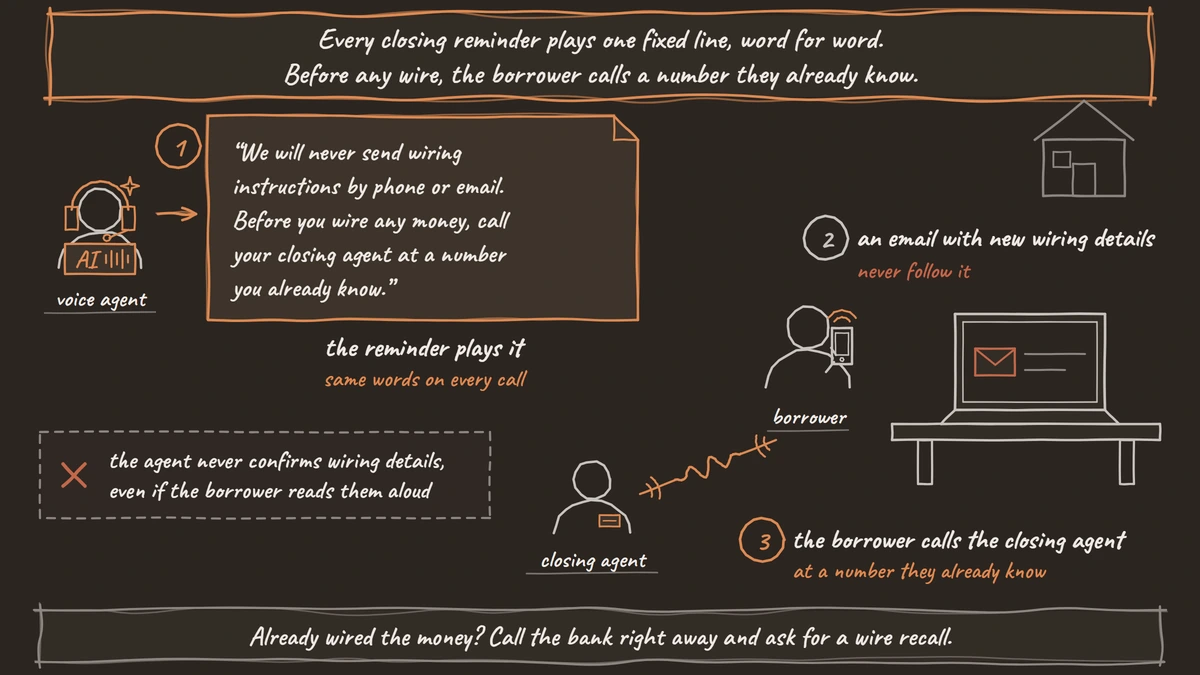
A prompt cannot guarantee wording, because the model writes each sentence. So play the line as fixed text. Put it in a pathway's Transition Speech into the closing details, or in the End Call tool's goodbye message, which plays exactly as saved, whether it is text or pre-recorded audio. On a speech-to-speech model, text Transition Speech does not play, so use a recorded clip of the line.
Tell the agent in the prompt never to read out an account or routing number and never to confirm wiring instructions, even if the borrower reads them aloud. If asked, it should repeat the line and point to the closing agent at a number the borrower already has. Our post on fraud-alert callbacks works the same way: the agent tells, and never asks for anything a criminal would want.
A borrower who mentions an email with new wiring details, or who has already wired money, needs a person on the line now. Tell the agent in the prompt to write the details to your system and transfer the call. The CFPB's advice for that moment is to contact the bank or wire-transfer company right away and ask for a wire recall, and to file a complaint with the FBI's Internet Crime Complaint Center.
Reschedules, consent and handing over
A reschedule runs the same way as the first booking. The agent reads new slots from the system, and any change that touches the loan, such as a new product, goes to the loan officer first. Tell it in the prompt never to promise that a new date will hold.
A reminder about the borrower's own closing encourages no purchase, so it generally falls outside the TCPA's definition of telemarketing in 47 CFR 64.1200(f)(13), "the initiation of a telephone call or message for the purpose of encouraging the purchase or rental of, or investment in, property, goods, or services". An AI-voice call to a mobile still needs the called party's prior express consent, which a borrower who gave the number for the loan has generally given. Confirm your position with counsel.
Dograh keeps no do-not-call list. When a caller opts out, an HTTP API tool writes it to your own list, and you remove those numbers before the next campaign upload. The do_not_call call tag records the request but never blocks a later call.
Transfer Call works on Twilio, Telnyx and Asterisk ARI. It passes no summary by default; on Twilio it can play a short spoken introduction to both people. Write the details to your system with an HTTP API tool before the transfer. If nobody answers within the 30-second default, the borrower stays with the agent; tell it in the prompt to offer a callback and write the request through an HTTP API tool. Web calls cannot transfer, so test it on a real phone line.
Before closing, the borrower hears "clear to close" on the status call, and the same booking pattern across industries is in AI voice agents for appointment scheduling. Self-hosted Dograh has no per-minute platform fee (servers, model keys and phone minutes still cost); Dograh Cloud has a 1¢-a-minute platform fee.
Join the Dograh Community
Dograh is an OSS alternative to Vapi. Join our Slack community for queries, releases, best practices & community interactions.
Glossary
- Closing Disclosure
- The Regulation Z form with the loan's final terms and costs. The borrower must receive it no later than three business days before consummation, so the closing call books only dates that fit.
- Consummation
- The moment the borrower becomes contractually bound on the loan, usually at the closing table. Regulation Z counts the Closing Disclosure's three business days back from it.
- Closing agent
- The settlement or title company person, or attorney, who runs the closing and handles the funds. The wire-fraud line sends borrowers to this person at a number they already know.
- Wire recall
- A request from the sending bank to pull back a wire, made as soon as fraud is suspected. Speed matters, which is why a borrower who has already wired money goes straight to a person.