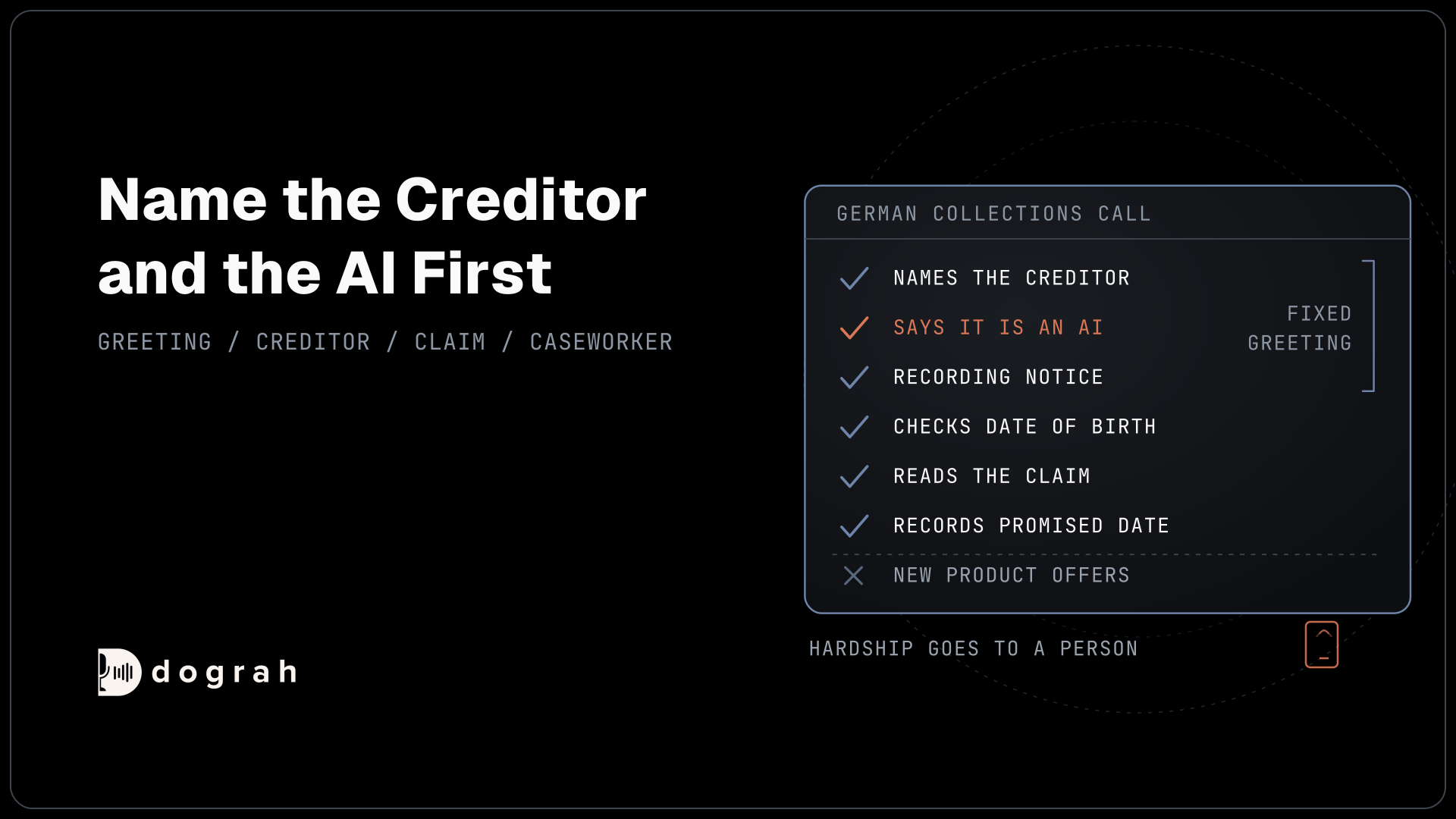

German AI voice agents for collections call debtors in German under EU and German rules rather than US law. The greeting names the creditor and says the caller is speaking with an AI. After verifying the debtor, the agent reads the claim from the collector's system and records any promised payment date. Disputes and hardship go to a person.
Key Takeaways
- Name the creditor and the AI in the first sentence, as fixed text.
- Formal notices and instalment confirmations go out in writing from the collector's system.
- Self-host in the EU with local models to keep call audio there.
This post is part of our guide to AI voice agents for fintech and lending. Below, we cover the rules behind a German collections call. Then we set out the speech models it can use in Dograh, the open-source AI voice agent platform we build.
Which rules apply to a German collections call
A German collections call runs under EU data and AI rules plus German collection law, and the US Telephone Consumer Protection Act and Fair Debt Collection Practices Act do not apply.
Many of the people reached are in real difficulty. The Creditreform SchuldnerAtlas 2025 counted about 5.67 million over-indebted adults in Germany in 2025, 8.16% of adults, up from 8.09% the year before. A collections agent has to expect hardship on a large share of its calls and know where to send it.
The call data falls under the General Data Protection Regulation (GDPR), called the DSGVO in Germany. The roles each company plays and the rules on moving data out of the EU are covered in GDPR and Voice AI, so we won't repeat them here.
The EU AI Act has added a disclosure duty since 2 August 2026. An AI system that talks directly with people must be designed so they are told they are interacting with an AI, at the latest at the first interaction, unless that is obvious. For a phone agent, that generally means saying so in the first sentence.
Collection law itself is set country by country. In Germany, a debt collection firm registered under the Legal Services Act (Rechtsdienstleistungsgesetz, RDG) must give a private debtor certain information in text form when it first asserts a claim, such as who the creditor is and how the amount is made up. Under the Civil Code (BGB), a debtor who does not pay after a reminder (Mahnung) that follows the due date is in default, so a friendly call before that point is generally a reminder rather than collection, though a Rechtsanwalt should confirm that before the first call.
The first sentence names the creditor and the AI
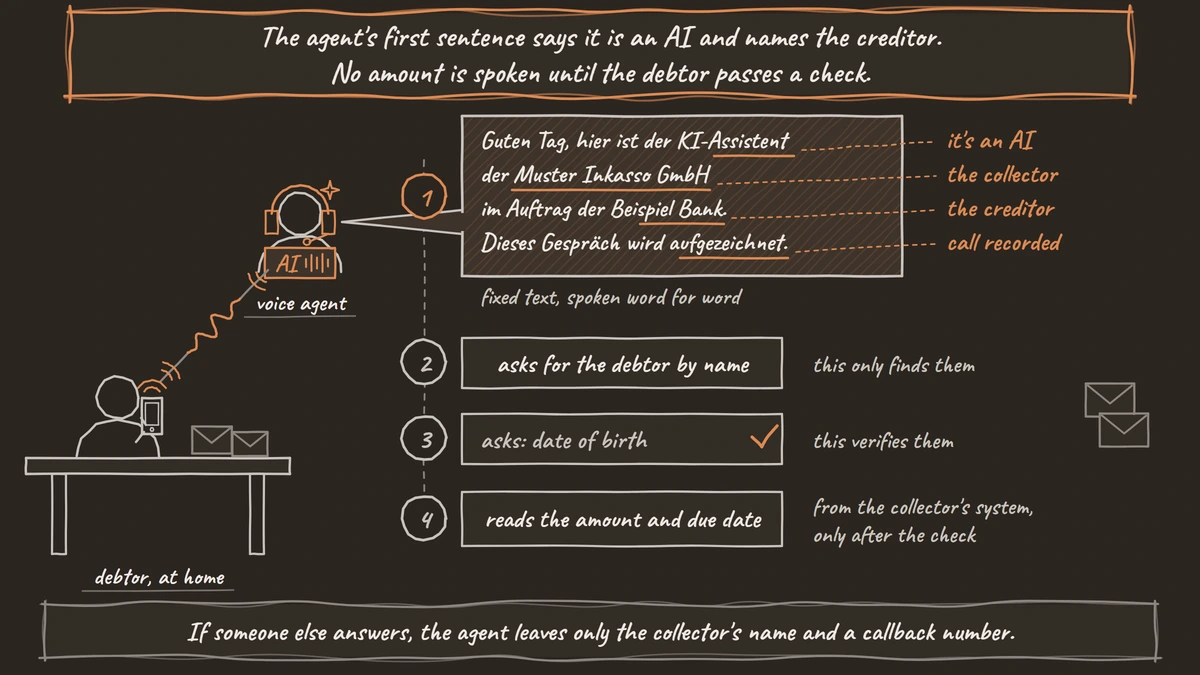
The opening line carries the AI notice and the creditor's name, so it is fixed text, never generated. The Greeting Text is the line Dograh speaks word for word as the call connects. For a collector calling on behalf of a lender, it might read: "Guten Tag, hier ist der KI-Assistent der Muster Inkasso GmbH im Auftrag der Beispiel Bank. Dieses Gespräch wird aufgezeichnet." The recording notice matters in Germany, and German AI Voice Agents for Automotive explains the criminal-law rule behind it and the formal "Sie" the agent should use.
Next, the agent asks for the debtor by name and then for an approved check, such as date of birth. Asking for the person by name only finds them. It does not verify them. If the check fails, or someone else answered, the agent leaves only the collector's name and a callback number and says nothing about a claim.
What the agent says, and what goes in writing
The agent reads the claim and records the debtor's answer, while formal notices and agreements go out in writing from the collector's system.
Pre-Call Data Fetch loads the claim from the collector's system once the call connects. After the check, the agent reads the amount and due date as returned, including any interest the system has already calculated, and never works out a figure itself. It asks when the debtor can pay and records the promised date as stated.
An instalment plan comes only from the options the collector's system returns. If the debtor accepts one, an HTTP API tool writes it back, and the collector's system sends the written confirmation and any cost warning German law requires. A payment link goes out the same way, by email or text from that system, because Dograh takes no payments on a call and sends no texts itself.
Disputes and hardship go to a person. Under GDPR Article 22, people have the right not to be subject to a decision with legal effect based solely on automated processing, so the agent records and a caseworker decides. Transfer Call works on Twilio, Telnyx, Plivo, Cloudonix and Asterisk ARI and connects the debtor only when the caseworker answers. No summary goes with the call by default, so the agent writes the details to the collector's system first. If nobody answers within the 30-second default, the debtor stays with the agent, which offers a callback.
Keep offers off these calls. A collections call is generally not advertising, but add an offer of a new product and the German rules on advertising calls apply instead. The US version of this call, under the FDCPA, is in AI Voice Agents for Debt Collection.

Open Source Alternative to Vapi / Retell
Self-hosted voice agent platform — no per-minute fees
dograh-hq/dograh
Star on GitHub
German speech models in Dograh
A German collections agent can run fully on Dograh's own models, which support German for both speech-to-text and the voice. In the agent's Model tab, set the speech-to-text Language dropdown to German, or to Multilingual (Auto-detect) with German ticked under Language Hints if some debtors switch to English. Language Hints work only with Dograh's own models or Deepgram Flux. Dograh's voice library includes German-language voices with German accents.
Third-party German voices work too, through your own keys, from providers such as ElevenLabs or Azure Speech. Azure lists a Germany West Central region, which is where that provider processes the audio. It is not self-hosting. Add collection words such as Forderung, Ratenzahlung and your clients' names to the agent's Dictionary, in its Settings, so speech-to-text hears them.
For local models, Dograh's "Local Models (Speaches)" provider connects to a self-hosted, OpenAI-compatible server. Speaches serves faster-whisper-large-v3 for German speech-to-text and Piper for the voice, such as the German Thorsten voice, which is released under CC0. The language model runs behind Ollama or vLLM. Kokoro, the default example voice, has no German voice, so swap it out.
Keeping the call audio in the EU
Call audio stays in the EU only when the platform, the models and your phone carrier's routing all stay in the EU. Two layers handle the call. As the orchestration layer, Dograh runs the call flow, tools and telephony, while the speech and language models are a separate layer you choose. Dograh Cloud names no EU data region, so self-hosting in an EU data centre is how you place recordings and transcripts there. With third-party models on your own keys, the debtor's voice still reaches each provider. With the local models above running in the same data centre, no model provider hears the call.
Self-hosted, recording can be switched off only for the whole server, and transcripts are still saved. There is no retention setting, so your own policy decides how long calls are kept. QA summaries come out in English by default, so a German-speaking reviewer reads the transcripts of flagged calls. Self-hosted Dograh has no per-minute platform fee (servers, model keys and phone minutes still cost). Dograh Cloud has a 1¢-a-minute platform fee.
Start with reminder calls before default, then add collection calls once your registered collector has approved the wording. To size the return, see Calculating ROI on Automated Collections Calls.
Join the Dograh Community
Dograh is an OSS alternative to Vapi. Join our Slack community for queries, releases, best practices & community interactions.
Glossary
- Mahnung
- A formal payment reminder after the due date. Under the Civil Code (BGB), a debtor who still does not pay after it is in default, which is generally where a friendly reminder call ends and collection begins.
- Rechtsdienstleistungsgesetz (RDG)
- Germany's Legal Services Act. Debt collection firms register under it, and it sets the information they must give private debtors in text form, which is why notices come from the collector's system rather than the call.
- Article 50 disclosure
- The EU AI Act duty, in force since 2 August 2026, to design AI systems that talk with people so those people are told they are interacting with an AI. In a call, it belongs in the fixed Greeting Text.
- Local Models (Speaches)
- Dograh's provider for self-hosted, OpenAI-compatible speech and voice models. With faster-whisper-large-v3 and a German Piper voice, it lets a German agent run without any outside model provider.