
AI voice agents for failed-payment and dunning recovery in SaaS call the accounts your billing system's retries and emails did not fix. After verifying the billing contact, they state the amount and reason as your billing system returns them, record any promise-to-pay date and have your billing provider send its card-update link. Card details never go through the call.
Key Takeaways
- Call only accounts still unpaid after card retries and dunning emails.
- Verify the billing contact before naming any amount or failure reason.
- Your billing provider sends the card-update link; card numbers never go through the call.
This post is part of our guide to AI voice agents for SaaS and subscription businesses. The guide's section "Keeping them paying: failed payments and renewals" sums up this call in one line: "The failed-payment call is for what retries and email did not fix." Here is that call in full, run in Dograh, an open-source, self-hostable voice agent platform.
Which failed payments are worth a call
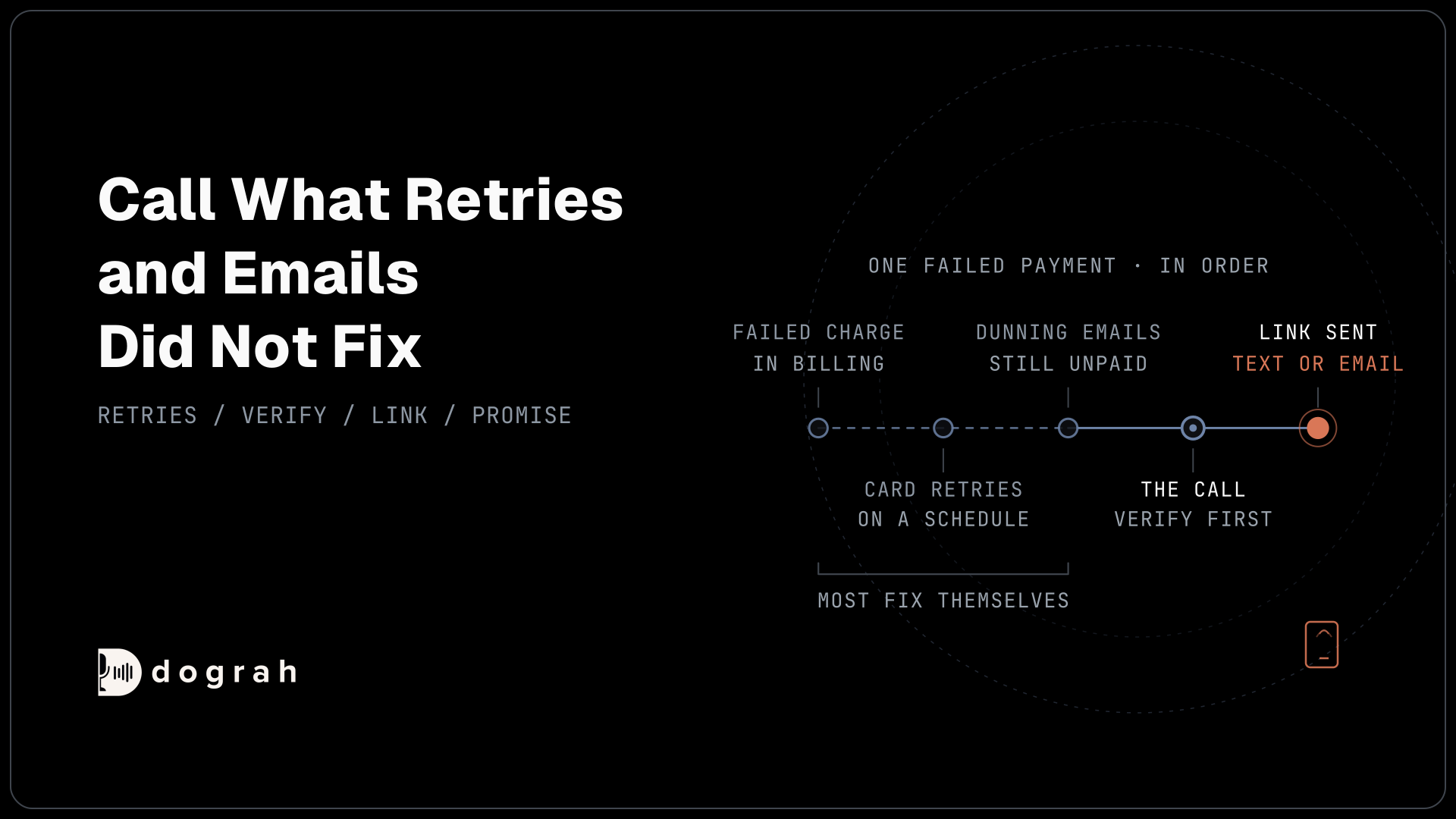
Most failed payments fix themselves without a call. Card network account updaters swap in new card details, your billing system retries declined cards on a schedule, and dunning emails carry a link to update the card.
The call is for what is left: accounts still unpaid after the final retry and the emails. For example, the reminder emails went to someone who has left, or a new company card needs a manager's sign-off.
That revenue is worth chasing. In ChartMogul's SaaS retention report, built from about 3,500 software companies with at least $250k in annual recurring revenue, the median B2B SaaS business had a net revenue retention of 82% through 2025. A customer lost to a dead card is churn the customer never chose.
Who gets called, and when
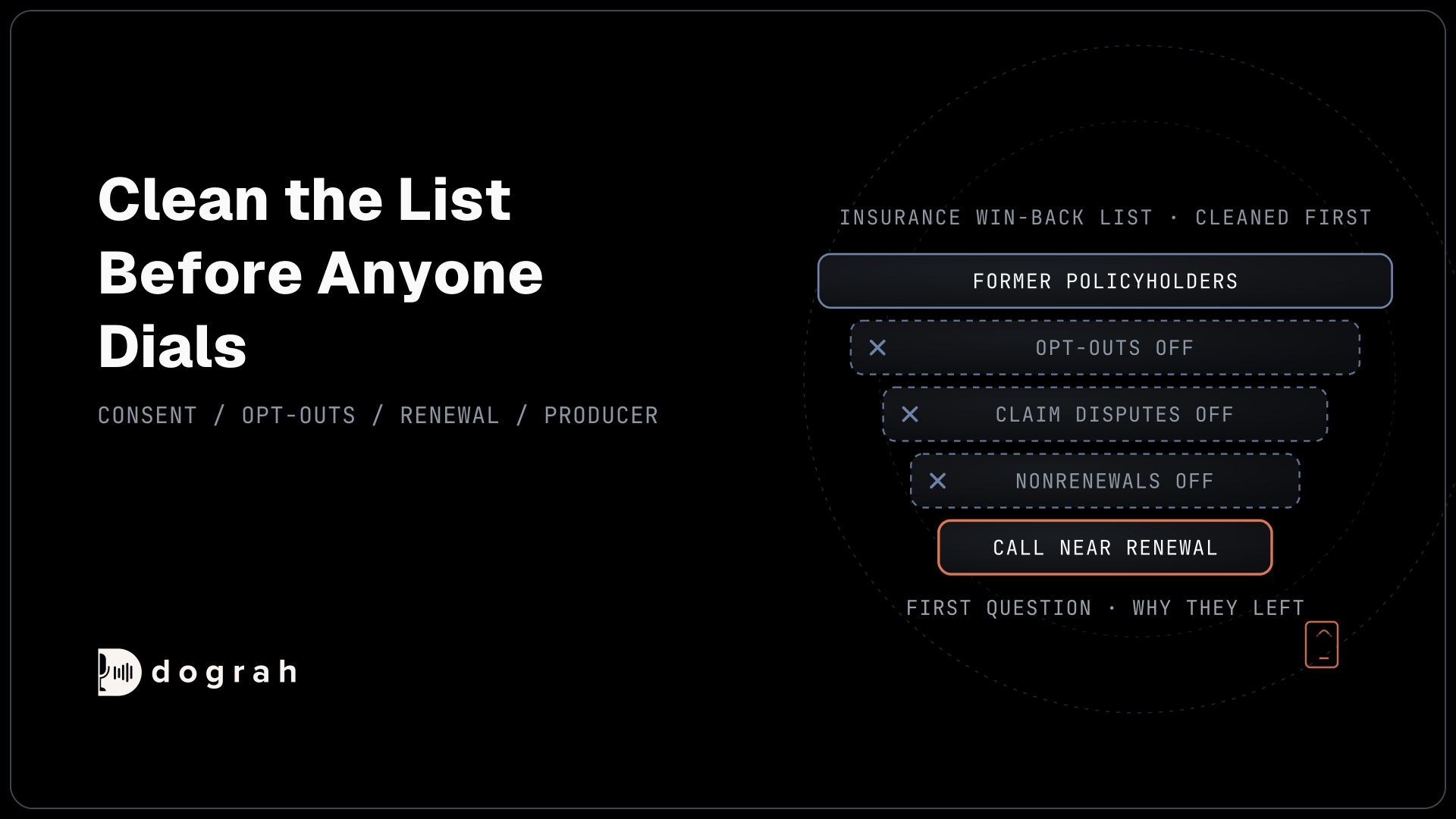
When the final retry fails, your billing system can start the call through the API Trigger, with the invoice number, amount, due date and decline reason in the call's context. Or upload each morning's unpaid accounts to Campaigns.
Campaigns set calling hours by weekday, in one time zone per campaign, so split a list that spans time zones. A campaign retries an unanswered contact 0 to 10 times (default 2). Beyond that, your own list sets how often anyone is called.
Some customers pay between the upload and the call. Pre-Call Data Fetch re-reads the balance when the call connects, so the agent can change what it says: a customer who paid an hour ago hears, after the check, that it is already paid. It never skips or stops the call, and on outbound calls it runs after the person answers. For lists that change daily, start calls with the API Trigger, so your system decides who is called.
Voicemail handling is off by default. To turn it on, open the agent's Settings, then Voicemail & Screening, and switch on "Enable voicemail and screening handling". Under "When voicemail is detected", keep "Disconnect the call", or choose "Leave a message" and keep it to your company's name and a number to call back. Never put the amount in a voicemail.
A failed-payment call with no offer is a service call. Under the FCC's rule at 47 CFR 64.1200, an artificial-voice call to a mobile generally needs "the prior express consent of the called party", and the FCC's February 2024 declaratory ruling confirmed AI voices count. Adding a discount or an upgrade turns it into a marketing call, which generally needs prior express written consent. This is general information, not legal advice; confirm your position with counsel.

Open Source Alternative to Vapi / Retell
Self-hosted voice agent platform — no per-minute fees
dograh-hq/dograh
Star on GitHub
How the call runs: verify, then the amount
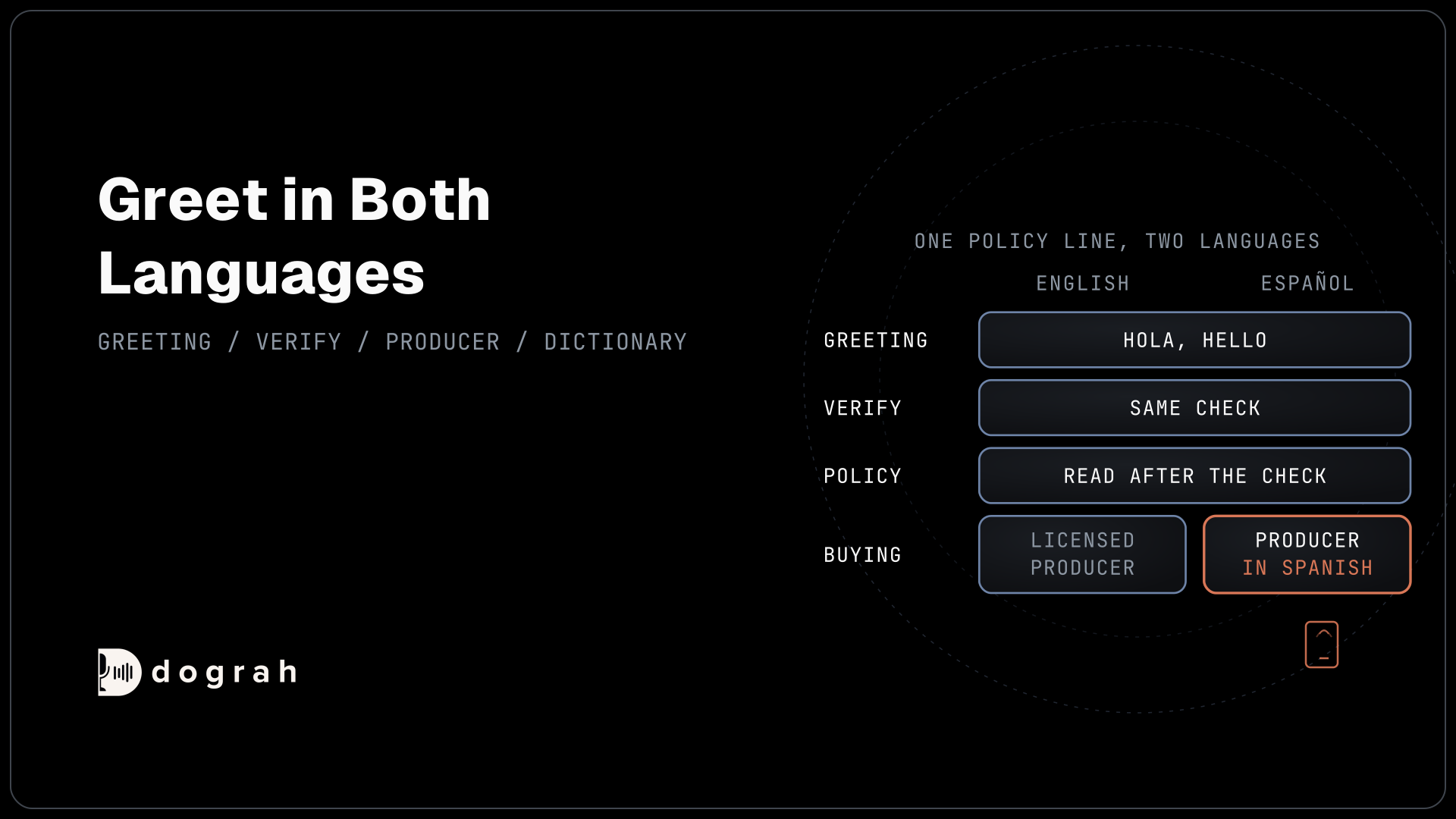
The call opens with Greeting Text, the fixed line Dograh plays word for word as the call connects. It names your company exactly as it appears on the invoice. Recording starts as the call connects, so any recording notice goes first. If you want to tell callers they're speaking with an automated assistant, or your location requires it by law, write that in the Greeting Text too.
Next the agent asks for the billing contact on the account. A phone number or a name only finds the account, but it does not prove who is speaking. Before it names an amount, a plan or an invoice, tell it in the prompt to ask for an approved check, such as the account email plus the number on the last invoice, checked against your system. In B2B accounts, tell it in the prompt that only a billing admin or the owner can hear or change billing. If the check fails, tell it in the prompt to leave only your company's name and number and say nothing about the payment.
After the check, the agent states the amount, the invoice and the reason the payment failed, only as the billing system returns it. Tell it in the prompt never to guess a reason the system did not give.
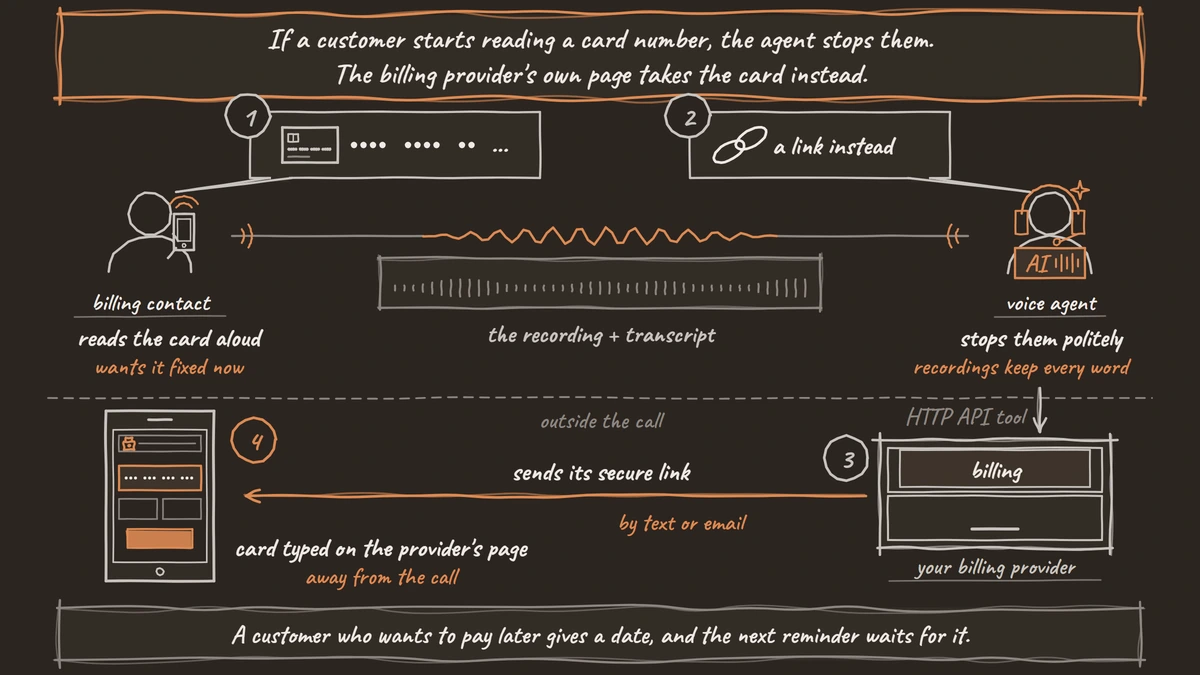
When the customer wants to fix it, an HTTP API tool asks your billing provider to send its secure card-update or invoice link by text or email, often through your own backend in front of a provider such as Stripe. The customer pays on the provider's page. If they want to pay later, the agent records the promise-to-pay date as the customer stated it, and another HTTP API tool writes it to your billing system so the next reminder waits for that date.
Card details never go through the call
Dograh has no payment feature and no keypad (DTMF) tool, so callers answer by voice. Recordings and transcripts keep whatever is said, so the call never asks for a full account, card or Social Security number; use a short check such as the last four digits, and send payment links by text or email from your own system.
If a customer starts reading a card number, tell the agent in the prompt to stop them politely and offer the link instead. The rules for taking cards on a phone line are covered in handling payment-sensitive (PCI) calls in a voice agent.
Where collection law starts
A SaaS company chasing its own subscription is generally outside the Fair Debt Collection Practices Act (FDCPA), and the reasons sit in the definitions. This section is general information, not legal advice.
15 U.S.C. 1692a defines a debt as "any obligation or alleged obligation of a consumer to pay money arising out of a transaction in which the money, property, insurance, or services which are the subject of the transaction are primarily for personal, family, or household purposes". A debt collector collects "debts owed or due or asserted to be owed or due another." A creditor is pulled back in if, collecting its own debts, it "uses any name other than his own which would indicate that a third person is collecting or attempting to collect such debts."
Read together, a B2B invoice is generally not a consumer debt, and a SaaS company collecting its own subscription is a creditor, so the FDCPA generally does not reach either call. An outside agency, or a name that sounds like one, changes that. That is why the Greeting Text uses your exact company name.
Our post on missed-payment recovery in BNPL explains the name test, and AI Voice Agents for Debt Collection covers third-party collection. Confirm your position, including any state rules, with counsel.
Disputes, opt-outs and handing over
Disputes, refund requests, hardship, a new contract and anything legal go to your billing or account team. A customer who says cancel has it recorded and processed through your billing system, or handed to someone who can, with no save offer.
Transfer Call works on Twilio, Telnyx and Asterisk ARI. It passes no summary by default; on Twilio it can play a short spoken introduction to both people. Write the details to your system with an HTTP API tool before the transfer. If nobody answers, the caller stays with the agent; tell it in the prompt to offer a callback.
Dograh keeps no do-not-call list. When a caller opts out, an HTTP API tool writes it to your own list, and you remove those numbers before the next campaign upload. The do_not_call call tag records the request but never blocks a later call.
Customers who call in about a failed card are covered in AI voice agents for account and billing support in SaaS. Self-hosted Dograh has no per-minute platform fee (servers, model keys and phone minutes still cost); Dograh Cloud has a 1¢-a-minute platform fee.
Join the Dograh Community
Dograh is an OSS alternative to Vapi. Join our Slack community for queries, releases, best practices & community interactions.
Glossary
- Dunning
- The billing system's process after a failed charge: automatic card retries and reminder emails. A voice agent calls only the accounts still unpaid after that, and the billing provider sends the payment link.
- Account updater
- A card network service that passes new card numbers and expiry dates to merchants when a bank reissues a card, so many expired-card failures are fixed before anyone needs a call.
- Promise-to-pay date
- The date a customer says they will pay, recorded during the call as the customer stated it and written to the billing system so the next reminder waits for it.
- Debt (FDCPA)
- Under 15 U.S.C. 1692a(5), a consumer's obligation from a transaction mainly for personal, family or household purposes. A B2B invoice is generally not one, which is part of why the FDCPA generally does not reach B2B dunning calls.