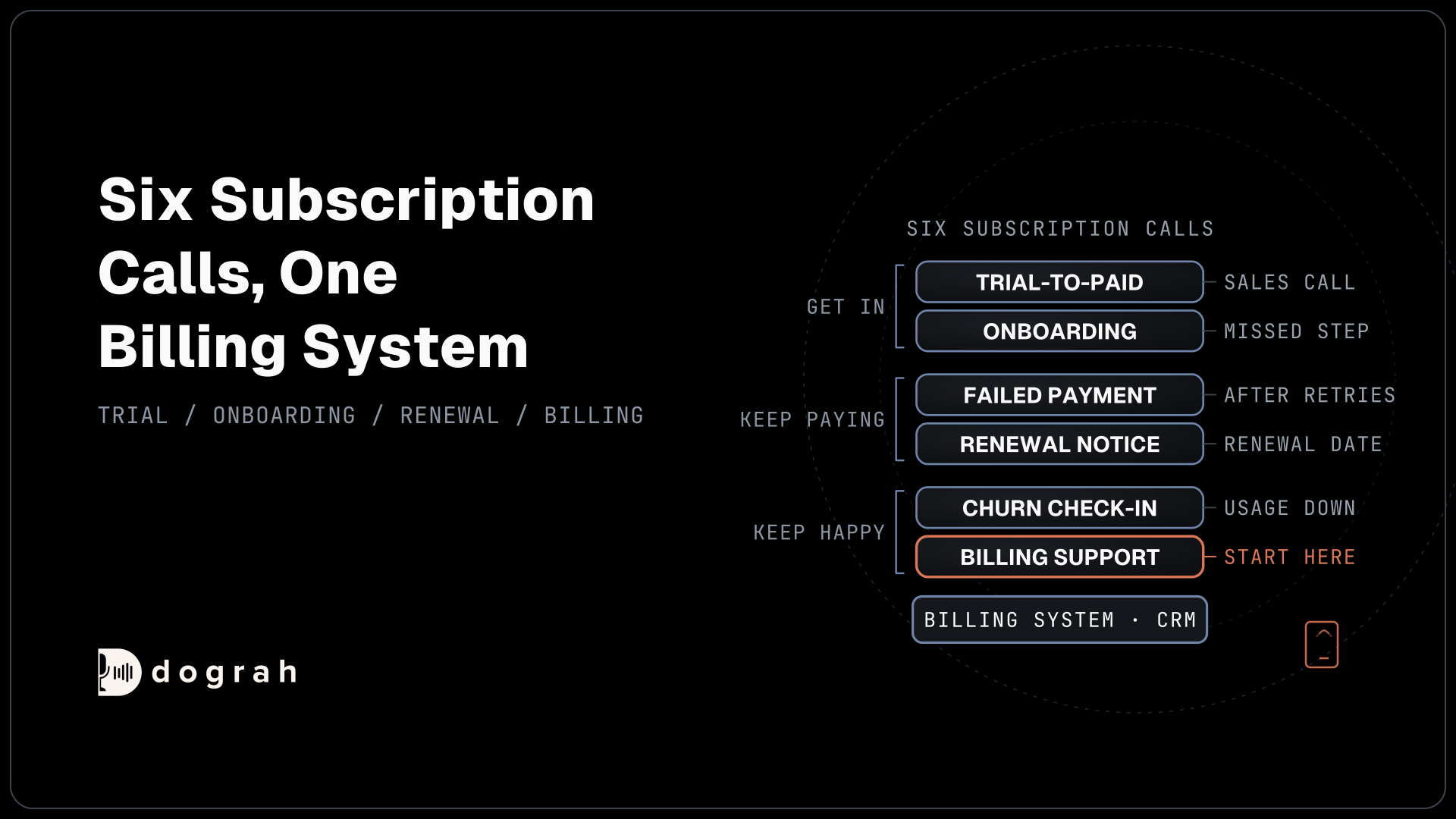

AI voice agents for SaaS and subscription businesses handle six calls: trial-to-paid, onboarding, failed payments, renewal reminders, churn-risk check-ins and billing support. They read plans, invoices and usage from the billing system and CRM during the call and write each outcome back. Sales calls generally need written consent, and card details never go through the call.
Key Takeaways
- Every answer comes from your billing system and CRM, read and written during the call.
- Offers and sales calls generally need written consent; plain service calls need prior express consent.
- Cancellations are processed with no save offer; card details never go through the call.
This guide follows a subscription from the first trial call to the renewal, then sets out the rules for every call and how each one runs in Dograh, an open-source voice agent platform. You can self-host it or run it on Dograh Cloud.
The calls a subscription business makes and takes
Six calls cover most of the lifecycle, from the trial to billing support. All but billing support are outbound and start from an event in your product or billing system.
Retention is where the money sits. In ChartMogul's SaaS retention report, built from about 3,500 software companies with at least $250k in annual recurring revenue, the median B2B SaaS business had a net revenue retention of 82% through 2025, and the upper quartile 97%. The median B2C SaaS business was at 49%. So the typical B2B company loses close to a fifth of its revenue base each year after expansion, and a consumer app about half. That is why most of this guide is about calls to existing customers, including small accounts no customer success manager ever calls.
In our view, an agent earns its place on a call with a clear answer in your systems, such as what the plan costs or why a charge failed. It should not decide anything that needs judgement, such as a refund outside policy. Telecom runs the same calls, and AI Voice Agents by Use Case covers each call type across industries.
Every answer comes from your billing system and CRM
The agent never keeps its own copy of a plan, an invoice or a balance. During the call, an HTTP API tool asks your systems for what the call needs, such as the plan and price, the renewal date or the reason a charge failed. The agent offers only what comes back. When the customer agrees to something, a second HTTP API tool writes it back, such as a plan change or a cancellation.
Pre-Call Data Fetch, at the bottom of the Start Call node, calls your endpoint once the call connects (on outbound calls, after the person answers), with the caller and called numbers, so the agent has the account before it speaks. Because it reads live data, a customer who paid an hour ago hears "it's paid, thank you". It never decides whether to call.
The API Trigger starts a call the moment an event fires, such as a failed charge, and Campaigns dial a list you upload. After the call, a Webhook node sends the outcome and transcript link to your CRM and retries a temporary failure. Dograh has no built-in billing or CRM integration: each connection points at your own APIs, or at your backend in front of a billing provider such as Stripe. Our guide to Integrating Voice Agents With Your Stack covers those routes.
Every call that touches an account runs greet, verify, then disclose. A phone number finds an account, but it does not prove who is calling. Before the agent names an amount, a plan or an invoice, tell it in the prompt to ask for an approved check, such as the account email plus the number on the last invoice, checked against your system. In B2B accounts, tell it in the prompt that only a billing admin or the owner can hear or change billing.
Transfer Call works on Twilio, Telnyx and Asterisk ARI. It passes no summary by default; on Twilio it can play a short spoken introduction to both people. Write the details to your system with an HTTP API tool before the transfer. If nobody answers, the caller stays with the agent; tell it in the prompt to offer a callback.
Getting customers in: trial and onboarding calls
The trial-to-paid call is a sales call. It fires on a trial event, such as a trial nearing its end, sent from your product through the API Trigger with the plan and usage facts in the call's context. The agent asks what the user was trying to get done and answers product questions from your own docs in the Knowledge Base. Then it books a call with sales through an HTTP API tool, or asks your billing system to send its upgrade link.
Because it sells, the call starts from the consent record. The trial form carries its own unticked consent line naming your company, AI-voice calls and the number, and saying that agreeing is not a condition of buying. Without a ticked box, there is no AI call. AI voice agents for trial-to-paid conversion calls covers the trigger, the form and the call.
The onboarding call is a help call with no offer. It fires on a missed step, such as no integration connected by day three. The agent asks what blocked them, answers setup questions from your product docs and books a session with a person. It records the blocker as the customer stated it, and a webhook sends that to your CRM. It cannot see the customer's screen, so it never walks them through clicks it cannot check. The moment it pitches a plan, it is the trial-to-paid call, with that call's consent rule. AI voice agents for customer onboarding calls in SaaS covers the triggers and the hand-off.

Open Source Alternative to Vapi / Retell
Self-hosted voice agent platform — no per-minute fees
dograh-hq/dograh
Star on GitHub
Keeping them paying: failed payments and renewals
The failed-payment call is for what retries and email did not fix: your billing system builds the list from accounts still unpaid after them. The Greeting Text, the fixed line Dograh plays word for word, names your company exactly. Recording starts as the call connects, so any recording notice goes first in it. After the approved check, the agent gives the reason a payment failed only as the billing system returns it.
When the customer wants to pay, an HTTP API tool asks your billing provider to send its secure card-update or invoice link by text or email. Disputes, refund requests and hardship go to a person, with the details written first. Adding a discount turns it into a marketing call, with the written-consent rule below. Whether debt collection law reaches the call depends on who collects and on what kind of plan. AI voice agents for failed-payment and dunning recovery in SaaS covers the call list, the payment link and where collection law starts.
The renewal reminder call is driven by a date. After verification, the agent reads the term, the renewal date and the price exactly as the billing system returns them. A call that only states the renewal date, the price and how to change or cancel is generally informational. A call that asks the customer to renew, or makes any offer, generally needs prior express written consent. A cancel request is processed as set out below, and price negotiation goes to the account owner. The call never replaces a written renewal notice that your contract or state law requires. AI voice agents for subscription renewal reminders covers the timing, the notice and cancellation.
Keeping them happy: check-ins and billing support
The churn-risk check-in starts from a signal in your own data, such as usage down or seats removed, sent through the API Trigger. The agent asks one open question and records the answer as stated, with a reason category. It offers only help, with no upgrade, discount or save offer, and a customer who says they are leaving goes to the account owner. To check that the agent stayed off sales, run Dograh's QA on a random sample of calls. It scores each step separately. AI voice agents for churn-risk check-in calls in SaaS covers the signals and the hand-off.
The account and billing support line is inbound: "why was I charged", "send me the invoice", "change my plan", "update my card", "cancel". Pre-Call Data Fetch in Inbound calls only mode finds the account by the calling number; the agent still runs the approved check before naming any amount. Invoice copies and card-update links come from your billing provider through an HTTP API tool, and plan changes are written once the customer confirms. Refunds above your policy line, disputes and chargebacks go to a person. AI voice agents for account and billing support in SaaS covers verification and refund routing.
Consent rules: service calls vs sales calls
Outbound calls need consent, and the kind depends on whether the call sells. This section is general information, not legal advice.
In its February 2024 declaratory ruling under the Telephone Consumer Protection Act (TCPA), the Federal Communications Commission (FCC) confirmed that "the TCPA's restrictions on the use of 'artificial or prerecorded voice' encompass current AI technologies that generate human voices". Such calls "require the prior express consent of the called party to initiate such calls absent an emergency purpose or exemption."
Sales calls need more. The FCC's rule at 47 CFR 64.1200 covers "any telephone call that includes or introduces an advertisement or constitutes telemarketing" and allows it "with the prior express written consent of the called party". Read with the ruling, onboarding help, failed-payment calls, renewal notices that only state the date and terms, and check-ins with no offer are generally service calls that need prior express consent. A trial-to-paid call, a call asking a customer to renew, or any call that adds an upgrade or a discount generally needs prior express written consent.
B2B accounts are no way around this. The rule covers "any telephone number assigned to a ... cellular telephone service", with no exception for business use, so a work mobile is generally covered whoever pays the bill. Most signups give a mobile, so treat every outbound AI call as needing consent on record. An offer inside a call the customer placed is generally outside these rules; a follow-up call you place to make that offer needs written consent.
State laws can add their own rules; our complete guide to compliant AI voice agents covers them. Confirm your position with counsel before the first outbound campaign.
Cancellations and card details: fixed on every call
This section is general information, not legal advice.
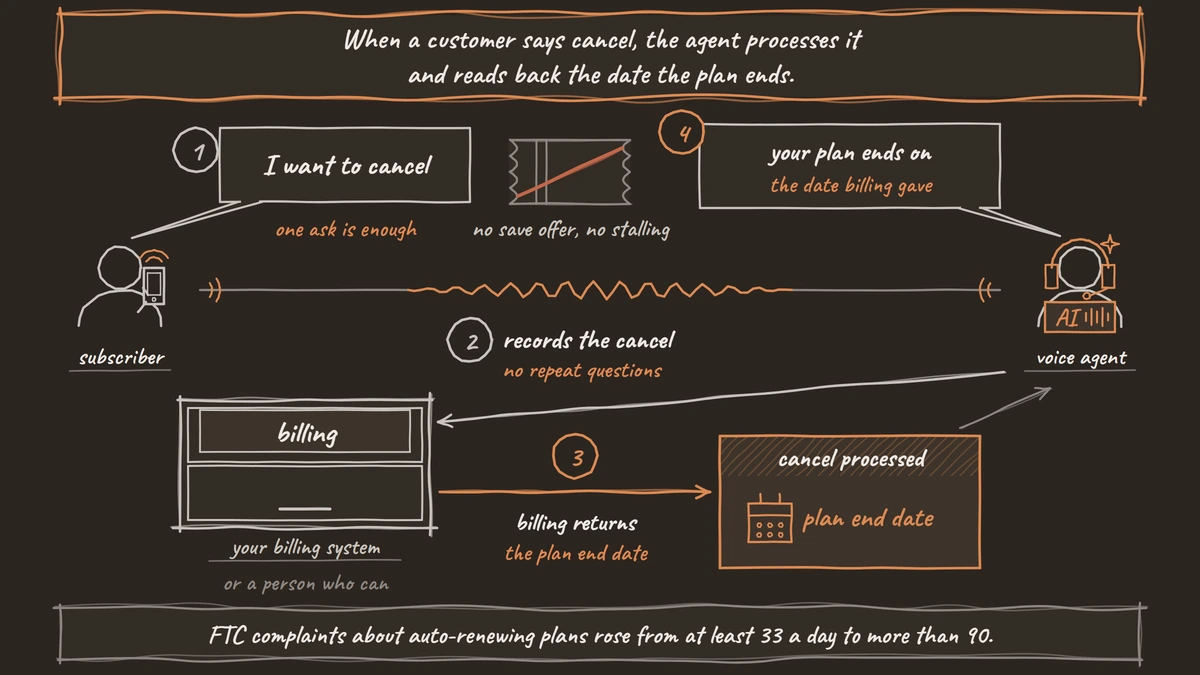
The Restore Online Shoppers' Confidence Act (ROSCA) requires a seller charging through a negative option online to provide "simple mechanisms for a consumer to stop recurring charges". There is no federal click-to-cancel rule in force. The FTC restored its older Negative Option Rule in February 2026, and in its March 2026 notice it asked whether new rules are needed. The same notice says complaints about these practices "steadily risen from at least 33 per day in late 2020 to more than 90 per day in 2025", so a cancel line that stalls invites the complaints regulators count. Many states have automatic renewal laws with their own notice and cancellation rules; check yours with counsel.
A phone line that takes cancellations is one such mechanism. When a customer says cancel, the agent records it, processes it through your billing system or hands it to a person who can, and reads back the date the plan ends. It never stalls the customer or makes a save offer.
Dograh keeps no do-not-call list. When a caller opts out, an HTTP API tool writes it to your own list, and you remove those numbers before the next campaign upload. The do_not_call call tag records the request but never blocks a later call, so to stop calling someone mid-campaign, pause it and start a new one from a corrected list. For lists that change daily, start calls with the API Trigger, so your system decides who is called.
The FCC has also adopted an opt-out rule, not yet in effect, under which one "stop" on a sales call generally ends every AI sales call from you to that number; AI voice agents for trial-to-paid conversion calls quotes the order.
Card details never go through the call. Dograh has no payment feature and no keypad (DTMF) tool. Recordings and transcripts keep whatever is said, so the call never asks for a full account, card or Social Security number; use a short check such as the last four digits, and send payment links by text or email from your own system. If a customer starts reading a card number, tell the agent in the prompt to stop them politely and offer the link.
Join the Dograh Community
Dograh is an OSS alternative to Vapi. Join our Slack community for queries, releases, best practices & community interactions.
Self-hosting or Dograh Cloud for subscription calls
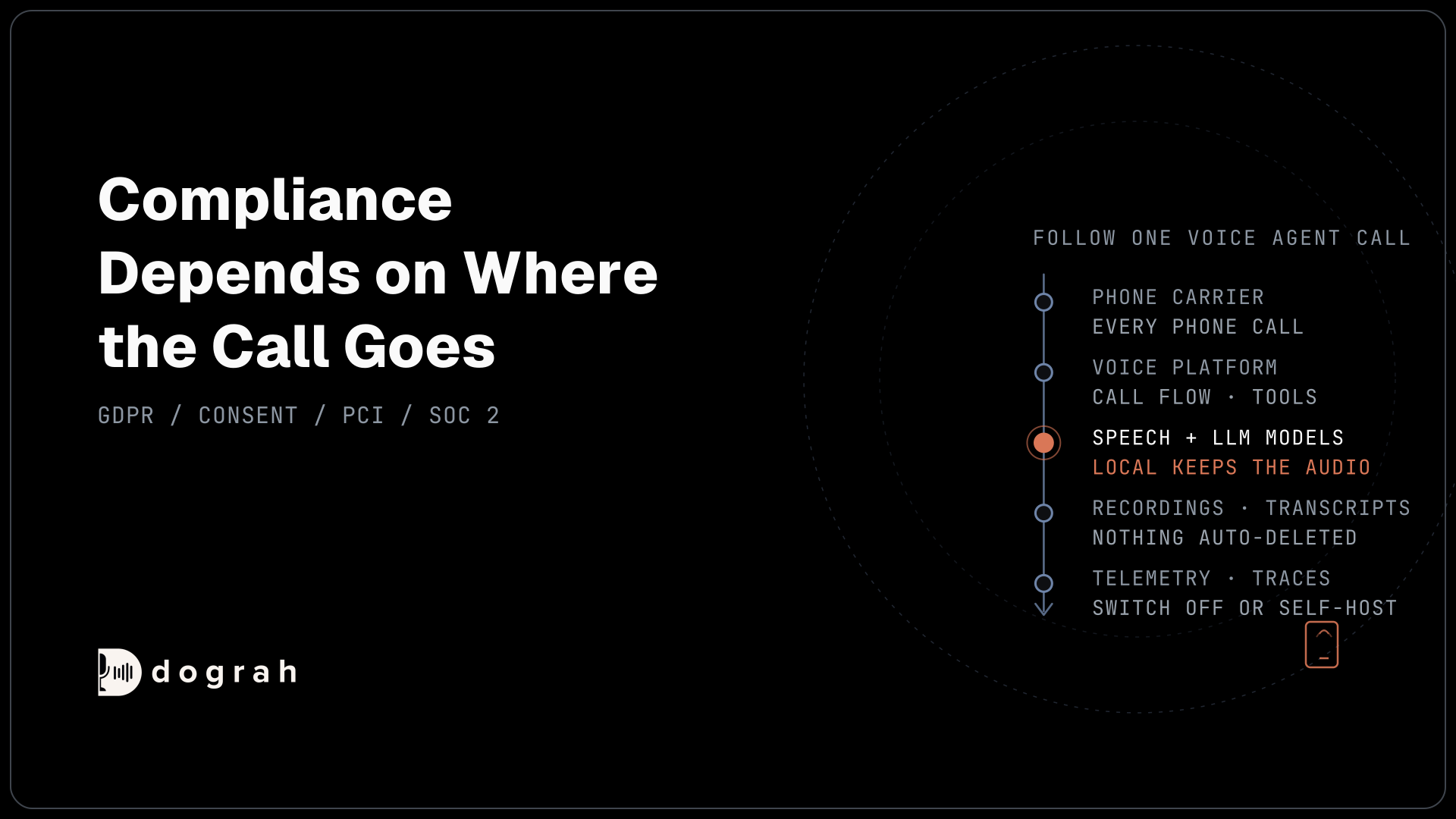
Self-hosting keeps your customers' recordings and transcripts on your own servers. Dograh is the orchestration layer: it runs the call flow, tools and telephony, and the speech and language models are a separate layer you choose. The call audio stays in-house only when the speech and language models run on your own servers too.
Dograh starts every account on its own managed models. To keep call audio away from Dograh, open Models, switch the Organization default to BYOK with your own speech and language providers (or local models), and check that no agent has its own model override.
Because you self-host Dograh inside your existing compliance perimeter, you don't need a separate vendor review for Dograh. The speech and language model providers you choose may still need their own review, unless those models run on your servers too.
Dograh Cloud handles the security work for you. Self-hosted Dograh has no per-minute platform fee (servers, model keys and phone minutes still cost); Dograh Cloud has a 1¢-a-minute platform fee.
Which subscription call to automate first
Start with the inbound billing support line: it raises no outbound consent question, and the answers already sit in your billing system. Onboarding help and failed-payment calls come next, as service calls with a clear trigger. Renewal notices follow. Sales calls and any call with an offer come last, once written consent is recorded. A campaign's calling hours run in one time zone, so split a list that spans zones into one campaign per zone.
Test on a real phone number before any customer hears the agent: most phone calls reach the agent as 8 kHz audio, not the 16 kHz of a browser demo, and web calls cannot transfer. Once live, run QA on a random 5 to 10% sample of calls and fix what the transcripts show.
Each subscription call above has its own deep dive:
- AI Voice Agents for Trial-to-Paid Conversion Calls
- AI Voice Agents for Customer Onboarding Calls in SaaS
- AI Voice Agents for Failed-Payment & Dunning Recovery in SaaS
- AI Voice Agents for Subscription Renewal Reminders
- AI Voice Agents for Churn-Risk Check-in Calls in SaaS
- AI Voice Agents for Account and Billing Support in SaaS
Glossary
- Net revenue retention (NRR)
- The share of last year's recurring revenue a business still earns from the same customers a year later, counting upgrades, downgrades and churn. Below 100% means the existing base shrinks before any new sale.
- Dunning
- The billing system's process after a failed charge: card retries and reminder emails. A voice agent calls only the accounts still unpaid after that, and the billing provider sends the payment link.
- Prior express written consent
- Under the TCPA, a signed written agreement that lets a business make advertising or telemarketing calls with an artificial or prerecorded voice to a given number. Sales calls and any call with an offer generally need it.
- Negative option
- A subscription that keeps charging until the customer says stop, such as an auto-renewing plan. ROSCA requires a simple way to stop the charges, so the agent processes every cancellation it hears.