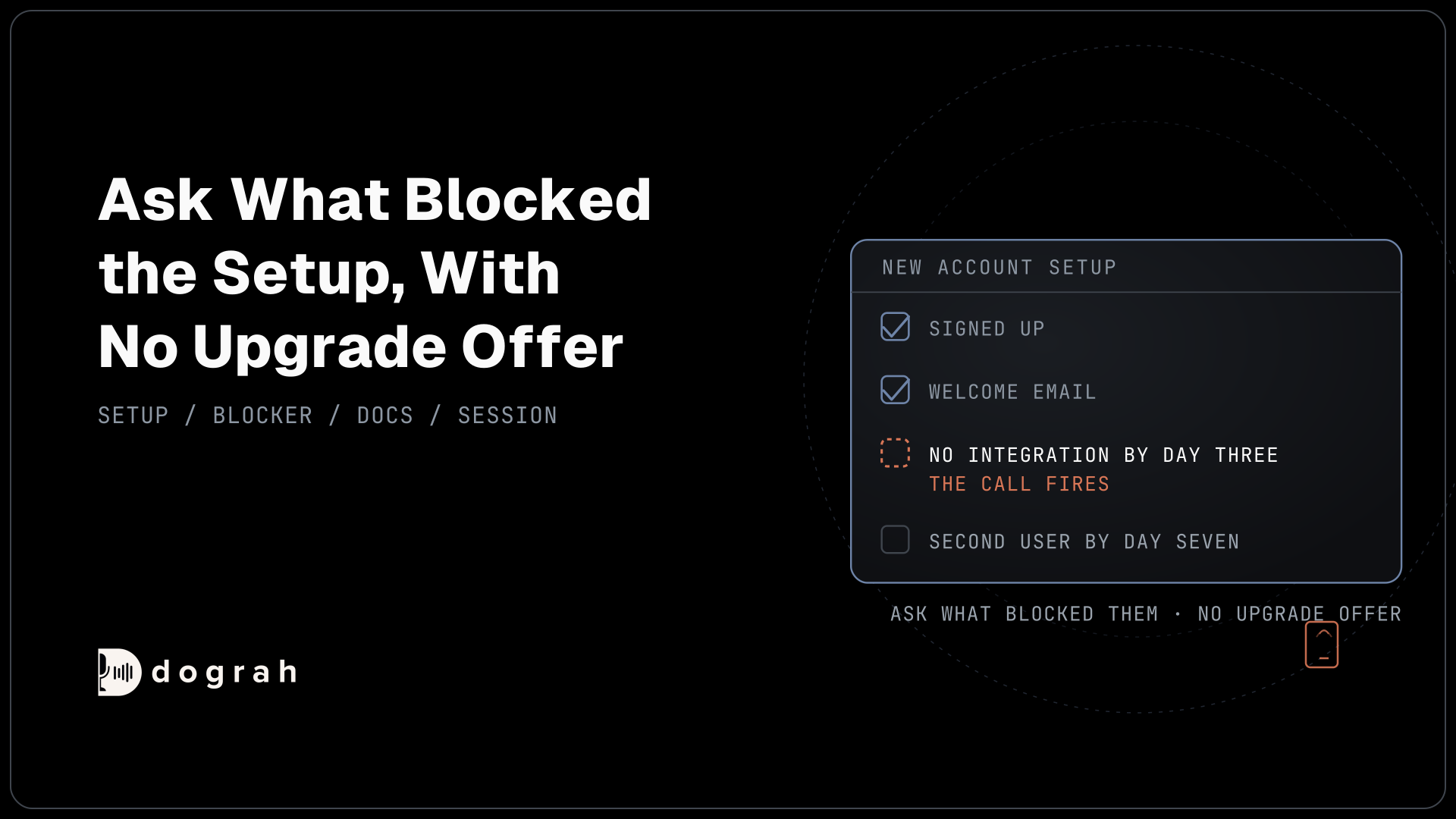

AI voice agents for customer onboarding calls in SaaS phone new accounts that stalled on a setup step, such as no integration connected by day three. The agent asks what blocked them, answers from your product docs, books a session with a person for anything hands-on and records the blocker in your CRM. It makes no upgrade offer.
Key Takeaways
- Call accounts that stalled on a setup step, not every new signup.
- The agent answers from your docs and books a person for anything hands-on.
- No upgrade offer: once it pitches a plan, it becomes a sales call.
This post is part of our guide to AI voice agents for SaaS and subscription businesses. The guide's section "Getting customers in: trial and onboarding calls" sets the rule for this one: "The onboarding call is a help call with no offer." Here is that call in full, run in Dograh, an open-source, self-hostable voice agent platform.
Which new accounts need an onboarding call
Most new accounts need no call at all. An in-product checklist and a welcome email cover the users who set up on their own, and those tools do that job well. The call is for accounts that stalled after them, and for the long tail of small accounts that no customer success manager ever reaches.
Those accounts carry more money than they look. In ChartMogul's SaaS retention report, built from about 3,500 software companies with at least $250k in annual recurring revenue, the median B2B SaaS business had a net revenue retention of 82% through 2025, and the upper quartile 97%. The gap between those two numbers is customers who stayed and grew, and customers who quietly left.
In our view, setup is the first place an account goes quiet. A short call there, while the customer still remembers why they signed up, costs less than chasing the account near its renewal date.
Trigger the call on a missed setup step
The call starts from what the account has not done. Pick one or two steps that matter for your product, such as no integration connected by day three or no second user invited by day seven, and let your product fire the call when a step is missed.
Your product starts the call through the API Trigger, with the facts in initial_context: first name, company, plan, signup date and the step that is missing. Those facts let the agent open on the real reason for calling. Our post on API triggers shows the request.
You can also upload yesterday's stalled accounts to Campaigns each morning. A campaign's calling hours run in one time zone, so split a list that spans time zones into one campaign per zone. Call one person per account, usually the admin who signed up, so a team of five does not get five calls.

Open Source Alternative to Vapi / Retell
Self-hosted voice agent platform — no per-minute fees
dograh-hq/dograh
Star on GitHub
How the onboarding call runs
The call opens with Greeting Text, the fixed line Dograh plays word for word as the call connects. It names your company. Recording starts as the call connects, so any recording notice goes first. If you want to tell callers they're speaking with an automated assistant, or your location requires it by law, write that in the Greeting Text too. Give each per-call variable a fallback, such as {{first_name | there}}, so a missing value still reads naturally.
Next the agent confirms who it is talking to. A phone number or a name only finds the account, but it does not prove who is speaking. Before it talks about the account's setup, tell it in the prompt to ask for an approved check, such as the email the account was opened with.
Then it asks one open question: what got in the way? Many answers are quick fixes, such as where to find the API key or how to invite a colleague. The agent answers those from your own help docs, uploaded to the Knowledge Base as PDF, DOCX, DOC, TXT, JSON or MD files of up to 5 MB each. It answers from what you uploaded, so keep those docs current.
The agent cannot see the customer's screen, so tell it in the prompt never to walk them through clicks it cannot check. Anything hands-on gets a session with a person. An HTTP API tool books it during the call in your calendar or scheduling system. Dograh has no built-in calendar integration, so the tool calls that system's own API. Our post on booking meetings mid-call with Calendly shows one way.
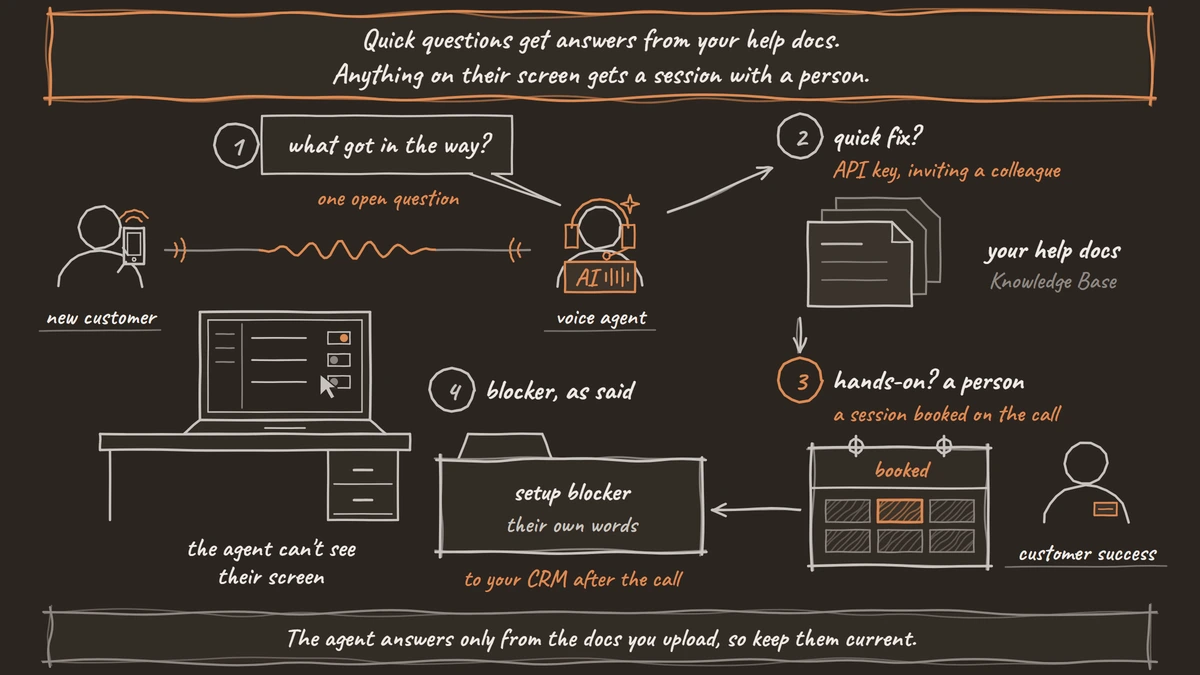
The agent also records the blocker as the customer stated it, in a variable such as setup_blocker, with the transcript and recording as the exact record. A Webhook node sends it to your CRM after the call, so the customer success team sees why each account stalled and which fixes to make in the product.
A help call with no upgrade offer
Onboarding help is a service call, and keeping it that way keeps the consent rule simple. This section is general information, not legal advice.
In its February 2024 declaratory ruling, the Federal Communications Commission (FCC) said calls using AI-generated voices "require the prior express consent of the called party to initiate such calls absent an emergency purpose or exemption." A setup-help call with no offer generally needs that prior express consent, so record it in your signup terms or account settings. A work mobile is generally covered whoever pays the bill.
A sales pitch changes the rule. Under 47 CFR 64.1200, "any telephone call that includes or introduces an advertisement or constitutes telemarketing" in an artificial voice to a mobile is allowed with "the prior express written consent of the called party". The moment the agent pitches a plan, it is the trial-to-paid call, with that call's written-consent rule, covered in AI voice agents for trial-to-paid conversion calls.
So tell the agent in the prompt to answer plan and price questions only by offering a person, and to make no upgrade or discount offer. To check that it stayed off sales, run Dograh's QA on a random sample of calls. It scores each step of the call separately. Confirm your position with counsel.
Handing over to customer success
Some customers want a person now. Transfer Call works on Twilio, Telnyx and Asterisk ARI. It passes no summary by default; on Twilio it can play a short spoken introduction to both people. Write the details to your system with an HTTP API tool before the transfer, such as the blocker and the account. Web calls cannot transfer, so test this on a real phone line.
If nobody answers, the caller stays with the agent; tell it in the prompt to offer a callback. Customers who would rather not be called again are opting out. Dograh keeps no do-not-call list. When a caller opts out, an HTTP API tool writes it to your own list, and you remove those numbers before the next campaign upload. The do_not_call call tag records the request but never blocks a later call.
Onboarding ends once the account is set up. Later calls, when usage drops or seats are removed, belong to AI voice agents for churn-risk check-in calls in SaaS. Self-hosted Dograh has no per-minute platform fee (servers, model keys and phone minutes still cost); Dograh Cloud has a 1¢-a-minute platform fee.
Join the Dograh Community
Dograh is an OSS alternative to Vapi. Join our Slack community for queries, releases, best practices & community interactions.
Glossary
- Missed setup step
- A step your product expects a new account to finish by a set day, such as connecting an integration by day three. When it is missed, the product starts the onboarding call through the API Trigger.
- Knowledge Base
- The documents an agent answers from during a call, uploaded as PDF, DOCX, DOC, TXT, JSON or MD files of up to 5 MB each. For onboarding calls, this is your own help docs.
- Variable extraction
- The AI step that records an answer from the call, such as the customer's setup blocker, as the customer stated it. The transcript and recording stay the exact record.
- Prior express consent
- The consent tier an AI-voice service call to a mobile generally needs, such as a setup-help call with no offer. A call that pitches a plan generally needs prior express written consent instead.