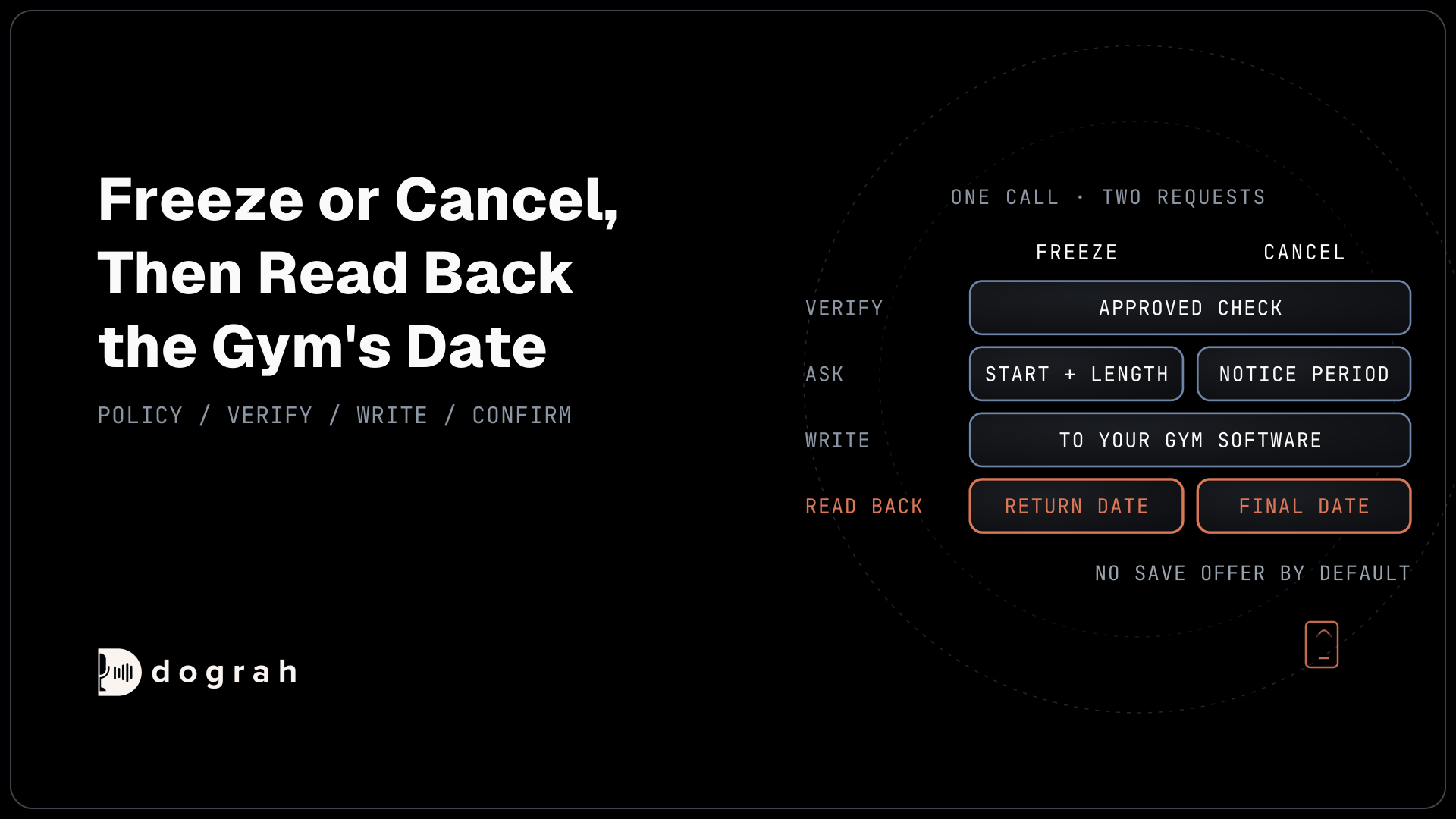

AI voice agents for membership freeze and cancellation requests verify the member, ask whether they want to pause or cancel, and follow the club's written policy. They write the request to the gym software and read back the effective date once the system confirms it. By default they make no save offer and never stall a cancellation.
Key Takeaways
- The club's written policy sets the notice period, freeze length and final billing date.
- Read back the effective date only after the gym software confirms it.
- No save offer by default; at most one, after the fixed "cancel" line.
This post is part of our guide to AI voice agents for gyms and fitness studios. The guide's section "Leaving and pausing: freeze and cancellation" sets the rule for this call: it "follows the club's written policy, and the agent never stalls a member who wants to cancel." Here is that call in full, run in Dograh, an open-source, self-hostable voice agent platform.
The club's written policy decides the terms
Freezing and cancelling are two different requests, and the club's policy sets the terms of each.
A freeze pauses the membership for a set time and brings the member back on a return date. A cancellation ends it on a final active date. Mixing them up is how a member who wanted a two-month pause ends up cancelled, or a member who cancelled keeps getting billed.
The terms come from the club, never from the agent. Upload the membership terms and the freeze and cancellation policy to the Knowledge Base, covering the notice period, the shortest and longest freeze, the freeze fee, how many freezes a year are allowed and how the final billing date is worked out. Where the answer depends on the member's own plan, such as a minimum term or a renewal date, an HTTP API tool reads it from the gym management software. Dograh has no built-in integration with any gym software, so that tool calls your system's own API.
Every request should leave the same record: the request date, the type, the start date, the return date for a freeze or the final active date for a cancellation, and the confirmation number your system issues. With 14 days' notice, for example, a request on 10 June might end on 24 June or on the next billing date after that, depending on the terms. Written down, those dates settle the argument before it starts.
How the call runs: verify, ask, write, confirm
The agent confirms nothing the gym software has not confirmed first.
The greeting names the club. The agent asks for the member's name to find the record, then an approved check, such as date of birth or the last digits of the member number, because a phone number does not prove who is calling. Then it asks one plain question: do you want to pause your membership or cancel it?
For a freeze, the agent reads the options the policy allows and asks for a start date and length. For a cancellation, it reads the notice period and the final billing date the system returns. An HTTP API tool writes the request. The agent reads back the effective date and the confirmation number only after the system returns them.
The written confirmation comes from the club's own system, because Dograh has no SMS tool. Another HTTP API tool can ask your system to send it by email or text during the call. A member with more than one membership on the account, such as a family plan, goes to staff, so the agent never cancels the wrong one. Members who ask about a freeze on the support line arrive here straight away, as described in AI voice agents for gym member support calls.

Open Source Alternative to Vapi / Retell
Self-hosted voice agent platform — no per-minute fees
dograh-hq/dograh
Star on GitHub
No save offer by default, and never a stall
By default the agent makes no save offer at all.
Tell it in the prompt to process the request as soon as the member says "cancel", without arguing or reading the policy back as a hurdle. Asking the reason once, for the club's records, is fine as long as the member can skip it.
If the club wants one offer, build the order into the flow. The offer sits on its own node, reached only through a pathway whose Transition Speech is a fixed line, such as "You can say cancel at any time and I'll process it straight away." Transition Speech plays fixed text or a recorded clip, so those words never drift. Text lines do not play on speech-to-speech models, so use a recorded clip there. The agent then makes one offer at most, read from the club's system, such as a freeze instead of a cancellation. One "cancel" ends it, and the cancellation goes through.
Choosing a pathway is the language model reading its written condition, so it is never a hard rule. Test the route on real phone calls and run QA on a sample of live calls to catch any offer made without the line. Hardship, bereavement and complaints get no offer. A member who cancels today is never offered a win-back in the same call. That belongs to AI voice agents for gym membership sales and win-back, later and with written consent.
What the law says about phone cancellations
Cancellation law differs by state, and California shows clearly what a phone line must do. This section is general information, not legal advice.
California's automatic renewal law, Business and Professions Code section 17602, says a business that takes cancellations by toll-free number "shall answer calls promptly during normal business hours and shall not obstruct or delay the consumer's ability to cancel". It allows an offer on a phone cancellation only after the business tells the consumer "they may complete the cancellation process at any time by stating that they want to "cancel"". The fixed line above follows that order. Many states have similar automatic renewal laws, and the details differ.
At the federal level, the FTC's 2024 click-to-cancel rule is gone. The Eighth Circuit found in July 2025 that the Commission had not followed required procedure, and wrote: "we grant the petitions for review and vacate the Rule." The Restore Online Shoppers' Confidence Act (ROSCA) still applies to memberships sold online. Under 15 U.S.C. 8403, the seller must provide "simple mechanisms for a consumer to stop recurring charges".
The FTC still brings cancellation cases against gyms. In August 2025 it sued the operators of LA Fitness, alleging they "trained staff to reject escalated requests and to deny cancellations requested by phone or email." That is an allegation, not a finding. Read together, a phone cancellation line should generally answer, take the request and process it with no obstacles. Confirm your position with counsel.
Medical freezes, hardship and failed writes
Some requests need a person, and some calls meet a system that does not answer.
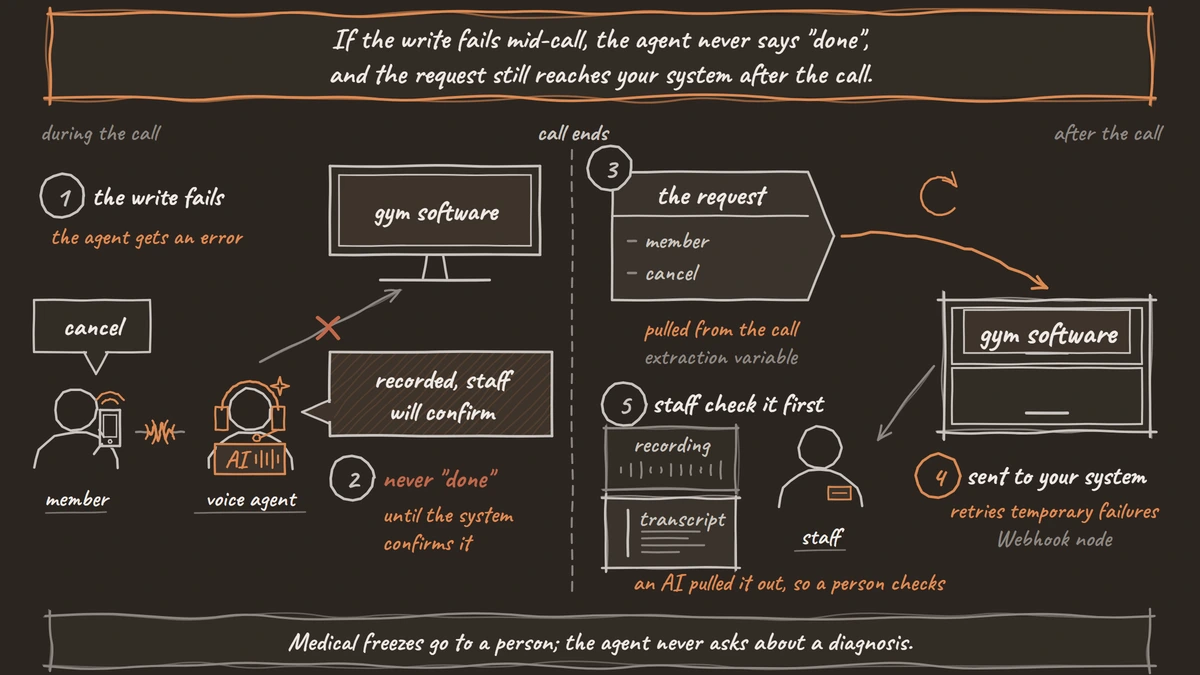
Medical freezes, hardship, billing disputes and refund requests go to a person. Tell the agent in the prompt never to ask about a diagnosis and to record "medical freeze requested" instead, so staff can handle the club's own form. Recordings and transcripts keep whatever is said, so less detail on the call is safer.
Transfer Call makes the handover. Transfer Call works on Twilio, Telnyx and Asterisk ARI. It passes no summary by default; on Twilio it can play a short spoken introduction to both people. Write the details to your system with an HTTP API tool before the transfer. If nobody answers, the caller stays with the agent; tell it in the prompt to offer a callback.
A write can fail. HTTP API tools wait 5 seconds by default and do not retry, so the agent gets an error. Tell it in the prompt to say the request is recorded and staff will confirm it, never "done". Set an extraction variable for the request on the node where the call ends, and a Webhook node sends it to your system after the call, retrying temporary failures automatically. Extraction is an AI step, so staff check it against the recording and transcript before acting.
A member who says "cancel" on a payment call lands in this same flow, as covered in AI voice agents for missed membership payment reminders. Self-hosted Dograh has no per-minute platform fee (servers, model keys and phone minutes still cost); Dograh Cloud has a 1¢-a-minute platform fee.
Join the Dograh Community
Dograh is an OSS alternative to Vapi. Join our Slack community for queries, releases, best practices & community interactions.
Glossary
- Final active date
- The last day a cancelled membership can be used, worked out from the club's notice period and billing date. The agent reads it back only after the gym software returns it.
- Save offer
- A discount, freeze or other benefit offered to a member who asked to cancel. The agent makes none by default; a club that wants one allows at most one, after a fixed line saying the member can say cancel at any time.
- Transition Speech
- Fixed text or a recorded clip that plays when the agent takes a pathway in Dograh. It carries the 'you can say cancel at any time' line word for word; text lines do not play on speech-to-speech models.
- Restore Online Shoppers' Confidence Act (ROSCA)
- The federal law that requires online sellers of recurring plans to give simple ways to stop recurring charges. It still applies to memberships sold online after the FTC's click-to-cancel rule was vacated.