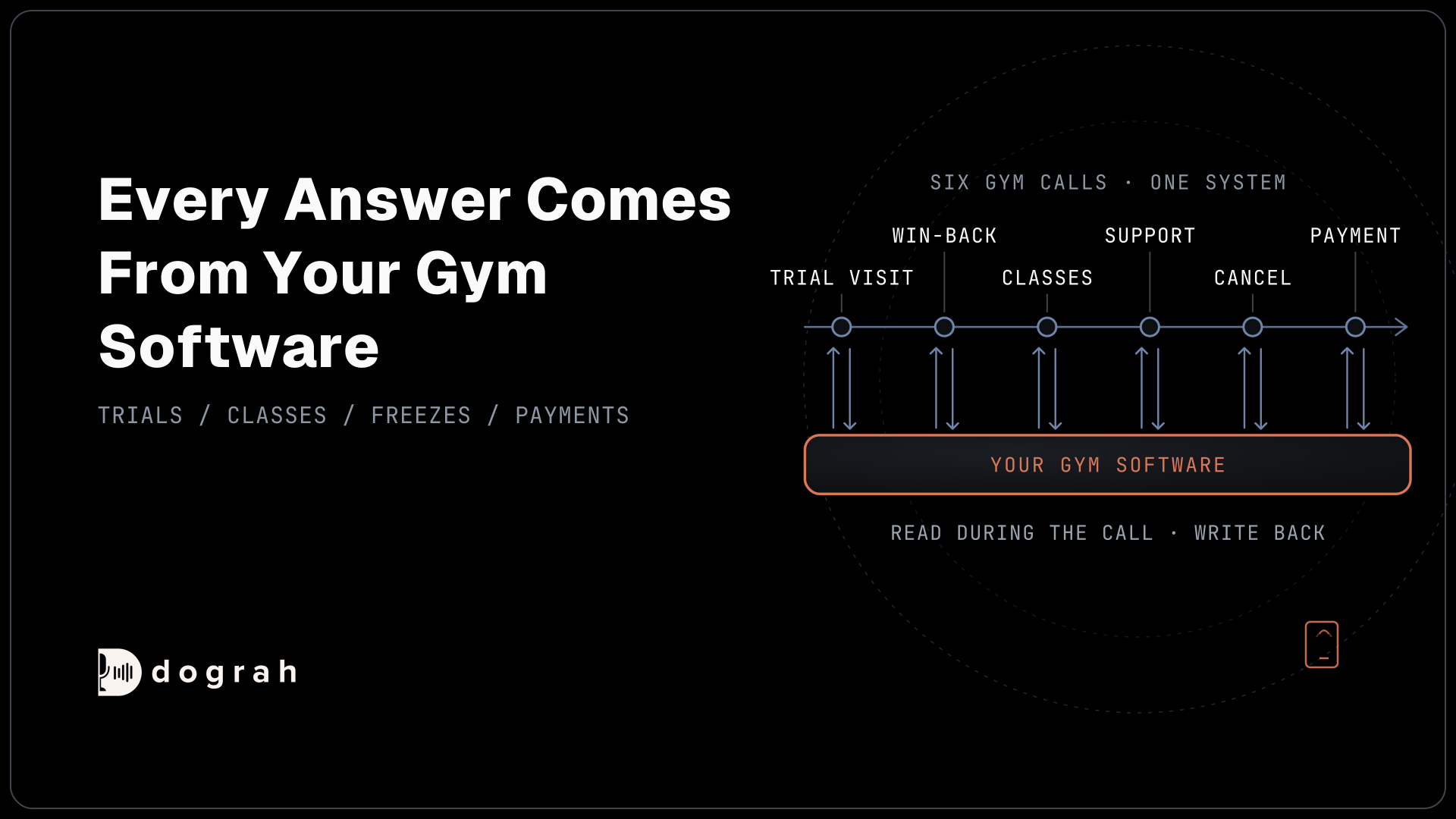

AI voice agents for gyms and fitness studios handle routine member calls: trial and tour booking, membership sales and win-back, class booking and reminders, member questions, freezes and cancellations, and missed payments. They read schedules, policies, bookings and balances from the gym management software during the call and write changes back. People keep disputes, refunds, hardship and medical questions.
Key Takeaways
- Every answer comes from your gym software or the club's own documents.
- Calls that sell or win back members generally need prior express written consent.
- The agent never stalls a cancellation and makes no save offer by default.
This guide follows a member from the first trial visit to the day they pause or leave, then sets out the rules for every call and how each one runs in Dograh, an open-source voice agent platform. You can self-host it or run it on Dograh Cloud.
What a gym's phone line hears
A gym's phone line carries calls from people who might join and from people who already pay every month. One number usually takes them all, so an agent has to handle both kinds of caller.
The member base is large and still growing. The Health & Fitness Association's 2026 consumer report, based on a yearly survey of about 18,000 US residents aged six and over, found that 81 million Americans belonged to a gym, studio or other fitness facility in 2025, up 5.2% from 2024. Those members made an estimated 7 billion visits, so even a small share of them calling the front desk is a heavy phone load.
An agent earns its place on calls with a clear answer that lives in the club's systems: which class has a spot, when a tour slot is free, what the freeze policy says, what a verified member owes. Persuasion, disputes, refunds and anything medical stay with people. For the same calls outside fitness, our playbook of AI voice agents by use case is the wider view.
Every answer comes from your gym software
During the call, an HTTP API tool asks your gym software for whatever the call needs: open class spots, tour slots, a member's plan or a failed payment. The agent offers only what comes back. When the caller agrees to something, a second HTTP API tool writes it: a booked trial, a class spot, a freeze request or a note for staff.
Dograh has no built-in integration with any gym management software. Every connection is an HTTP API tool, a Model Context Protocol (MCP) tool, the Webhook node, Pre-Call Data Fetch or the API Trigger, pointed at your gym management software's own API. Our guide to Integrating Voice Agents With Your Stack covers each route.
Written policies come from the club's own documents. Upload the membership terms, freeze and cancellation policy, class rules and opening hours to the Knowledge Base as PDF, DOCX, DOC, TXT, JSON or MD files, up to 5 MB each.
One agent can serve every location: several phone numbers can point at it, and Pre-Call Data Fetch, at the bottom of the Start Call node, receives the dialled number as to_number. Your endpoint returns that club's name, address, hours and class timetable, so the agent answers for the right location. The greeting waits for that fetch, and the caller hears ringing meanwhile.
Every call with a member runs greet, verify, then disclose. A phone number can find a membership, but it does not prove who is calling. Before the agent names a plan, a balance, a booking or a freeze date, it asks for the member's name to find the record, then an approved check such as date of birth or the last digits of the member number.
Transfer Call works on Twilio, Telnyx and Asterisk ARI. It passes no summary by default; on Twilio it can play a short spoken introduction to both people. Write the details to your system with an HTTP API tool before the transfer. If nobody answers, the caller stays with the agent; tell it in the prompt to offer a callback. Web calls cannot transfer.
Prospects: trial visits, tours and membership sales
Free trials and tours
The trial and tour call books a first visit from the slots your gym software returns. On an inbound call, the agent answers questions about the club from the Knowledge Base, offers the trial classes or tour times the system lists, and writes the booking back. A reminder before that booked visit is a service call.
The agent never signs anyone up to a trial that turns into a paid membership. The club's own sign-up captures the price, the cancellation terms, the member's signature and consent. It never reads out a door code or trial pass either. Your system sends those after its own check. Outbound calls to web leads go only to leads whose form carried written consent for AI calls, and your lead system can start them within minutes through the API Trigger. AI voice agents for free-trial and tour booking at gyms covers both paths.
Membership sales and win-back
The sales and win-back call is a marketing call, so it goes only to numbers with prior express written consent for AI calls on file. A past membership is not a consent record. The greeting names the club and says how to stop calls. Tell the agent in the prompt to ask why the person left before anything else, then make one offer read from the club's system, never one it invents.
A yes books a visit or goes to a salesperson, with the details written first. Signing up and paying stay off the call. A "stop" is written to the club's own list and the call ends. A member who cancels today is never offered a win-back in the same call. AI voice agents for gym membership sales and win-back covers the call.

Open Source Alternative to Vapi / Retell
Self-hosted voice agent platform — no per-minute fees
dograh-hq/dograh
Star on GitHub
Members on the schedule: class booking and reminders
When a member asks for the 6 p.m. spin class, an HTTP API tool checks the class in your gym software, and the agent offers the open spot, another time or the waitlist. Once the system confirms, the agent reads back the class, day, time and location.
Reminder calls go to members who booked. The member confirms the spot or gives it up, which frees it for the waitlist. A move to another class is written back the same way. Late-cancel and no-show fees are mentioned only as the club's written policy states them, from the Knowledge Base. A reminder like this is a service call. An offer, such as a discounted personal training pack, makes it a marketing call with a different consent rule.
Personal training sessions work the same way, with the trainer's calendar as the source of open times. AI voice agents for class booking and reminder calls covers waitlists, reminder calls, fees and retry-safe bookings.
Member questions: the support line
The member support call answers general questions from the club's own documents and account questions only after verification. Hours, holiday timetables, guest passes, locker rules and parking come from the Knowledge Base, per location. A member's plan, next billing date, freeze end date or class bookings are read live from the gym software once the member passes the check.
When the documents do not cover a question, tell the agent in the prompt to say so and offer a person, never to guess. Billing disputes, refund requests, complaints about staff or other members, and any question about an injury go to a person, with the details written to your system first.
A freeze or cancel request never stays on the support line. It moves straight to the cancellation flow in the next section. AI voice agents for gym member support calls shows the line.
Leaving and pausing: freeze and cancellation
The agent verifies the member, then asks whether they want to pause or cancel. The notice period, freeze length, freeze fee and final billing date come from the policy in the Knowledge Base or from the gym software. An HTTP API tool writes the request, and the agent reads back the effective date and confirmation number only after the system returns them. The written confirmation comes from the club's own system, because Dograh has no SMS tool.
By default the agent makes no save offer. Tell it in the prompt to process the request as soon as the member says "cancel", without arguing or asking twice. If the club wants one offer, it may come only after a fixed line telling the member they can say "cancel" at any time. That line plays as Transition Speech, as text or a recorded clip, so the words never drift. Text lines do not play on speech-to-speech models, so use a clip there. The agent makes one offer at most, read from the club's system, and one "cancel" ends it.
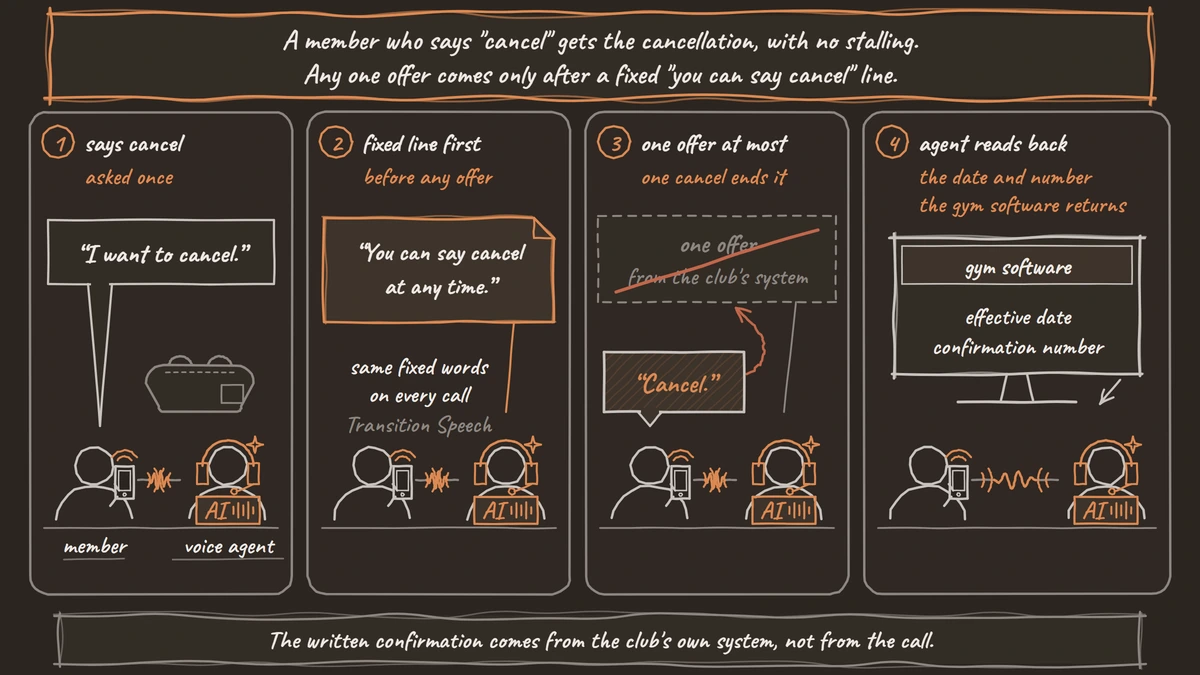
California shows why. Its automatic renewal law, Business and Professions Code section 17602, says a business that takes cancellations by toll-free number "shall answer calls promptly during normal business hours and shall not obstruct or delay the consumer's ability to cancel". It allows an offer on a phone cancellation only after the business tells the consumer "they may complete the cancellation process at any time by stating that they want to "cancel"". Many states have similar automatic renewal laws, and the details differ. This is general information, not legal advice; confirm your position with counsel.
Medical freezes, hardship, disputes and refund requests go to a person, with the details written first. If the write fails, tell the agent in the prompt to say the request is recorded and staff will confirm it. A Webhook node then sends the request to your system after the call and retries temporary failures automatically. AI voice agents for membership freeze and cancellation requests covers the flow.
Join the Dograh Community
Dograh is an OSS alternative to Vapi. Join our Slack community for queries, releases, best practices & community interactions.
Money: missed membership payment reminders
The missed payment call goes out only after the billing system's own retries and messages have failed, and it never takes a card number.
The greeting names the club. The agent verifies the member, then says the monthly payment did not go through and reads the amount your billing system returns. If the member wants to fix it, an HTTP API tool asks the billing system or payment provider to send its own secure payment link by text or email. Dograh has no keypad (DTMF) tool and no feature for taking payments on a call. Tell the agent in the prompt to stop any member who starts reading one.
A member who says "cancel" on this call is passed to the cancellation flow at once, never argued with, and the payment call never offers a save deal. Hardship and disputes go to a person. AI voice agents for missed membership payment reminders covers the call.
Rules that apply to every gym call
This section is general information, not legal advice.
Outbound calls with an AI voice need consent. In its February 2024 declaratory ruling, the Federal Communications Commission (FCC) confirmed that "the TCPA's restrictions on the use of "artificial or prerecorded voice" encompass current AI technologies that generate human voices." A class reminder or payment notice is generally a service call that needs prior express consent, which the membership agreement can record.
An offer turns the call into marketing. Under 47 CFR 64.1200(a)(2), a call to a mobile number that "includes or introduces an advertisement or constitutes telemarketing" with an artificial voice is barred "other than a call made with the prior express written consent of the called party". So any call that sells, whether a trial invitation or a win-back offer, generally needs written consent on file before the phone rings. Our post on which restaurant calls need consent walks through the same split. Confirm your position with counsel.
Opt-outs live in your system. Dograh keeps no do-not-call list. When a caller opts out, an HTTP API tool writes it to your own list, and you remove those numbers before the next campaign upload. The do_not_call call tag records the request but never blocks a later call. To stop calling someone mid-campaign, pause the campaign and start a new one from a corrected list. For lists that change daily, start calls from your own system with the API Trigger.
Campaign calling hours run in one time zone per campaign, so a chain with clubs in several time zones splits its list by zone. If you want to tell callers they're speaking with an automated assistant, or your location requires it by law, write it in the Greeting Text along with the club's name.
Tell the agent in the prompt to give no medical, injury or training advice and to offer a trainer or staff member instead. If a caller describes a medical emergency, an emergency pathway plays one fixed line as Transition Speech (a recorded clip on speech-to-speech models): hang up and call 911 (999 in the UK). Recordings and transcripts keep whatever is said, so the call never asks for a full account, card or Social Security number; use a short check such as the last four digits, and send payment links by text or email from your own system.
Which gym call to hand over first
Start with inbound member support and class booking, because they read before they write and raise no outbound consent questions. Trial and tour booking comes next, then freezes and cancellations once the policy documents and the fixed line are tested. Payment reminders and sales or win-back campaigns come last, once consent is recorded in your own system.
Put the agent on a real phone number before any member hears it: most phone calls reach the agent as 8 kHz audio, while a browser test runs at 16 kHz. Testing Voice Agents Before You Go Live sets the order. Once live, run quality assurance (QA) on a random 5 to 10% sample of calls and fix what the transcripts show. For one agent answering every call at the front desk, The Ultimate Guide to AI Receptionists covers that set-up.
Self-hosting keeps member recordings and transcripts on your own servers. Dograh is the orchestration layer: it runs the call flow, tools and telephony, and the speech and language models are a separate layer you choose. The call audio stays in-house only when the speech and language models run on your own servers too. Self-hosted Dograh has no per-minute platform fee (servers, model keys and phone minutes still cost); Dograh Cloud has a 1¢-a-minute platform fee.
Each call above has its own deep dive:
- AI Voice Agents for Free-Trial and Tour Booking at Gyms
- AI Voice Agents for Gym Membership Sales & Win-Back
- AI Voice Agents for Class Booking & Reminder Calls
- AI Voice Agents for Gym Member Support Calls
- AI Voice Agents for Membership Freeze and Cancellation Requests
- AI Voice Agents for Missed Membership Payment Reminders
Glossary
- Gym management software
- The system a club runs on: memberships, class timetables, bookings and billing. The voice agent reads from it and writes to it during the call through its API, so the agent never keeps its own copy.
- Prior express written consent
- A signed written agreement, given before the call, that authorizes a business to send marketing calls with an artificial voice to a named phone number. Calls that sell a membership or win back a former member generally need it.
- Membership freeze
- A pause on a membership for a set period, on the terms in the club's written policy, such as length, fee and notice. The agent records the request and reads back the dates the gym software returns.
- Save offer
- A discount or other benefit offered to a member who asked to cancel. The agent makes none by default; a club that wants one allows at most one, after a fixed line saying the member can say cancel at any time.