
AI voice agents for gym member support calls answer general questions, such as opening hours, guest passes and the freeze policy, from the club's own documents. Account questions, such as a billing date or booked classes, get an answer only after the member passes an identity check. Disputes, refunds, complaints and injury questions go to a person.
Key Takeaways
- Hours and policies come from your own documents in the Knowledge Base.
- Account details wait until the member passes an approved identity check.
- A freeze or cancel request leaves the support line at once.
This post is part of our guide to AI voice agents for gyms and fitness studios. The guide's section "Member questions: the support line" sums up this call in one line: it "answers general questions from the club's own documents and account questions only after verification." Here is that line in full, run in Dograh, an open-source, self-hostable voice agent platform.
What a gym support line answers, and from where
A member support line takes two kinds of question, and each one has its own source. General questions come from the club's documents. Questions about the caller's own membership come from the gym management software, and only after the caller proves who they are.
The volume behind this is large. The Health & Fitness Association's 2026 consumer report, based on a survey of about 18,000 US residents, counted 81 million Americans with a gym, studio or other fitness membership in 2025, making an estimated 7 billion visits. Most of what those members ring about has a written answer somewhere, such as the holiday timetable, the guest pass rule, where to park or how a freeze works.
A member who calls should get that answer in one turn, by asking in their own words, with no keypad menu in the way. Anything without a written answer, or anything that needs judgement, goes to a person. The sections below draw that line call by call.
General questions come from your own documents
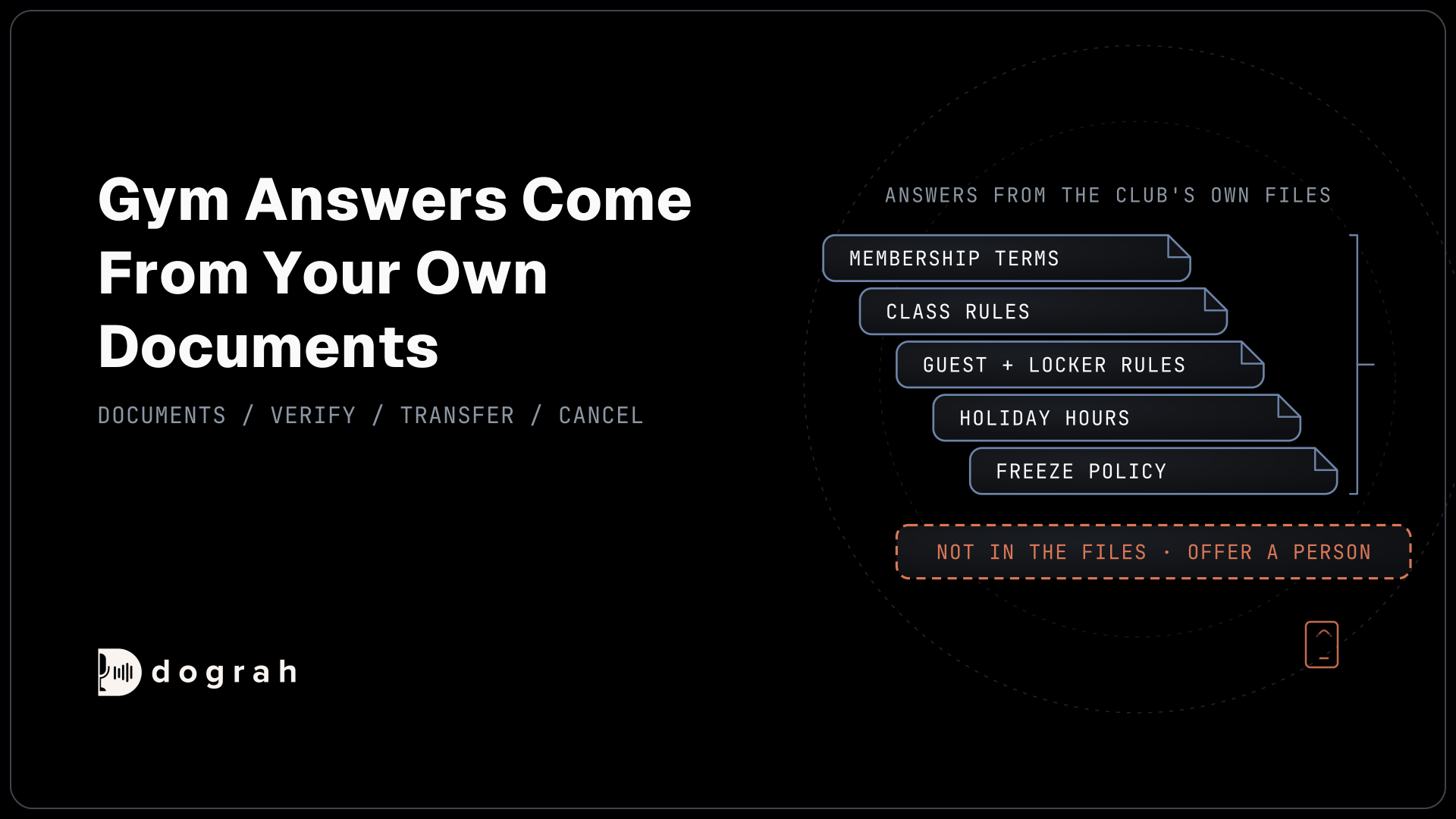
The agent answers general questions from files you upload, so its words match what your front desk would say.
Upload the membership terms, class descriptions, guest and locker rules, holiday hours and the freeze and cancellation policy to the Knowledge Base, under "Files" in Dograh (page heading "Knowledge Base Files"). It accepts PDF, DOCX, DOC, TXT, JSON and MD files, up to 5 MB each. Then select those files on the agent's node under "Knowledge Base Documents".
There are two search modes. Full Document needs no embedding key, which makes it the simpler start for a short policy sheet. Chunked Search finds the relevant passage in a long handbook and needs an embedding key. It works like retrieval-augmented generation, where the model answers from the passage it found.
Tell the agent in the prompt to answer only from those documents, and when they do not cover a question, to say so and offer a person instead of guessing.
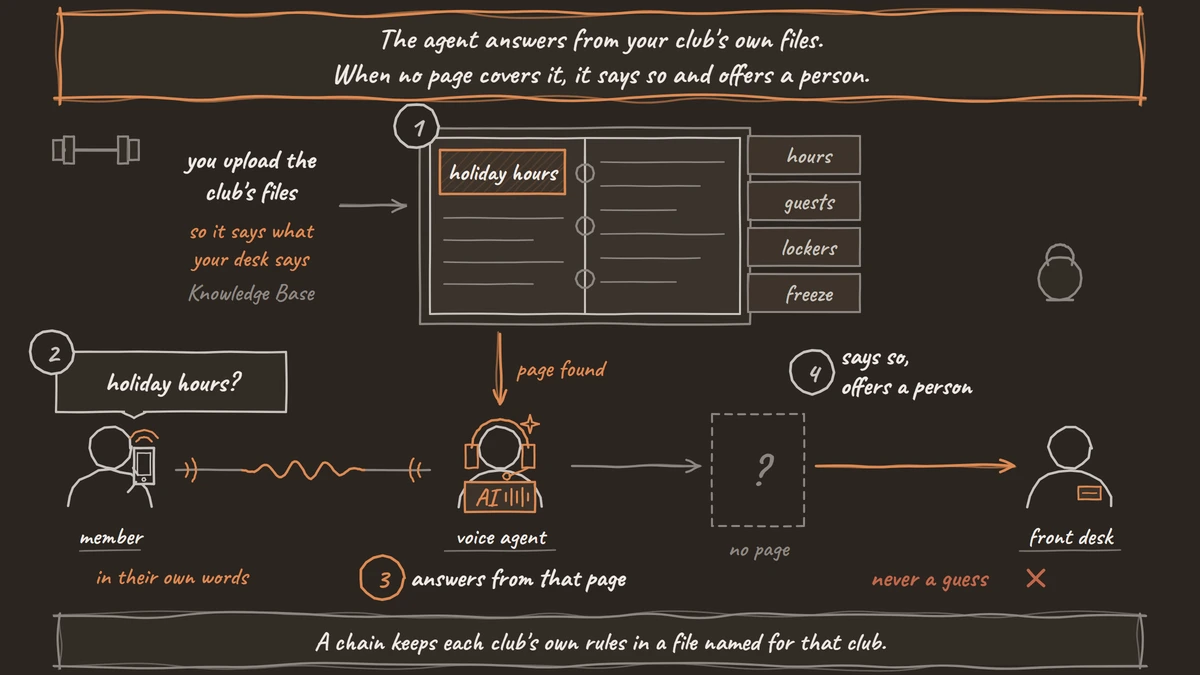
A chain with several clubs can run one agent. Several phone numbers can point at the same agent, and Pre-Call Data Fetch, at the bottom of the Start Call node, receives the dialled number as to_number. Your endpoint returns that club's name, address and today's hours, so a holiday closure your system already knows about reaches the agent too. Keep each club's own rules in a file named for that club, and tell the agent in the prompt to answer from the file for the club it is serving.

Open Source Alternative to Vapi / Retell
Self-hosted voice agent platform — no per-minute fees
dograh-hq/dograh
Star on GitHub
Account questions wait for the identity check
Anything about the caller's own membership waits until the agent knows who is calling. The greeting names the club. If you want to tell callers they're speaking with an automated assistant, or your location requires it by law, write it in the Greeting Text along with the club's name. The caller's number can find a membership, but it does not prove who is calling, and family members often share a phone. So the agent asks for the member's name to find the record, then an approved check, such as date of birth or the last digits of the member number.
Only after that check does an HTTP API tool read the member's plan, next billing date, freeze end date or booked classes from the gym management software. Dograh has no built-in integration with any gym software, so the tool calls your system's own API. If the check fails, the agent answers general questions only and offers a callback from staff.
Recordings and transcripts keep whatever is said, so the call never asks for a full account, card or Social Security number; use a short check such as the last four digits, and send payment links by text or email from your own system. A member who wants to update a card gets the billing system's own secure link, which another HTTP API tool can request during the call.
Disputes, refunds and injuries go to a person
Some questions have no written answer, and some need a person even when they do.
Billing disputes, refund requests, complaints about staff or other members, and any question about an injury or a medical condition go to a person. Tell the agent in the prompt to give no medical, injury or training advice and to offer a trainer or staff member instead. Write the details to your system with an HTTP API tool before the transfer: the member, the reason and what was said, so staff do not ask again.
Transfer Call then hands the caller over. Transfer Call works on Twilio, Telnyx and Asterisk ARI. It passes no summary by default; on Twilio it can play a short spoken introduction to both people. If nobody answers, the caller stays with the agent; tell it in the prompt to offer a callback. Web calls cannot transfer, so test this on a real phone line.
Emergencies get a fixed line. If a caller describes a medical emergency, an emergency pathway plays one line as Transition Speech: hang up and call 911 (999 in the UK). If a caller reports a fire or a gas smell at the club, the line tells them to get to safety and call 911. Transition Speech plays fixed text or a recorded clip, so the words never drift (on speech-to-speech models only the clip plays), but choosing the pathway is the model reading its written condition, so test it with real emergency phrasing. Our post on patient support lines runs the same pattern for clinics.
Freeze, cancel and class requests move on at once
Some requests sound like support questions but belong to another part of the workflow.
A member who asks to freeze or cancel is moved straight into the cancellation part of the workflow through a pathway, with no debate on the support line. California's automatic renewal law, Business and Professions Code section 17602, says a business that takes cancellations by toll-free number "shall not obstruct or delay the consumer's ability to cancel". A support agent that keeps answering other questions instead is a delay. This is general information, not legal advice; confirm your position with counsel.
That flow, with its rule on save offers, is covered in AI voice agents for membership freeze and cancellation requests. A member who wants a class is handed to class booking, which books only spots the timetable returns; AI voice agents for class booking and reminder calls covers that call.
Start with the documents, then test. Run calls in the browser first and then on a real phone number, because most phone calls reach the agent as 8 kHz audio while a browser test runs at 16 kHz. The same documents-first line serves apartment communities in our post on resident support.
Self-hosting keeps member recordings and transcripts on your own servers. Dograh is the orchestration layer: it runs the call flow, tools and telephony, and the speech and language models are a separate layer you choose. The call audio stays in-house only when the speech and language models run on your own servers too. Self-hosted Dograh has no per-minute platform fee (servers, model keys and phone minutes still cost); Dograh Cloud has a 1¢-a-minute platform fee.
Join the Dograh Community
Dograh is an OSS alternative to Vapi. Join our Slack community for queries, releases, best practices & community interactions.
Glossary
- Knowledge Base Documents
- The files selected on an agent's node in Dograh, such as membership terms and holiday hours, uploaded under Files. The agent answers general questions from them, and says so when they do not cover a question.
- Chunked Search
- A Knowledge Base search mode that finds the relevant passage in a long document before the model answers. It needs an embedding key; Full Document, the other mode, does not.
- Approved identity check
- A question only the member should be able to answer, such as date of birth or the last digits of the member number, asked after the name finds the record. Account details are shared only once it passes.
- Transition Speech
- Fixed text or a recorded clip that plays when the agent takes a pathway, such as the emergency line. The words never change, though choosing the pathway is still the model reading its condition.