
AI voice agents for automotive lead qualification answer the sales line and call back web leads. They ask every buyer the same questions about the vehicle, timeline, trade-in and payment, record the answers in the dealer's CRM and quote no prices. Ready buyers go to the right sales desk with notes written first, or get a callback booked.
Key Takeaways
- Ask about vehicle, timeline, trade-in and payment. Quote no price or trade value.
- Write the notes to the CRM before the transfer reaches the sales desk.
- Call a bought lead only when its form's consent covers your dealership.
Dealership web leads get answered quickly now, then stall at the handover to a salesperson. We cover the buyer questions in Dograh, why no prices or trade values are spoken, routing hot leads to the right desk and consent by lead source. It is one use case in our guide to AI outbound sales calls.
Where dealer leads stall
Dealers answer web leads faster than ever, and the leads now get lost later, at the handover to a person. Auto Remarketing's report on Pied Piper's 2026 internet lead study, which mystery-shopped 3,290 dealerships, found phone calls in 75% of dealer responses. But when an inquiry needed a person, the score dropped nine points, and the shopper was twice as likely to get no personal response. "Teams assume automation is working and that someone will step in if it fails," said Cameron O'Hagan of Pied Piper. "Too often, no one does."
Most buyers still finish at the store. Cox Automotive's Car Buyer Journey study found that 53% of buyers did every step of the purchase in person at the dealership, while 19% used AI tools while shopping. So a qualifying call has a narrow job. It gets a ready buyer to a salesperson or a visit, and it does not try to sell the car.
Our guide to AI voice agents for automotive and dealerships covers the service side of the phone line. This post stays with sales leads.
The questions, recorded as the buyer says them
The agent asks every lead the same short set of questions, whatever site or form it came from. When a web lead arrives, your CRM or lead router starts the call through the API Trigger and passes the vehicle the buyer looked at and where the lead came from. The agent opens by naming that car, so the buyer knows why you are calling.
Then it works through the dealer's questions. It asks whether the buyer wants the new or used model and which trim, and how soon they want to drive it home. It asks whether there is a trade-in, with its make, model and rough mileage, and whether they will pay cash, finance or lease. Keep it to those, because each extra question is one more chance for the buyer to drop off.
Each answer becomes an extracted variable that the agent records as the buyer stated it. Because a model fills those variables, the transcript and recording remain the word-for-word account of what the buyer said. Add your model names, trims and package codes to the Dictionary in the agent's Settings so the speech model hears them right. AI voice agents for lead qualification covers the general pattern for any business. A dealership adds the trade-in and the desk.

Open Source Alternative to Vapi / Retell
Self-hosted voice agent platform — no per-minute fees
dograh-hq/dograh
Star on GitHub
No prices or trade values on the call
The agent never quotes a price, a monthly payment, a rate or a trade-in value. Those numbers depend on the buyer's credit and the trade's condition, and a figure spoken by an AI on a call is one the desk then has to defend. Tell the agent in the prompt to record money questions as the buyer asked them and say a salesperson will answer them.
The trade-in works the same way. The agent records the car as the buyer describes it, and the salesperson puts a number on it after seeing it. Credit questions stop at "cash, finance or lease". A credit application never happens by voice, so the agent never asks for a Social Security number or income. AI voice agents for test-drive scheduling applies the same rule to buyers who want to book a drive.
Handing a hot lead to the right desk
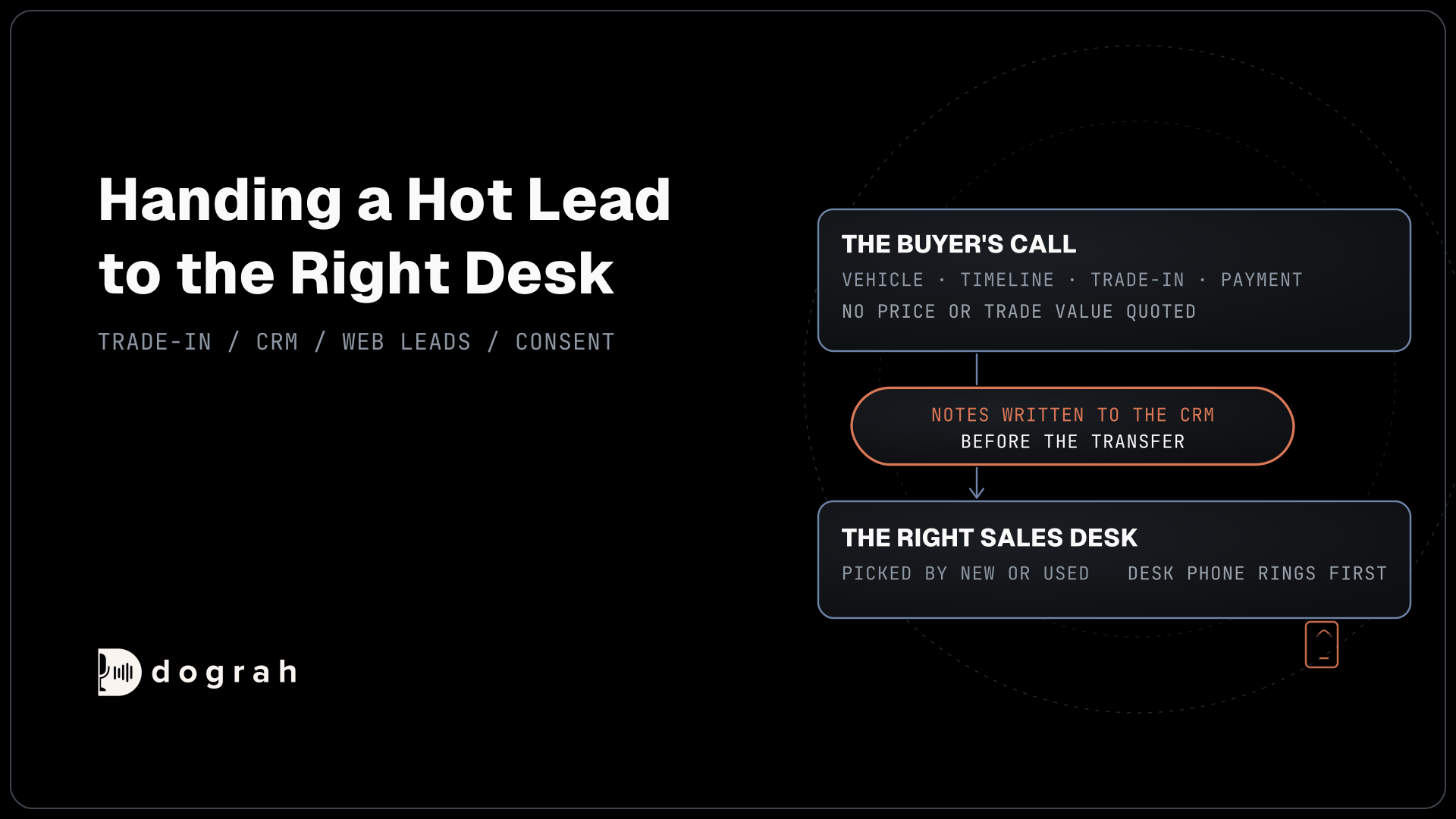
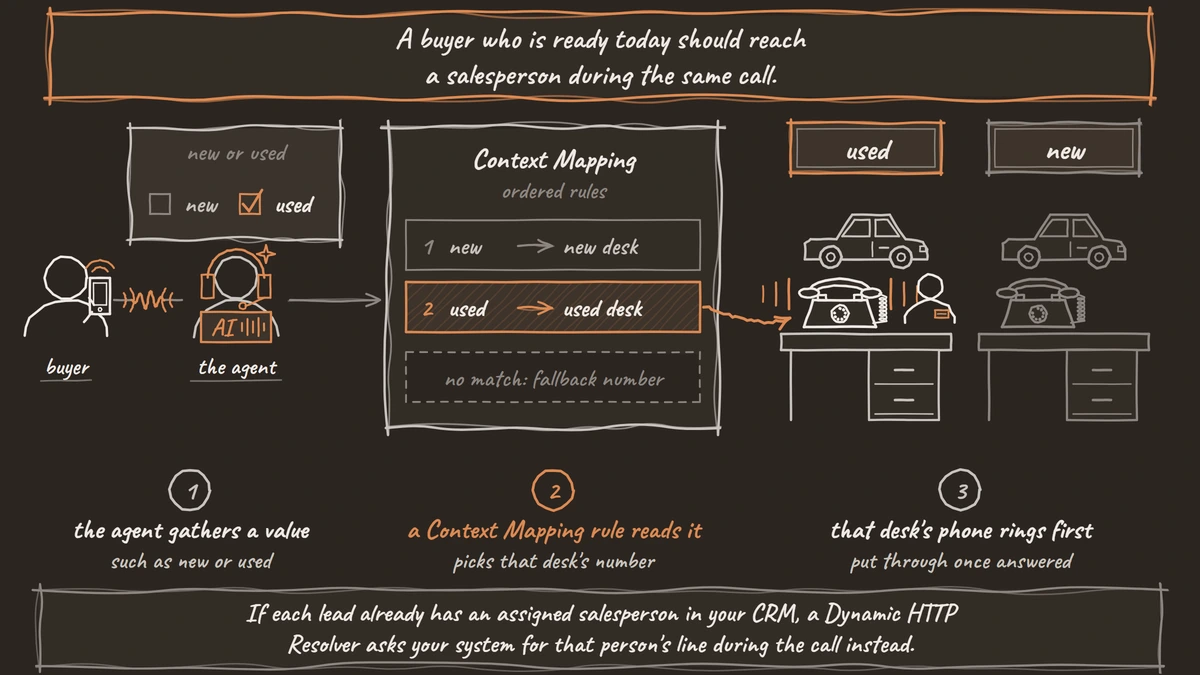
A buyer who is ready today should reach a salesperson during the same call. Transfer Call works on Twilio, Telnyx, Plivo, Cloudonix and Asterisk ARI. The desk phone rings first, and the buyer is put through only once a salesperson answers. On a Twilio number, a short spoken introduction can play to the salesperson and the buyer together just before they connect.
The right desk depends on the answers. A Context Mapping rule reads a value the agent gathered, such as new or used, and picks that desk's number, with a fallback number if nothing matches. If each lead already has an assigned salesperson in your CRM, a Dynamic HTTP Resolver asks your system for that person's line during the call instead.
The salesperson gets no call summary by default, so before the transfer an HTTP API tool writes the buyer's answers to the CRM, and the salesperson opens the lead already knowing the car and the trade-in. This is the step Pied Piper found breaking, and it is the one to test hardest.
If nobody picks up within the 30-second default, the buyer stays with the agent. Tell it in the prompt to offer a callback at a time the buyer picks and write that request to the CRM. A buyer who is just browsing gets logged for a later follow-up, with every answer kept.
Join the Dograh Community
Dograh is an OSS alternative to Vapi. Join our Slack community for queries, releases, best practices & community interactions.
Consent for web, phone and bought leads
Each lead source carries its own consent, so check it before the first dial. A buyer who calls your sales line started the call, and the agent's questions need no TCPA consent. Calls the dealership places are a different matter, because the FCC's 2024 ruling on AI-generated voices classes an AI voice as an artificial voice under the Telephone Consumer Protection Act (TCPA).
A callback to a web lead is a sales call you place. Under the FCC's calling rules, an AI-voice sales call to a mobile generally needs prior express written consent. That is a signed agreement, on the form itself, that names your dealership and the number. Leads bought from marketplaces or sent by a manufacturer's portal are harder. The form the buyer filled in must cover a call from your dealership, so read its wording and check it with counsel before those leads reach the API Trigger.
The greeting names the dealership, and a buyer who says stop is written to your own do-not-call list through an HTTP API tool before the call ends. Sales calls also stay between 8 a.m. and 9 p.m. in the buyer's time zone.
Start with the sales line
Start with inbound calls to the sales line, where consent is simplest and the buyer already wants to talk. Add callbacks to leads from your own website next, once the form's consent wording is clean. Bought and portal leads come last.
Before launch, run test calls on a real phone line. Only a real call can exercise a transfer, and the transfer to the desk is the part that has to work every time.
Glossary
- Third-party lead
- A buyer inquiry the dealership did not collect itself, such as one bought from a car marketplace or passed on by a manufacturer's portal. Its consent depends on what the original form said.
- Context Mapping
- A Call Transfer setting in Dograh that picks the destination from a value gathered on the call, such as new or used, checking ordered rules and using the first match.
- Dynamic HTTP Resolver
- A Call Transfer setting in Dograh that asks your own system for the destination during the call, such as the line of the salesperson assigned to that lead.
- Prior express written consent
- A signed agreement, electronic signatures included, that allows sales calls with an artificial voice to a named number. A callback to a web lead generally needs it on the form.