
An AI sales agent is a voice agent that does the phone work around a sale. It qualifies leads, follows up the ones reps never reach, books meetings into a rep's calendar and hands ready buyers to a rep. Its value rests on the handover, so the rep should pick up knowing what the buyer wants.
Key Takeaways
- A voice sales agent qualifies, follows up, books and hands over.
- Write the buyer's answers to your CRM before the transfer starts.
- Closing, pricing exceptions and relationships stay with your reps.
Most tools sold as AI sales agents write emails, yet much of selling happens on the phone. We go through the four phone jobs a voice sales agent does in Dograh, from qualifying and follow-up to booking and the handover, plus what stays with reps. It belongs to our guide to AI outbound sales calls.
What an AI sales agent does
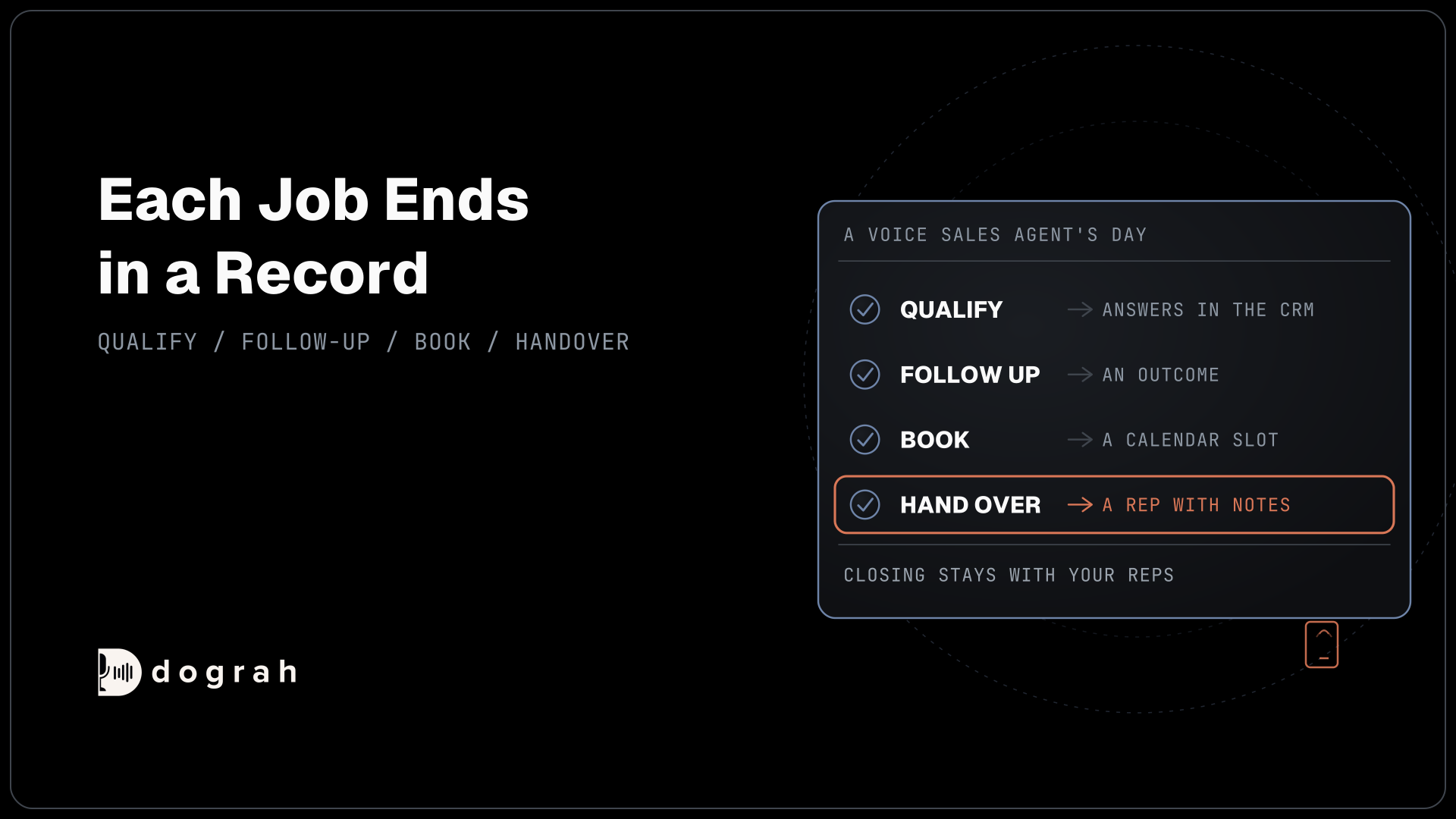
Most tools sold as AI sales agents write emails. A voice sales agent works the phone, and its day splits into four jobs, which are qualifying a lead, following up the leads nobody called back, booking a meeting, and handing a ready buyer to a rep.
Each job ends in a record your team can act on. A lead gets answers in the CRM, a follow-up gets an outcome, a meeting gets a calendar slot, and a handover gets a rep on the line with notes in front of them. An agent that talks well but leaves no record has done half the job.
In Dograh, each job is a part of one agent, with pathways and extracted answers for qualifying, campaigns and triggers for follow-up, tools for booking, and Transfer Call for the handover. You can self-host it or run it on Dograh Cloud.
Qualifying a lead on the phone
Qualifying is a short, fixed set of questions asked the same way to every lead, such as what they need and when they need it. Keep the set small, since the prospect did not plan their day around your call.
Write the questions in the Agent Node's prompt, then turn on Enable Variable Extraction and list each answer under Variables to Extract, such as timeline and budget_range. The agent records each answer as the person said it, and those values can travel to your CRM after the call. Edges out of the node send the call down a path based on a written condition, such as "the person has a project in the next three months". Choosing the path is the model reading that condition, so test it on real calls.
Tell the agent in the prompt never to quote a price or discount your system did not give it. Our guide to AI voice agents for lead qualification covers the question set in depth.

Open Source Alternative to Vapi / Retell
Self-hosted voice agent platform — no per-minute fees
dograh-hq/dograh
Star on GitHub
Following up the leads reps never reach
Follow-up is where an agent saves the most rep time, because reaching a person takes several tries. Belkins' cold calling benchmarks, from more than 175,000 dials its reps logged in 2025, found that 24.5% of prospects picked up over an average of three attempts. Few reps make the third call. An agent makes it every time you tell it to.
Two settings drive follow-up in Dograh. For a list, a campaign retries on a busy signal, no answer or voicemail, with Max Retries and Retry Delay you set, inside the calling hours you choose. For a fresh lead, an API Trigger node gives the agent a URL your CRM or form tool can call with the lead's phone number, so the agent rings while the lead still remembers asking.
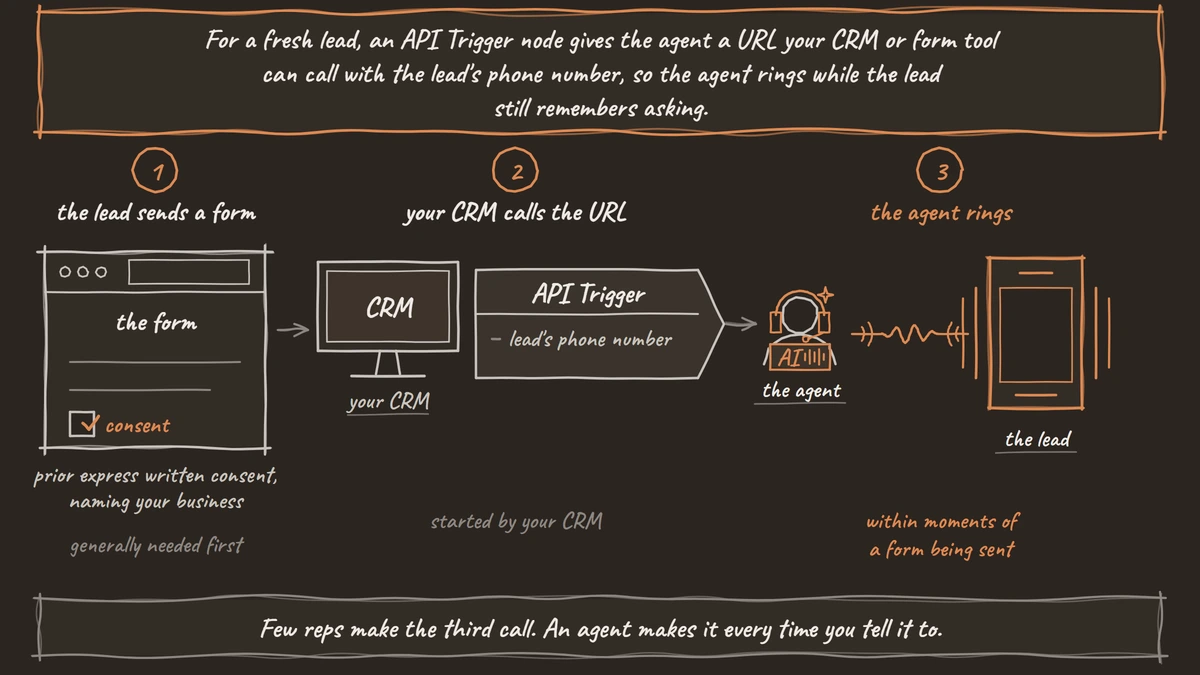
Consent comes first on both. Under the Telephone Consumer Protection Act (TCPA), the FCC's ruling on AI-generated voices makes an AI voice an artificial voice. So before your agent follows up a lead on a mobile or home line, you generally need that lead's prior express written consent, naming your business. Build that wording into the form, and check it with counsel before the agent calls anyone.
Booking the meeting into a rep's calendar
A meeting booked on the call beats a promise to send a link. Dograh connects to your own calendar through an HTTP API tool, so the agent checks open slots, offers two, and books the one the buyer picks.
Calendar lookups take a moment. In the tool's Messages card, add a line under When the tool starts, typed or as a recorded clip, such as "Let me check the calendar". The tool waits 5 seconds by default before giving up, so raise Timeout (ms) if your calendar is slow.
To keep a retried request from booking twice, add the call's ID under Preset Parameters, with the value {{initial_context.workflow_run_id}}. Your calendar system can then ignore a second request with the same ID. Tell the agent in the prompt to read the booked time back to the buyer before ending. AI voice agents for appointment and demo booking walks through the booking flow in full.
Handing the buyer to a rep
The handover is where an AI sales agent earns its keep or wastes a good lead. A buyer who asks for a person should reach one who already knows what they want.
Attach the Transfer Call tool to the agent with your rep's number. Dograh rings the rep first and brings the buyer onto the line only after the rep answers. With a Twilio number, the agent can also introduce the buyer to the rep out loud before the two are joined. No summary goes across by default, so tell the agent in the prompt to call an HTTP API tool that writes the buyer's answers to your CRM first. Our post on extracting call data to your CRM covers that write in detail.
When no rep answers within the Transfer Timeout, the buyer stays with the agent. Tell it to offer a callback at a time the buyer picks, and write that request to your CRM so a rep calls back.
After every call, a disposition code records the outcome, such as qualified, callback or do_not_call. Send it to your CRM, so reps see which leads are ready and opted-out numbers leave the next list.
Join the Dograh Community
Dograh is an OSS alternative to Vapi. Join our Slack community for queries, releases, best practices & community interactions.
What stays with your reps
An AI sales agent takes the calls a rep would rather not make, such as the third follow-up or the after-hours callback. It should not close. Pricing exceptions, negotiation, contracts and the relationship after the first meeting stay with people.
Measure the agent by its handovers. Count the transfers that reach a rep and the booked meetings that actually happen, then ask reps whether the notes were right. If those numbers are weak, fix the questions and the CRM write before you add more calls.
Glossary
- AI sales agent
- Software that does sales work on its own. A voice sales agent qualifies leads, follows up, books meetings and transfers ready buyers to a rep over the phone.
- Speed to lead
- How quickly a business contacts a lead after the lead asks to be contacted. An agent started by your CRM can call within moments of a form being sent.
- Variable extraction
- A step where the agent pulls named answers, such as a timeline or a budget range, out of the conversation so they can be stored and sent to a CRM.
- Call disposition
- One outcome code per call, such as qualified, callback or do_not_call, picked from your own list after the call ends.