
LiveKit Cloud's Build plan is free with 1,000 agent session minutes, Ship costs $50 a month with 5,000 and Scale $500 with 50,000, then $0.01 a minute. Models and phone minutes bill on top. Self-hosting LiveKit drops the plan fee but adds servers. Dograh is open source too, with a visual builder, on your servers or Dograh Cloud.
Key Takeaways
- Every paid LiveKit Cloud plan charges $0.01 per agent minute past its allowance.
- Models, phone minutes and numbers bill on top of the plan fee.
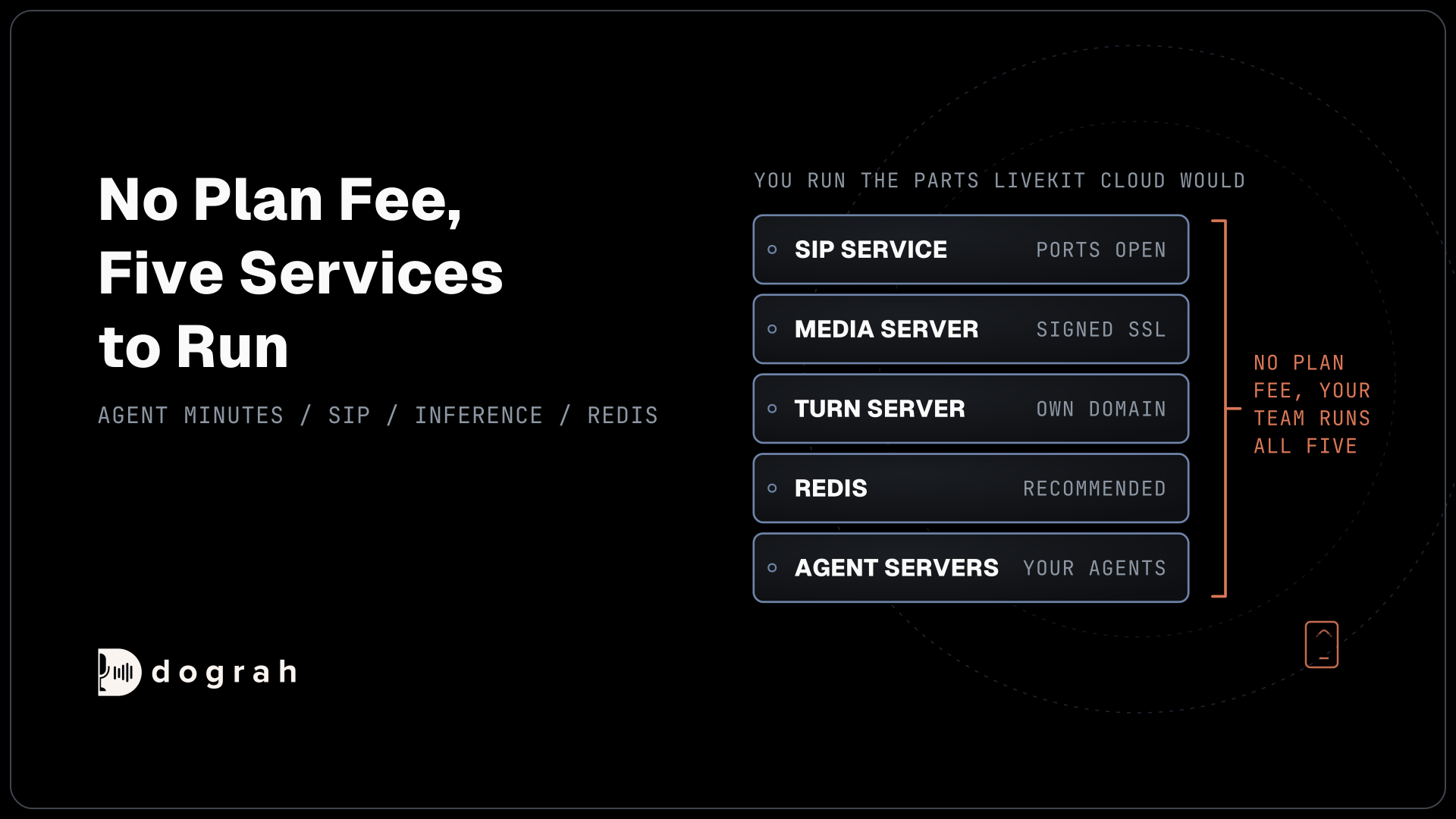
- Self-hosting LiveKit drops the plan fee, and your team runs five services.
A LiveKit bill has more lines than the plan fee. We go through the three Cloud plans, the two meters, a worked month on Ship, what self-hosting costs and how the cost lines in Dograh compare. For other options, see our guide to open-source voice AI platforms.
LiveKit Cloud plans at a glance
LiveKit Cloud sells three self-serve plans, and each one includes a block of agent session minutes. LiveKit's pricing page lists them like this:
| Plan | Monthly price | Agent session minutes included | Concurrent agent sessions | After the allowance |
|---|---|---|---|---|
| Build | $0 | 1,000 | 5 | No overage listed |
| Ship | $50 | 5,000 | 20 | $0.01 a minute |
| Scale | $500 | 50,000 | Up to 600 | $0.01 a minute |
| Enterprise | Custom | Custom | Custom | Custom |
Build is for testing. It lists no overage rate, so treat its 1,000 minutes as a ceiling. Ship is where most small phone agents start, and Scale is the plan for volume and for buyers with a security review.
Scale also adds SOC 2 Type II reports, and its plan card lists HIPAA among its features. If your calls carry patient data, confirm the signed business associate agreement (BAA) with LiveKit before you sign up. Every plan lists a 99.99% uptime target.
Agent minutes and WebRTC minutes
LiveKit Cloud runs two meters, and a phone agent mostly uses one of them. Agent session minutes count the time your agent spends connected to a session. WebRTC participant minutes count each person connected to a room through a browser or an app.
A phone caller reaches the agent through SIP, the protocol phone carriers use for internet calls, not through a browser. So a phone agent's bill is agent session minutes plus phone minutes. Participant minutes matter when people talk to your agent from a web page or a mobile app.
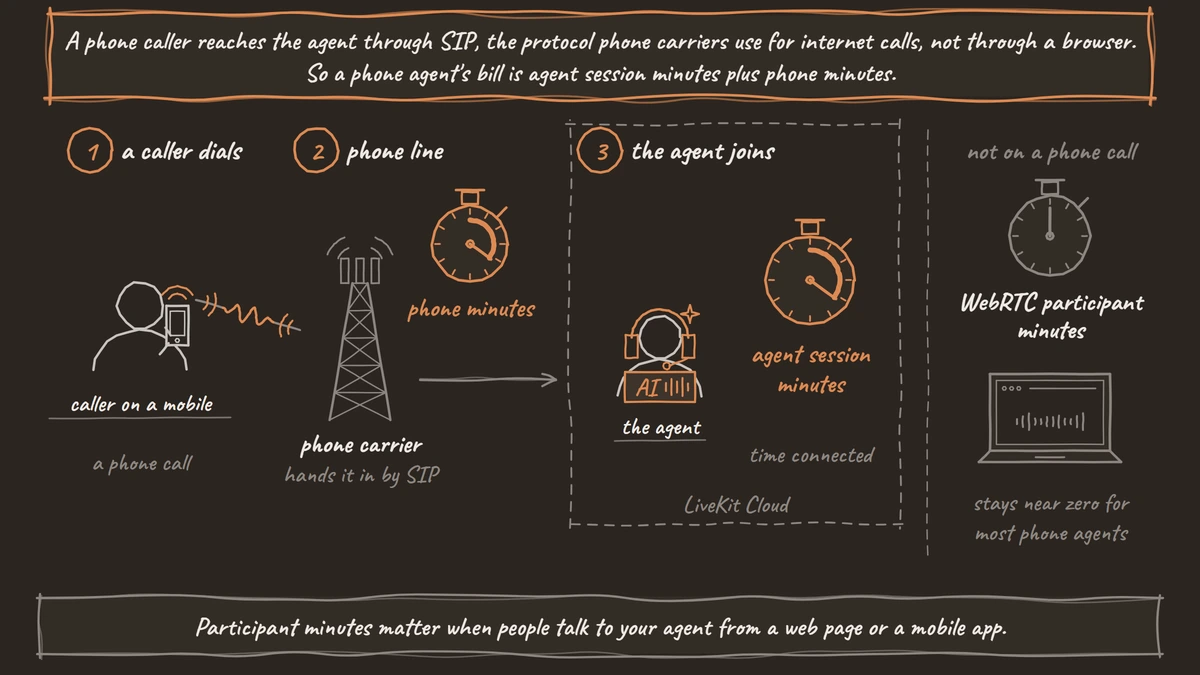
Each plan includes plenty of them, with 5,000 on Build, 150,000 on Ship and 1.5 million on Scale. Past that, Ship charges $0.0005 a minute and Scale $0.0004. For most phone agents, this meter stays near zero.
Models, phone numbers and other extras
The agent minute pays for LiveKit's side of the call. The speech and language models bill separately, either through LiveKit Inference or on your own provider keys.
LiveKit Inference puts the models on your LiveKit bill at LiveKit's own prices. Deepgram Nova-3 speech-to-text is $0.0048 a minute on Build and Ship, and $0.0042 on Scale. Cartesia Sonic 3 voices are $50 per million characters, or $37.50 on Scale. GPT-4.1 mini is $0.40 per million input tokens and $1.60 per million output tokens. Plans include a small Inference credit: $2.50 on Build, $5 on Ship and $50 on Scale. Our post on BYOK vs managed models covers when your own keys make more sense.
Phone numbers and minutes come next. LiveKit Cloud includes one free US local number, then $1.00 a month each. Toll-free numbers cost $2.00 a month and $0.02 a minute. Ship includes 100 local inbound minutes and Scale 1,000, then $0.01 a minute.
You can bring your own carrier through a SIP trunk instead. Ship includes 5,000 third-party SIP minutes and Scale 50,000, then $0.004 and $0.003 a minute, and your carrier bills its own rate on top. Telephony 101 for voice AI explains how numbers and trunks fit together.
Smaller lines sit beside those. Session recordings cost $0.005 a minute past the plan allowance, and downstream data costs $0.12 per GB on Ship and $0.10 on Scale past 250 GB and 3 TB. LiveKit's simulated test calls cost $0.02 a turn for text and $0.05 for audio.

Open Source Alternative to Vapi / Retell
Self-hosted voice agent platform — no per-minute fees
dograh-hq/dograh
Star on GitHub
A worked month on the Ship plan
A worked month shows how the lines add up. This is our own arithmetic with stated assumptions, not a LiveKit quote.
Take 3,000 minutes of inbound calls a month on one LiveKit local number. We assume the agent speaks for about half of each minute, which we put at 400 characters of text. The models are Nova-3 for speech-to-text and Cartesia Sonic 3 for the voice, both through LiveKit Inference.
| Line | Working | Monthly cost |
|---|---|---|
| Ship plan | 5,000 agent minutes included, 3,000 used | $50.00 |
| Local inbound minutes | 100 included, 2,900 at $0.01 | $29.00 |
| Phone number | One included | $0.00 |
| Speech-to-text | 3,000 minutes at $0.0048 | $14.40 |
| Voice | 1.2 million characters at $50 per million | $60.00 |
| Inference credit | Ship includes $5 | minus $5.00 |
| Total before the language model | $148.40 |
That is about 4.9 cents a minute before the language model's tokens, which depend on your prompt length. The voice is the largest single line, so the voice model you pick moves the bill more than the plan does.
What self-hosting LiveKit costs
Self-hosting LiveKit removes the plan fee, and the work moves to your team. The server and the Agents framework are Apache-2.0, so there is no license fee.
You run the parts LiveKit Cloud would. The media server needs a domain with a signed SSL certificate, and a TURN server with its own domain for callers behind strict firewalls. Redis is recommended for production. Phone calls need a separate SIP service with its own ports open to the internet. Then come the agent servers. LiveKit's deployment guide suggests 4 cores and 8GB per agent server as a starting point, handling 10 to 25 calls at once.
Self-hosted LiveKit also has no phone numbers, no Inference and no Agent Builder. So you bring a carrier and pay its own rate. Twilio's SIP trunking rates are $0.0034 a minute for local inbound calls in the US and $1.15 a month for a local number, so the 3,000-minute month above costs about $11.35 in phone lines. The models bill at each provider's own price on your keys.
One LiveKit charge can remain. LiveKit's turn detector, the model that decides when a caller has finished speaking, runs free for agents deployed on LiveKit Cloud. Self-hosted agents that call the full model through Inference on a Ship or Scale account pay $0.50 per 1,000 requests past a development allowance, and Adaptive Interruption costs $1.20 per 1,000. The smaller v1-mini runs locally on CPU at no charge. If you are still choosing a framework, LiveKit vs Pipecat compares the two.
Join the Dograh Community
Dograh is an OSS alternative to Vapi. Join our Slack community for queries, releases, best practices & community interactions.
LiveKit and Dograh, line by line
Dograh is the other open-source route, and its cost lines sit in different places. It runs on a fork of Pipecat, not on LiveKit, and it ships the product around the agent: a visual builder, telephony connections, Campaigns, call history and QA.
| Cost line | LiveKit Cloud (Ship) | Self-hosted LiveKit | Dograh, self-hosted | Dograh Cloud |
|---|---|---|---|---|
| Platform fee | $50 a month for 5,000 agent minutes, then $0.01 a minute | None | None | 1¢-a-minute platform fee |
| Models | LiveKit Inference or your own keys | Your own keys or local models | Dograh's models, your own keys or local models | Dograh's models or your own keys |
| Phone | LiveKit numbers or your SIP trunk | Your carrier, at its rate | Your carrier, such as Twilio, Vonage, Plivo or Telnyx | Your carrier, as self-hosted |
| Servers | Run by LiveKit | Media server, SIP service, Redis, TURN, agent servers | Dograh's Docker install on your servers | Run by Dograh |
| Turn detection | Included for Cloud-deployed agents | v1-mini free, full model per request | Transcription-based or the open Smart Turn model, run locally | Same as self-hosted |
| Concurrency | 20 sessions | Your servers | 10 calls by default, adjustable | 10 calls included, more on request |
| Building the agent | Code | Code | Visual workflow builder | Visual workflow builder |
Next to LiveKit's $0.01 agent minute, self-hosted Dograh adds no per-minute platform fee, so the spend is servers, model keys and phone minutes, and Dograh Cloud's platform fee is 1¢-a-minute. Self-hosting with Docker runs 10 calls at once by default, and an environment variable raises it.
The real choice is less about the minute rate than about the work. LiveKit gives your developers a framework and a cloud to run it on. Dograh gives a phone team the finished product on servers it controls, and Dograh vs LiveKit compares the two beyond cost.
Glossary
- Agent session minute
- LiveKit Cloud's billing unit for agents: one minute of an agent connected to a session. Each plan includes an allowance, and Ship and Scale charge $0.01 a minute beyond it.
- WebRTC participant minute
- A separate LiveKit meter for people joining a room from a browser or an app. A phone caller arriving over SIP is billed as phone minutes instead.
- LiveKit Inference
- LiveKit's way of putting speech-to-text, language and voice models on your LiveKit bill. The prices are LiveKit's own and can differ from the model vendor's list price.
- Turn detector
- LiveKit's model that decides when a caller has finished speaking. The full model is free on LiveKit Cloud, billed per request for self-hosted agents past an allowance, and v1-mini runs locally for free.