
Deepgram alternatives split by what you replace. For speech-to-text, AssemblyAI, Speechmatics, Gladia and Soniox are hosted APIs, while Whisper, Parakeet, Canary-Qwen and Voxtral are open models you run yourself. For the Voice Agent API, Dograh is the open-source platform. You can self-host it or run it on Dograh Cloud, and keep Deepgram's speech models with your own key.
Key Takeaways
- Leave Deepgram's agent API and keep its models: Dograh runs Nova-3, Flux and Aura-2.
- The host serving an open model moves its error rate as much as the weights.
- Deepgram's self-hosting is Enterprise-only and reports usage to its license server.
This guide starts with what Deepgram sells and why teams look past it. We compare speech-to-text APIs and open models in one table, and voice agent platforms in another. Then we cover what Deepgram costs and when staying makes sense, with Dograh as the worked example for the agent layer.
What Deepgram sells, and why teams look elsewhere
Deepgram is a speech model company first, and it also rents a voice agent API built on those models. Its speech-to-text models are Flux, built for conversations, and Nova-3, its general-purpose model with a medical version. For text to speech it sells Flux TTS and two generations of Aura voices.
The third product is the Voice Agent API. It is one WebSocket that handles "the full speech pipeline (listening, thinking, and speaking)", with a managed language model from OpenAI, Anthropic, Google or NVIDIA, or your own. You build the agent in code, with SDKs in Python, JavaScript, C# and Go, and you write the bridge between the WebSocket and your phone provider yourself. Deepgram publishes guides for Twilio and Plivo.
The business is large and growing. In August 2026, Deepgram announced that it had passed $100 million in annual recurring revenue, alongside the general release of Flux TTS.
Teams search for Deepgram alternatives for one of two reasons, and they lead to different shortlists. Some want a different speech model, for more languages or a model they can run on their own servers. Others are happy with the models but want a different agent layer, one with a visual builder and code they can host. The first group compares speech-to-text APIs. The second compares voice agent platforms, and some of those can still run Deepgram's models.
What Deepgram does well
Deepgram is a strong default, and many teams should not leave it. Flux has end-of-turn detection built into the speech model, so it can tell when a caller has finished speaking. That is the hardest part of turn-taking on a live call. Nova-3 has no turn detection of its own and relies on the platform around it.
Billing is fair to small teams. Speech-to-text is billed per second, with no rounding up to blocks, and a new account gets a $200 credit, with no card needed, that does not expire.
The compliance basics are in place for buyers who need them. Deepgram is SOC 2 Type 1 and Type 2 certified and offers an EU endpoint. Enterprise customers who handle protected health information get a business associate agreement (BAA). On Enterprise, Deepgram's models can also run in your own cloud or data centre.
The question that matters is whether its bundle fits your hosting rules and the way you want to build the agent.
How we compared the alternatives
Four questions sort the field. First, which layer it replaces, the speech model or the agent platform around it. Second, whether the weights are open, so you can run the model with no vendor contract. Third, where it runs, on the vendor's cloud only or on your own servers. Last, how you pay, per minute of audio or as a bundled agent rate.
Prices come from each vendor's own pricing page, at self-serve list rates. Speech-to-text vendors quote per minute or per hour, so the table converts everything to one hour of streaming audio, the mode a live phone call uses. Batch prices for recorded files are lower and are left out.
Accuracy comes from one independent source, the Artificial Analysis Word Error Rate Index, which gives agent-style conversation half the weight in its score. Vendors' own accuracy claims are left out, because each tests on audio it chose. Latency is left out too. It depends on your region, your phone path and the platform far more than on the model, so measure it on your own calls.
Speech-to-text alternatives to Deepgram
These are the speech-to-text options that come up most often in place of Nova-3 and Flux, with Deepgram as the baseline.
| Model or API | Open weights | Where it runs | Streaming price | Notes |
|---|---|---|---|---|
| Deepgram Nova-3 and Flux (baseline) | No | Deepgram's cloud, self-hosted containers on Enterprise | $0.46 an hour (Nova-3 English) | Flux detects end of turn. Nova-3 Medical for clinical terms |
| AssemblyAI | No | AssemblyAI's cloud | $0.15 an hour (Universal-Streaming), $0.45 (Universal-3.6 Pro Realtime) | Billed on WebSocket session time. $50 free credit |
| Speechmatics | No | Its cloud, on-prem containers on Enterprise | From $0.30 an hour (Linden 1), $0.40 (Melia 1) | Melia 1 transcribes 56 languages without picking one first |
| Gladia | No | Gladia's cloud, custom hosting on Enterprise | €0.68 an hour | Solaria-1 lists 100+ languages |
| Soniox | No | Soniox's cloud | $0.12 an hour | 60+ languages |
| Whisper Large v3 (OpenAI) | Yes, MIT | Your own servers, or a hosting provider | Your GPU cost | Built for 30-second chunks, so live use needs a streaming server around it |
| Parakeet TDT 0.6B v3 (NVIDIA) | Yes, CC-BY-4.0 | Your own servers | Your GPU cost | 25 European languages. Small enough for a single GPU |
| Voxtral Small (Mistral) | Yes, Apache-2.0 | Your own servers | Your GPU cost | Most accurate open-weights model on the index below |
Dograh is not in this table, because it is not a speech model. It runs any of them inside a voice agent, as the next section shows.
On accuracy, the Artificial Analysis Word Error Rate Index (AA-WER v2), as measured on 29 October 2026, put Deepgram Nova-3 at 5.2%. Voxtral Small scored 2.8%, the best of the 15 open-weights models among the 62 it tested. Canary-Qwen 2.5B scored 4.3% and Parakeet TDT 0.6B v3 4.5%.
The host matters as much as the model. The same Whisper Large v3 weights scored 4.1% on fal.ai and 10.1% on Replicate. A model's name tells you less than a test on your own audio, through the exact server you plan to use. Phone audio makes this sharper. Most phone calls still reach the agent as 8 kHz audio, while a browser demo runs at 16 kHz, so test every shortlisted model on a real phone line.

Open Source Alternative to Vapi / Retell
Self-hosted voice agent platform — no per-minute fees
dograh-hq/dograh
Star on GitHub
Dograh: change the agent layer, keep Deepgram
If you like Deepgram's speech models and want a different agent layer, you do not have to give them up. Dograh can keep Deepgram as its speech layer: Nova-3 or Flux for speech-to-text and Aura-2 voices, with your own Deepgram key, billed by Deepgram. Nova-3 comes in general and medical versions, Flux in English and multilingual, and the older Aura-1 voices are there too. Our page on running Deepgram in your own voice agent platform shows Nova-3 or Flux and Aura-2 voices on your own key, with phone lines and a visual builder already working.
The setup lives in Model Configurations, where you add your Deepgram key and pick the model. You can choose Deepgram's EU or Australia endpoint. You can also add several Deepgram keys to one connection, and Dograh picks one at random each time it connects to Deepgram, which spreads load across accounts' concurrency limits. Words in the agent's Dictionary are sent to Deepgram as keyterms on Nova-3 and Flux, so product names and jargon get a better chance of being heard right.
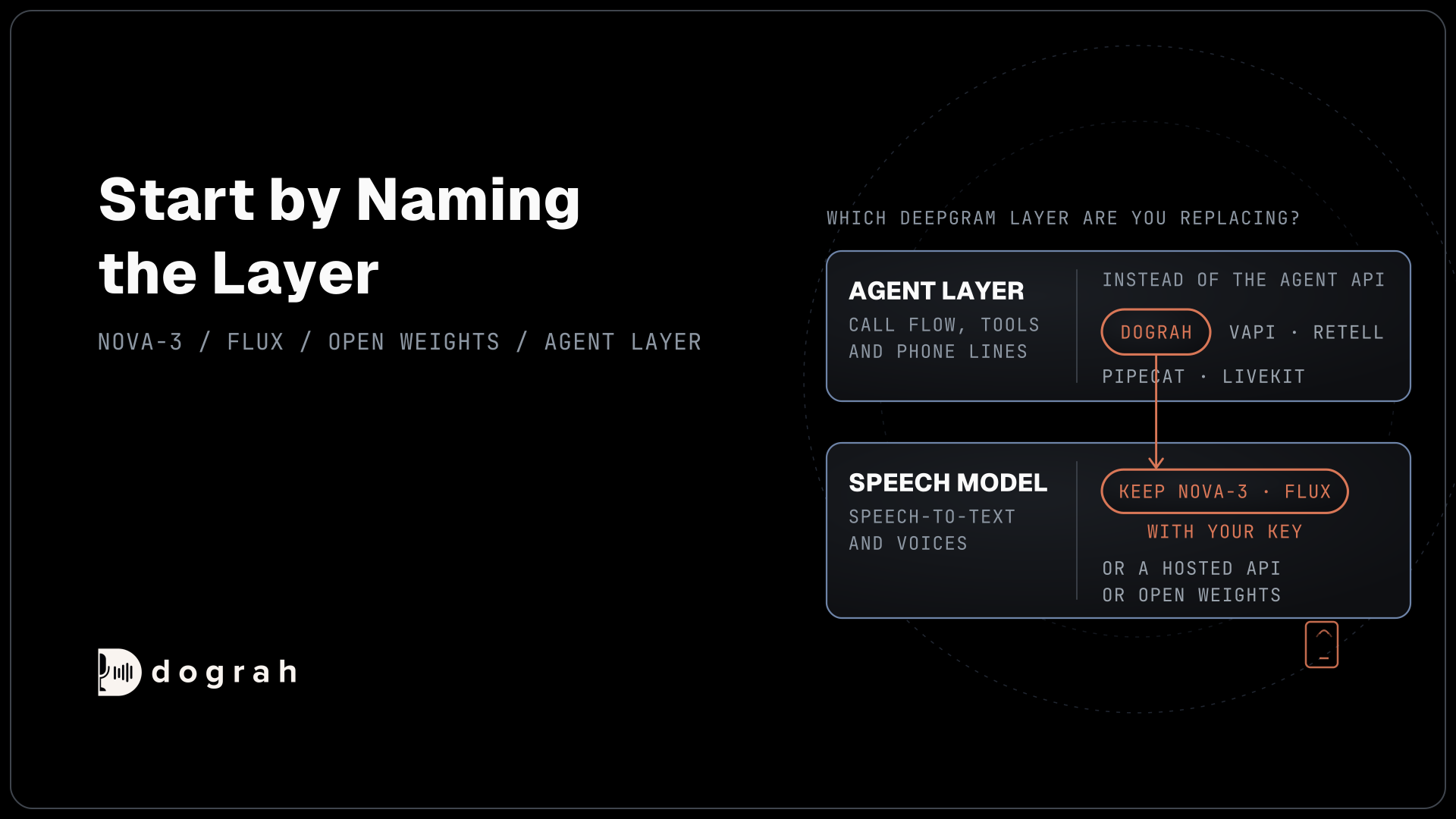
Dograh does not run Deepgram's Voice Agent API or Flux TTS. It replaces the agent API. Dograh is the orchestration layer that runs the call flow, tools and telephony, and the speech and language models are a separate layer you choose. That can be Deepgram, another provider with your own key, Dograh's own models, or open-weight models on your own servers. With your own keys, call audio still reaches each provider, Deepgram included. It stays in-house only when the models run on your own servers too.
The platform is what the Voice Agent API leaves to your code. Agents are built in the visual workflow builder, as nodes joined by pathways, or by an AI assistant through Dograh's MCP server. Phone lines connect through Twilio, Vonage, Plivo, Telnyx, Cloudonix, Exotel, Vobiz or Asterisk ARI, with no bridge to write. HTTP API tools read and write your systems during the call, and QA scores each step of every call.
When a caller needs a person, Transfer Call works on Twilio, Telnyx, Plivo, Cloudonix and Asterisk ARI. Dograh calls the destination first and connects the caller only when someone answers. On Twilio, it can play a short spoken introduction to both people before connecting them.
What it leaves to you is concrete. There is no keypad (DTMF) input and no built-in SMS, and self-hosting puts the servers and updates on your team. The code is open under BSD-2-Clause. Self-hosted Dograh has no per-minute platform fee (servers, model keys and phone minutes still cost). Dograh Cloud has a 1¢-a-minute platform fee. For every feature against Deepgram's agent, see Dograh vs Deepgram.
Open-source speech-to-text models
Open weights are the only way to run speech-to-text on your own servers with no vendor contract. Deepgram does offer self-hosting, and it is worth being exact about what that means. Deepgram offers self-hosted containers on its Enterprise plan. They run on NVIDIA GPUs and report usage to Deepgram's license server, without sending audio, as Deepgram's self-hosting docs explain. The weights stay closed, and the contract stays in place.
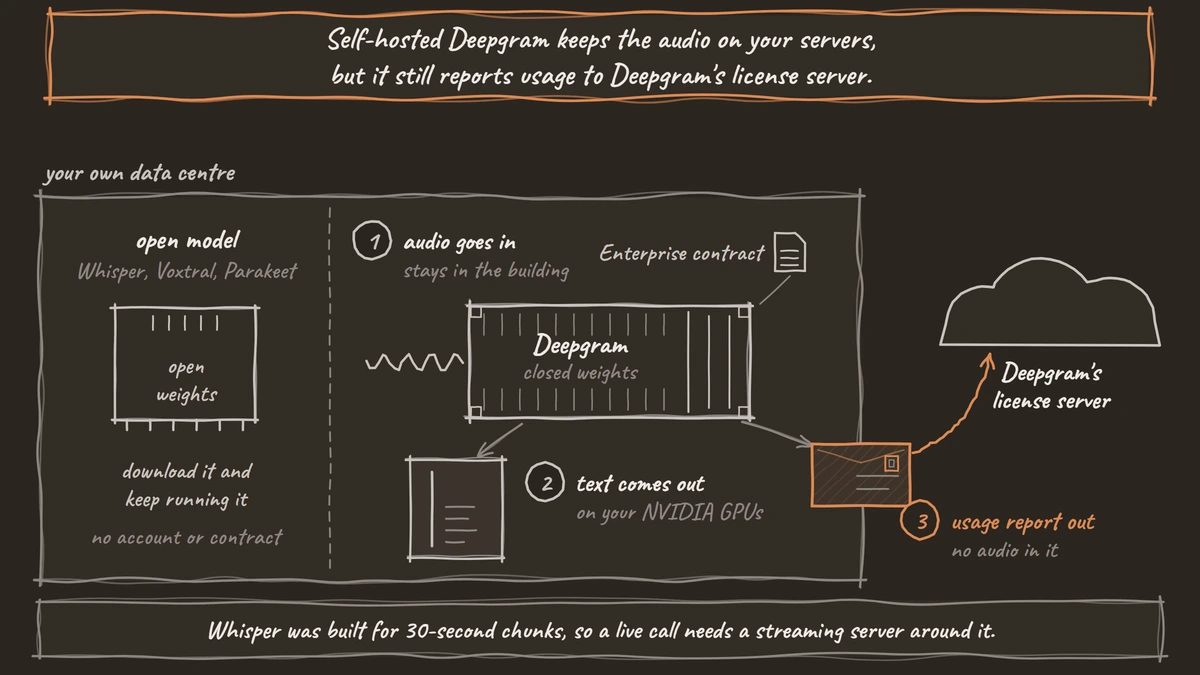
Open models change that. Whisper is MIT-licensed, Voxtral is Apache-2.0, and NVIDIA's Parakeet and Canary-Qwen are CC-BY-4.0, which allows commercial use with attribution. You can download them and keep running them with no account or contract.
Dograh connects local speech-to-text through Speaches, which runs Whisper models, or through any OpenAI-compatible transcription server. The Transcriber settings list Speaches as "Local Models (Speaches)". Parakeet, Canary-Qwen and Voxtral are options to try behind an OpenAI-compatible server, and you should test each on a live call before relying on it.
Be honest about the trade. Whisper was built for 30-second chunks, so on a live call it needs a streaming server and careful tuning to keep replies quick. You also take on the GPUs and the updates, and every model needs its own testing. Our guide to running voice AI on local, self-hosted models covers GPU sizing and the full open stack. The open-source alternative to Deepgram covers licences and how a local model plugs into Dograh.
Voice agent API alternatives
If the agent layer is what you want to replace, these are the options teams weigh against Deepgram's Voice Agent API.
| Platform | Open source | Where it runs | Models | What you get, and what's missing |
|---|---|---|---|---|
| Deepgram Voice Agent API (baseline) | No | Deepgram's cloud, Kubernetes self-hosting on Enterprise | Deepgram speech models, managed or your own LLM, Deepgram, Cartesia or your own voices | One WebSocket and one bundled rate. You write the call logic and the phone bridge in code |
| Dograh | Yes, BSD-2-Clause | Your own servers, or Dograh Cloud | Any supported provider with your own keys, Deepgram's Nova-3, Flux and Aura-2 included, Dograh's models, open-weight models | Visual builder, eight phone providers, MCP server, per-step QA. But no keypad input, and self-hosting is your team's job |
| Vapi | No | Vapi's cloud | Your own keys or models at cost | Developer platform at $0.05 a minute for hosting, models and phone on top |
| Retell AI | No | Retell's cloud | A choice of language models, OpenAI realtime speech-to-speech included | Visual Conversation Flow builder. $0.055 a minute for voice infrastructure |
| ElevenLabs Agents | No | ElevenLabs' cloud, private deployment in your AWS or GCP account through sales | ElevenLabs' speech engine, with the LLM billed separately | $0.08 a minute covers its speech engine, not the LLM or the phone line |
| OpenAI Realtime, Gemini Live | No | The model vendor's cloud | One speech-to-speech model | A model API, not a platform. Tools, phone wiring and call history are yours to build |
| Pipecat | Yes, BSD-2-Clause | Your own servers, or Pipecat Cloud | Any model you wire in | Python framework from Daily. The product around it is yours to build |
| LiveKit Agents | Yes, Apache-2.0 | Your own servers, or LiveKit Cloud | Any model you wire in | Framework on the LiveKit media server. Same build work as Pipecat |
Of the open-source options, only Dograh ships as a full platform. Pipecat and LiveKit Agents are frameworks, and Dograh itself is built on a fork of Pipecat. Our comparison of the best open-source voice AI platforms goes deeper on the two frameworks.
The hosted platforms each have their own guide. Vapi alternatives covers the self-serve developer platforms, and ElevenLabs alternatives covers ElevenLabs' agent product and its voices.
If you are weighing one speech-to-speech model against a cascade of separate models, see our guide to the best realtime voice API for phone agents.
What Deepgram costs
Deepgram prices each product on its own meter, so a speech rate and an agent rate are never the same kind of number. On Deepgram's pricing page, Nova-3 streaming is $0.0077 a minute for one language and $0.0092 for many on pay as you go, and Flux English is $0.0077. Aura-2 voices are $0.030 per 1,000 characters. The Voice Agent API is $0.075 a minute on Standard, "one rate covering speech-to-text, a managed language model, and text-to-speech", billed on connection time.
Those numbers buy different things. A Nova-3 minute is only the transcription. A Voice Agent minute bundles the models, and the phone line is still on top. Dograh's platform fee covers neither models nor phone, so it never compares directly with either. Our breakdown of Deepgram pricing covers add-ons, the Growth plan, concurrency limits and every Voice Agent tier.
Join the Dograh Community
Dograh is an OSS alternative to Vapi. Join our Slack community for queries, releases, best practices & community interactions.
When keeping Deepgram makes sense
Staying is the right call for some teams. If you want one vendor for the speech models and the agent, on one contract with a BAA, the Voice Agent API gives you that. Flux's built-in end-of-turn detection is a real strength for conversation, and per-second billing with a credit that does not expire makes it easy to start.
Teams that must self-host but are happy with closed weights can stay too. Deepgram's Enterprise containers run in your own cloud or data centre, and they send usage reports, not audio, to Deepgram.
And if the only problem is the agent layer, the speech models can stay where they are. Running Nova-3 or Flux inside Dograh keeps the transcription you know and changes the builder and the phone wiring.
Picking your Deepgram alternative
Start by naming the layer. If a speech model is the problem, shortlist two or three from the speech-to-text table and test them on recorded phone calls from your own line, through the server you will use in production. If the agent layer is the problem, pick a platform first and keep Deepgram's models until a test says otherwise.
Teams that need call audio to stay on their own servers should look at open-weight models with a self-hosted platform. Dograh with a local model through Speaches is the shortest path there. Teams that want to stop writing call logic in code, but like Deepgram's transcription, can move the agent to Dograh and keep their Deepgram key.
Each part of this guide has its own deep dive:
Glossary
- Word error rate (WER)
- The share of words a speech-to-text model gets wrong against a reference transcript. It depends on the audio, so the same model can score differently on phone calls, meetings and the server that runs it.
- Open weights
- A model whose trained parameters you can download and run yourself, under a licence such as MIT or Apache-2.0. Deepgram's self-hosted containers run on your hardware, but the weights stay closed.
- End-of-turn detection
- Deciding that a caller has finished speaking so the agent can reply. Deepgram's Flux does it inside the speech model, while Nova-3 leaves it to the platform around it.
- Keyterm prompting
- Deepgram's way of telling the model which words to listen for, such as product names. Dograh sends the agent's Dictionary words to Deepgram as keyterms on Nova-3 and Flux.