
An open-source alternative to Deepgram is an open-weight speech-to-text model, such as Whisper, Parakeet, Canary-Qwen or Voxtral, running on your own servers inside Dograh, an open-source AI voice agent platform you can self-host or run on Dograh Cloud. Deepgram's own self-hosting is Enterprise-only, and its containers keep closed weights and report usage to its license server.
Key Takeaways
- Self-hosted Deepgram keeps closed weights and reports usage to its license server.
- Dograh connects local Whisper through Speaches or any OpenAI-compatible transcription server.
- Test every local model on a phone line, through the server you'll run.
This post is part of our guide to Deepgram alternatives, where open weights are the only way to run speech-to-text on your own servers with no vendor contract. Here we compare open models with Deepgram's self-hosting and show how a local model runs on a call in Dograh.
What self-hosting Deepgram gives you
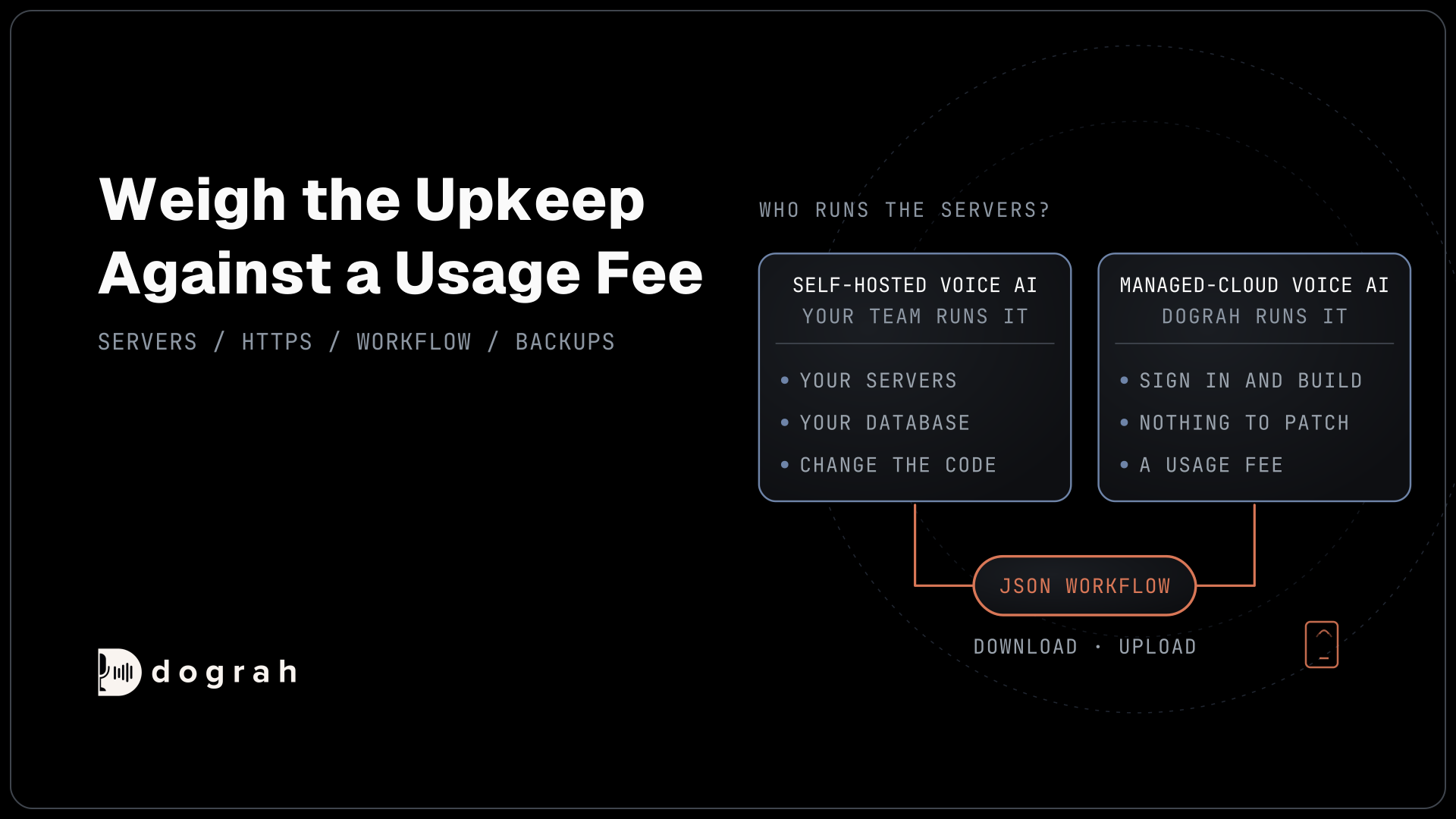
Deepgram can run on your own hardware, but the weights and the contract stay with Deepgram. Deepgram offers self-hosted containers on its Enterprise plan. They run on NVIDIA GPUs and report usage to Deepgram's license server, without sending audio. Deepgram's self-hosting docs say the Docker and Kubernetes routes need an Enterprise plan, and that the Amazon SageMaker route from AWS Marketplace "runs fully airgapped".
For many companies that is enough. Call audio stays in your own cloud account, and Deepgram signs the contract. But it is licensed software. You can't read or change the model, and you need a sales contract before the first test. The container also keeps talking to Deepgram about usage. Teams that need a network with no outside connections at all have fewer routes, which our post on air-gapped voice agents covers.
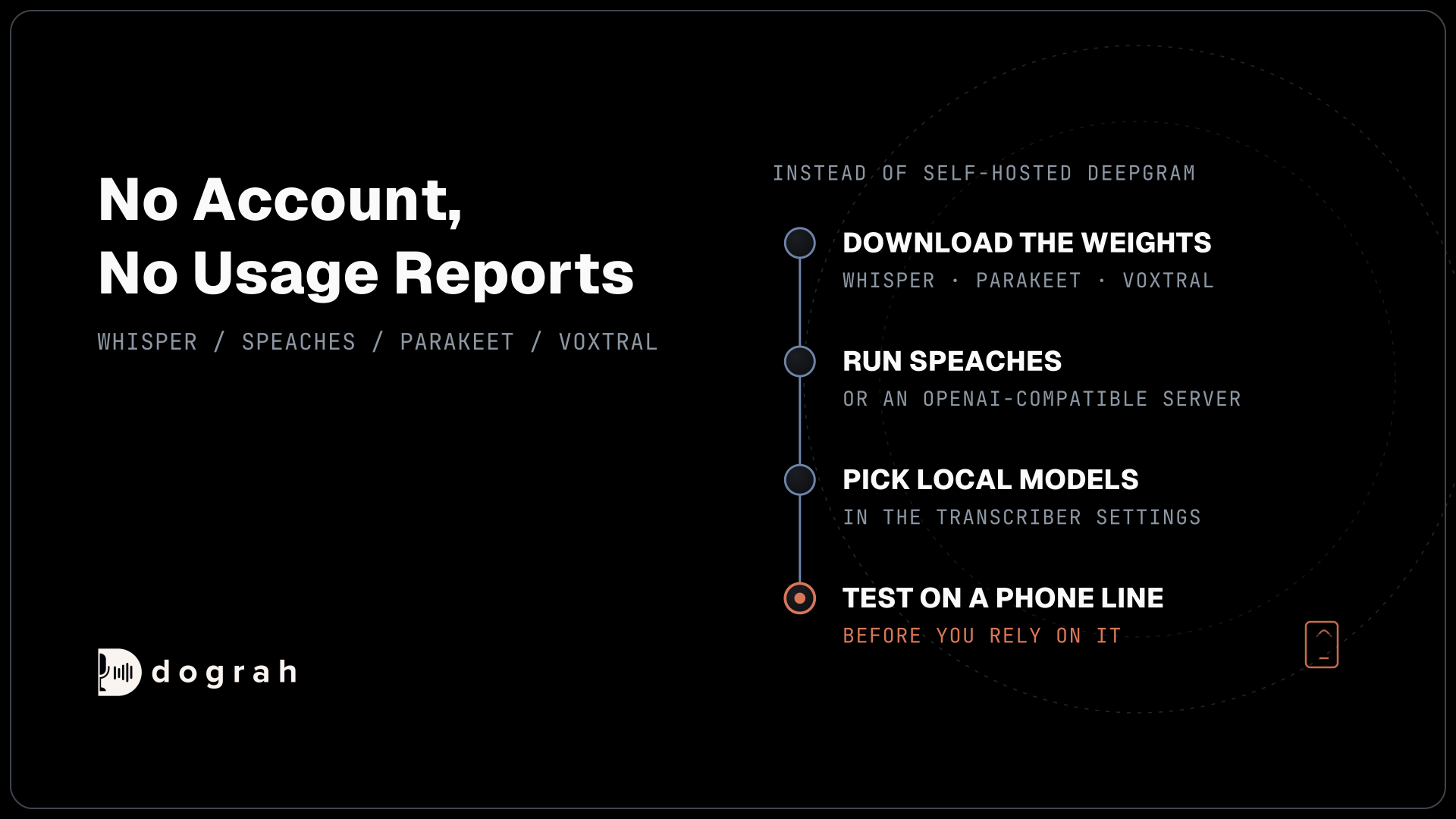
An open-weight model works differently. You download the weights under a published licence and keep running them on your own servers, with no account and no usage reports.
Open speech-to-text models compared
Several open models now score close to Deepgram on independent tests. On the Artificial Analysis Word Error Rate Index (AA-WER v2), as measured on 29 October 2026, the five models below scored as follows, where lower is better.
| Model | Weights and licence | AA-WER v2 | How it runs in Dograh |
|---|---|---|---|
| Deepgram Nova-3 (baseline) | Closed. Self-hosted only on Enterprise | 5.2% | Built-in provider with your own Deepgram key |
| Voxtral Small (Mistral) | Open, Apache-2.0 | 2.8% | An option to try behind an OpenAI-compatible server |
| Whisper Large v3 (OpenAI) | Open, MIT | 4.1% on fal.ai, 10.1% on Replicate | Through Speaches, which runs it with faster-whisper |
| Canary-Qwen 2.5B (NVIDIA) | Open, CC-BY-4.0 | 4.3% | An option to try behind an OpenAI-compatible server |
| Parakeet TDT 0.6B v3 (NVIDIA) | Open, CC-BY-4.0 | 4.5% | An option to try behind an OpenAI-compatible server |
Voxtral Small was the most accurate of the 15 open-weights models among the 62 tested. Parakeet is the small one. Its model card describes a 600-million-parameter model for 25 European languages, ready for commercial use. CC-BY-4.0 asks for attribution, unlike MIT and Apache-2.0, so credit NVIDIA wherever you ship it.
Look at the two Whisper scores. The same weights scored 4.1% on one host and 10.1% on another. The server and settings around the model move the result as much as the model does, so the score that counts is the one from your own setup.

Open Source Alternative to Vapi / Retell
Self-hosted voice agent platform — no per-minute fees
dograh-hq/dograh
Star on GitHub
How a local model plugs into Dograh
Dograh connects local speech-to-text through Speaches, which runs Whisper models, or through any OpenAI-compatible transcription server. In the Transcriber settings, pick "Local Models (Speaches)" and point it at your Speaches server, by default at localhost on port 8000. Speaches runs Whisper with faster-whisper, and you run it beside Dograh on your own machine.
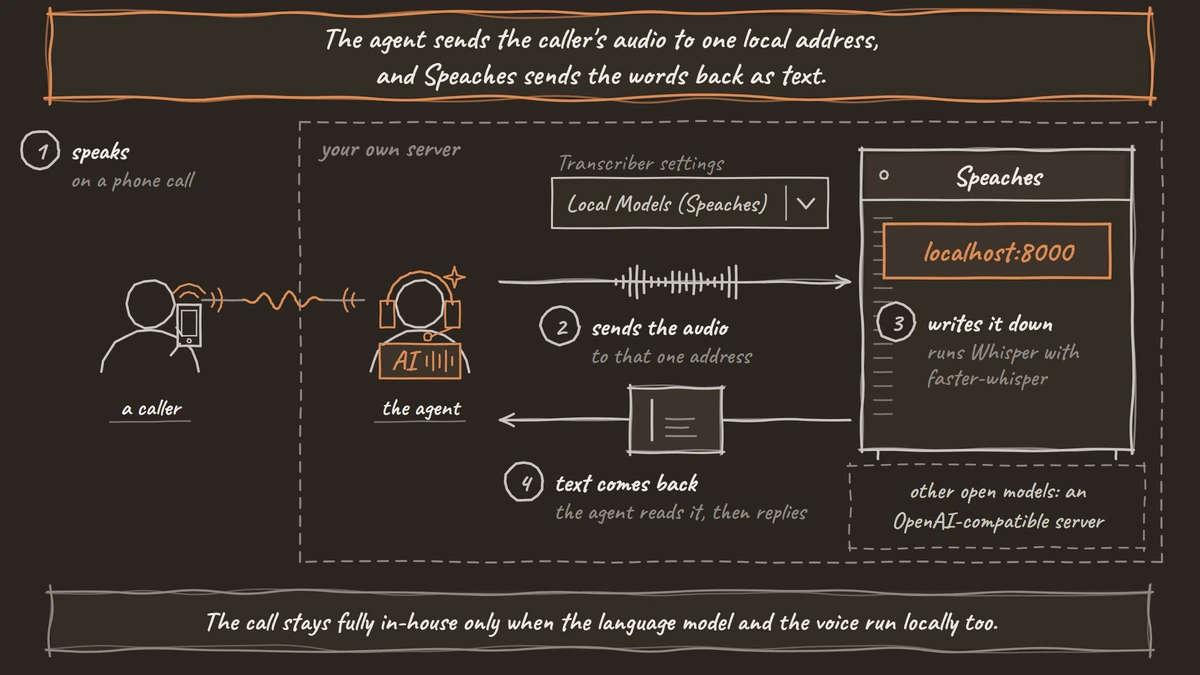
Parakeet, Canary-Qwen and Voxtral are options to try behind an OpenAI-compatible server, such as vLLM for Voxtral. Point Dograh's OpenAI speech-to-text provider at that server's address, and test it on a live call before you rely on it.
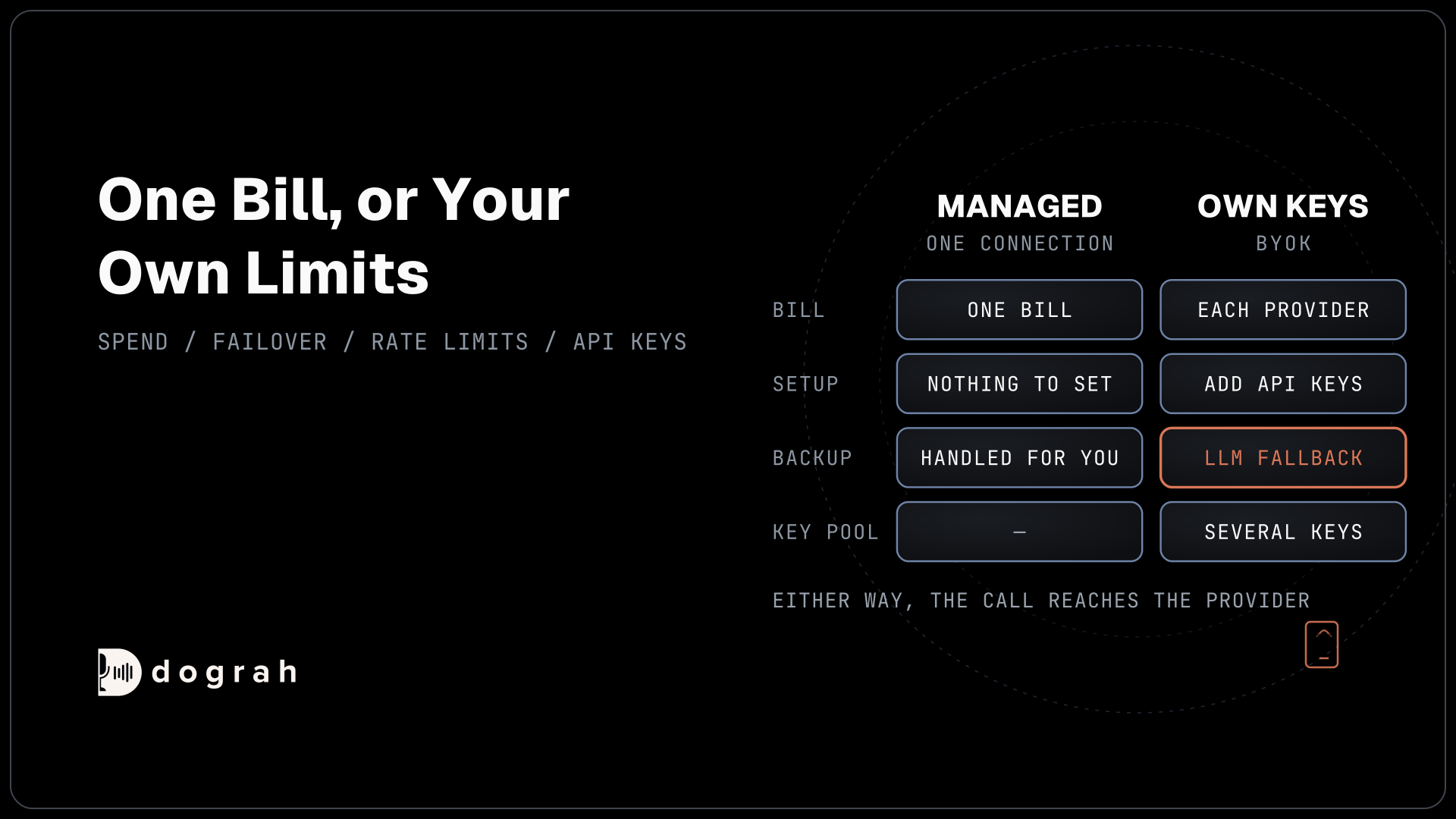
Dograh is the orchestration layer that runs the call flow, tools and telephony, and the speech and language models are a separate layer you choose. So the speech model can change per agent. In Model Configurations you save named setups, so one agent can keep Deepgram for the languages it covers best while another runs a local model where call data must stay in-house.
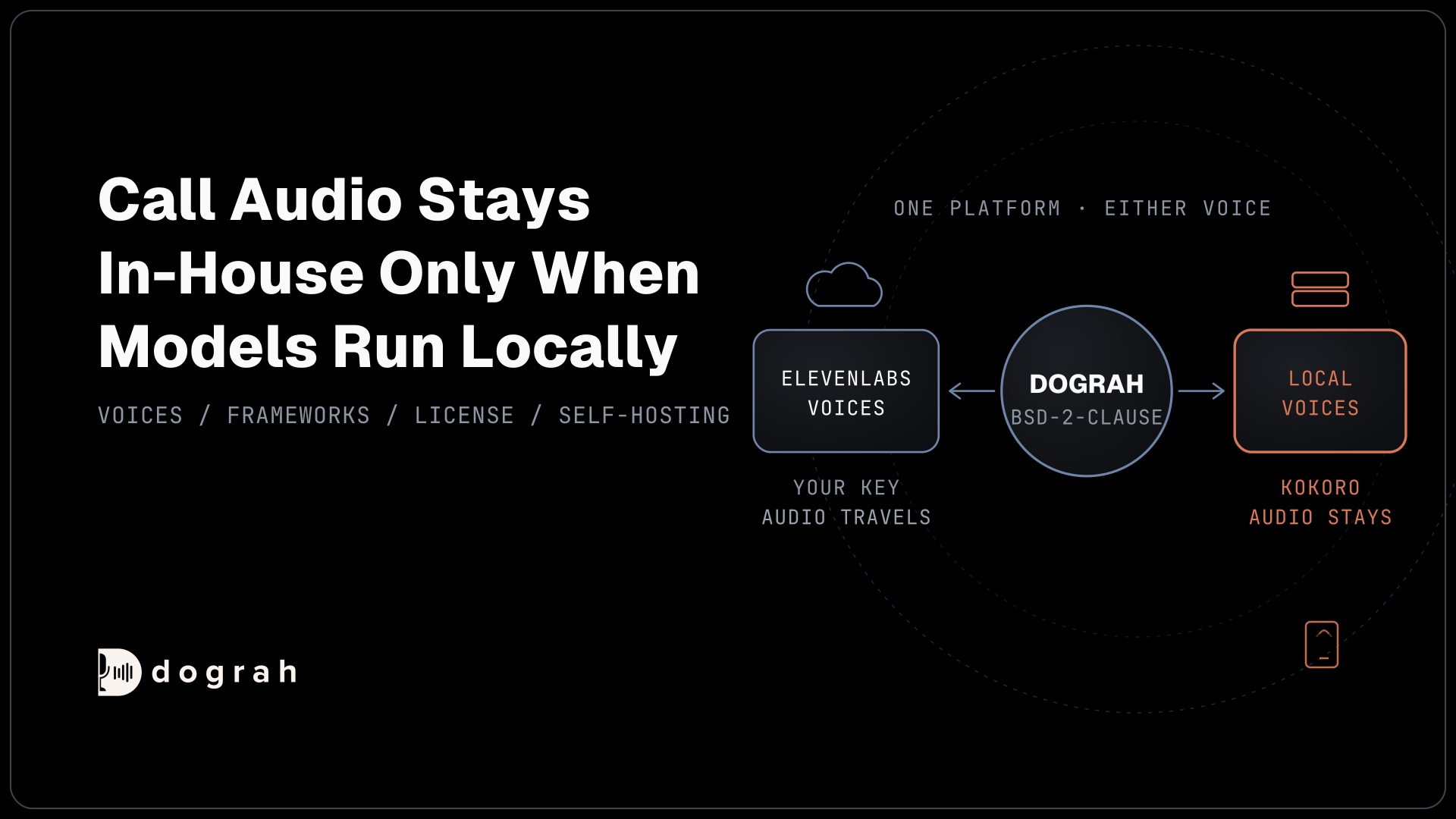
A local speech model alone does not keep the call on your servers. Data stays fully in-house only when the language model and the voice run locally too, for example a model served by vLLM or Ollama, and Kokoro through Speaches for the voice. Our guide to running voice AI on local, self-hosted models covers GPU sizing for the whole stack. How to build a voice agent on fully local open-source models walks through the setup.
What running your own speech model costs
Open weights remove the per-minute fee, and the work moves to your team. Our breakdown of Deepgram pricing shows the fee you would drop. Whisper was built to read audio in 30-second chunks, so on a live call it needs a streaming server around it, and replies can lag if that is tuned badly. faster-whisper helps. Its authors report it runs up to 4 times faster than the original Whisper for the same accuracy, with less memory.
You also run the GPUs and keep the models updated. A self-hosted Dograh install runs 10 calls at once by default, and you can raise that limit, though your GPUs and phone carrier set the real ceiling. The Docker guide covers the install. Self-hosted Dograh has no per-minute platform fee (servers, model keys and phone minutes still cost). Dograh Cloud has a 1¢-a-minute platform fee.
Test on the phone line before launch. Most phone calls still reach the agent as 8 kHz audio, while a browser demo runs at 16 kHz, so a model that looks clean in the browser can miss names and numbers on a real call.
Join the Dograh Community
Dograh is an OSS alternative to Vapi. Join our Slack community for queries, releases, best practices & community interactions.
Which route fits your team
If you need closed weights under a vendor contract and are on Deepgram's Enterprise plan, its self-hosted containers are the shortest route. You keep the model you know, with Deepgram's support behind it.
If you want no vendor contract at all, run an open model. Whisper through Speaches is the documented path in Dograh today. The NVIDIA and Mistral models are worth testing for speed and for their languages.
If only some calls need to stay in-house, mix the two. Keep Deepgram with your own key for the agents where it works well, and move the sensitive ones to a local model on your own servers, all in one Dograh install.
Glossary
- Open weights
- A model whose trained parameters you can download and run yourself under a published licence. Whisper (MIT) and Parakeet (CC-BY-4.0) are open weights, while Deepgram's self-hosted containers are not.
- License server
- Deepgram's service that its self-hosted containers contact to validate the licence and report usage. Deepgram says no audio or transcripts are sent to it.
- Speaches
- An open-source server with an OpenAI-compatible API that runs Whisper models through faster-whisper. Dograh lists it as Local Models (Speaches) for speech-to-text.