
Dograh is an open-source AI voice agent platform you can self-host or run on Dograh Cloud, with a visual builder and built-in phone lines. Deepgram's Voice Agent API is one WebSocket you build on in code, priced at $0.075 a minute on Standard with its models included. Dograh can still run Deepgram's Nova-3, Flux and Aura-2 with your own key.
Key Takeaways
- Deepgram's agent is a WebSocket you code against, with the phone bridge yours.
- Dograh ships the builder and phone providers, and can keep Deepgram's speech models.
- Deepgram's rate bundles the models, while Dograh's platform fee leaves them separate.
This post is part of our guide to Deepgram alternatives, where Dograh replaces the Voice Agent API and can keep Deepgram as its speech layer. Here we compare the two on building, phone lines, models, hosting and price, and say which teams each one suits.
What each one is
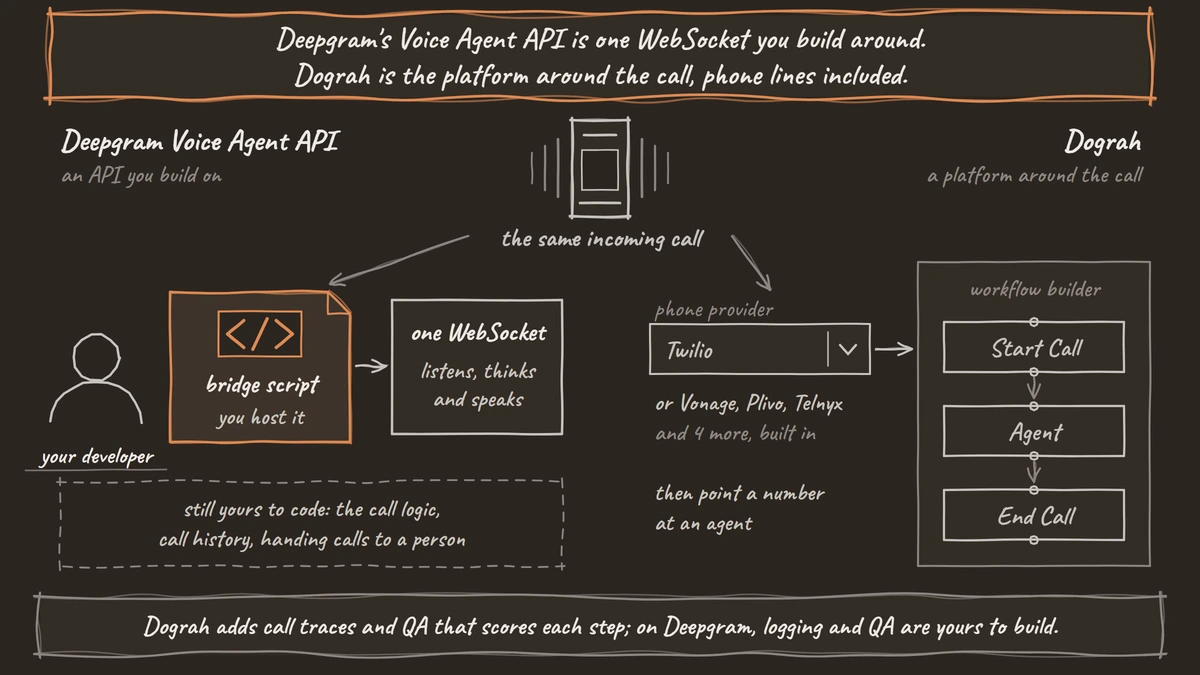
Deepgram's Voice Agent API is a building block, and Dograh is a finished platform. The Voice Agent API is one WebSocket that handles "the full speech pipeline (listening, thinking, and speaking)". You send it settings for the models it uses, and it can call your functions mid-conversation. Everything else is code you write: the call logic, the phone connection, call history and how a call reaches a person.
Dograh is an open-source AI voice agent platform under BSD-2-Clause. Its GitHub repository holds the whole product, from the workflow builder to phone providers, tools, transfers, campaigns, call traces and QA.
The two overlap less than the names suggest. Deepgram also sells the speech models, and Dograh can run those models. So the real choice is how you want to build and run the agent, with Deepgram's transcription available either way.
Dograh vs Deepgram at a glance
| Dograh | Deepgram Voice Agent API | |
|---|---|---|
| What it is | Open-source AI voice agent platform, BSD-2-Clause | Hosted API, one WebSocket per conversation |
| How you build | Visual workflow builder, or an AI assistant through the MCP server | Code, with SDKs in Python, JavaScript, C# and Go, plus a playground |
| Phone lines | Built in: Twilio, Vonage, Plivo, Telnyx, Cloudonix, Exotel, Vobiz, Asterisk ARI | A bridge you write and run, with guides for Twilio and Plivo |
| Handing a call to a person | Transfer Call on Twilio, Telnyx, Plivo, Cloudonix and Asterisk ARI | Your own code, through function calling and your phone provider |
| Speech-to-text | Any supported provider, Deepgram Nova-3 and Flux included, or a local model | Deepgram's own models |
| Language model | Your own keys for many providers, Dograh's models, or a local model | Managed OpenAI, Anthropic, Google or NVIDIA models, or your own |
| Voice | Any supported provider, Deepgram's Aura-2 included, or a local model | Deepgram's voices, Cartesia, or your own key for others |
| Speech-to-speech | OpenAI, Gemini, Grok, Ultravox, Azure and AWS Nova Sonic realtime models | A cascade: Deepgram speech-to-text, a language model, then a voice |
| Testing and quality | Call traces, plus QA that scores each step of a call | A playground for testing. Logging and QA are yours to build |
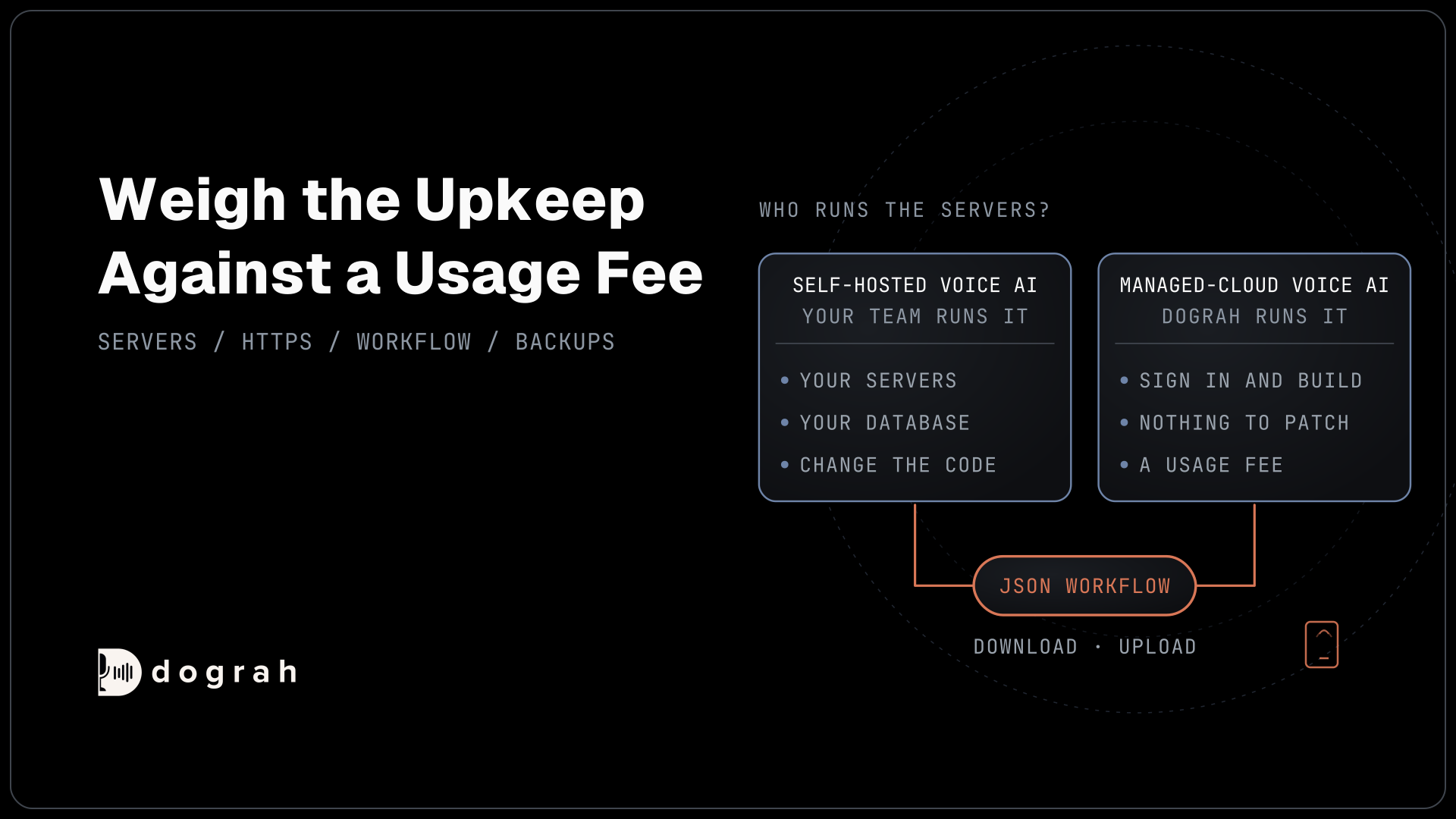
| Where it runs | Your servers, or Dograh Cloud | Deepgram's cloud, Kubernetes self-hosting on Enterprise |
| Price | Self-hosted: no per-minute platform fee. Dograh Cloud: 1¢-a-minute platform fee, models separate | $0.075 a minute on Standard, models included, phone line on top |
| Compliance | Self-host inside your own perimeter | SOC 2 Type 1 and Type 2, EU endpoint, BAA on Enterprise |

Open Source Alternative to Vapi / Retell
Self-hosted voice agent platform — no per-minute fees
dograh-hq/dograh
Star on GitHub
Building the agent: workflow or code
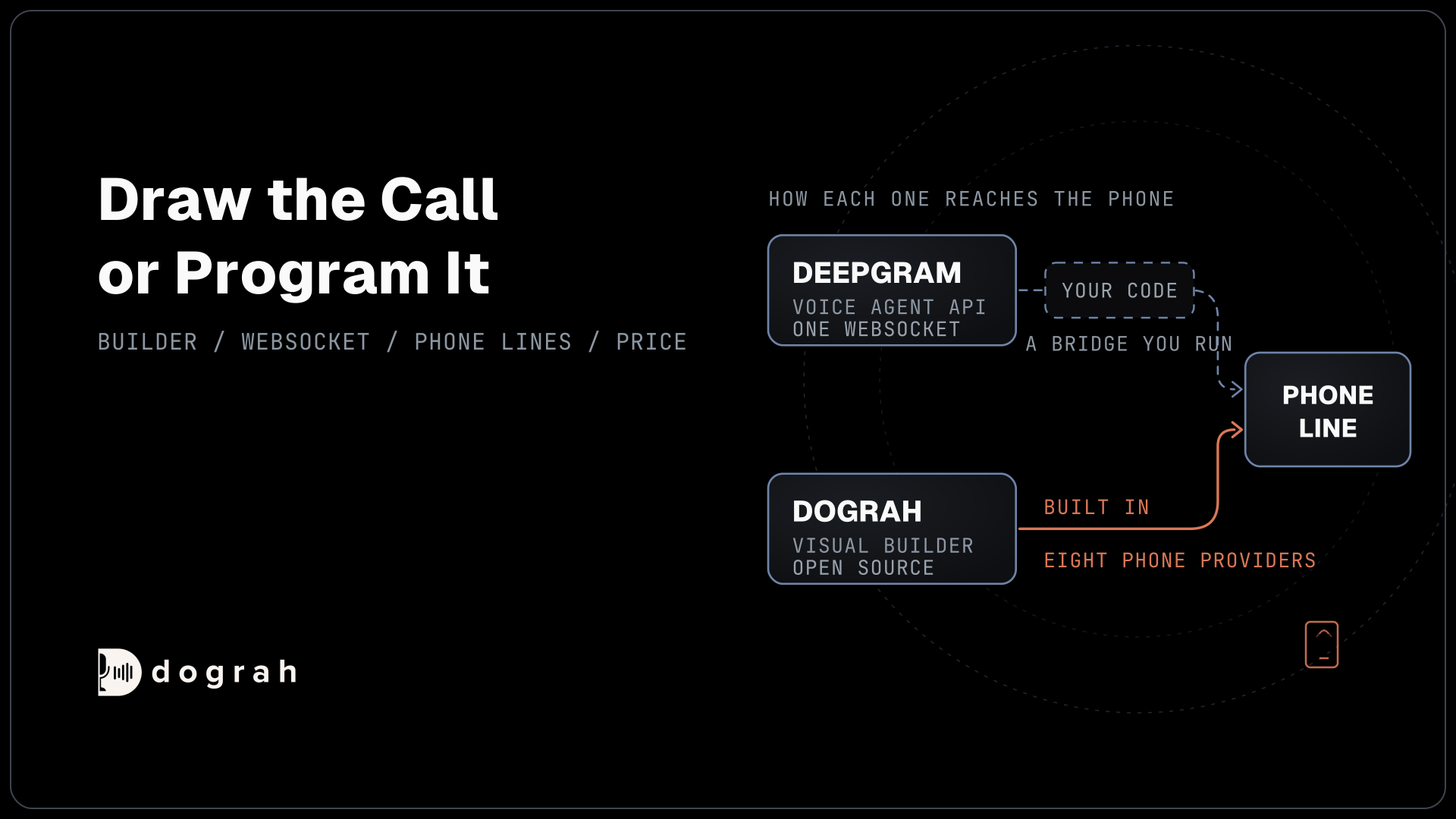
In Dograh you draw the call, and in Deepgram you program it. Dograh's visual workflow builder lays out a call as nodes joined by pathways. Each node has its own prompt and tools, so each step of the call stays separate and easy to test.
Engineers can skip the canvas. Through Dograh's MCP server, an AI assistant such as Claude or Codex can create and edit agents in your workspace.
The Voice Agent API gives you one prompt and a list of functions, configured in code. Branching and what the agent says after a tool fails are yours to write. For a developer team that likes to own every line, that is a feature. For a support or operations team that wants to change the script without a deploy, it is slow.
Some reviewers find Dograh's editor less polished than closed platforms. Dograh Cloud removes the setup work for anyone who wants to try it first, and the MCP route lets developers build without the canvas at all.
Phone lines and handing calls to people
Dograh connects to your phone provider out of the box, and Deepgram leaves that wiring to you. In Dograh, you add a telephony provider and point a number at an agent. With the Voice Agent API, you run a service that carries call audio between your phone provider and Deepgram's WebSocket. Deepgram publishes guides for Twilio and Plivo, but the service is yours to host and keep up.
Handing over to a person follows the same pattern. Dograh's Transfer Call works on Twilio, Telnyx, Plivo, Cloudonix and Asterisk ARI. Dograh calls the destination first and connects the caller only when someone answers. On Twilio, it can play a short spoken introduction to both people before connecting them. No summary goes across by default, so the agent writes the caller's details to your system first.
With Deepgram, a transfer is a function your code handles through your phone provider's own API.
Join the Dograh Community
Dograh is an OSS alternative to Vapi. Join our Slack community for queries, releases, best practices & community interactions.
Models, hosting and what you pay
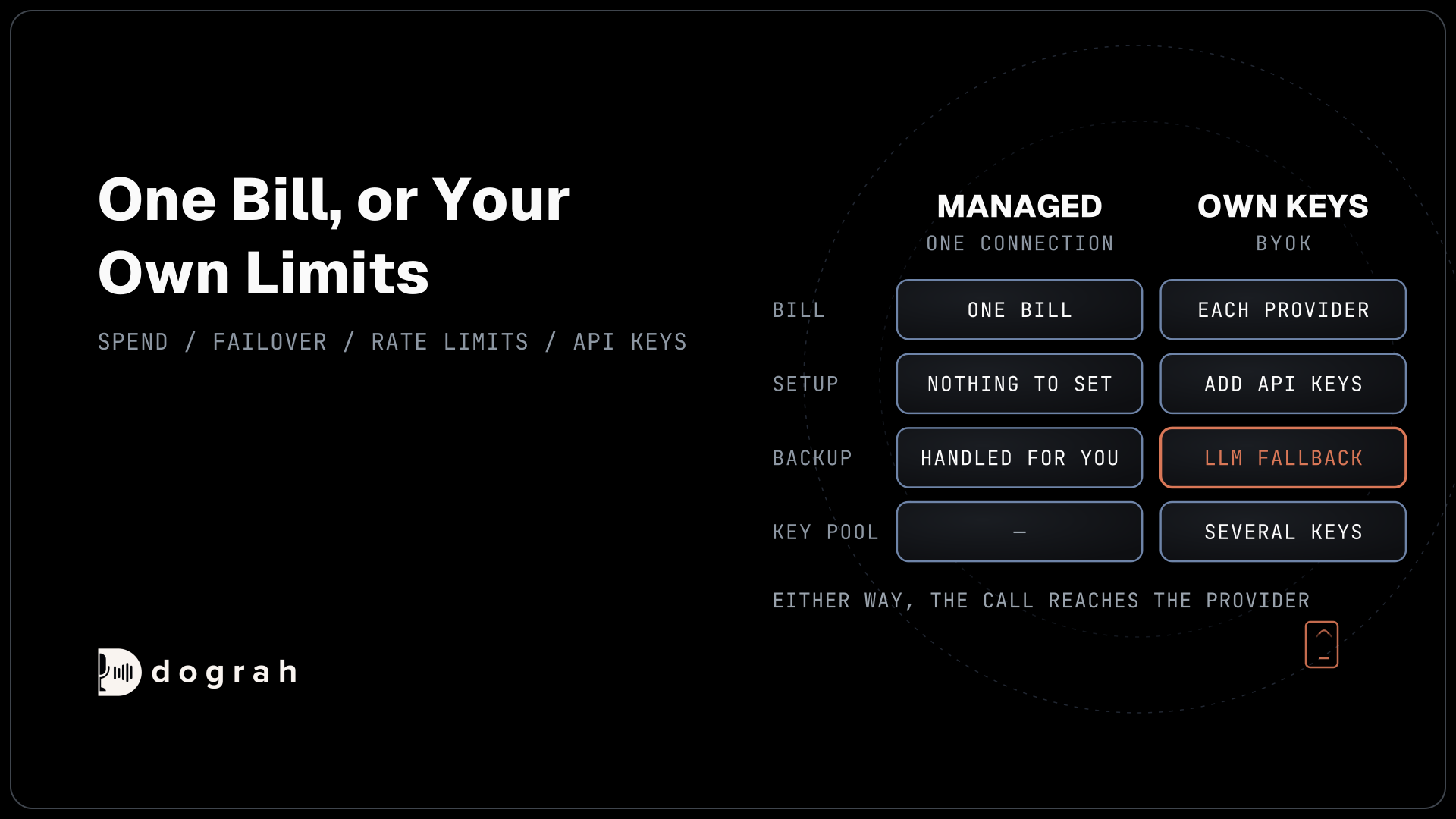
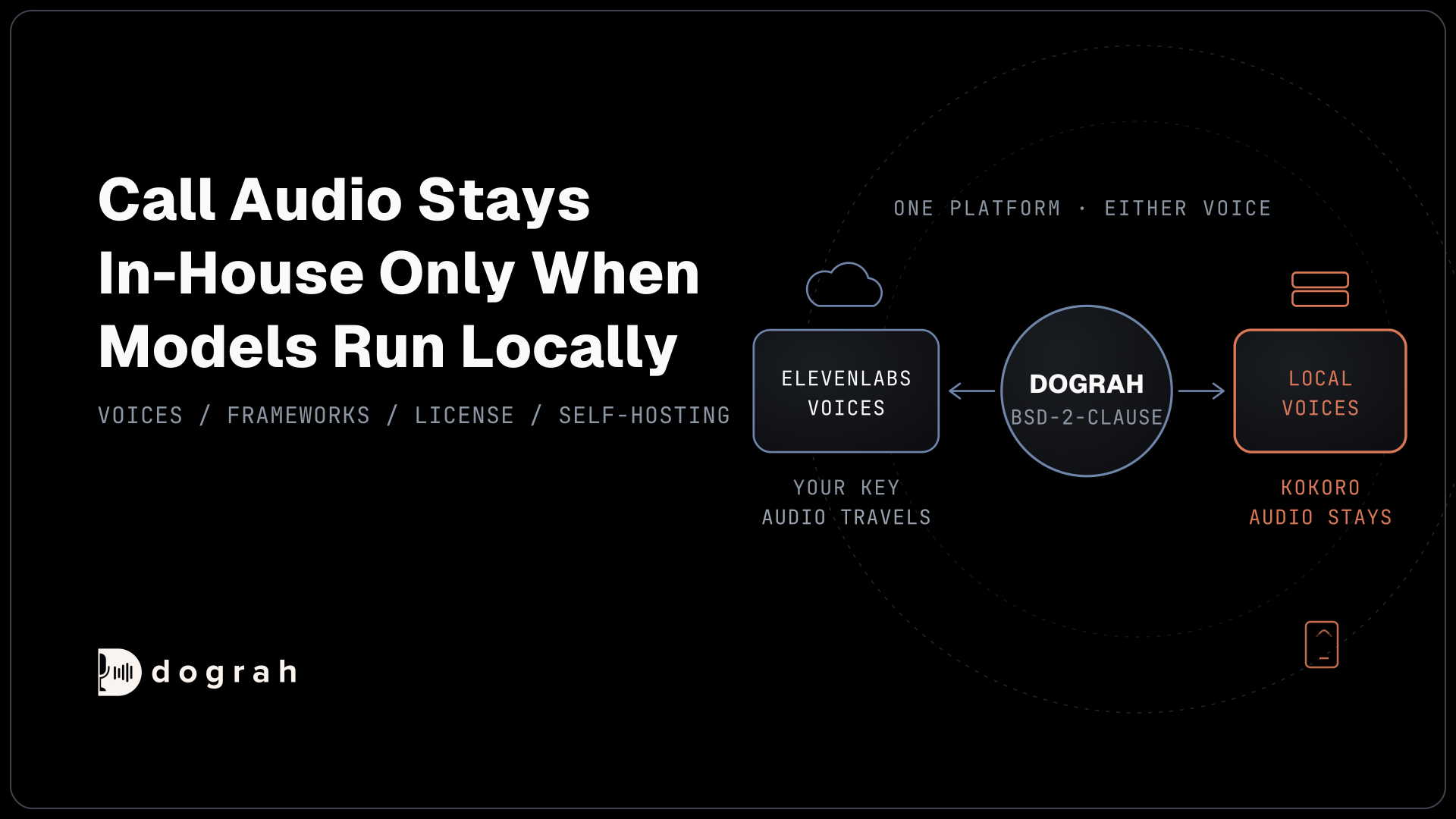
Deepgram's agent runs Deepgram's speech models, and Dograh lets you pick each model. Dograh can keep Deepgram as its speech layer: Nova-3 or Flux for speech-to-text and Aura-2 voices, with your own Deepgram key, billed by Deepgram. It does not run Deepgram's Voice Agent API or Flux TTS. Dograh is the orchestration layer that runs the call flow, tools and telephony, and the speech and language models are a separate layer you choose, so you can also swap in another provider, a local model or a speech-to-speech model per agent.
The Voice Agent API offers managed models from OpenAI, Anthropic, Google and NVIDIA, or your own, and the tier you land on depends on the model. Deepgram's model list puts smaller models such as gpt-5-mini and claude-haiku-4-5 on Standard and larger ones on Advanced.
The prices measure different things. On Deepgram's pricing page, Standard is $0.075 a minute and Advanced $0.163, each "one rate covering speech-to-text, a managed language model, and text-to-speech", billed on connection time. Bringing your own language model and voice brings Standard down to $0.050. Self-hosted Dograh has no per-minute platform fee (servers, model keys and phone minutes still cost). Dograh Cloud has a 1¢-a-minute platform fee. On Dograh, the models are billed by each provider, or as Dograh's managed models at about $0.07 a minute for most models. The phone line is extra on both. Our breakdown of Deepgram pricing lists every tier.
Hosting differs too. Deepgram runs the agent in its cloud, and Enterprise customers can run it on their own Kubernetes cluster with GPU nodes. Dograh is self-hostable by anyone, and Dograh Cloud includes 10 concurrent calls, with more on request.
Who Deepgram suits, and who Dograh suits
Deepgram suits developer teams that want one WebSocket and one bundled rate and are happy to write the call handling and the phone bridge in code. It also fits teams that want Deepgram's own speech models under one vendor contract, and Enterprises that need a BAA from the vendor get one on its Enterprise plan.
Dograh suits teams that want the platform ready-made, with a builder non-developers can use and the freedom to choose each model. It also suits teams that need the platform on their own servers without a sales contract, since the code is open.
Dograh has gaps of its own. There is no keypad (DTMF) input, no built-in SMS and no recording retention setting, and self-hosting puts the servers and updates on your team. If your reason for looking is self-hosting the speech model as well, our post on the open-source alternative to Deepgram covers the open models.
And you don't have to choose one vendor's speech models to choose the other's platform. Many teams moving off the Voice Agent API keep their Deepgram key and change only the agent layer.
Glossary
- Voice Agent API
- Deepgram's hosted product that runs speech-to-text, a language model and a voice over one WebSocket. You build the call logic and the phone connection around it in code.
- Bundled rate
- One per-minute price that includes the models, such as Deepgram's $0.075 Standard rate. It is simpler to read, but it cannot be compared directly with a platform fee that leaves models separate.
- Phone bridge
- A service you run that carries call audio between a phone provider such as Twilio and an agent's WebSocket. Dograh has phone providers built in, so no bridge is needed.