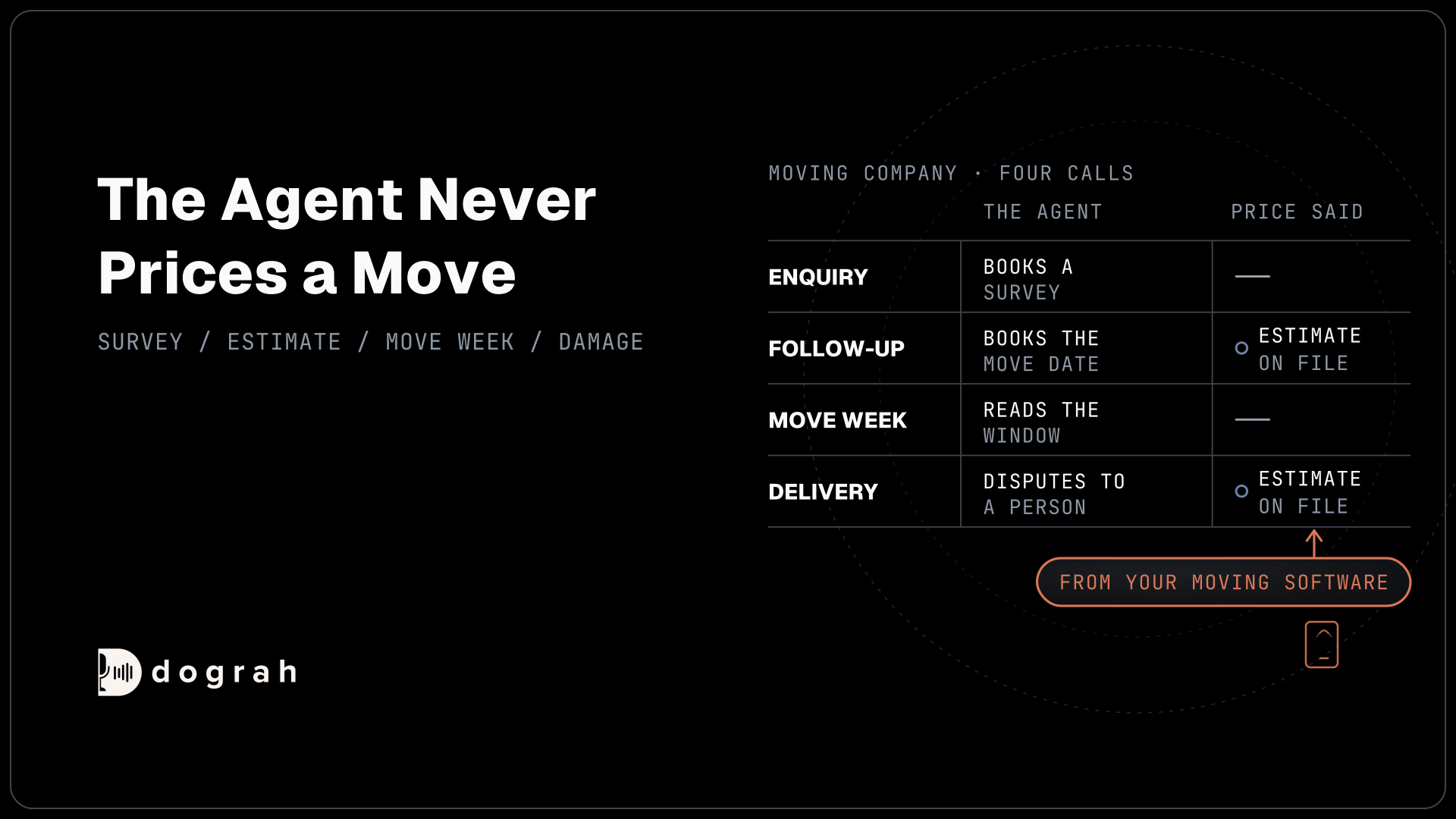

AI voice agents for moving and relocation answer new move enquiries, book on-site or video surveys, follow up on quotes and confirm move dates. The agent never prices a move. It collects the details, and any estimate it states is the one on file in the mover's system, because interstate estimates must rest on a survey of the goods.
Key Takeaways
- The agent collects move details and books the survey, but never prices.
- Any figure it says is the estimate on file in your system.
- Charge disputes and damage reports at delivery go straight to a person.
This guide covers calls a mover can hand to a voice agent, from first enquiry to delivery day, with prices from your moving software. We show how each part works in Dograh, the open-source AI voice agent platform we build. You can self-host it or run it on Dograh Cloud.
What a moving company's phone line hears
A moving company's phone rings most with people planning a move and people in the middle of one. New callers want to know whether you cover their route and dates, and what it might cost. Customers with a quote want to book, change the date or add a piano. The week of the move brings "what time is the crew coming", and delivery day brings questions about the truck and the bill.
Other calls come from HR teams arranging relocations for employees, and from customers reporting damage after the move. Some of these need a person from the first word.
A voice agent can take most of the rest if it reads and writes your moving software during the call. That system holds the customer record, the estimator calendar, the estimate on file and the crew schedule. The agent books a survey, reads a move date or writes a change, and every answer it gives comes from that record. An HR relocation enquiry is recorded and handed to a coordinator, because it usually involves a contract and several moves.
The agent never prices a move
The firmest rule for a moving agent is that it never prices a move, and federal rules back that up. Under FMCSA's household goods rules, an interstate mover must do a physical survey of the goods and give a written estimate based on it. The survey can be on site or virtual, by live or recorded video, as long as the mover can clearly identify the goods. The customer can waive it only in writing, signed before loading.
So a phone call cannot produce an interstate estimate. The agent collects what the estimator needs, such as the addresses, the move date, the home's size and any piano or safe, then books the survey. Local moves follow state rules instead, but the same habit protects you there too. It also keeps the agent away from a figure a customer would quote back to you on delivery day.
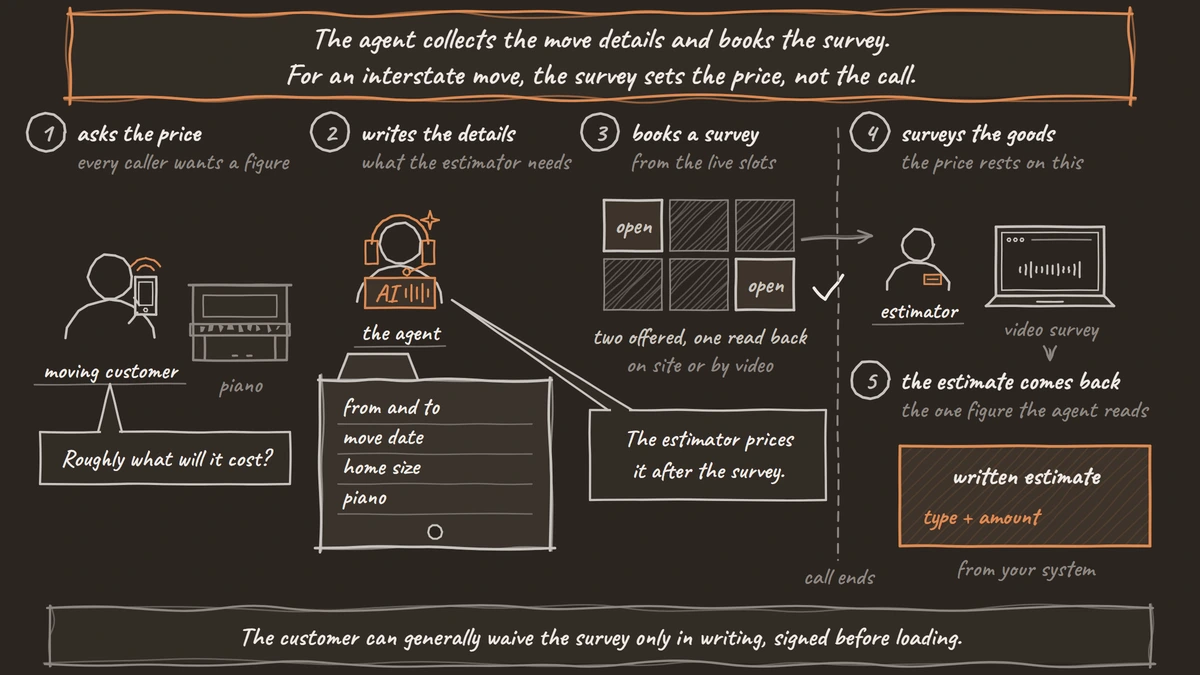
When a customer with an estimate calls back, the agent reads the estimate on file. An HTTP API tool asks your moving software for it, and the endpoint returns the estimate type, the amount and the survey date. Tell the agent in the prompt to state only that figure and never to work one out, add to it or round it. A caller who asks "what if I add a sofa" is told the estimator will update the estimate, and the agent gives no new figure.
A prompt alone cannot guarantee the agent never says a number, so check it after the calls as well, as the last section explains.
Binding and non-binding estimates
Most price questions are about what kind of estimate the customer holds, and the agent reads that from your system. A binding estimate guarantees the total cost for the goods and services it lists, and the mover may charge for preparing it. A non-binding estimate is free and rests on the estimated weight or volume and the services needed. The final charge comes from the mover's tariff, so it can come out higher.
The rules add a protection on non-binding estimates. The customer cannot be required to pay more than 110 percent of a non-binding estimate at delivery to get their goods. The agent can say which type of estimate is on file and the amount, but it never promises how the final bill will come out.
With the written estimate, the mover must also give the customer two federal booklets, "Ready to Move?" and "Your Rights and Responsibilities When You Move". FMCSA's Protect Your Move pages hold both. If a caller asks about their rights, the agent can point them to the booklets your system sent, and a person takes any deeper question.

Open Source Alternative to Vapi / Retell
Self-hosted voice agent platform — no per-minute fees
dograh-hq/dograh
Star on GitHub
New enquiries and survey booking
New enquiries end with a survey on the calendar. The agent asks for the moving-from and moving-to addresses, the dates, the number of rooms, and items that need special handling, then records each one as the caller stated it. Extraction is an AI step, so the transcript and recording stay the exact record.
Questions about how you work, such as packing services, parking permits, storage or valuation options, are answered from your own documents. Policies go in the Knowledge Base, and prices stay in your system, because a price list in a document goes stale the day your rates change. Our post on knowledge-base grounding shows how to load and test those documents.
The survey is booked from your estimators' live slots. An HTTP API tool reads open times for an on-site or video survey, the agent offers two and reads the chosen one back, and a second tool writes the booking. Add a Preset Parameter named workflow_run_id with the value {{initial_context.workflow_run_id}} so a request sent twice makes one booking. There is no built-in connector for moving software, so each tool points at your system's own API or a small service in front of it.
The same booking pattern runs estimate visits for plumbers and HVAC firms, described in AI voice agents for home-services appointment booking.
Quote follow-up and booking the move
A follow-up call goes to a customer who has an estimate but has not booked. The agent reads the estimate on file, answers what it can, books the move date from dates your schedule returns, and has your system send its deposit link. Any change to the inventory goes back to the estimator.
Because the call tries to win the job, it is a sales call, and with an AI voice that needs written consent on file. AI voice agents for moving quote follow-up and booking covers the consent rule, quote-site leads and the booking step in depth.
Move-week confirmations and arrival windows
Move-week calls confirm the plan and give the crew's arrival window, both read from your schedule. A campaign the day before can call every customer on the list. Campaign calling hours run in one time zone, so split a cross-country list by time zone and run one campaign per zone.
For changes, your system starts the call. When a crew's window moves, your scheduling system calls the API Trigger with the customer's number and the job details, and Dograh rings the customer at once.
On the call, the agent checks it has the right person, then reads the date, the window and anything the customer must do, such as reserving the elevator or a parking spot. It asks whether anything has changed. A new item or a changed address is written to your system and flagged for the estimator, because extra goods can mean a new estimate before loading.
If the customer cannot be reached, the campaign retries busy or unanswered numbers, 2 times by default and up to 10. A customer who has still not confirmed by the evening before goes on a coordinator's list for a personal call, because a crew turning up to a locked house costs a full day.
Delivery day: disputes and damage go to a person
Delivery-day calls about money or damage go to a person, with the details written first. A customer told the bill is higher than expected may be facing exactly the situation the 110 percent rule exists for. The agent reads the estimate on file and says nothing beyond what your system returns. It writes the dispute to your system and transfers the call.
A damage report gets the same treatment. The agent records what was damaged and how, as the caller stated it, and has your system send its secure upload link for photos. It never accepts or denies liability. Our post on damaged and lost shipment claims shows the same pattern for parcel carriers.
Transfer Call works on Twilio, Telnyx, Plivo, Cloudonix and Asterisk ARI. Dograh calls the destination first and connects the caller only when someone answers. On Twilio, it can play a short spoken introduction to both people before connecting them. No summary travels by default, so the agent writes the reason to your system first. If nobody answers within the 30-second default, the caller stays with the agent, which offers a callback and writes that request to your system.
Join the Dograh Community
Dograh is an OSS alternative to Vapi. Join our Slack community for queries, releases, best practices & community interactions.
Consent for outbound calls
A call about a move the customer has booked is a service call, and a call that tries to win the job is a sales call. Under the Telephone Consumer Protection Act (TCPA), the FCC's calling rules require prior express consent for a call to a mobile that uses an artificial or prerecorded voice, and the FCC ruled in 2024 that AI voices count. A booked customer who gave their number has generally given consent for calls about that move.
A quote follow-up or an offer of storage or packing makes the call telemarketing, which needs prior express written consent. When a customer asks not to be called again, the agent writes the opt-out to your system during the call, and your system removes the number from the next list. Confirm your own position with counsel before the first outbound campaign.
Where moving call data sits
Moving calls carry two home addresses, dates when a home will be empty, and an inventory of what is inside, so decide where that data lives before the first call. Dograh is self-hostable. Run it on your own servers and the platform never sees your callers' data.
The speech and language models are a separate layer you choose. Bringing your own keys (BYOK) to a model provider changes whose contract covers the models, but the audio still reaches that provider. Data stays fully in-house only with open-weight models on your own servers. No card numbers are taken on the call. Deposits and balances go through your own payment link, sent by your system.
The self-hosting guide covers the install. Self-hosted Dograh has no per-minute platform fee, but servers, model keys and phone minutes still cost money. Dograh Cloud charges a 1¢-a-minute platform fee, and its own managed models, if you use them, are a separate charge of about $0.07 a minute for most models.
Which call to hand over first
Start with new enquiries and survey booking, because the agent only records details and books from live slots. Add move-week confirmations next, then quote follow-up once your consent records are in order. Delivery-day calls stay with people longer, since they are where disputes start.
Before launch, call the agent from a real phone and push it for a price in every way a customer might, such as "roughly", "ballpark" or "what did my neighbour pay". Check that it only ever states the estimate on file.
Once live, replace the QA system prompt with mover-specific instructions that flag any call where the agent said a dollar amount the estimate tool did not return. Our post on automated QA for voice agents explains how QA scores each step. A supervisor reads flagged calls the same day.
The quote follow-up and booking call has its own deep dive:
Glossary
- Physical survey
- The mover's inspection of the goods, on site or by live or recorded video, that an interstate written estimate must be based on unless the customer waives it in writing. The voice agent books it and never replaces it.
- Binding estimate
- An interstate estimate that guarantees the total cost for the goods and services it lists. The mover may charge for it, and the agent reads its type and amount from the mover's system.
- Non-binding estimate
- A free interstate estimate of the likely cost, with the final charge set by the mover's tariff, so it can come out higher. The agent states the amount on file and never predicts the final bill.
- 110 percent rule
- The federal protection that a customer cannot be required to pay more than 110 percent of a non-binding estimate at delivery to get their goods. Disputes about it go to a person.