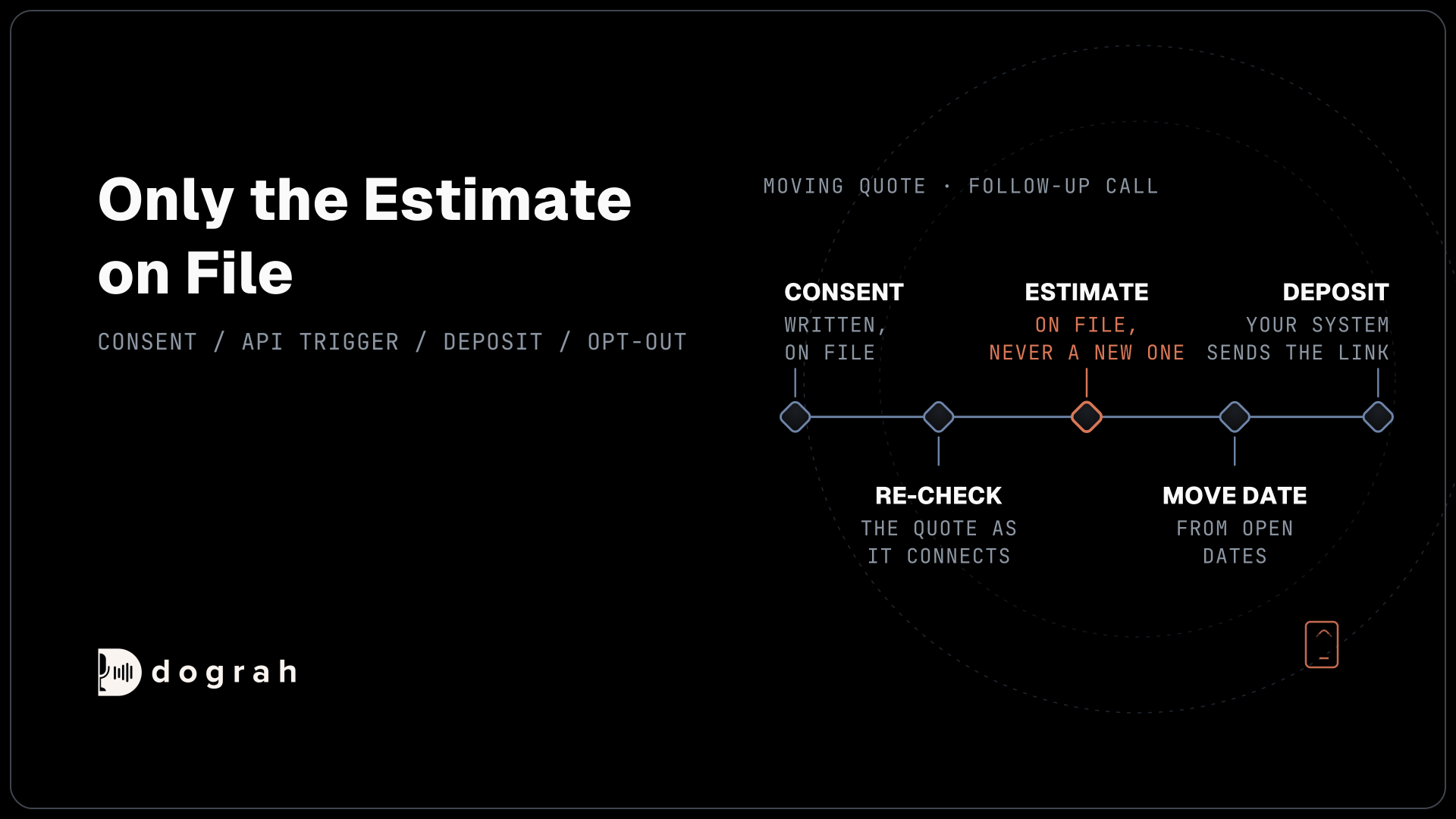

AI voice agents for moving quote follow-up and booking call customers who have an estimate but have not booked. The call tries to win the job, so it needs prior express written consent. The agent re-reads the quote, states only the estimate on file, books from open dates, and the mover's system sends the deposit link.
Key Takeaways
- Only quotes with written consent on file get an AI follow-up call.
- An added item goes back to the estimator, never a new price.
- Book from open dates only, and let your own system send the deposit link.
This post is part of our guide to AI Voice Agents for Moving & Relocation, where prices come from the mover's system. Below, we cover who to call, the estimate and booking the date. Then we set up the call in Dograh, the open-source AI voice agent platform we build.
Who gets a follow-up call
A follow-up on a moving quote tries to win the job, so it is a sales call, and that decides who you may call. Under the Telephone Consumer Protection Act (TCPA), the FCC's calling rules say a telemarketing call that uses an artificial or prerecorded voice to a mobile or home line needs the person's prior express written consent. The FCC ruled in 2024 that AI voices count. Asking for a quote does not by itself give that consent.
Written consent is a signed agreement (an e-signature counts) that clearly allows your company's calls to that number and says agreeing is not a condition of buying. The simplest place to collect it is the quote form. Our post on quote follow-up in home services shows how to word that checkbox and store it.
Leads from quote-comparison sites need care. In its January 2025 ruling, the Eleventh Circuit struck down the FCC's one-seller consent limits, so there is no longer a federal one-seller rule. A lead from a quote-comparison site still needs written consent that covers your company's calls, and consent to calls from "movers" in general may not be enough.
So only quotes with written consent on file go into the AI follow-up list. Everyone else gets a text from your own system or a call from a salesperson. Rules also differ by state, so confirm your own position with counsel before the first campaign.
Check the quote again as the call connects
The call starts from your moving software and re-checks the quote before the agent says a word. A few days after an estimate goes out, your system calls the API Trigger with the customer's number and quote ID. The trigger dials at once, so the waiting time lives in your system or a scheduler.
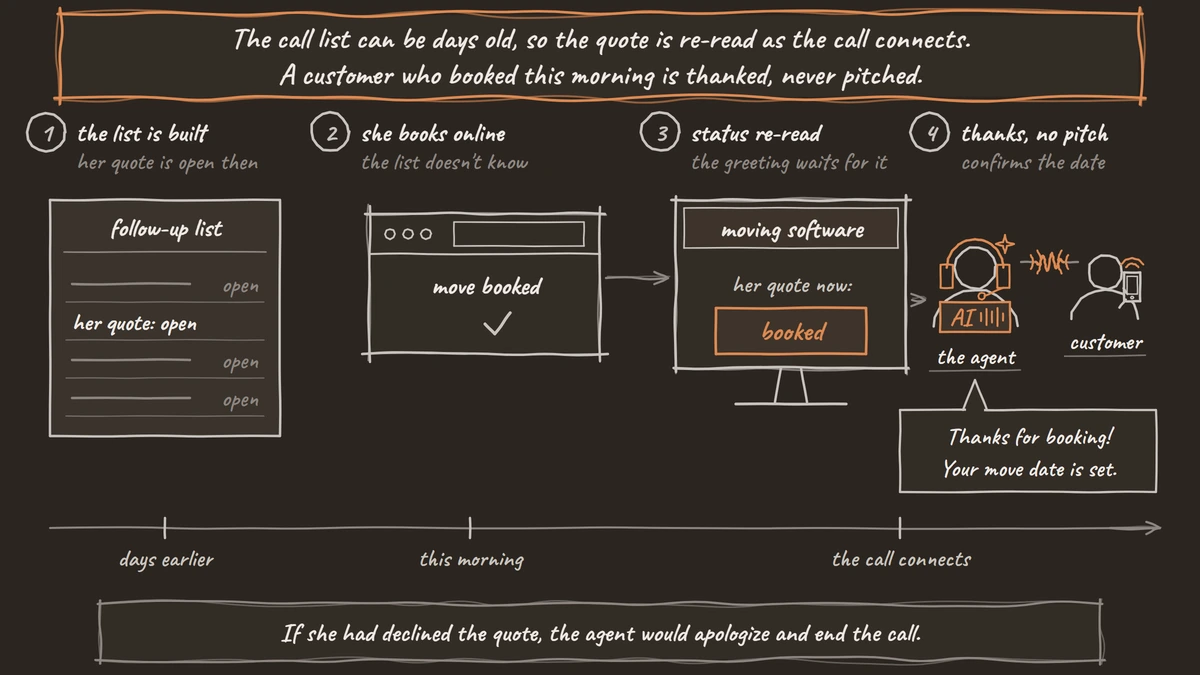
A lot can change between building the list and the call. The customer may have booked online that morning, or told a salesperson no. Pre-Call Data Fetch, set to Outbound calls only, asks your system for the quote's current status as the call connects. The greeting waits for it, and the customer hears ringing meanwhile.
If the quote is already booked, the agent thanks the customer and confirms the date, with no pitch. If it was declined, the agent apologises for the call and ends it. Our post on personalizing calls with CRM context shows the setup.
Read the estimate on file, never a new price
The agent talks about the estimate your estimator wrote, and nothing else. The Greeting Text names your company first and says why you are calling. Before any detail of the move, the agent confirms it is speaking to the customer, with the check your company sets.
Then it reads the estimate from your system, meaning its type, the amount and the move date the quote assumed. Tell the agent in the prompt to state only those values, never to work out a new figure, and never to offer a discount. Questions about price beyond what is on file go to the estimator.
Inventory changes are the common trap. Under FMCSA's household goods rules, extra goods or services the estimate did not cover mean the estimate must be confirmed again or replaced before loading. So when a customer mentions a piano or a storage unit, the agent records the change as stated, writes it to your system, and tells the customer the estimator will send a revised estimate.

Open Source Alternative to Vapi / Retell
Self-hosted voice agent platform — no per-minute fees
dograh-hq/dograh
Star on GitHub
Booking the move date and the deposit
A customer ready to book gets a date from your schedule, never from the agent. An HTTP API tool asks your system for open move dates for the crew size the estimate needs. The agent offers two, reads the chosen one back with the arrival window, and a second tool writes the booking.
A booking request can arrive twice, for example after a slow reply. Add a Preset Parameter named workflow_run_id with the value {{initial_context.workflow_run_id}} to the booking tool. Your system sees the same workflow_run_id and keeps one booking, so the same crew is never booked twice for one move.
Most movers take a deposit to hold the date. The agent takes no card number on the call. During the call, the HTTP API tool asks your system to send its secure payment link by text or email, and the agent tells the customer it is on its way. The booking is confirmed when your system records the payment.
Join the Dograh Community
Dograh is an OSS alternative to Vapi. Join our Slack community for queries, releases, best practices & community interactions.
Opt-outs, voicemail and handing over
A customer who says "stop calling" comes off your list. The agent writes the opt-out to your system during the call, and your system removes the number from the next list. Campaigns retry busy or unanswered numbers 2 times by default, up to 10, and have no per-person call cap, so set retries low and let your list decide how often anyone hears from you.
Voicemail handling is off by default, and once turned on it disconnects unless you choose "Leave a message". A short message with your company name and a callback number is enough. Our post on voicemail detection explains the setting.
A customer who wants to negotiate, or has questions the estimate does not answer, goes to a salesperson. Transfer Call works on Twilio, Telnyx, Plivo, Cloudonix and Asterisk ARI. Dograh calls the destination first and connects the caller only when someone answers. On Twilio, it can play a short spoken introduction to both people before connecting them. No summary travels by default, so the agent writes the quote ID and the reason to your system first.
Glossary
- Prior express written consent
- A signed agreement, e-signatures included, that clearly allows a company's telemarketing calls with an artificial or AI voice to a number. A moving quote follow-up needs it.
- Quote-comparison site
- A website that collects one moving request and passes it to several movers. Its consent must cover your company's calls, and consent to movers in general may not be enough.
- Revised estimate
- A new or reconfirmed estimate after the customer adds goods or services. The agent records the change and the estimator issues it before loading.
- Federal Motor Carrier Safety Administration (FMCSA)
- The federal agency whose household goods rules cover movers' estimates. Extra goods or services the estimate did not cover mean it must be confirmed again or replaced before loading.