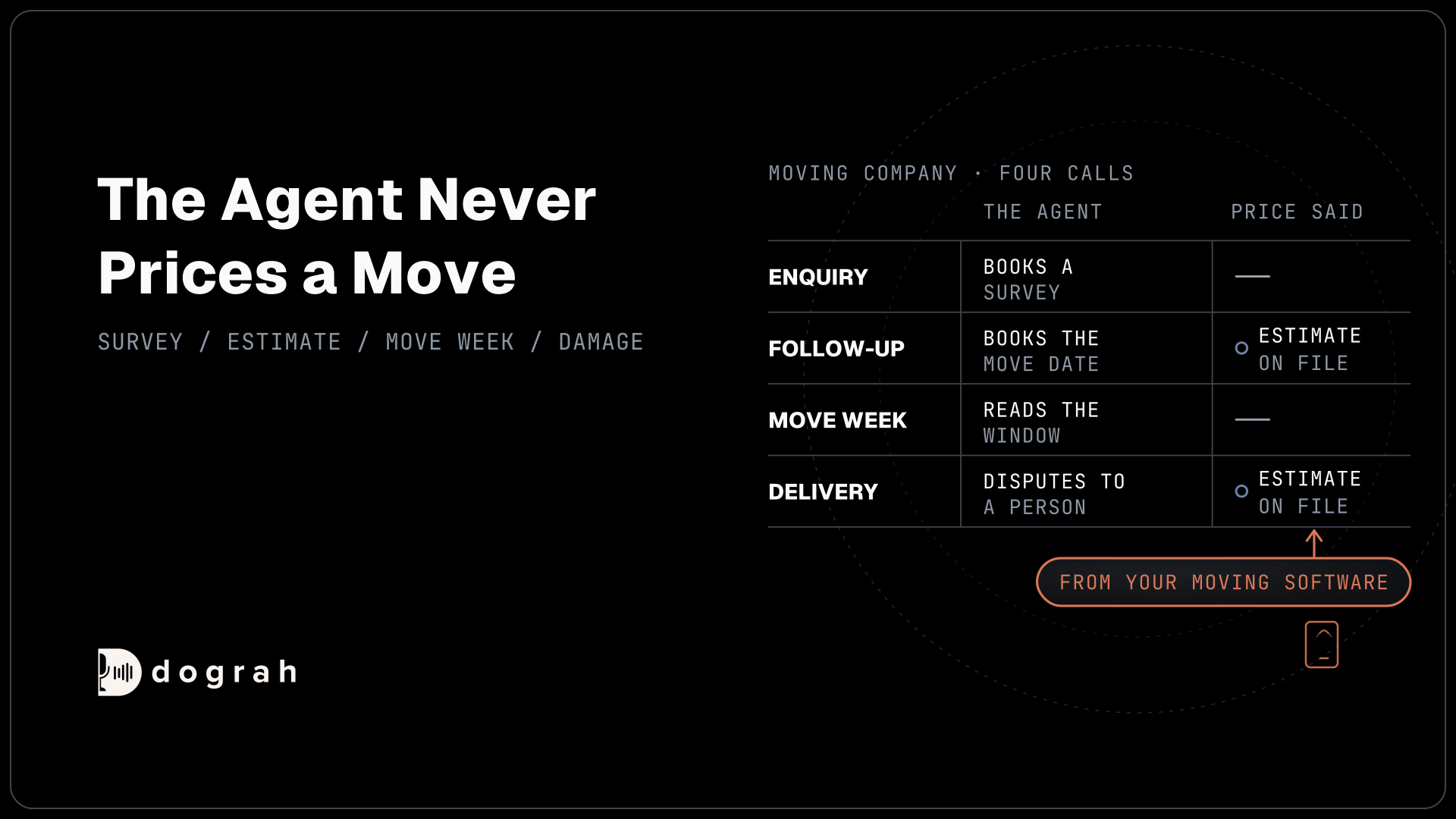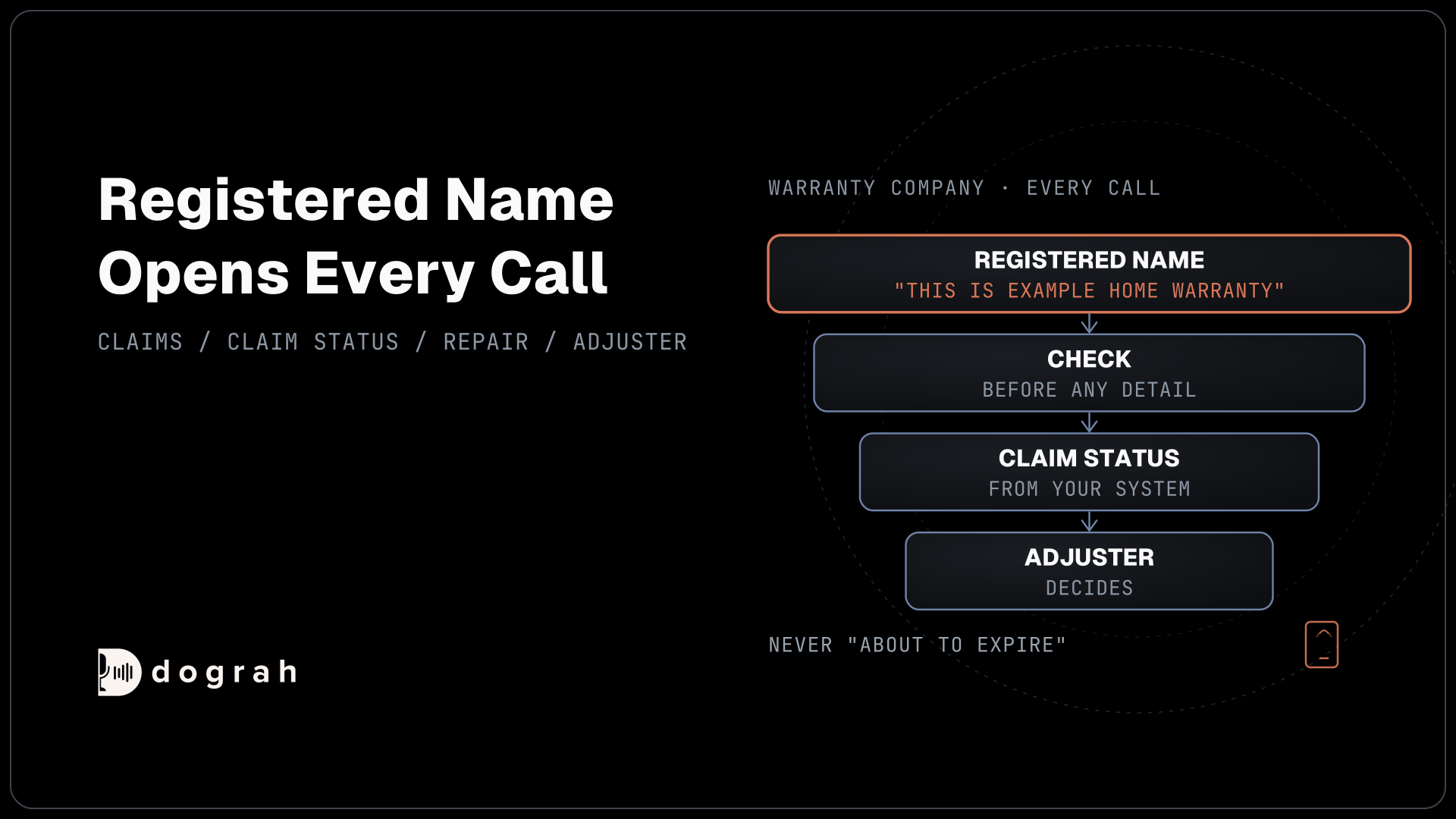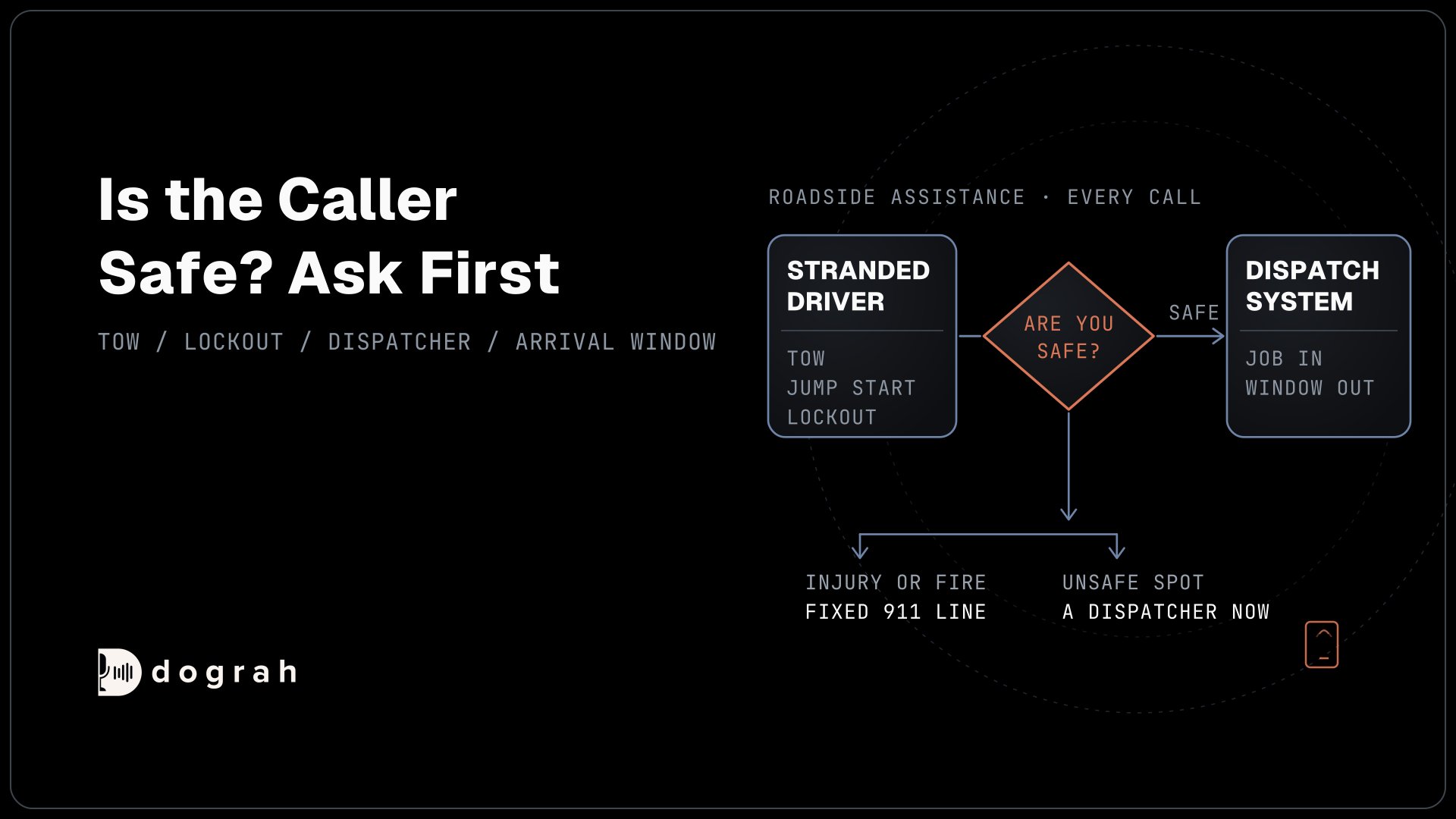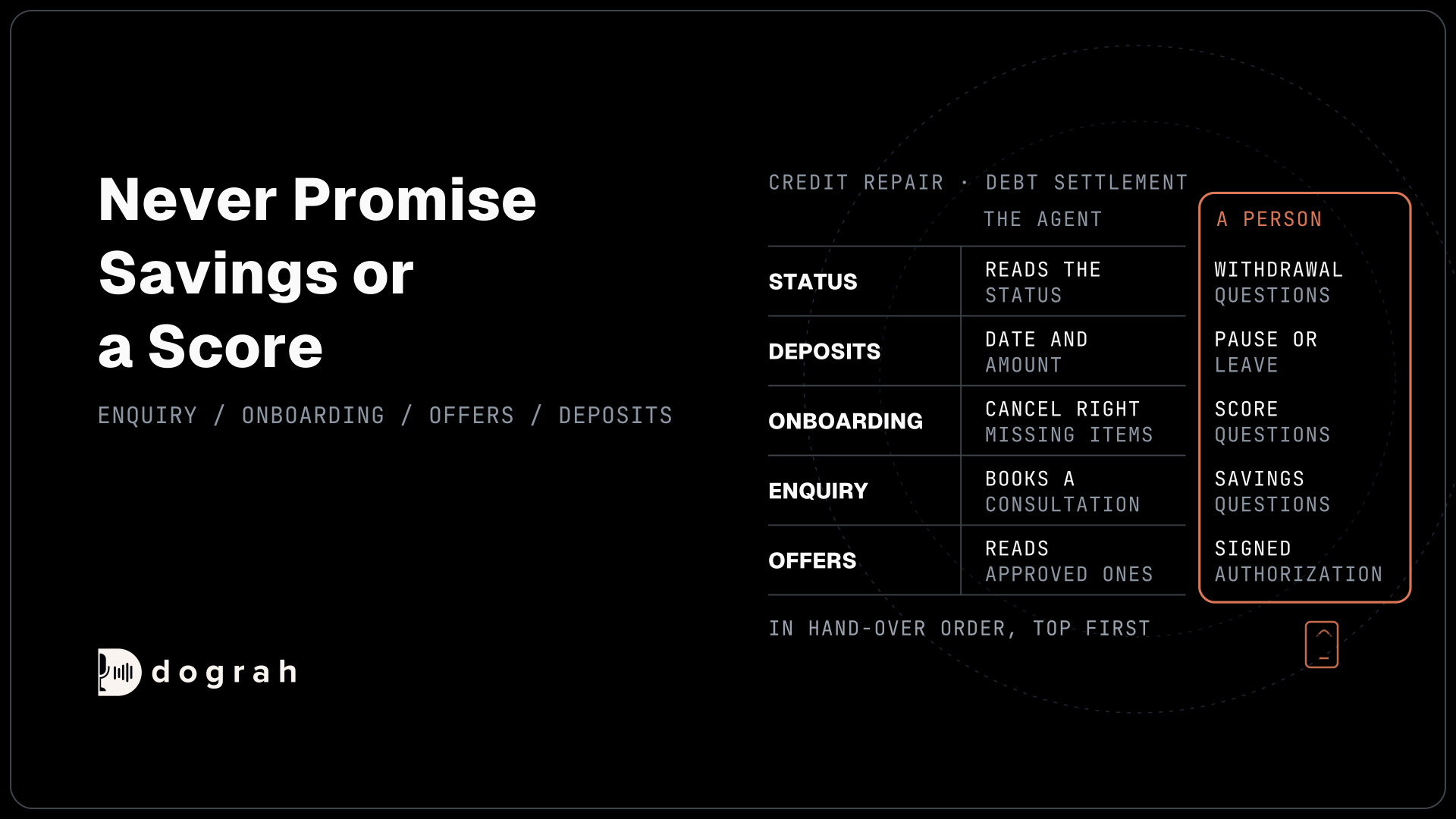

AI voice agents for credit repair and debt settlement firms answer enquiry and status calls and place welcome, document, offer and deposit reminder calls. After an approved check, the agent reads each answer from the firm's system and records what the client says. It never promises savings or a score change, and hands those questions to a person.
Key Takeaways
- The firm works for its client, so debt relief and credit repair rules apply.
- The agent never states savings, a score change, a removal or a timeline.
- Required disclosures play as fixed text your counsel wrote, never as model output.
This guide maps the calls a credit repair or debt settlement firm can hand to a voice agent, with the fee and claims rules. We show how each part works in Dograh, the open-source AI voice agent platform we build. You can self-host it or run it on Dograh Cloud.
Who a credit repair or settlement firm works for
The person on the line is the firm's own client, and that decides which rules shape every call. A collection agency works for the creditor. A credit repair or debt settlement firm works for the consumer, who is its client. So its calls follow the federal debt relief and credit repair rules, and the collector's rules don't fit them.
Our post on AI voice agents for debt collection covers the collector's side of the same debt. The lender's own calls are in our guide to AI voice agents for fintech and lending.
A firm's phone line hears the same handful of calls every day, from people answering an ad and from clients asking about their account. The firm also calls clients about documents, offers, deposits and installments. Most of the answers already sit in its own system, such as its CRM or settlement platform.
So on every call, the agent reads from your system and writes back what the client said. In Dograh, an HTTP API tool fetches the client's record during the call, and a second one writes the answers back. There is no built-in connector for credit repair or settlement software, so each tool points at your system's own API, or at a small service your team builds in front of it.
Claims and fees: the rules behind every call
These firms are regulated on what they claim and when they get paid, so the agent never promises a result. For debt relief sold by phone, the FTC's Telemarketing Sales Rule bans misrepresenting how much a client may save, how long results take, what happens to their credit or collections, and how many clients get those results. The Credit Repair Organizations Act bans untrue or misleading claims about what a credit repair service can do.
The cost of a savings promise is easy to see. In its October 2026 announcement, the FTC said a federal court entered a $106.8 million default judgment against the companies behind an operation called Accelerated Debt Settlement, and banned them from selling debt relief. The FTC alleged they posed as banks and government agencies, told people they could cut their debt by as much as 75% or more, reached them through telemarketing and inbound calls, and collected illegal advance fees.
Consumers keep reporting the same pattern. In the CFPB's complaint database, "Didn't provide services promised" was the top issue consumers filed in 2025 against both debt settlement (554 of 2,139 complaints) and credit repair services (531 of 1,920). From January to late October 2026, about half of the 1,397 credit repair complaints cited confusing or missing disclosures.
So the agent never states savings, a percentage off, a score change, the removal of an item or a timeline. Tell it in the prompt that any "how much will I save" or "will my score go up" question goes to a person, with the details written to your system first. Then back the prompt with data. An HTTP API tool hands the whole response to the language model, so build the endpoint the agent reads so it never returns projected savings, a score estimate or a completion date. Data the agent never receives is data it cannot say.
Required disclosures need exact words, and a prompt can't promise them. The model avoids a banned phrase and then says the banned meaning in other words. Exact wording holds only where Dograh plays fixed text, such as the Start Call Greeting Text, a pathway's Transition Speech or a recorded clip. Transition Speech plays with the caller muted, so it runs in full, but it can't carry per-client values. Our post on prompt and flow design patterns explains this split. The required statements live in your written documents, and any line you want said on a call plays as fixed text your counsel wrote. On a speech-to-speech model, text lines there don't play, so record the line as a clip.
Fees follow two rules, and the agent quotes neither from memory. A debt relief firm can't charge a fee until at least one debt is settled under an agreement the client signed, and the client has made at least one payment to the creditor under it. A credit repair firm can't take payment before the service is fully performed. When credit repair is sold by phone, the payment waits until the promised results show on a credit report issued more than six months after they were achieved. The agent reads a client's fee only from your system, and any question beyond what it reads goes to a person.
Enquiry calls from your ads
An enquiry call is a sales call, even when the person rang you after seeing an ad. For debt relief, the Telemarketing Sales Rule still covers inbound calls that answer an ad, so the usual inbound exemption doesn't apply.
The agent's job on this call is to answer general questions and book a person. The Greeting Text names the firm. If you want to tell callers they're speaking with an automated assistant, or your location requires it by law, write that in the Greeting Text along with the firm's name. General answers come from material your firm approved, such as an FAQ document loaded into the Knowledge Base.
Then the agent records the caller's situation as they state it, such as the kinds of debt, a rough total, whether payments are behind or they've been sued, and their state. It never says whether they'll qualify for savings or how much a program could cut. It books a consultation through an HTTP API tool against your calendar, or hands the call to an enrollment specialist.
Enrollment itself stays with people and your written documents. The disclosures before a client agrees to pay, the contract and any consent to pay happen there. The agent never asks for a full Social Security number or account numbers on this call.

Open Source Alternative to Vapi / Retell
Self-hosted voice agent platform — no per-minute fees
dograh-hq/dograh
Star on GitHub
Enrollment and onboarding calls
Onboarding calls follow the order the law sets, and the agent explains each step without promising what it will change. For credit repair, the Credit Repair Organizations Act puts a written "Consumer Credit File Rights Under State and Federal Law" statement before any contract. It requires a signed, dated contract and holds the work for three business days after signing. The client can cancel before midnight of the third business day.
The welcome call fits inside that window. After an approved check, the agent confirms the paperwork arrived and states the cancel right as a fixed line, while the client's own cancel-by date comes from your system. Later calls name any missing document, with your system sending its upload link, and say what the firm does next, never what the report will show.
For debt settlement, the welcome call confirms the dedicated account is set up and reads the first deposit date from the account administrator. AI voice agents for enrollment and onboarding calls in credit repair walks through each of these calls.
Settlement offer calls with clients
The agent talks with the client about an offer, and a person makes the deal with the creditor. Some products send an AI agent to the collector instead. Kikoff, for example, offers an AI tool that negotiates with debt collectors for the user, and its own page says nothing is finalized without the user's approval. For a firm, calls to creditors and collectors stay with human negotiators.
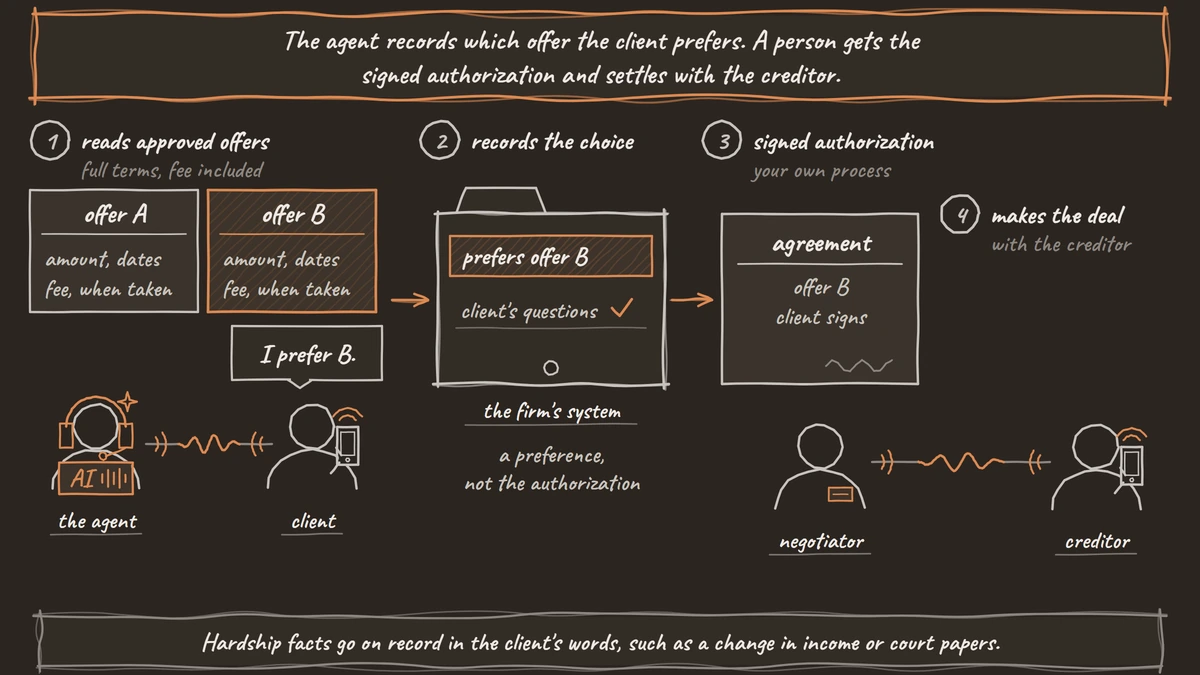
After verifying the client, the agent collects hardship facts in the client's words, such as a change in income or court papers. Then it reads the offers your system approved, with their full terms, including the firm's fee and when it is taken. It never sums up an offer as a saving.
The agent records which option the client prefers and any questions. It never treats the client's "yes" as the authorization. The fee rule turns on an agreement the client signed, so a person gets the client's signed authorization through your own process and then settles with the creditor. AI voice agents for debt settlement negotiation calls covers the full call.
Deposit and installment reminders
Reminder calls are about money that is the client's own, and the agent reads every figure from the account administrator. Under the Telemarketing Sales Rule, the dedicated account belongs to the client, sits at an insured bank, and is run by a company that isn't owned by or tied to the firm. The client can withdraw at any time.
So the reminder never implies that the client can't stop or get the money back. After an approved check, the agent reads the next draft date and amount and records whether the deposit will go through. Installments on an agreed settlement work the same way, though a missed one can count as a default under many settlement agreements.
If the client can't make the deposit or wants to pause or leave the program, the agent records it and hands the call to a person. It never takes card numbers. Dograh has no keypad (DTMF) tool and no feature for taking payments on a call, so an HTTP API tool asks your system or the administrator to send its own secure link. AI voice agents for payment-plan reminders in debt settlement covers consent and voicemail.
Status calls and handing over to a person
"What's happening with my account?" is a call every firm gets, and the agent answers it only after a check. Every call runs greet, verify, then disclose. A phone number finds the record, but it doesn't prove who is calling. So the agent asks for your firm's approved check, for example date of birth together with the last digits of the enrolled account.
Pre-Call Data Fetch can load the record for the calling number as the call connects, and the prompt keeps every detail unspoken until the check passes. Then the agent reads the stage and the next step, such as which debts have a settlement in place. Build that endpoint to return only what the agent may say.
Money questions go to a person. In 2025, consumers filed 438 debt settlement complaints about unauthorized withdrawals or charges, out of 2,139 in the CFPB's database. A client who questions a withdrawal or a fee should reach someone who can open the account.
Transfer Call works on Twilio, Telnyx, Plivo, Cloudonix and Asterisk ARI. Dograh calls the destination first and connects the caller only when someone answers. On Twilio, it can play a short spoken introduction to both people before connecting them. No summary travels by default, so the agent writes the details to your system through an HTTP API tool first.
If nobody answers within the 30-second default, the caller stays with the agent. Tell it in the prompt to offer a callback and write that request to your system. Browser test calls can't transfer, so test every transfer on a real phone line.
Join the Dograh Community
Dograh is an OSS alternative to Vapi. Join our Slack community for queries, releases, best practices & community interactions.
Consent and recording on these calls
Outbound calls to clients need consent, and the kind depends on what the call says. Under the Telephone Consumer Protection Act (TCPA), the FCC's 2024 ruling on AI-generated voices says an AI voice counts as an artificial voice. So calls that use one need the called person's prior express consent.
A call about something the client already has, such as their plan, a document or a deposit, is generally informational, and prior express consent covers it. Any offer turns the call into telemarketing, which needs prior express written consent. That includes asking a client to enroll another debt. So keep offers off service calls and put them on their own list, built only from clients whose written consent sits in your system.
Recording adds a second rule. Some states require every party's consent before a call is recorded, so say in the greeting that the call is recorded. Our post on call-recording consent laws shows how to set it up.
A client who asks not to be called again comes off your list. The agent writes the opt-out to your system during the call, and your system removes the number from the next list. Fee and consent rules also differ by state, so confirm your firm's position with counsel before the first call.
Where client call data sits
These calls carry debts, incomes, hardship and sometimes lawsuits, so decide where the audio and transcripts live before you go live. Dograh is self-hostable. Run it on your own servers and the platform never sees your clients' data. The page on self-hosted voice agents for debt settlement and credit repair covers status calls and deposit reminders run from your own system, with required lines played as fixed text your counsel wrote.
Dograh is the orchestration layer that runs the call flow, tools and telephony, and the speech and language models are a separate layer you choose. Bringing your own keys (BYOK) to a model provider changes whose contract covers the models, but the audio still reaches that provider. Data stays fully in-house only with open-weight models on your own servers, such as Qwen3.8 27B for language, Parakeet TDT 0.6B v2 for speech-to-text and Magpie TTS for the voice. The phone carrier stays on the call either way, and so does your cloud provider if the servers run in one.
The Telemarketing Sales Rule asks sellers and telemarketers to keep each script and a record of each telemarketing call for five years. Dograh has no retention setting and no automatic deletion for recordings and transcripts, so your own schedule decides how long they stay. Self-hosted, recording can be switched off only server-wide, and transcripts are still saved.
The self-hosting guide covers the install. Self-hosted Dograh has no per-minute platform fee, but servers, model keys and phone minutes still cost money. Dograh Cloud charges a 1¢-a-minute platform fee, and its managed models are about $0.07 a minute for most models, billed separately.
Which call to hand over first
Start with inbound status calls, because the agent only reads, after a check, from an endpoint with no projections in it. Deposit reminders come next, then onboarding calls, then enquiry calls. Settlement offer calls go last, once your offer endpoint and hand-over are tested.
Test on a real phone number before launch. Most phone calls reach the agent as 8 kHz audio, while a browser test runs at 16 kHz, so creditor names can sound different to the speech model. Ask "how much will I save" and "when will my score go up" in as many ways as your staff can think of, and check that the agent hands each one over.
Once live, use QA as the safety net. Replace its system prompt with instructions that flag any call where the agent mentioned savings, a percentage, a score change, a removal or a timeline, and keep the Sample Rate at 100% for that check. A person reviews each flagged call the same day.
Each call above has its own deep dive:
- AI Voice Agents for Debt Settlement Negotiation Calls
- AI Voice Agents for Enrollment & Onboarding Calls in Credit Repair
- AI Voice Agents for Payment-Plan Reminders in Debt Settlement
Glossary
- Dedicated account
- The account a debt settlement client's deposits build up in. Under the Telemarketing Sales Rule it belongs to the client, sits at an insured bank, is run by a company not tied to the firm, and the client can withdraw at any time.
- Advance fees
- Debt relief fees taken before the work is done, which the Telemarketing Sales Rule bans. No fee is allowed until at least one debt is settled under an agreement the client signed and the client has made a payment under it.
- Consumer Credit File Rights
- The title of the written statement the Credit Repair Organizations Act requires a credit repair firm to give before any contract is signed. It belongs in the firm's documents, never in a call script the model writes.
- Prior express written consent
- The signed consent a telemarketing call with an AI voice needs under the TCPA. A reminder that adds an offer, such as enrolling another debt, becomes a call that needs it.