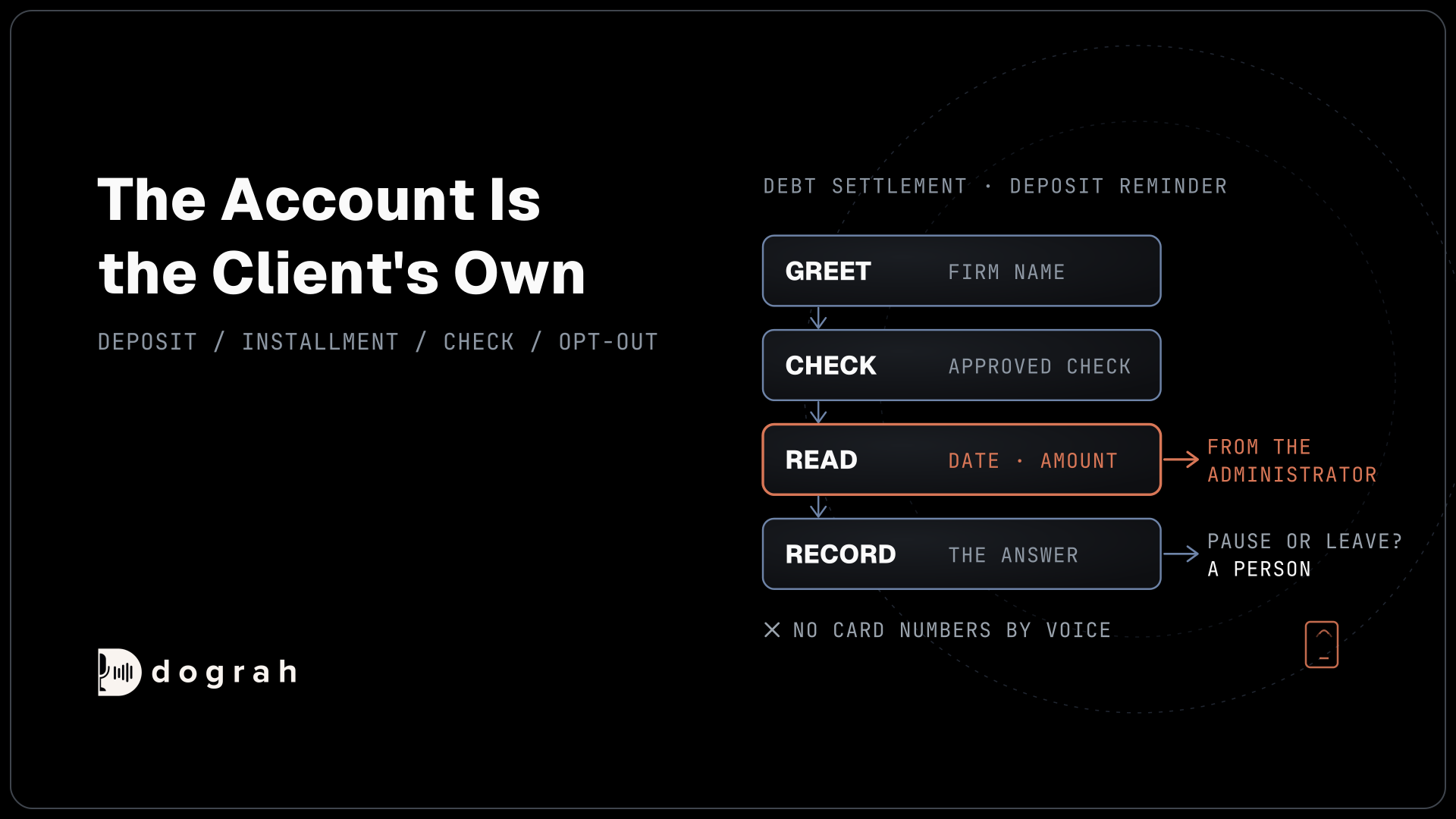

AI voice agents for payment-plan reminders in debt settlement call clients before a deposit into their dedicated account, or a settlement installment, is due. After an approved check, the agent reads the date and amount from the account administrator and records the client's answer. It never takes card numbers, and pause or exit requests go to a person.
Key Takeaways
- The dedicated account is the client's own. The call never implies otherwise.
- Your system or the administrator sends any payment link. No card numbers by voice.
- A reminder about an agreed plan is a service call. An offer changes that.
This post is part of our guide to AI Voice Agents for Credit Repair & Debt Settlement. Below, we cover the two reminders a settlement program needs and the consent rules behind them. Then we set up the reminder call in Dograh, the open-source AI voice agent platform we build.
Two reminders: deposits and installments
A settlement program runs on two kinds of payment, and the agent reminds the client about both from the same record. The first is the monthly deposit into the client's dedicated account, which builds the money for future settlements. The second is an installment on a settlement the client already agreed to. How the client first hears that settlement's terms is covered in our post on debt settlement negotiation calls.
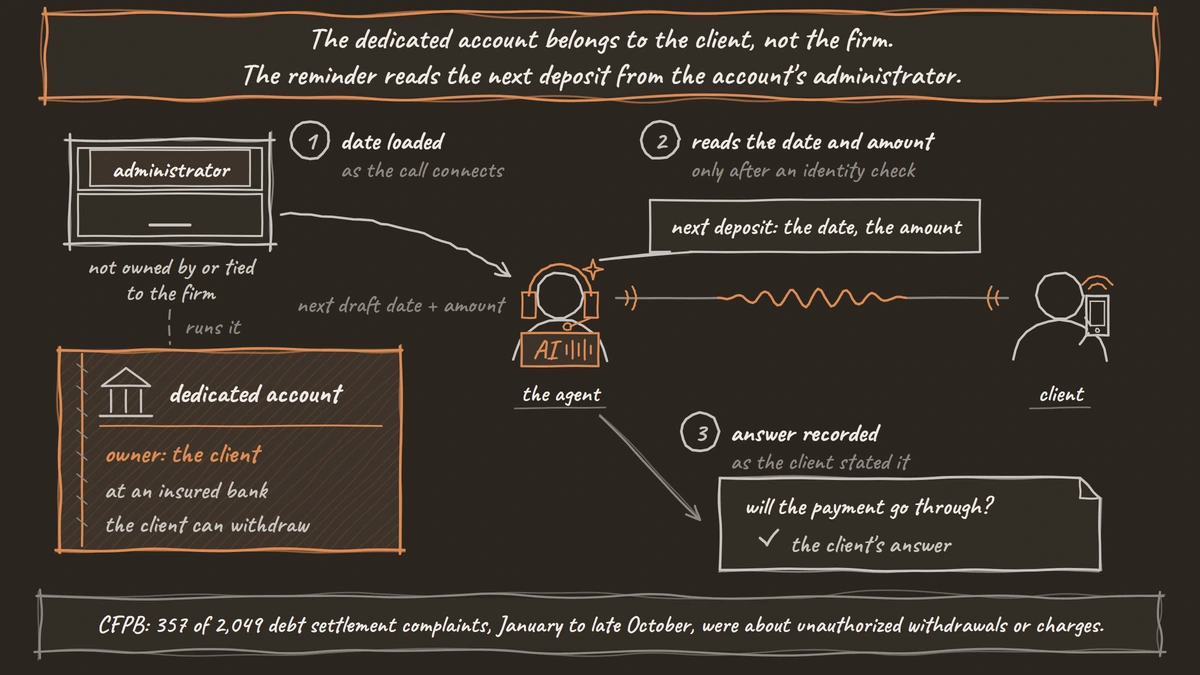
The dedicated account belongs to the client. Under the Telemarketing Sales Rule, as the FTC's debt relief guide for business explains, it sits at an insured bank and is run by a company that isn't owned by or tied to the firm. The client can withdraw at any time, and a client who leaves gets the balance back, minus fees the firm already earned. So a reminder never says or implies that the client can't stop or will lose the money.
Installments carry a different risk. A consumer attorney's guide to stalled programs warns that many settlement agreements treat a missed installment as a default, and the original balance can come back. A call a few days before the due date gives the client time to fix a problem.
This is not a collection call. The firm calls its own client about the client's own plan. Our post on payment and bill reminders covers billing reminders and where collection begins.
Reading the date and amount after a check
The agent states a date or an amount only after the client passes a check, and only as your records show it. The call runs greet, verify, then disclose. A phone number finds the client's record but doesn't prove who answered, so the agent asks for your firm's approved check, for example date of birth together with the last digits of the enrolled account.
Pre-Call Data Fetch loads the client's next draft date and amount as the call connects, from your system or the account administrator's. The prompt keeps both unspoken until the check passes. Then the agent reads them out and records whether the payment will go through, as the client stated it.
Reading from the administrator matters because money questions are where trust breaks. In the CFPB's complaint database, 357 of the 2,049 debt settlement complaints consumers filed from January to late October 2026 were about unauthorized withdrawals or charges. The agent never states a balance or a draft it didn't read, and a client who questions a withdrawal goes to a person.

Open Source Alternative to Vapi / Retell
Self-hosted voice agent platform — no per-minute fees
dograh-hq/dograh
Star on GitHub
When a client wants to pause or leave
A client who can't make a deposit or wants out of the program is making a choice about their own money, and a person handles it. The agent records the request in the client's words and hands the call over. It never argues or warns that funds are lost.
If the client asks, the agent can say only that the dedicated account is theirs. Everything else, including fees already earned and how the balance comes back, comes from a person reading the client's actual file.
Transfer Call works on Twilio, Telnyx, Plivo, Cloudonix and Asterisk ARI. Dograh calls the destination first and connects the client only when someone answers. No summary travels by default, so the agent writes the request to your system first. If nobody answers within the 30-second default, the client stays with the agent, and the prompt has it record a callback request.
No card numbers on the call
The reminder never collects a payment by voice. Dograh has no keypad (DTMF) tool and no feature for taking payments on a call, and card numbers spoken aloud would land in the transcript and recording.
If a client wants to make an extra deposit or catch up a missed one, an HTTP API tool asks your system or the account administrator to send its own secure link by text or email. Dograh sends no texts itself. If the client starts reading a card number, the agent stops them and explains that the link is coming. Our post on handling payment-sensitive calls covers the wider card rules.
Join the Dograh Community
Dograh is an OSS alternative to Vapi. Join our Slack community for queries, releases, best practices & community interactions.
Consent, opt-outs and voicemail
Reminder calls need consent, and the kind depends on what the call says. Under the Telephone Consumer Protection Act (TCPA), the FCC's 2024 ruling on AI-generated voices treats an AI voice as an artificial voice. A reminder about the client's own plan is generally informational, so prior express consent covers it. Any offer, such as enrolling another debt, makes the call telemarketing, which needs prior express written consent. So keep offers off reminder calls.
Clients can take consent back, and consent revocation needs no form. Under the FCC's calling rule, they can revoke it in any reasonable way, including on the call, and the firm must honor it within ten business days. The agent writes the opt-out to your system during the call, and your system removes the number from the next list.
Voicemail needs care, because anyone in the household might hear it. Voicemail handling is off by default. Once you turn it on, "Disconnect the call" is preselected, and a message plays only if you set it to Leave a message. That message plays right after the greeting is classed as voicemail, so keep it to the firm's name and a callback number, with no plan or debt details. Detection works only on cascade agents, and our post on voicemail detection explains the settings. Consent and revocation rules have state versions too, so confirm your setup with counsel.
Setting up reminder campaigns in Dograh
Reminders run as a daily campaign built from your system's list of upcoming drafts and installments. Export the clients due in the next few days, with consent on file and minus anyone who opted out, and upload the list to Campaigns as a CSV.
A campaign's calling hours run in one time zone, so split the list by time zone and run one campaign per zone. Retries run from 0 to 10, 2 by default, with a delay of 30 seconds to an hour between them. Campaigns have no per-person call cap, so your list decides how often a client hears from you.
Test every path on a real phone line, because browser test calls can't transfer. Then use QA as the safety net. Replace its system prompt with instructions that flag any call where the agent mentioned an offer, a card number, a balance it didn't read or a warning about lost funds, and keep the Sample Rate at 100%. A person reviews each flagged call the same day.
Glossary
- Dedicated account
- The account at an insured bank where a debt settlement client's deposits build up. Under the Telemarketing Sales Rule it belongs to the client, is run by a company not tied to the firm, and the client can withdraw at any time.
- Account administrator
- The company that runs the dedicated account for the client. The reminder reads the next draft date and amount from its records, and its own system sends any secure payment link.
- Consent revocation
- A client taking back consent to calls. Under the FCC's rule it can happen in any reasonable way, including on the call, so the agent writes it to the firm's system and the number comes off the next list.
- Telephone Consumer Protection Act (TCPA)
- The US law under which the FCC's 2024 ruling treats an AI voice as an artificial voice. A reminder about the client's own plan generally needs prior express consent, and adding an offer raises that to written consent.