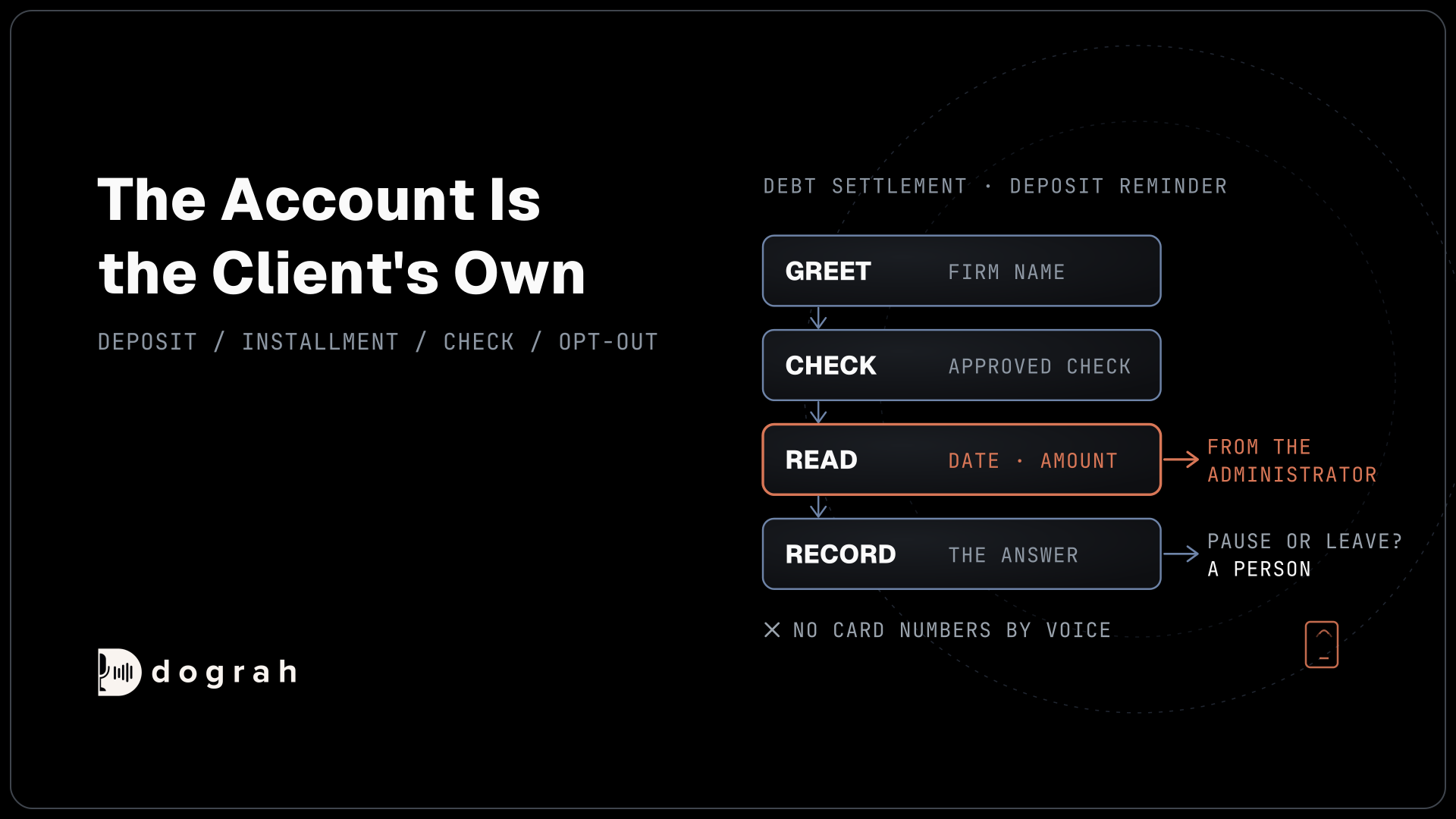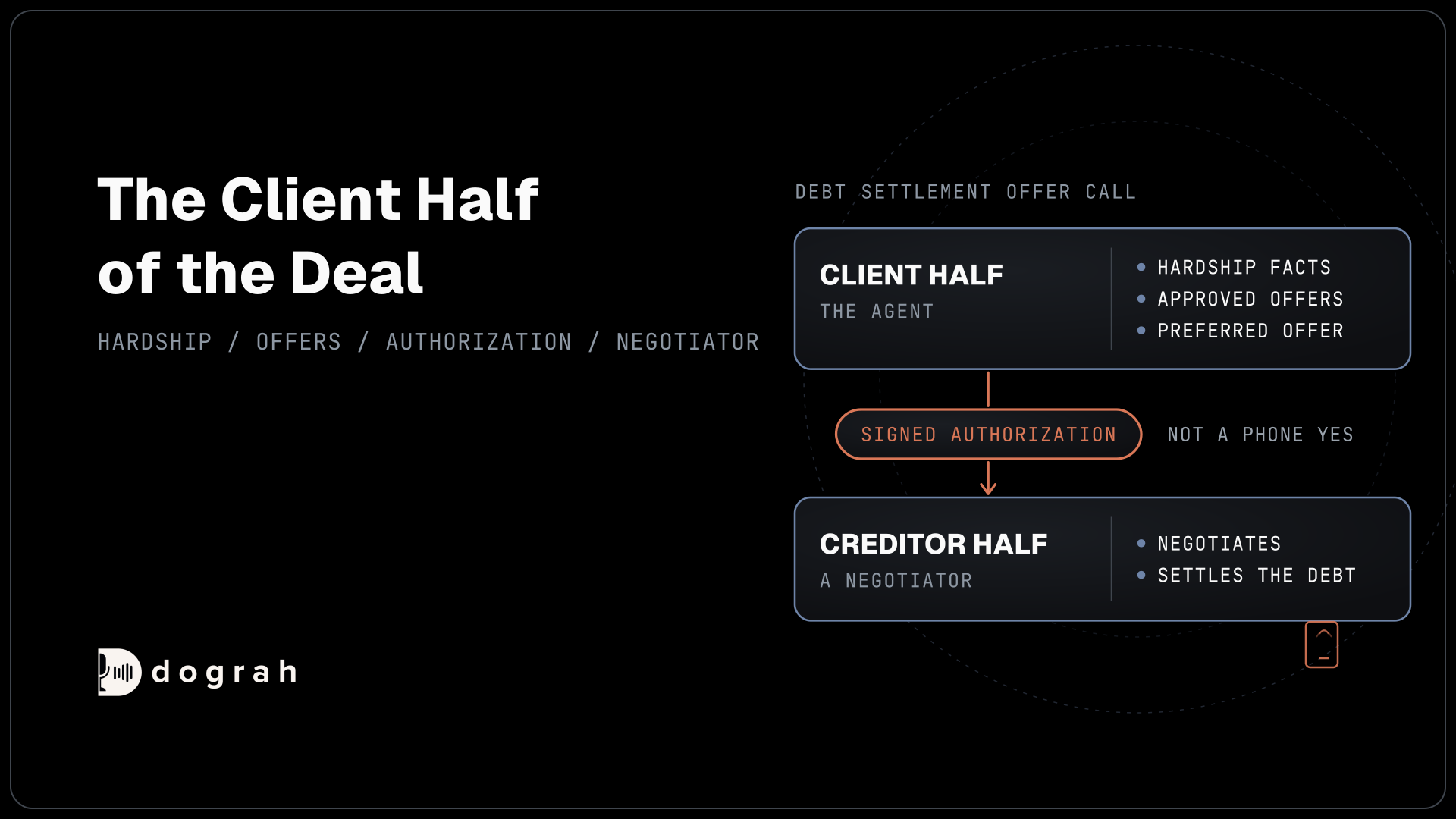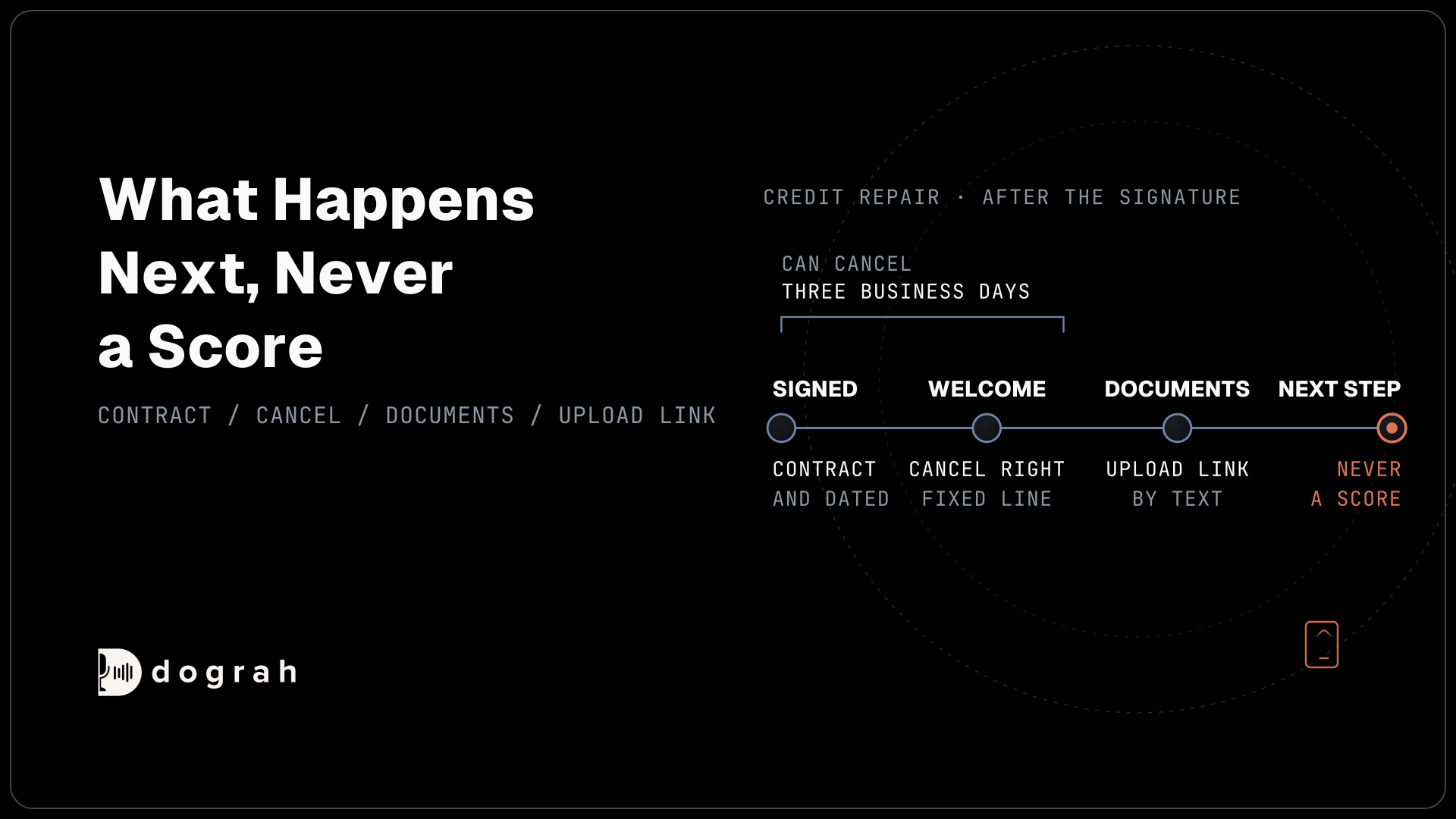

AI voice agents for enrollment and onboarding calls in credit repair call clients after they sign. After an approved check, the agent confirms the contract arrived and explains the three-business-day right to cancel. It names any missing document, and your system sends the upload link. The agent says what the firm does next, never what changes on a report.
Key Takeaways
- The rights statement and contract reach the client in writing before any call.
- Documents never go through the call. Your system sends the upload link.
- The next-step call says what the firm does next, never what the score does.
This post is part of our guide to AI Voice Agents for Credit Repair & Debt Settlement. Below, we cover the order the law sets for onboarding and each call in it. Then we set up the calls in Dograh, the open-source AI voice agent platform we build.
The order the law sets before any call
Credit repair onboarding follows a fixed order, and the calls fit inside it. The Credit Repair Organizations Act (CROA) requires a firm to give the client a separate written statement, "Consumer Credit File Rights Under State and Federal Law", before any contract is signed. The CROA's contract rules then call for a signed, dated written contract. The work can't start until three business days after signing, and the client can cancel without penalty before midnight of the third business day.
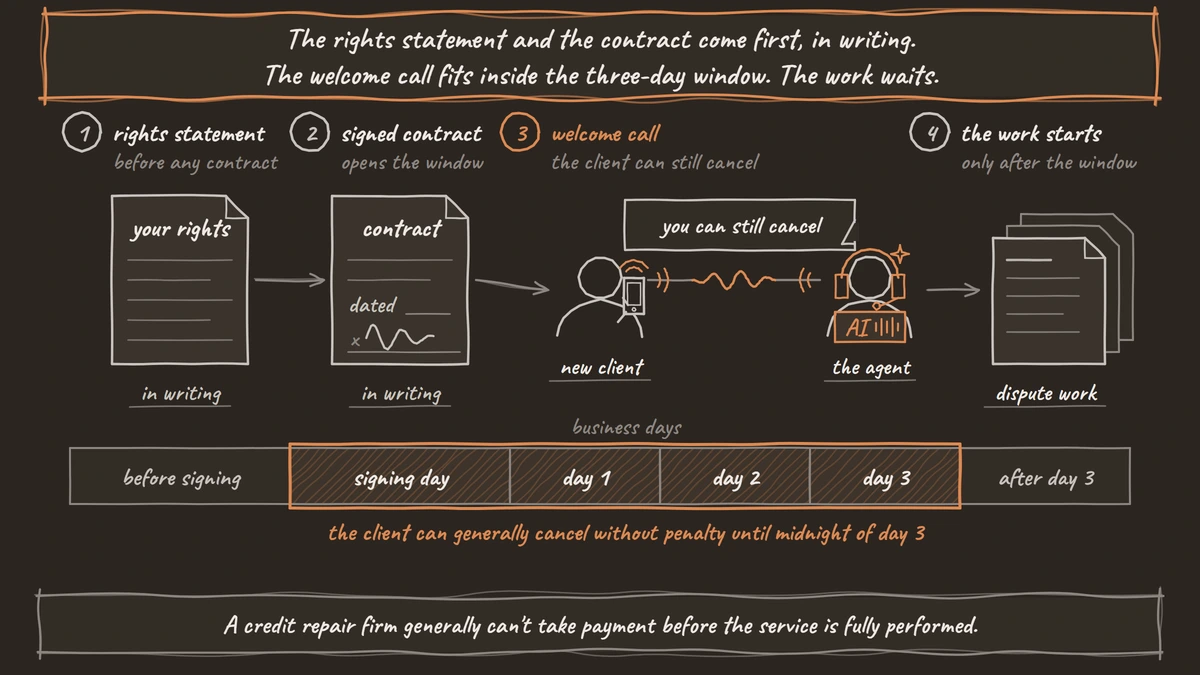
So the statement and contract are written documents the client gets before signing. They are never a call script the model writes. The calls start after the signature, and they explain where the client stands.
Disclosures are where many complaints land. In the CFPB's complaint database, consumers filed 1,397 credit repair complaints from January to late October 2026, and 694 of them, about half, cited confusing or missing disclosures. A welcome call that says plainly what happens next answers the same confusion before it turns into a complaint.
Fees follow their own rule. A credit repair firm can't take payment before a service is fully performed, and when credit repair is sold by phone, payment waits even longer. Our guide covers both rules, and the onboarding calls never quote a fee the agent didn't read from your system.
The welcome call inside the three-day window
The welcome call reaches a new client while they can still cancel, and it tells them so. Your system starts it the moment a contract is signed, through the API Trigger, with the client's number and record ID.
The call runs greet, verify, then disclose. The Greeting Text names the firm. A phone number finds the client's record but doesn't prove who answered, so the agent asks for your firm's approved check, for example date of birth together with the last digits of the client account number. Only then does it talk about the contract.
The agent confirms that the contract and the rights statement arrived, and asks whether the client has questions about them. Then it states the three-business-day cancellation right as a fixed line your counsel wrote, such as "You can cancel your contract without penalty before midnight of the third business day after you signed it." Put that line in a pathway's Transition Speech, which plays with the caller muted and runs in full. Transition Speech can't carry the client's own date, so the cancel-by date comes from your system and the model reads it out.
Then it explains what happens after day three. The work waits for your system to clear the window, and the agent never starts anything itself. This is a call about something the client already has, so prior express consent generally covers it. Keep offers off it, because an offer turns it into telemarketing, which needs prior express written consent.

Open Source Alternative to Vapi / Retell
Self-hosted voice agent platform — no per-minute fees
dograh-hq/dograh
Star on GitHub
The document call: name it, send the link
Disputes can't go out without the client's documents, and the agent names what's missing without collecting it. Credit repair software sets the list. Credit Repair Cloud's dispute letter FAQ, for example, asks for a photo ID and proof of address for the first round, and has the client sign a Limited Power of Attorney in the client portal.
After the check, the agent reads which items your system still lacks and says why each one matters. A photo ID shows the letters come from the client. A utility bill shows the current address, and a state ID counts only if it shows that address. Then an HTTP API tool asks your system to send its secure upload link by text or email. Dograh sends no texts itself.
Nothing sensitive is read out on the call. The agent never asks for a full Social Security number or an ID number. Those go through the upload link, where your system stores them. The same pattern runs in lending, covered in our post on loan document collection.
For clients still missing items a few days later, run a daily list through Campaigns. A campaign's calling hours run in one time zone, so split the list by time zone. Retries run from 0 to 10, 2 by default, and campaigns have no per-person call cap, so your list decides how often anyone hears from you. Debt settlement firms use the same daily-list setup for payment-plan reminder calls.
The next-step call never predicts a score
The next-step call says what the firm will do next and when the client will hear, and nothing about what the credit report will show. The client often asks the second question first. "Will my score go up?" and "When will that late payment come off?" go to a person.
There's a legal reason as well. The FTC's credit repair FAQs say no one can legally remove accurate, current information from a credit report. The FTC also lists red flags, such as telling a client not to contact the credit bureaus, or to dispute information they know is accurate. The agent never says either, and never offers a "new credit identity".
So the agent reads the next step from your system, such as the letters going out this week or the date a specialist will call. It never states score points or a timeline for removals, and never says "we'll remove that". Tell the agent in the prompt to hand any score or removal question to a person, with the details written to your system first. CROA bans misleading claims about a credit repair service, and state rules add their own, so confirm your scripts with counsel before launch.
Join the Dograh Community
Dograh is an OSS alternative to Vapi. Join our Slack community for queries, releases, best practices & community interactions.
Setting up onboarding calls in Dograh
The onboarding calls share one agent, and your system decides which call each client gets. Pre-Call Data Fetch loads the client's record as the call connects: the cancel-by date and the missing items. The prompt keeps all of it unspoken until the check passes. The Greeting Text uses a fallback such as {{client_name | there}}, so a missing name is never spoken as a blank.
Voicemail handling is off by default. Once you turn it on, set it to leave a message that gives only the firm's name and a callback number, because anyone in the household might hear it.
Test every path on a real phone line before launch. Then use QA as the safety net. Replace its system prompt with instructions that flag any call where the agent mentioned score points, a removal, a timeline or a fee it didn't read, and keep the Sample Rate at 100%. A person reviews each flagged call the same day.
Glossary
- Consumer Credit File Rights
- The title of the separate written statement the Credit Repair Organizations Act requires a credit repair firm to give before any contract is signed. It belongs in the firm's documents, never in a call script the model writes.
- Three-business-day cancellation right
- The client's right under CROA to cancel a credit repair contract without penalty before midnight of the third business day after signing. Work can't start until that window closes.
- Limited Power of Attorney
- A form some credit repair firms have clients sign at onboarding so the firm can send dispute letters for them. The agent can name it as a missing item, and the client signs it in the firm's own portal.
- Credit Repair Organizations Act (CROA)
- The federal law that sets the order of credit repair onboarding, from the written statement to the signed contract and the wait before work starts. It also bans misleading claims, so the agent never promises score points or removals.