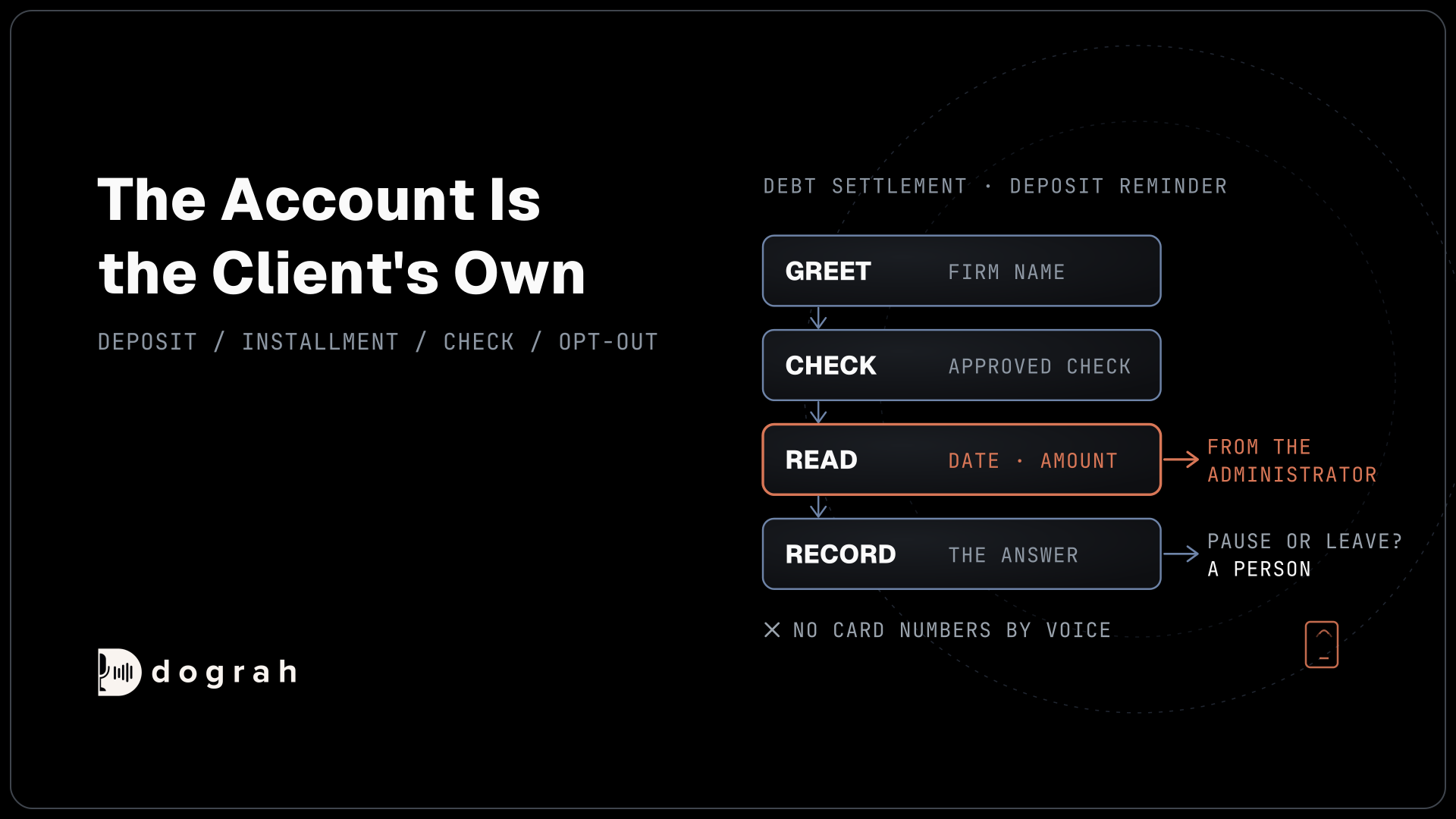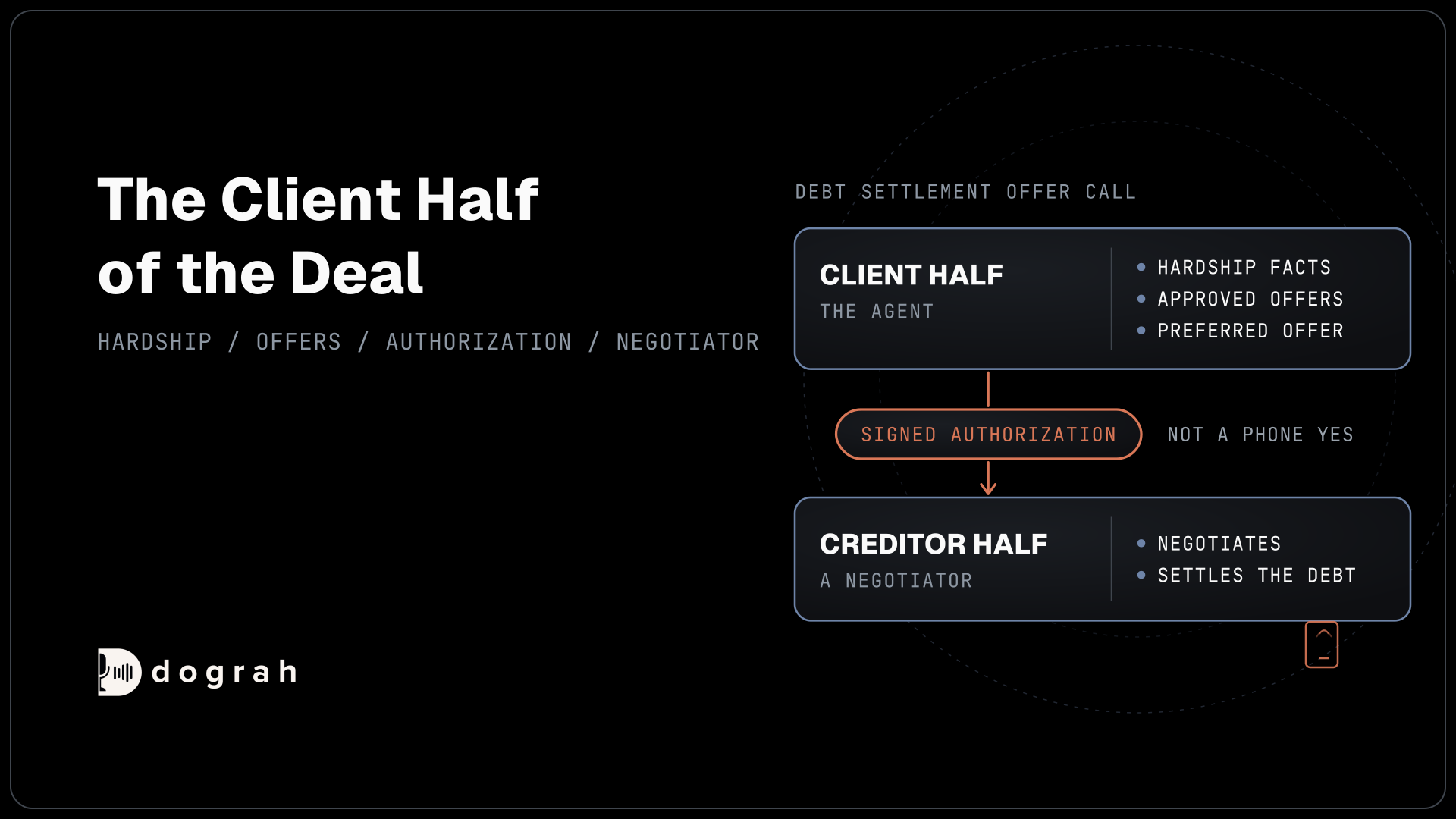

AI voice agents for debt settlement negotiation take the client side of the deal. After an approved check, the agent collects hardship facts, reads the offers your system approved with their full terms, and records which one the client prefers. A person then gets the client's signed authorization and settles with the creditor. The agent never promises savings.
Key Takeaways
- The agent talks only with your client. Negotiators call the creditors.
- Your offer endpoint returns approved offers only, with every term spelled out.
- A client's spoken yes is a preference. The signed agreement is the authorization.
This post is part of our guide to AI Voice Agents for Credit Repair & Debt Settlement. Below, we cover which half of a negotiation the agent takes and how it reads offers. Then we set up the offer call in Dograh, the open-source AI voice agent platform we build.
Which half of the negotiation the agent takes
A settlement has a client half and a creditor half, and the agent takes only the client half. Some products send an AI agent to the collector. Kikoff, for example, offers an AI tool that negotiates with debt collectors for the user, and its own page says nothing is finalized without the user's approval. For a firm, calls to creditors and collectors stay with your negotiators.
The creditor half is judgment work. The FTC's guide to getting out of debt notes that creditors have no obligation to agree to negotiate a settlement, so every offer is a separate negotiation a person runs.
The client half has its own legal weight. Under the Telemarketing Sales Rule, a debt relief firm earns no fee until a debt is settled under an agreement the client signed and the client has made a payment under it. So the client's signed settlement authorization is a legal step, and a phone "yes" to an agent doesn't replace it.
This call is also not debt collection. The firm works for the client, and the agent calls its own client about their own program. The collector's side, with its own rules, is in our post on AI voice agents for debt collection.
Hardship facts, recorded as the client says them
Negotiators need current facts before they can push a creditor, and the agent collects them in the client's words. The call runs greet, verify, then disclose. A phone number finds the client's record, but it doesn't prove who is speaking. So the agent asks for your firm's approved check, for example date of birth together with the last digits of the enrolled account, before it names any debt or offer.
Then it asks what changed, such as income, a new monthly budget, a job loss or a medical bill, and which enrolled debts worry the client most. It also asks whether the client has received court papers on any debt. A settlement program doesn't stop a lawsuit, so a "yes" goes to a person on the same call.
The agent records each answer as the client stated it. Variable extraction is an AI step, so the transcript and recording stay the exact record of what was said. The negotiator reads the facts, and checks the recording when a detail matters.

Open Source Alternative to Vapi / Retell
Self-hosted voice agent platform — no per-minute fees
dograh-hq/dograh
Star on GitHub
Reading approved offers with their full terms
The agent reads only offers your system approved, and it reads every term. An HTTP API tool asks your system for this client's open offers during the call. Dograh hands the whole response to the language model, so anything the endpoint returns, the agent can say. Build that endpoint to return only offers a negotiator or your rules approved, and never a projected saving.
Each offer comes with its full terms. That means the settlement amount, the number of installments, their dates, and the firm's fee and when it is taken. The fee timing matters. A consumer attorney's guide to stalled programs warns that many settlement agreements treat a missed installment as a default, and that a firm generally takes its full fee for that account once the first installment is paid. A client who hears the whole schedule can judge whether the payments fit.
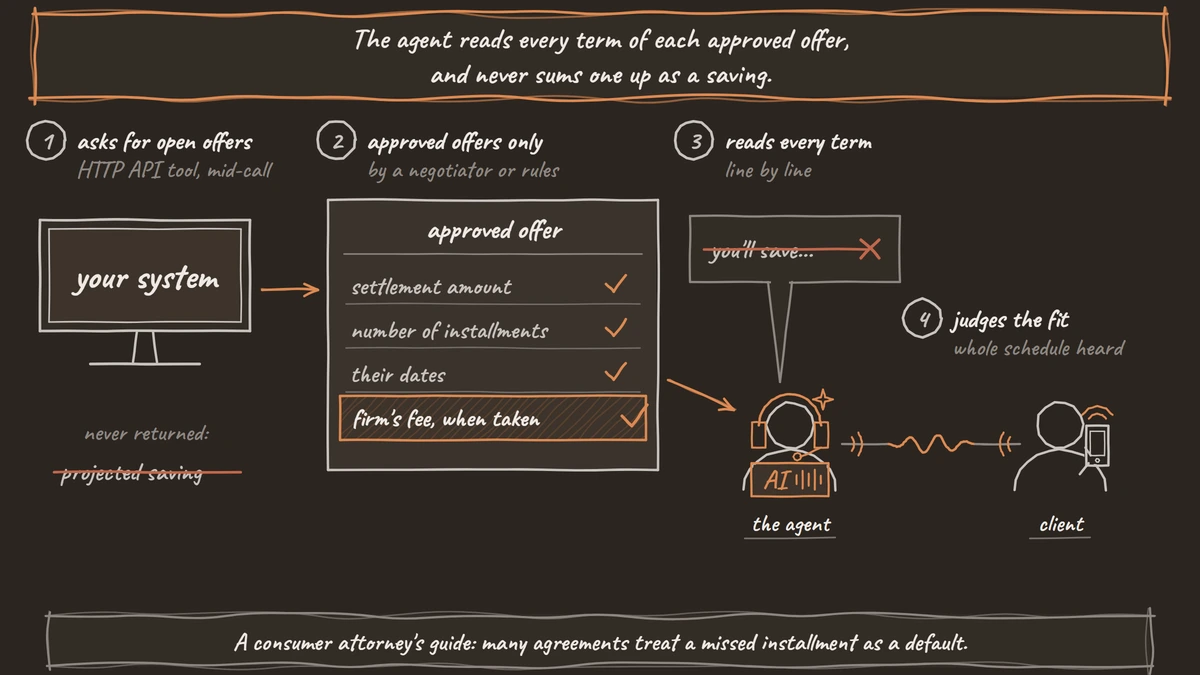
The agent never sums up an offer as a saving or a percentage off. Promises are where complaints start. In the CFPB's complaint database, consumers filed 2,049 debt settlement complaints from January to late October 2026, and 604 of them named "Didn't provide services promised" as the issue.
A fixed line can frame every offer. Put it on the pathway into the offers as Transition Speech, for example: "These offers came from your creditors through our negotiators. Nothing is final until you sign the agreement we send you." It plays with the caller muted, so it runs in full. It can't carry the client's figures, so the amounts come from the endpoint and the model speaks them. That makes QA and transcripts your check on what was said.
Recording the choice, then a person makes the deal
The agent records which offer the client prefers, and a person finalizes it. It writes the offer ID and any questions the client asked. It never records a "promise to pay", because this isn't a collection call.
After the call, a Webhook node sends those values to your system, and a temporary failure is retried automatically. Our post on extracting call data to your CRM shows how to set the fields up. A person then gets the client's signed authorization through your own process and settles with the creditor. Dograh has no e-signature feature, so that step stays in your system.
Some questions need a person on the call. A client who wants a different amount or schedule, or who asks about taxes, goes to a negotiator through Transfer Call. It works on Twilio, Telnyx, Plivo, Cloudonix and Asterisk ARI. Dograh calls the negotiator first and connects the client only when someone answers. No summary travels by default, so the agent writes the details to your system first.
On taxes, the agent gives no advice. The IRS page on canceled debt explains that forgiven debt is generally taxable income, with exceptions such as insolvency, so a tax question always goes to a person. Fee and tax rules turn on each client's facts, so confirm your scripts with counsel. Once a settlement is signed, payment-plan reminders keep its installments on track.
Join the Dograh Community
Dograh is an OSS alternative to Vapi. Join our Slack community for queries, releases, best practices & community interactions.
Setting up the offer call in Dograh
The offer call is one agent with a short flow, and most of its safety sits in your endpoint. Pre-Call Data Fetch loads the client's record as the call connects, and the prompt keeps it unspoken until the check passes. The Greeting Text names the firm and uses a fallback such as {{client_name | there}}, so a missing name is never spoken as a blank.
After the check, the hardship node asks its questions and extracts the answers. The offers pathway plays its Transition Speech, then the offer tool reads the approved offers. The last node extracts the preferred offer and any questions before the Webhook node runs.
Test it on a real phone line, because browser test calls can't transfer. Then use QA as the safety net. Replace its system prompt with instructions that flag any call where the agent mentioned savings, a percentage off, a credit score or tax advice, and keep the Sample Rate at 100%. A negotiator reviews each flagged call before the authorization goes out.
Glossary
- Settlement authorization
- The client's signed agreement to one settlement offer. Under the Telemarketing Sales Rule the firm's fee depends on it, so a person collects it through the firm's own process and a spoken yes on the call is only a preference.
- Hardship facts
- The changes a client reports, such as lost income or new medical bills, that a negotiator uses with a creditor. The agent records them as the client stated them, and the recording stays the exact record.
- Canceled debt
- The part of a balance a creditor forgives in a settlement. The IRS generally treats it as taxable income, with exceptions such as insolvency, so tax questions go to a person.
- Transition Speech
- A fixed line that plays word for word, with the caller muted, when the call moves onto a pathway. Here it frames every offer, but it can't carry the client's figures, so the amounts come from the endpoint.