
AI voice agents for warranty and extended-service plans handle calls for people who already hold a contract: claims, claim status, repair scheduling and coverage questions, all read from the administrator's system. Every outbound call opens with the company's registered name, never sounds like a warranty robocall, and makes no offer without the customer's prior express written consent.
Key Takeaways
- Open every outbound call with your registered business name, in fixed words.
- Coverage and claim status come from your system, never from the agent.
- A renewal offer is telemarketing and needs prior express written consent.
This guide covers the warranty calls a voice agent can take, from claims in your administration system to renewals, without sounding like a robocall. We show how each part works in Dograh, the open-source AI voice agent platform we build. You can self-host it or run it on Dograh Cloud.
Who calls a warranty company, and why
Almost every call to a warranty or service-contract company comes from someone who already holds a contract. A homeowner's water heater has failed and they want to open a claim. A driver whose car is at a repair shop wants to know whether the claim was approved. Others ask what their plan covers, want to book the technician, or want to cancel and ask about a refund.
A voice agent can take most of these if it reads and writes the plan administrator's system during the call. That system holds the contract, the coverage terms, the open claims and the repair slots. The agent opens a claim, reads its status and books a visit, and every answer it gives comes from that record.
Some decisions stay with people. Approving a repair or judging whether a failure is covered needs a claims adjuster, and so does a dispute. The agent records what the caller says and passes the claim on, so the adjuster starts with the facts.
Outbound calls are fewer, but they decide whether customers trust you. They include a claim update, a reminder that a technician is coming, or a note that a contract is close to its end date. Those calls are the subject of the next section.
Why your customers distrust warranty calls
People have learned to hang up on anyone who calls about their warranty, and the reason is a long run of robocalls. In its penalty order, the FCC fined one operation nearly $300 million for more than five billion auto warranty robocalls. The calls sold leads to vehicle service contract sellers, and their caller ID mimicked the area code of the person being called.
The complaints keep coming. The FTC's Do Not Call data book for fiscal 2025 records over 2.6 million Do Not Call complaints, and about 21,300 of them named warranties and protection plans as the topic.
The FTC's consumer advice on auto warranties tells people that calls and letters warning that a warranty is "about to expire" may make a seller look like the dealer or manufacturer, often under labels such as "Final Warranty Notice". It says those companies probably aren't working with the dealer or manufacturer at all.
So a real warranty company's agent has to sound nothing like that. It names your company before anything else and says why it is calling, in plain words. It never says a warranty is about to expire in that urgent style, and it never asks for a card number. If the customer is unsure, the agent invites them to end the call and ring back on the number printed on their contract. Fraud-alert callbacks follow the same idea. The agent gives information and never asks for anything a scammer would want.
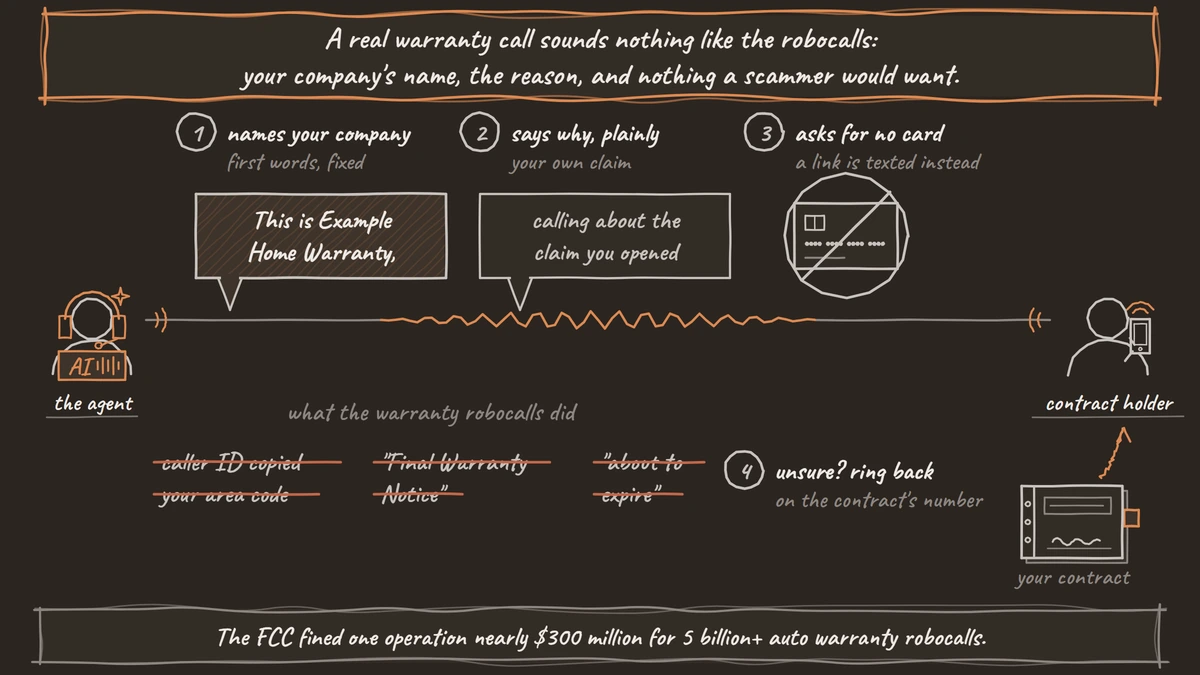
Name the company in the first sentence
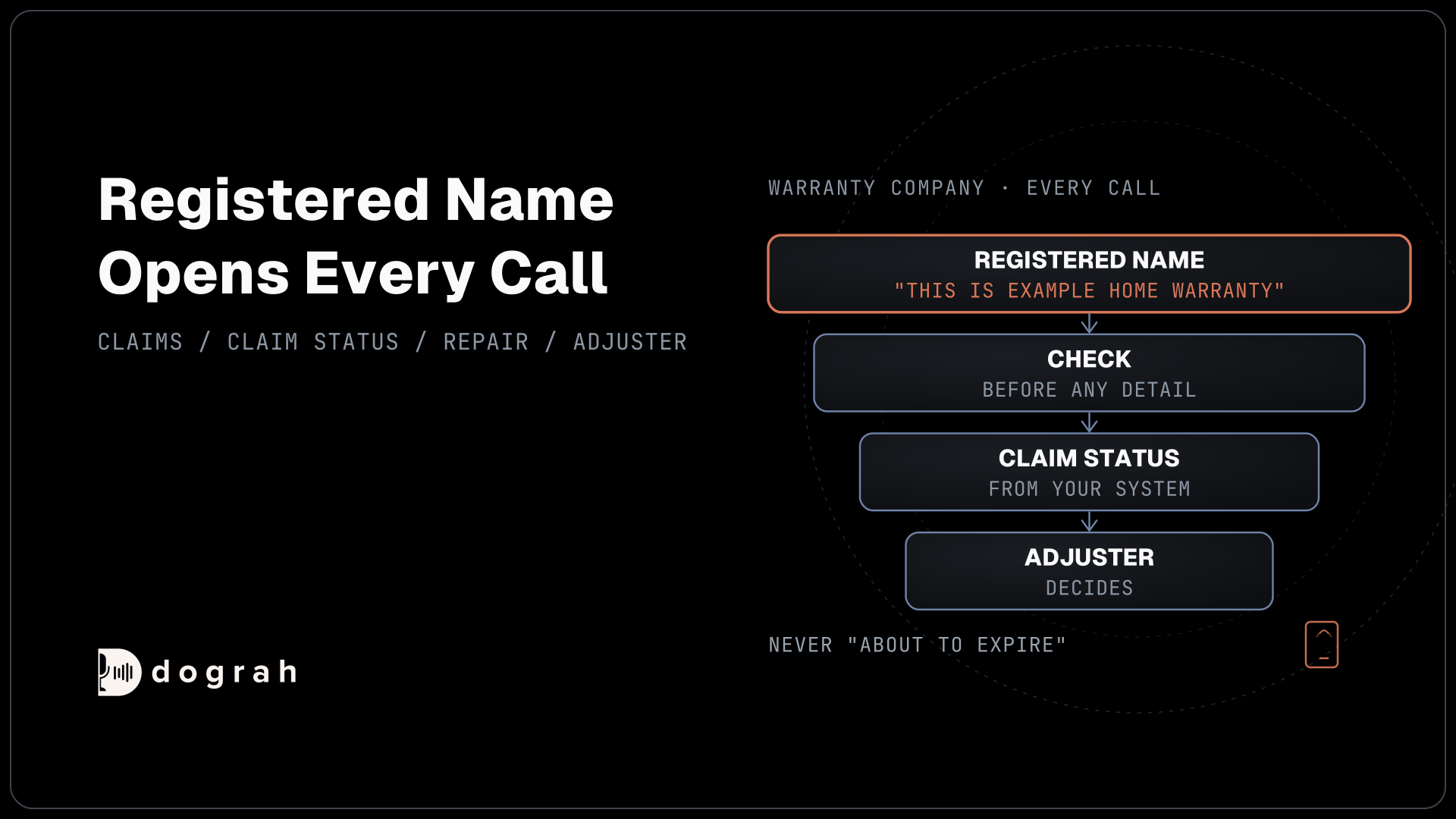
The company's name opens every call, as fixed words. The FCC's calling rules require an artificial or prerecorded voice message to say, at the start, which business is responsible for the call, using the name it is registered under with the state.
In Dograh, the Greeting Text on the Start Call node is spoken word for word. Put the registered name in its first sentence, then the reason: "This is Example Home Warranty, calling about the claim you opened on Monday." Variables need a fallback, such as {{customer_name | there}}, so a missing name is never spoken as a blank. If you want to tell callers they're speaking with an automated assistant, or your location requires it by law, write it in the Greeting Text along with the business's name.
The name on the screen is a separate matter. Caller ID name, often called CNAM, is set with your phone carrier, not in Dograh, so ask your carrier to register it before the first campaign.
Verify before any contract detail
A phone number finds the contract, but it does not prove who is calling, and neither does an address. Pre-Call Data Fetch can load the contract that matches the calling number as the call connects, and the prompt keeps every detail from it unspoken until the caller passes a check.
Your company decides that check, such as the contract number plus the ZIP code of the covered property, or date of birth together with the last digits of the contract number. If it fails, the agent shares nothing about the plan, records a callback request and gives the company's name and main number.

Open Source Alternative to Vapi / Retell
Self-hosted voice agent platform — no per-minute fees
dograh-hq/dograh
Star on GitHub
Claims and claim status from your system
The agent opens claims and reads their status, and every answer comes from the administrator's system. On a new claim, it asks what failed, when it happened and whether the item is still usable. An HTTP API tool first checks whether a claim for the same item is already open, then writes the new one. The agent reads back the claim number your system returns.
That tool hands your system's whole response to the language model, so the endpoint decides what the agent can say. Return the claim's status, the next step and any booked visit. Leave out adjuster notes and fraud flags, because anything the agent receives, it can repeat.
The agent never decides whether a repair is covered and never authorizes one. If the caller asks, it reads what your system says, such as "under review" or "approved for repair", and a claims adjuster makes every decision. A caller who disagrees with a decision goes to a person.
Many plans charge a service fee per claim. The agent can say the amount your system returns, but it takes no card number on the call. During the call, an HTTP API tool asks your system to text its secure payment link to the customer.
Booking the technician works the same way. The agent offers only slots your system returns, reads the chosen one back, and writes it with a Preset Parameter named workflow_run_id set to {{initial_context.workflow_run_id}}, so a request sent twice makes one booking.
Registration and recall calls
Registration and recall calls are where a manufacturer or plan administrator reaches buyers before anything has gone wrong. A registration call asks for the model, serial number and purchase date and sells nothing. A recall call reads the approved recall notice word for word, checks whether the caller's product is affected, and books the free fix.
AI voice agents for warranty registration and recall campaigns covers both calls in depth, including the consent rule for each and why recall wording must never be paraphrased.
Service calls and offers need different consent
A call about the customer's own contract is a service call, and an offer turns it into a sales call. Under the Telephone Consumer Protection Act (TCPA), the FCC's calling rules require the called party's prior express consent for a call to a mobile that uses an artificial or prerecorded voice. The FCC's 2024 ruling on AI voices confirmed that AI-generated voices are covered.
A claim update or a technician reminder to the number the customer gave you is generally informational, so that prior express consent covers it. A renewal offer, a plan upgrade or any new product makes the call telemarketing, which needs prior express written consent, meaning a signed agreement that clearly allows your calls. Holding a contract with you does not replace it for AI-voice sales calls to mobiles.
So keep offers off service calls. A renewal campaign runs separately, on a list your system has filtered to customers with written consent on file. Our post on service reminders in automotive makes the same split for dealers.
When a customer asks not to be called again, the agent writes the opt-out to your system during the call, and your system removes the number from the next list. Rules also differ by state, so confirm your own position with counsel before the first outbound campaign.
Voicemail and handing over to a person
A voicemail that mentions "your warranty" sounds like the scam, so keep it short or leave none. Voicemail handling is off by default. When you turn it on in Settings, "When voicemail is detected" is set to "Disconnect the call", and a message plays only if you choose "Leave a message". If you do, name the company and give the number on the contract, and nothing else. Our post on voicemail detection explains how detection works.
Disputes, authorizations and anything the agent cannot answer go to a claims person. Transfer Call works on Twilio, Telnyx, Plivo, Cloudonix and Asterisk ARI. Dograh calls the destination first and connects the caller only when someone answers. On Twilio, it can play a short spoken introduction to both people before connecting them.
No summary travels with the call by default, so the agent writes the claim number and the reason to your system first. If nobody answers within the 30-second default, the caller stays with the agent. Tell it in the prompt to offer a callback and write that request to your system. Browser test calls cannot transfer, so test every transfer on a real phone line.
Join the Dograh Community
Dograh is an OSS alternative to Vapi. Join our Slack community for queries, releases, best practices & community interactions.
Where warranty call data sits
Warranty calls carry names, addresses, contract numbers and details of people's homes and cars, so decide where that data lives before the first call. Dograh is self-hostable. Run it on your own servers and the platform never sees your callers' data.
The speech and language models are a separate layer you choose. Bringing your own keys (BYOK) to a model provider changes whose contract covers the models, but the audio still reaches that provider. Data stays fully in-house only with open-weight models on your own servers. The phone carrier stays on the call either way.
The platform has no retention setting and no automatic deletion for recordings and transcripts, so your own retention schedule handles them, and our post on call-recording consent laws covers what to say before recording. The self-hosting guide covers the install. Self-hosted Dograh has no per-minute platform fee, but servers, model keys and phone minutes still cost money. Dograh Cloud charges a 1¢-a-minute platform fee, and its own managed models, if you use them, are a separate charge of about $0.07 a minute for most models.
Which call to hand over first
Start with inbound claim-status calls, because the agent only reads from your system after a check. Add claim intake next, once the duplicate check and the claim number read-back pass every test. Outbound service calls come last, after your carrier has registered your caller ID name and your consent records are filtered by call type.
Before launch, call the agent from a real phone. Ask it, in as many ways as you can, whether a repair is covered, and check that it only reads your system's status. Ask it to take your card number and check that it refuses.
Once live, replace the QA system prompt with warranty-specific instructions that flag any call where the agent mentioned an offer, a deadline or a payment card. A supervisor reads those transcripts the same day.
The registration and recall calls have their own deep dive:
Glossary
- Vehicle service contract
- A paid plan that covers certain car repairs, often sold as an extended warranty. Robocalls selling them are why customers distrust any call about their warranty.
- Prior express written consent
- A signed agreement, e-signatures included, that clearly allows a business to make telemarketing calls with an artificial or AI voice to a number. A renewal or upgrade offer needs it, and a claim update does not.
- Caller ID name (CNAM)
- The business name a phone shows for an incoming call. It is registered through the phone carrier, not set in the voice agent.
- Plan administrator
- The company that runs warranty contracts and claims, and holds the system the agent reads from. It decides coverage, and the agent only reports what it decided.