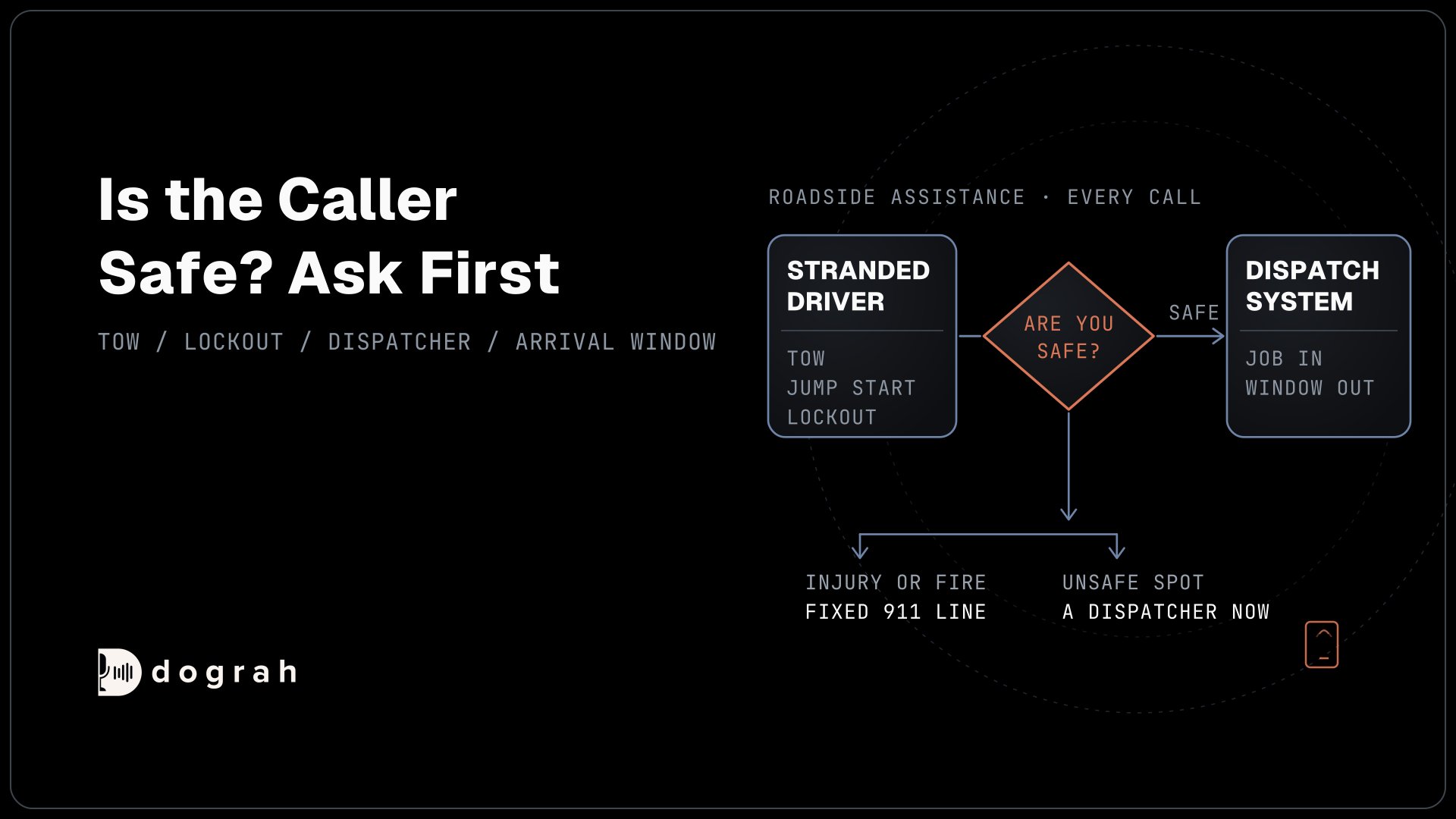

AI voice agents for roadside assistance answer breakdown calls, take the job details and read arrival times from the dispatch system. The first question is whether the caller is safe. Injury, fire or immediate danger gets a fixed line to get to safety and call 911. An unsafe spot with no injury goes straight to a dispatcher.
Key Takeaways
- Ask about safety first, before membership, location or the vehicle.
- An unsafe spot with no injury goes straight to a dispatcher.
- The dispatch system assigns trucks and times, and the agent reads them back.
This guide covers the calls a roadside provider can hand to a voice agent, from the safety question to jobs in your dispatch system. We show how each part works in Dograh, the open-source AI voice agent platform we build. You can self-host it or run it on Dograh Cloud.
What a roadside assistance line hears
Most roadside calls are a stranded driver who needs a tow, a jump start, fuel, a tire change or a lockout, and many of them come at night. After that come the follow-ups. A driver who called twenty minutes ago wants to know where the truck is. Someone whose car started after all wants to cancel. A member asks what their plan covers before they call for help.
A voice agent can take most of these if it reads and writes your dispatch system during the call. The new job goes in as a record, the arrival window comes back out, and a cancellation closes the job. Coverage questions are answered from the member record, never from the model's memory.
Some calls stay with people. Motor clubs and insurers that send you jobs need a dispatcher who can make a decision, and so does a police officer asking you to clear a scene. The agent recognises them, writes down who called and why, and passes them on.
A crash with an insurance claim behind it is a different call. The driver's insurer takes the claim itself, and our post on AI voice agents for FNOL intake covers that side. This guide stays with the provider that sends the truck.
Ask whether the caller is safe first
The first thing the agent finds out is whether the caller is safe, because a breakdown is often in a dangerous place. In the Emergency Responder Safety Institute's 2025 struck-by data, 36 emergency responders were struck and killed by vehicles in the US in 2025. Eleven were tow operators and three were road service technicians, and many died at a disabled-vehicle scene.
Drivers passing those scenes often do not make room. In AAA's 2025 review of roadside footage, drivers slowed down or moved over for a stopped tow truck 58% of the time, against 66% for police vehicles. Every state and D.C. has a Slow Down, Move Over law. AAA's release also names the stranded motorists those laws protect, so the caller's own car is part of the hazard.
So the safety question goes in the Greeting Text, which Dograh speaks word for word. Something like "Thanks for calling Example Roadside. Before anything else, are you and everyone with you safe right now?" means no caller gets to the vehicle questions first.
Then the answer decides the path. If anyone is hurt, there is a fire, or the caller is in immediate danger, the agent plays the provider's fixed line, for example: "If you're in danger, get to safety and call 911." If the caller is in an unsafe spot but nobody is hurt, such as a live lane, a narrow highway shoulder, a dark road, a child or pet in a hot or freezing car, the agent sends the call straight to a dispatcher with Transfer Call. It writes the location and callback number to your dispatch system first, so the dispatcher starts with them.
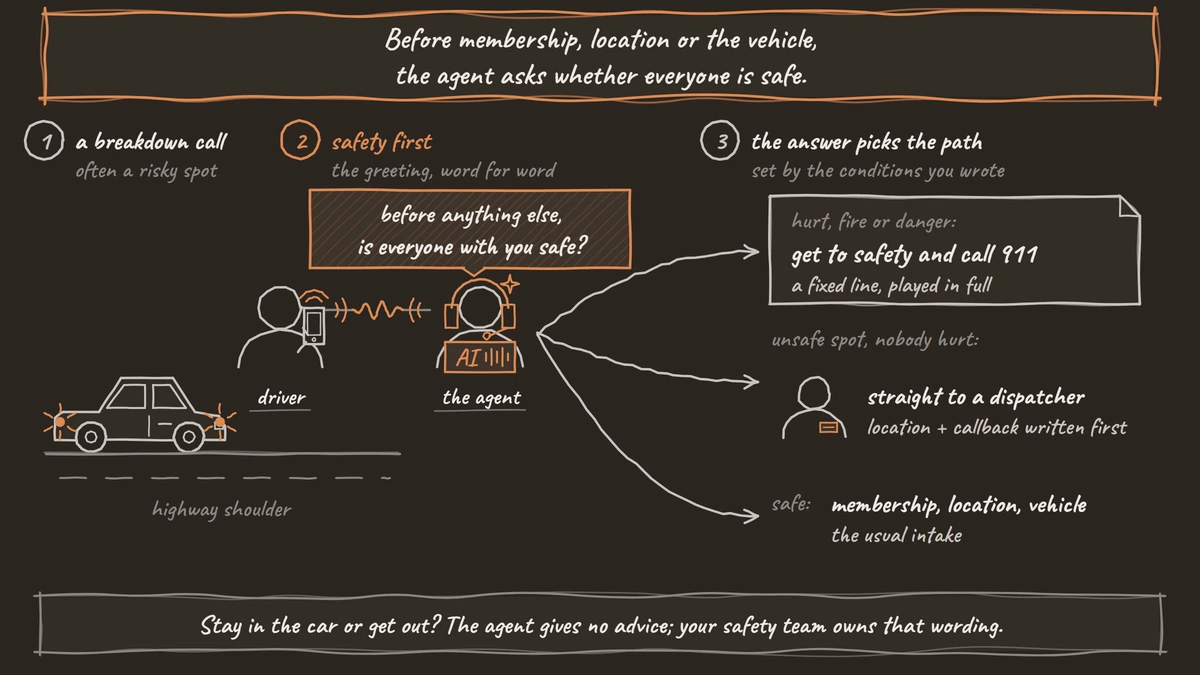
Whether to stay in the car or get out depends on the road and the traffic, so the agent gives no advice either way. That wording belongs to your safety team, and the agent only plays what they approve.
The 911 line must play as fixed words. A prompt cannot guarantee wording, because the model avoids a banned phrase and then says the same meaning in other words. Exact wording holds only in Greeting Text, a pathway's Transition Speech or a recorded clip. Put the line on the pathway for injury, fire and danger as Transition Speech, which plays with the caller muted, so it runs in full. Choosing that pathway is the model reading the condition you wrote, so test it with many phrasings and read the transcripts. Our post on prompt and flow design patterns explains the split. On a speech-to-speech model, text transition lines do not play, so record the line as a clip.
The same pattern runs a utility's gas-leak line, described in our post on emergency intake in utilities. Safety words first, then a person.
Find the member, then verify
A phone number finds the member record, but it does not prove who is calling. Pre-Call Data Fetch can load the record that matches the calling number as the call connects, and the prompt keeps every detail from it unspoken until the caller passes a check.
Your company sets that check, such as the membership number plus the ZIP code on the account. If it fails, the agent can still take the breakdown job, because nobody should be left at the roadside over a paperwork question. It simply says nothing about the plan and flags the job for a dispatcher to confirm coverage.
After the check, the agent reads coverage from your system, such as the service calls left this year and how many miles of towing the plan includes. It never decides coverage itself and never quotes a price your system did not return. If the member owes a fee, your own system sends its secure payment link by text, and no card number is ever taken on the call.

Open Source Alternative to Vapi / Retell
Self-hosted voice agent platform — no per-minute fees
dograh-hq/dograh
Star on GitHub
Intake and dispatch: write the job, read it back
The intake call collects what the truck needs and puts it into your dispatch system as a job. The agent asks where the car is, in the terms that suit the place: highway, direction and the nearest mile marker or exit on a highway, a cross street in town, the level and bay in a parking garage. Then it asks for the vehicle, the problem, and whether the car can be driven.
An HTTP API tool writes that job to your dispatch system during the call. Add a Preset Parameter named workflow_run_id with the value {{initial_context.workflow_run_id}}, so your system can ignore a second copy if the request is sent twice.
Your dispatch system assigns the truck and sets the arrival window. The agent reads back what the system returns and never picks a truck or makes up a time. AI voice agents for roadside assistance intake and dispatch walks through that call question by question, including what to say when no window exists yet.
A phone call gives Dograh the caller's number, not their position. If your company has a location-share link, your own system texts it, and the agent asks it to through an HTTP API tool.
"Where is my truck?" Read the dispatch system
Arrival-time calls are the easiest place to start, because the agent only reads. After the check, an HTTP API tool asks your dispatch system for the job, and the agent says the window it gets back.
That tool passes the whole response to the language model, so build the endpoint to return only what the caller may hear, such as the window and the type of truck. A driver's mobile number or another member's job should never be in it. A short Custom Message on the tool, such as "Let me check on your truck", plays before the lookup so the line is not silent.
If the system has no window yet, the agent says a dispatcher will confirm it and gives no estimate of its own. When the window is set or changes, your dispatch system can start a call through the API Trigger with the job details, and the agent reads the new time to the driver.
Handing over to the dispatcher on duty
Some calls belong with a person, such as unsafe callers, partner calls and anything the agent cannot answer. Those should reach whoever is on shift. Transfer Call works on Twilio, Telnyx, Plivo, Cloudonix and Asterisk ARI. Dograh calls the destination first and connects the caller only when someone answers. On Twilio, it can play a short spoken introduction to both people before connecting them.
To reach the dispatcher on duty, set the destination source to Dynamic HTTP Resolver. Dograh asks your system for the number during the call, and your system returns tonight's dispatcher. No summary travels with the call by default, so the agent writes the job and the reason for the handover to your dispatch system first.
If nobody answers within the 30-second default, the caller stays with the agent. Tell it in the prompt to mark the job urgent and to play the 911 line if the caller says they are now in danger. Browser test calls cannot transfer, so test every transfer on a real phone line.
Some tows end at a dealer's service bay. The dealer side of that hand-off, from booking the repair to the recall check, is in AI voice agents for automotive and dealerships.
Join the Dograh Community
Dograh is an OSS alternative to Vapi. Join our Slack community for queries, releases, best practices & community interactions.
Noisy roadside audio and accents
Roadside calls come from the worst audio conditions a voice agent meets: passing trucks, wind, rain and hazard lights clicking. Test with recordings of real roadside calls, not a quiet office, because most phone calls still reach the agent as 8 kHz audio, while a browser demo runs at 16 kHz.
Exit numbers, highway names and car models are easy to mishear. Add them to the agent's Dictionary in Settings. Those words reach only Deepgram, Dograh's own speech-to-text, AssemblyAI, Soniox and Speechmatics, so pick one of those if the list matters.
Drivers far from home call in their own language. Dograh supports 70+ languages, depending on the speech-to-text and voice providers you choose, and the Multilingual (Auto-detect) setting picks up the caller's language. The greeting plays before Dograh can hear that language, so a bilingual line writes the safety question in both. Our post on accents, background noise and real-world audio covers the testing in depth.
Consent for outbound status calls
An update about a driver's own job is a service call, and that sets the consent rule. Under the Telephone Consumer Protection Act (TCPA), the FCC's calling rules require the called party's prior express consent for a call to a mobile that uses an artificial or prerecorded voice, and the FCC ruled in 2024 that AI voices count. A driver who asked for help and gave their number has generally consented to calls about that job.
Keep offers off those calls. A membership upgrade pitched during an arrival-time update makes the call telemarketing, which needs prior express written consent. A caller who asks not to be called again is handled by your system: the agent writes the opt-out there during the call, and your system removes the number from the next list. Rules differ by state as well, so confirm your own position with counsel before the first outbound campaign.
Where roadside call data sits
Every roadside call carries personal details and a precise location, often from someone alone at night, so decide where that data lives before the first call. Dograh is self-hostable. Run it on your own servers and the platform never sees your callers' data. See our page on self-hosted voice agents for roadside assistance for breakdown calls that write each job to your dispatch system and read back only the arrival window it returns.
The speech and language models are a separate layer you choose. Bringing your own keys (BYOK) to a model provider changes whose contract covers the models, but the audio still reaches that provider. Data stays fully in-house only with open-weight models on your own servers. The phone carrier stays on the call either way.
The platform has no retention setting and no automatic deletion for recordings and transcripts, so your own schedule handles them. The self-hosting guide covers the install. Self-hosted Dograh has no per-minute platform fee, but servers, model keys and phone minutes still cost money. Dograh Cloud charges a 1¢-a-minute platform fee, and its own managed models, if you use them, are a separate charge of about $0.07 a minute for most models.
Which call to hand over first
Start with "where is my truck" calls, because the agent only reads from your dispatch system after a check. Add after-hours breakdown intake next, once the safety pathway and the dispatcher transfer pass every test. Outbound arrival-time updates come last, after your consent records are in order.
Before launch, call the agent from a real phone at the roadside, with traffic behind you. Describe danger in as many ways as your dispatchers have heard it, and check that the 911 line plays and that unsafe-spot calls reach a person every time.
Once live, replace the QA system prompt with roadside instructions that flag any call where the caller mentioned injury, fire, a live lane or a child in the car. A supervisor reads those transcripts the same day.
The intake and dispatch call has its own deep dive:
Glossary
- Slow Down, Move Over law
- A state law requiring drivers to slow down or change lanes when passing a stopped emergency or roadside vehicle. Every state and D.C. has one, yet drivers often ignore it, which is why a stranded caller's location is a safety question.
- Struck-by incident
- A responder or motorist hit by a passing vehicle while working or stopped at the roadside. Tow operators and road service technicians are among those killed each year, many at disabled-vehicle scenes.
- Arrival window
- The time range the dispatch system gives for a truck to reach the driver. The agent reads it from the system and never estimates one itself.
- Dispatch system
- The provider's software that holds jobs, assigns trucks and tracks arrival times. The voice agent writes jobs into it and reads status back during the call.