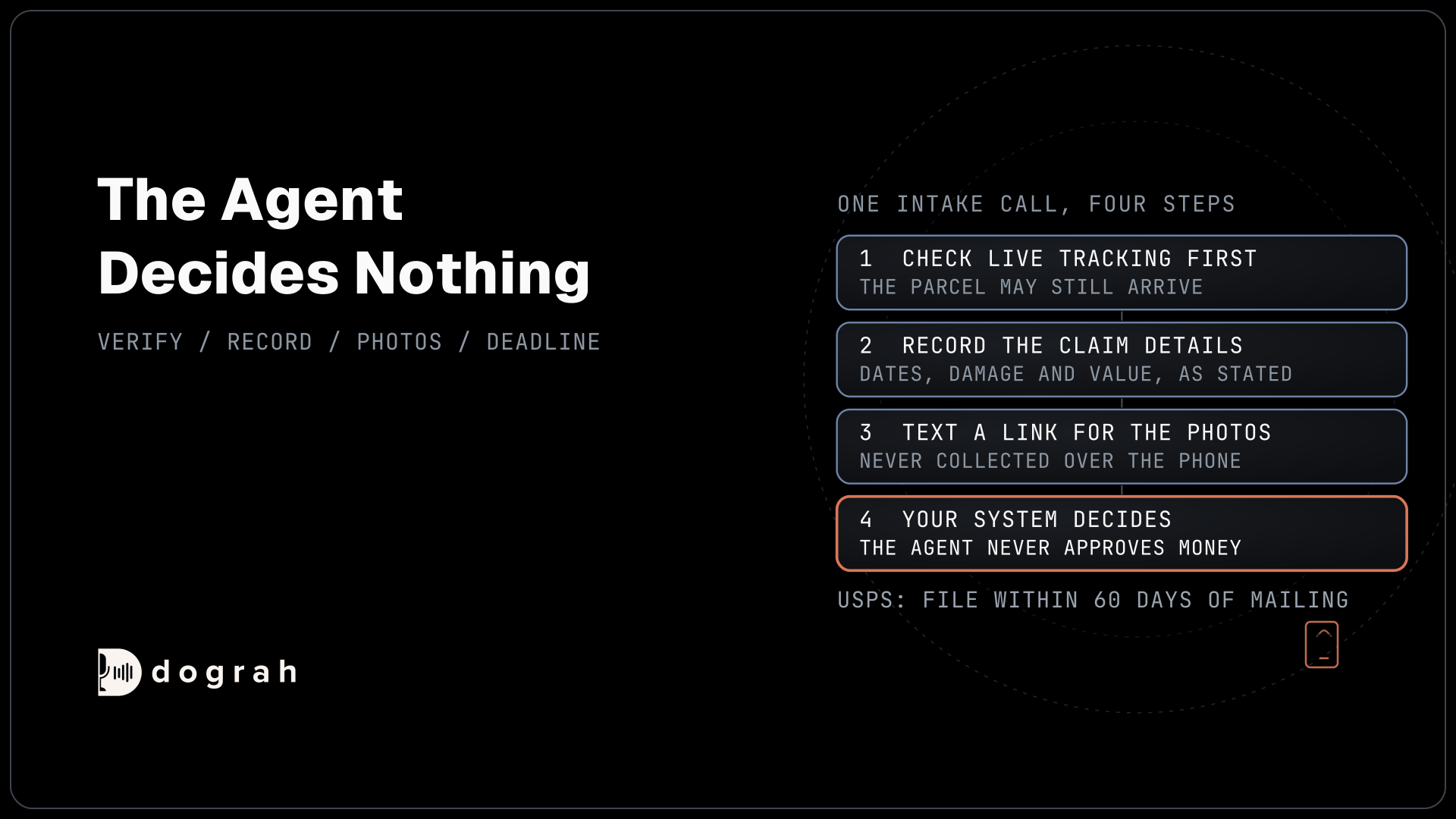

An AI voice agent for damaged and lost shipment claims takes the intake call: it verifies the caller, records the tracking number, the carrier, the dates and what is damaged or missing as the caller stated it, sends a secure photo-upload link by text through an HTTP API tool, and creates the claim in your claims system.
Key Takeaways
- Half of flagged parcels self-resolve, so read live tracking before opening a claim.
- Photos travel by a link sent during the call, never described down the phone.
- The agent decides nothing; your system checks the replacement threshold.
This post is part of our guide to AI voice agents for logistics and delivery. The guide places this call among the customer calls after the delivery: the tracking number and what is damaged, a secure upload link sent through an HTTP API tool, no documents collected in the call, and a replacement threshold checked by your own claims system. In Dograh, an open-source, self-hostable voice agent platform, the intake is one flow, and the claim is created in your own system through an HTTP API tool before the call ends.
A parcel claim is a carrier claim, and the carrier's clock runs it
A damaged or lost parcel produces a carrier claim rather than an insurance claim, and that shapes everything the intake call does. The recipient reports the problem, the shipper or retailer files with the carrier under the carrier's tariff, and the carrier's filing window decides whether anyone gets paid. The kind of claim with an adjuster is a different set of calls, covered in AI Voice Agents for Insurance Claims: Six Calls, One Set of Rules.
The first thing the call does is check whether there is a claim at all. In Seven Senders' talk at DELIVER Europe 2025, the company said that in European e-commerce "3 out of every 1,000 parcels experience an issue, usually delay, loss, or damage", and that "half of these are false alarms that self-resolve". Those are the vendor's own figures, and the second one is the design rule: a parcel reported lost on Tuesday is often scanned on Wednesday. The agent reads the live tracking record before it opens anything, and if the parcel moved since the last scan it says so, records the call, and offers to call back if nothing arrives in two days.
Verify, then take the intake
The intake starts the same way every call in this guide starts: greet, verify, then disclose. The caller's number finds the order. It does not prove who is calling, and a shipment's contents, value and delivery address are personal details. The agent asks for the tracking or order number and one thing the caller should know, such as the delivery postcode or the name on the order, before it reads a single detail back.
Then it collects what the claim will need, in the caller's words. The tracking number, the carrier and service if the caller knows them, whether and when the parcel was delivered, what is damaged or what is missing from the contents, and the value of what was lost. Each answer is recorded as an extracted variable, as the caller stated it. The transcript and recording are the exact record if the claim is questioned later.
Two of those fields are dates, because the carrier's filing window counts from a date and which date depends on the carrier and the service. Often this call follows the confirmation call in our post on AI voice agents for proof-of-delivery confirmation. The dates and reference then arrive in the initial context and the agent only confirms them.
Photos go by link, never by phone
Every carrier wants photos of the outer packaging and the damaged item, and a phone call is the wrong channel for that. The rule we set for insurance document collection applies here word for word: never collect documents inside the call, send a secure upload link, and cap how often you follow up. The reasoning is in AI Voice Agents for Claims Document Collection in Insurance: people rarely withhold documents on purpose; they miss them because nobody said which ones were needed.
In Dograh, the link goes out during the call. An HTTP API tool attached to the intake step calls your messaging endpoint with the claim reference and the caller's number, and the secure upload link arrives as a text from your messaging provider. The agent then tells the caller what to photograph and adds the one instruction the carrier will hold them to: keep the original packaging and everything in the parcel until the claim is settled.
A "we received your claim" notice with nothing to decide is a text; the call exists because the description, the dates and the value are answers only the caller has.

Open Source Alternative to Vapi / Retell
Self-hosted voice agent platform — no per-minute fees
dograh-hq/dograh
Star on GitHub
The deadlines the intake must respect
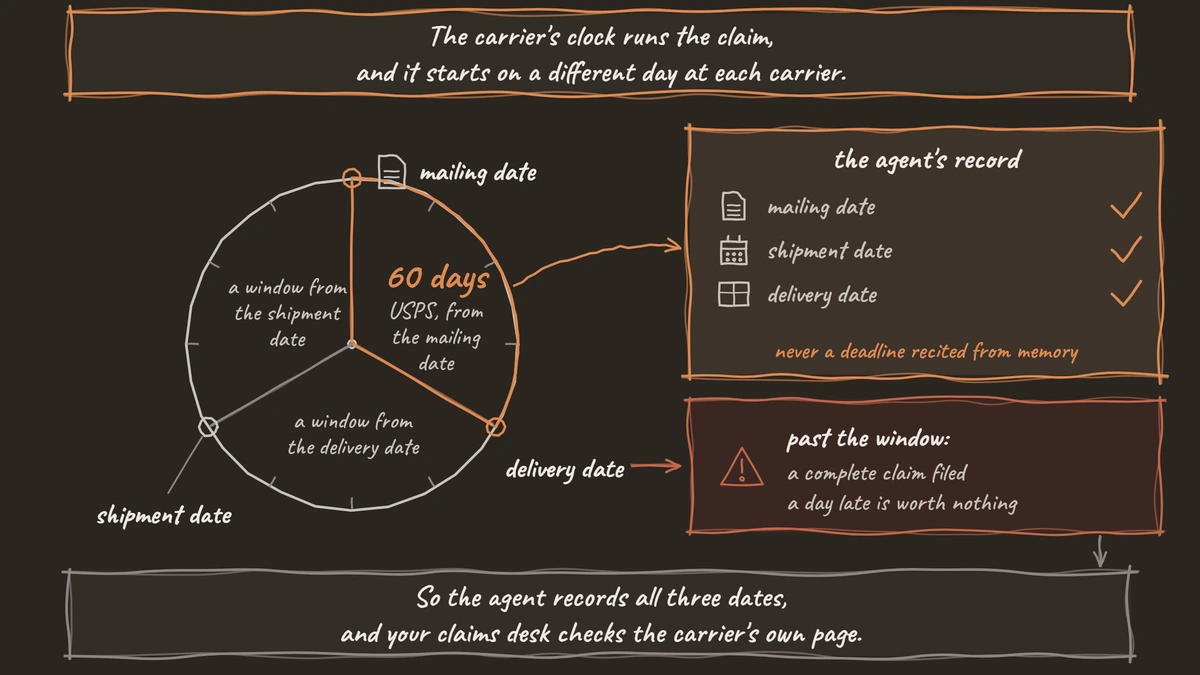
The intake has to know the window it is working inside, because a complete claim filed a day late is worth nothing. The United States Postal Service states its rules on its own claims page. For damaged or missing contents, you may file right away but "must file no later than 60 days after the mailing date". For lost mail the earliest filing date depends on the service, and every claim must be filed within 60 days of the mailing date; the service-by-service windows are in the FAQ below.
Other carriers run different windows for damage and for non-delivery, and they count from different dates, sometimes the shipment date and sometimes the delivery date. The agent does not recite those from memory. It records the carrier, the service and both dates, and the claims desk checks the carrier's own deadline page. Where your claims system holds the windows per carrier, the agent can read them through the HTTP API tool and tell the caller the exact date from your data.
What the agent may decide
The agent decides nothing on its own, and the one exception is not really an exception. If your policy says a damaged item under a set value is reshipped without a review, the check belongs to your own system. The agent calls an HTTP API tool with the order value and the claim type, your system answers yes or no, and the agent reads the answer. Dograh has no fixed-rule branching; the AI picks the next pathway from written conditions, so a money decision needs a hard check from a system that does not improvise.
Everything else goes to a person, and the list is short. Repeat claimants, high-value items, any caller who disputes what the tracking record shows, and anything that sounds like a payment dispute rather than a carrier claim. Claims are where abuse shows up. In Signifyd's State of Fraud Report 2026, e-commerce fraud pressure rose 33% year over year in the first four months of 2026, and first-party fraud and consumer abuse rose 9%. A claims agent that approves on description alone is the softest target you can build.
In Sendcloud's E-commerce Delivery Compass 2025, a survey of 1,000 UK consumers, 14% had received a damaged item in the previous three months, and 59.4% said a damaged parcel would be enough to walk away from a retailer. A fast, complete intake is a retention call as much as a claims call.
When the follow-up is the agent calling the customer back, that outbound call needs consent captured at order or sign-up; our post on AI voice agents for logistics and delivery in the US covers what that means.
Join the Dograh Community
Dograh is an OSS alternative to Vapi. Join our Slack community for queries, releases, best practices & community interactions.
Create the claim and hand it on
The call ends with a claim record that already exists in your system. An HTTP API tool creates the record in the claims system during the call, with the extracted variables as its fields, and the agent reads the claim number back so the caller can write it down. After the call, the webhook node posts the recording link, the transcript reference and the final variables to the same record. A temporary failure (timeout, 5xx, 429) is retried automatically, up to five attempts. A wrong URL or credential is not, so test the endpoint before going live.
For the cases that need a person, the order is write first, then transfer. The agent files what it has learned through the HTTP API tool, then uses Transfer Call to reach the claims desk. Transfer Call works on Twilio only, passes no summary by itself, and the optional spoken introduction on Twilio is off by default, which is why the write comes first. Test it on a real phone call; browser test calls cannot run a transfer.
Run quality assurance (QA) on a sample of intake calls. Dograh scores each step separately, so a misrecorded damage description shows up on that step. On cost, self-hosted Dograh has no per-minute platform fee; servers and any paid model keys still cost money.
Start with one carrier whose rules you know best and a replacement threshold your finance team has signed off. Read the first fifty transcripts before you add a second carrier.
Glossary
- carrier claim
- A request to the carrier, under its tariff, to pay for a parcel it lost or damaged, filed within the carrier's own window.
- secure upload link
- A one-time link, sent as a text during the call, where the caller uploads photos of the packaging and the item instead of describing them.
- false alarm
- A parcel flagged lost or late that the next tracking scan resolves without a claim.
- replacement threshold
- The value below which your own system approves a reshipment, checked by the agent through an HTTP API tool rather than decided by the AI.