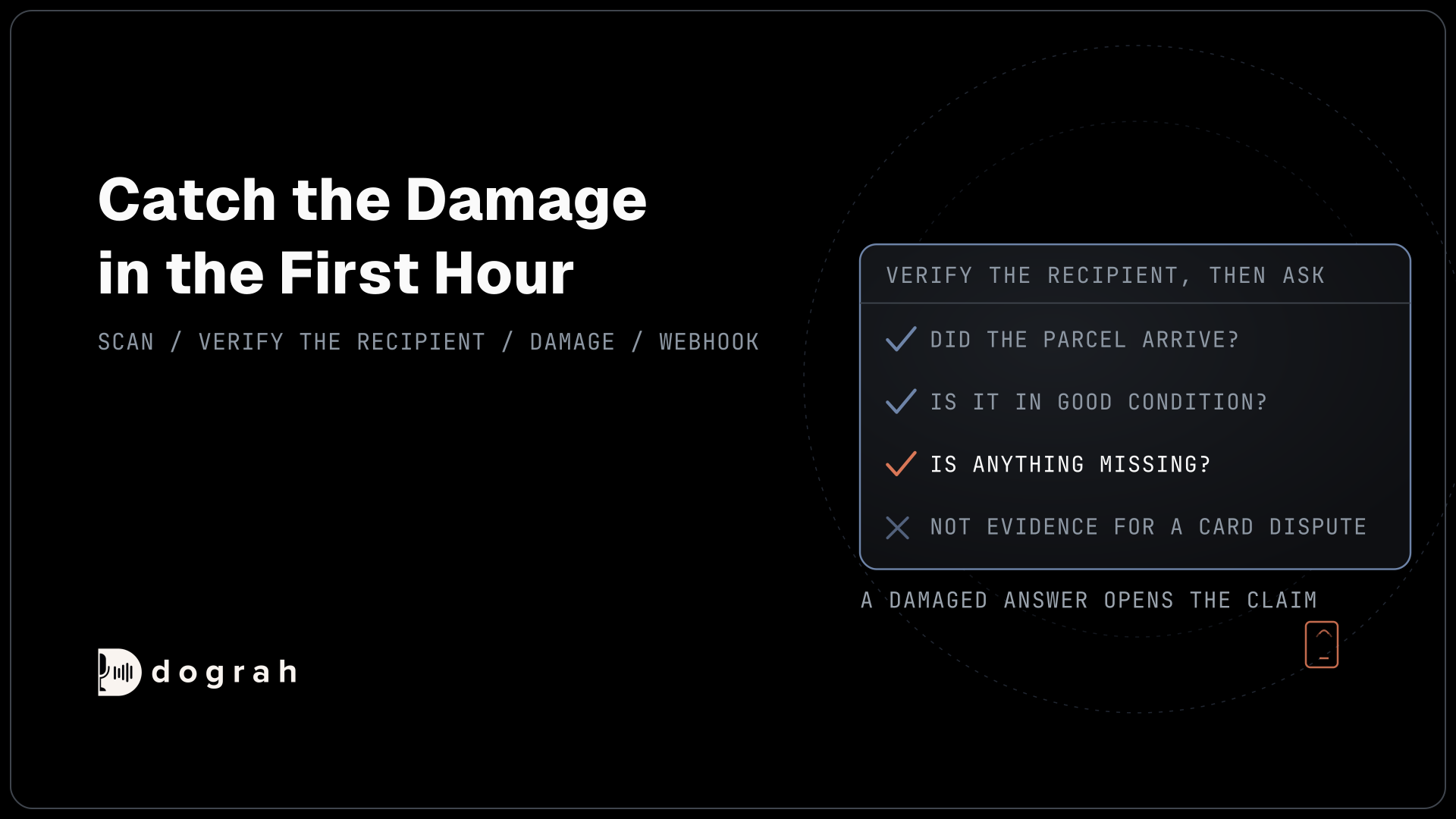

An AI voice agent for proof-of-delivery confirmation calls the recipient shortly after the delivery scan, verifies who answered, and asks whether the parcel arrived, in what condition, and whether anything is missing. It records the answers as the recipient stated them and pushes them to your order system by webhook. The carrier's proof of delivery still wins the card dispute.
Key Takeaways
- The call's job is early damage and missing-item capture, not dispute evidence.
- Verify the recipient before naming the parcel, even on a "delivered" order.
- A "damaged" answer hands to the claims intake with the call's record attached.
This post is part of our guide to AI voice agents for logistics and delivery. The guide lists this call among the customer calls after the delivery, as the one that confirms arrival and condition, sends the answers onward as extracted variables, and catches damage early without pretending to be card-dispute evidence. In Dograh, an open-source, self-hostable voice agent platform, the call is three questions, and the answers reach your order system by webhook.
What the confirmation call is for
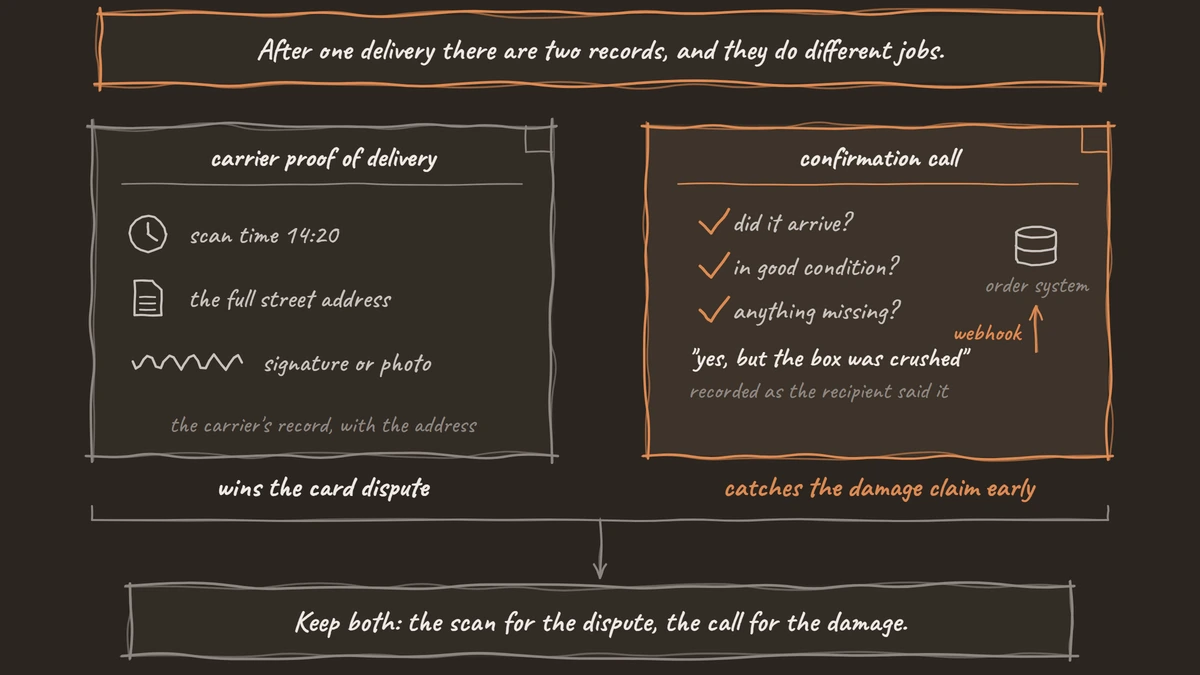
A proof-of-delivery confirmation call has two jobs, and the second one is smaller than people expect. The first job is to find out, within hours of the scan, whether the parcel arrived in one piece with everything inside. The second is to leave a receipt record in your own system, next to the carrier's scan, in the recipient's own words.
The first job matters because the scan does not tell you. "Delivered" means the driver recorded a drop, and the gap between that and a satisfied customer is where theft, damage, short shipments and wrong items live. In Security.org's 2025 package theft report, a survey of 3,307 US adults in October 2025, one in four Americans, about 64 million people, said a package had been stolen from them at some point, with the average stolen package worth about $222. After a theft, 64% contacted the store they bought from and 62% contacted the delivery company. Those are the calls your support desk takes a day or a week later, with no record of what the recipient saw.
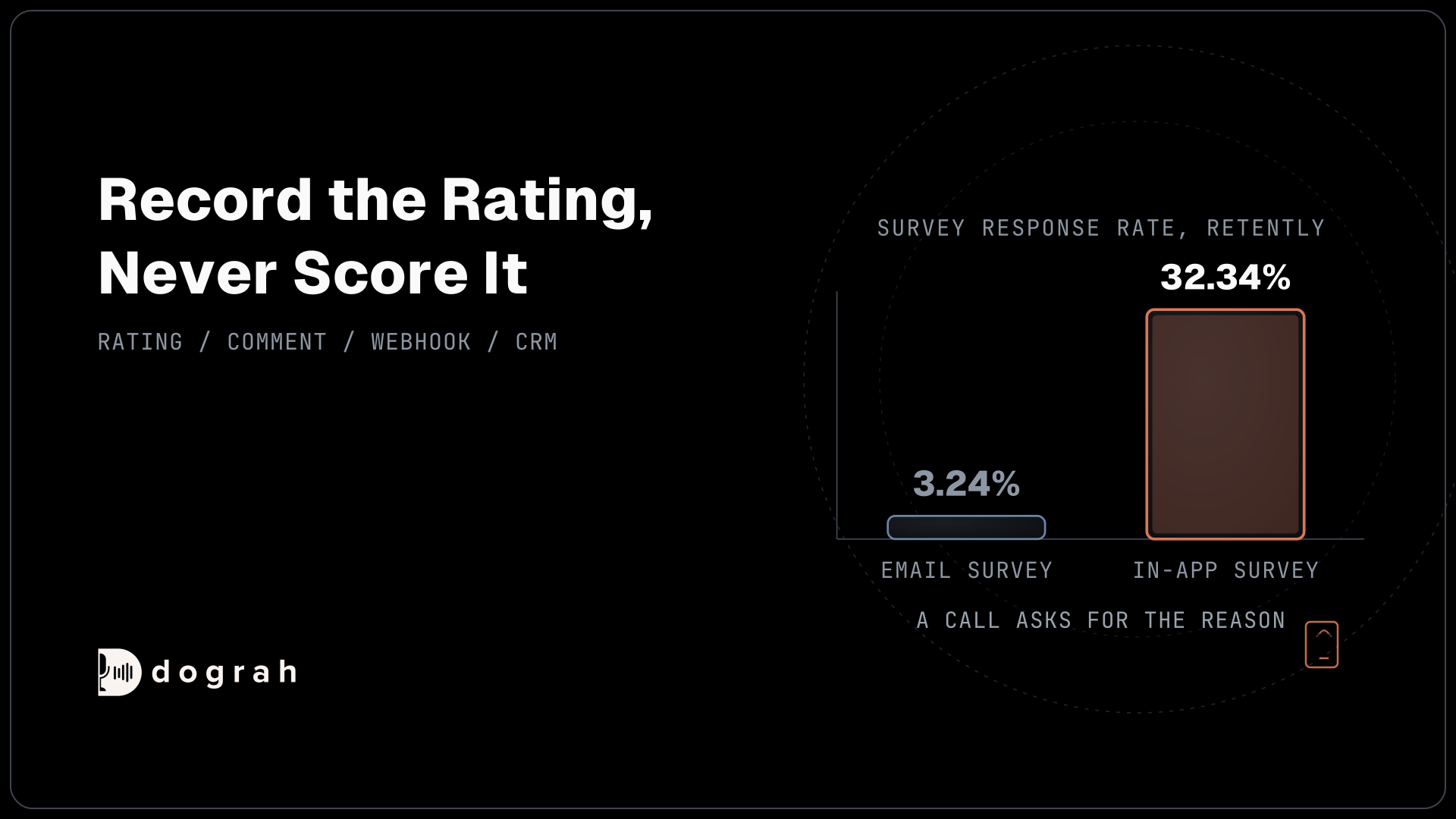
The confirmation call moves that conversation to the hour after delivery, when the packaging is still on the porch and the carrier's claim window has barely opened. The survey and the rating question belong elsewhere, and this post keeps them out.
Start the call from the delivery scan
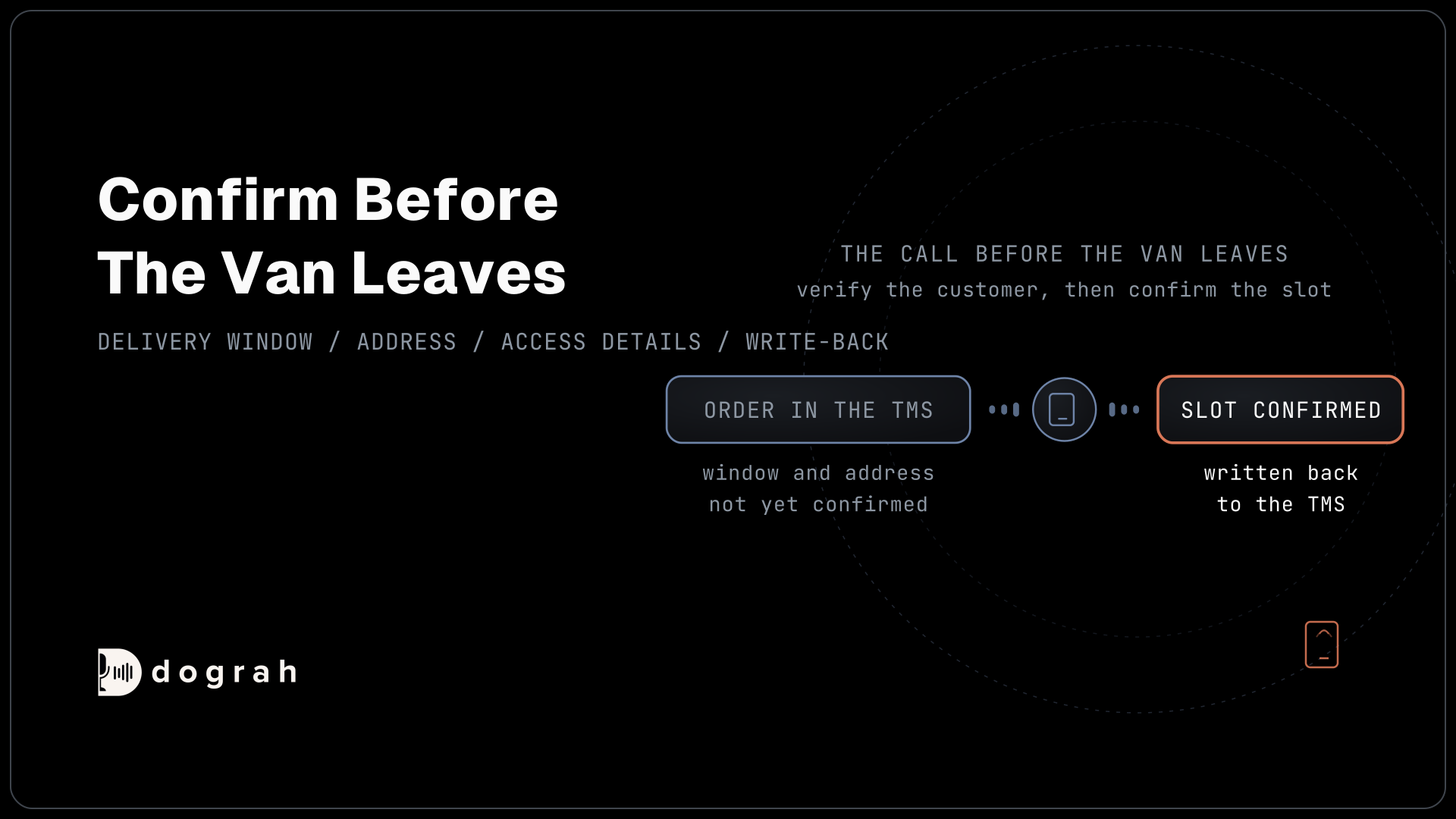
The call should start from the delivery event itself rather than from a daily batch. When the carrier posts the "delivered" status to your order or transportation management system (TMS), that system calls the API Trigger with the order details in the initial context: the recipient's first name, the order reference, the item count and the delivery address. The agent then knows what it is calling about before it says hello. Our post on API Triggers: Start a Voice Agent Call From Any System covers the request; the one thing to hold onto is that the production URL runs the published workflow only, so a draft change does not reach live recipients until you publish it.
Not every delivered parcel needs a call. A plain "your parcel was delivered at 14:20" is a text, sent by your delivery system, with no call placed. The call exists to ask a question the text cannot: is it there, and is it whole. Many operators call only on first orders, high-value items, deliveries with no signature, or addresses with a past problem, and let the text carry the rest.
One sentence on consent: this is an outbound call about a purchase, and the recipient's consent to it should be captured at order or sign-up. Our post on AI voice agents for logistics and delivery in the US covers the rules and the exemption that covers carriers but not most shippers.
Verify before you name the parcel
Reaching the recipient's number is not the same as reaching the recipient. The person who answers may be a partner, a child, a flatmate or a colleague on a shared line, and a parcel's contents and address are personal details. The agent greets, verifies, then discloses.
Verification on this call is light but real. The agent asks for the name on the order, or the last digits of the order number from the confirmation email, before it says what was delivered or where. If the person answering is not the recipient and cannot verify, the agent offers to call back or to send a text and ends there. It does not read the item list to whoever picked up.
This matters more after delivery than before it. Before delivery the worst leak is a window. After delivery the leak is "your two laptops were left by the side door", said to a stranger.

Open Source Alternative to Vapi / Retell
Self-hosted voice agent platform — no per-minute fees
dograh-hq/dograh
Star on GitHub
Three questions, recorded as stated
The call itself is three questions and should run under a minute: did the parcel arrive, is it in good condition, and is anything missing from it. The agent records each answer as the recipient stated it into extracted variables. Variable extraction is an AI step, so it captures the meaning of "yes, but the box was crushed" rather than a word-for-word field; the transcript and recording are the exact record if a claim is later disputed.
Branching comes from the answers. "Arrived, fine, complete" ends the call with a thank-you and a webhook. "Damaged" or "something is missing" does not turn this call into a claims call. The agent says what happens next, records the recipient's description, and hands the case to the intake flow described in our post on AI voice agents for damaged and lost shipment claims, where the photo-upload link and the carrier deadlines live. A confirmation agent that tries to settle the claim on the same call runs long and gets things wrong.
The rating question stays out too. A one-question satisfaction score belongs to the survey call, covered in AI voice agents for delivery feedback and CSAT surveys, and mixing it into a damage check lowers the quality of both. The recipient who just found a crushed box wants a next step, not a scale of one to five. In Glance's 2026 CX Trends survey of more than 600 US consumers, 68% named getting a complete resolution as the most important thing in a support interaction, and 75% said a fast AI answer had still left them frustrated. The resolution here is a claim opened in the first hour, with the recipient's own words already in it.
Why the call is not dispute evidence
The record the call produces is useful, and it is worth being exact about what it is not. When a cardholder tells their bank an order never arrived, Visa's rules for that dispute (dispute condition 13.1, merchandise or services not received) say what a merchant needs to answer it. Rule 11.10.2.6 of the Visa Core Rules and Visa Product and Service Rules requires, for delivered merchandise, "proof of delivery that contains the full delivery address (tracking with partial address is not permitted)". That is the carrier's record, and it is why your TMS should keep the carrier's proof of delivery with the full address and any signature or photo.
The call's record sits beside that, as a dated acknowledgment in the recipient's words, and it is at its most useful in the opposite case: when the parcel did not arrive or arrived broken, and you want to know on the day rather than when the chargeback lands. Design the call for that, and do not sell it internally as chargeback protection.
Join the Dograh Community
Dograh is an OSS alternative to Vapi. Join our Slack community for queries, releases, best practices & community interactions.
Push the answers to your system
The last step is the one that makes the call worth placing: the answers have to land where the operations team already works. The webhook node runs after the call and posts the extracted variables, the recipient's answers, the call outcome and a link to the recording, to your order system or TMS. Map the fields so the record sits next to the carrier's scan for the same order. A temporary failure (timeout, 5xx, 429) is retried automatically, up to five attempts, while a wrong URL or credential is not, so test the endpoint first and give it one that answers quickly.
Two operating notes. Run quality assurance (QA) on a sample of these calls; Dograh scores each step separately, so a misheard "it's fine" on the condition question shows up as a low score on that step rather than being lost in a call average. And on cost, self-hosted Dograh has no per-minute platform fee; servers and any paid model keys still cost money, which for a sub-minute call is a small number per delivery.
Start with one lane: one carrier, one product category where damage is common, calls on the day of delivery. Read the first hundred transcripts, then widen.
Glossary
- proof of delivery
- The carrier's record that a parcel reached its address, with the scan time and, where captured, a signature or photo.
- dispute condition 13.1
- Visa's category for a cardholder claim that merchandise or services were not received, answered with proof of delivery at the full address.
- API Trigger
- The endpoint that starts a Dograh call from another system, carrying the order details the agent should know before it speaks.
- extracted variables
- The answers the agent records from the conversation, as the recipient stated them, for the webhook to carry into your systems.