
Key Takeaways
- GPT-Live-1 leads on conversational dynamics. Gemini leads the aggregate index.
- None of the three can be self-hosted. Only the layer around them.
- Three different pricing bases. Any single blended per-minute figure is invented.
We support all three of these models, so what follows comes from using them rather than from reading launch posts. Dograh is the open-source voice platform we build, and it runs any of them behind a phone number.
For phone agents, GPT-Live-1 is the strongest pick on interaction quality and the only one documenting a SIP telephony path. Gemini 3.8 Live's standard configuration costs less per minute, and its Extended Thinking (High) configuration scores higher on the aggregate benchmark. Grok Voice suits a cloned voice without an enterprise sales conversation.
The short answer for phone agents
Pick GPT-Live-1 if the call has to feel like a conversation, Gemini 3.8 Live if per-minute cost is the binding constraint, and grok-voice-think-fast-2.0 if you need a cloned voice without going through a sales conversation. That is the whole answer, and the rest of this post is the evidence behind it.
One thing separates this from a spec comparison. Only one of the three vendors currently documents a way to answer an actual phone number natively. Gemini and Grok document socket transports only. Fine in a browser, and reachable on a real call only through an orchestration layer bridging that socket to telephony, the way Dograh does. GPT-Live-1's SIP path, by contrast, is vendor-documented and terminates at OpenAI's own endpoint, with no application-layer bridge required. If you're relying on the model's own native connectivity rather than a bridge, that distinction narrows the field before any benchmark does.
Where we measured something ourselves, it says so. Where a number comes from a vendor or from an independent index, that is stated too, because a vendor claim and a measured result are not the same kind of evidence.
The three things that actually decide this
Three axes matter for a phone agent, and a headline benchmark score is not one of them on its own.
The first is interaction quality, meaning whether the model can hold a turn, get interrupted, and recover without sounding like it is reading. This is close to but distinct from raw latency. Our own bar for the sub-800ms budget that keeps conversation natural still applies, and a model can clear it while still feeling wooden.
The second is telephony readiness, specifically, whether the model reaches a real phone call natively or only through an orchestration layer bridging it there. A model that needs a bridge isn't disqualified, but it adds a dependency and another vendor in the path, whatever it scores.
The third is the pricing basis, which is the axis most likely to mislead. These three vendors bill on genuinely different units, and flattening them into one number produces a figure none of them publish.
Worth settling one piece of vocabulary before the comparison. A speech-to-speech model takes audio in and gives audio out in a single hop. A cascade pipeline runs speech-to-text, then a language model, then text-to-speech as three separate stages. Cascade is cheaper and adds delay at every handoff. All three models here are speech-to-speech.
Interaction quality, and the number we are conceding
The independent benchmark does not hand OpenAI a clean win, and pretending otherwise would be easy to check.
On the Artificial Analysis Speech-to-Speech Index, Gemini 3.8 Live Extended Thinking (High) scores 82.6, ahead of GPT-Live-1 (Astra, medium) at 81.5. Standard Gemini 3.8 Live sits at 76.0 and Gemini 3.1 Flash Live High at 71.5. The index is a weighted average of speech reasoning, agentic performance, arena preference and task success rate.
So Gemini takes the top line. The picture changes on conversational dynamics, which is the sub-score closest to what a caller actually experiences. GPT-Live-1 (Astra, medium) reaches 94.9 percent there, and the Sol configuration at lower reasoning effort reaches 97.3 percent.
That narrower claim is the one worth making. GPT-Live-1 wins on how the conversation feels rather than on aggregate capability. It runs full duplex, it can shift context part way through a call, and it delivers acknowledgement cues while the caller is still speaking, which drops perceived latency below what a stopwatch would show. It also delegates reasoning to a backend model, so tool calling holds up better than a voice-only model usually manages. That matters a great deal for how quickly a caller decides the agent is worth talking to.
OpenAI separately reports a 30 percentage point improvement over GPT-Realtime-2.1 on Full Duplex Bench. That figure is OpenAI's own, published by OpenAI, and we could not verify it against an independent measurement. Treat it as a vendor claim.

Open Source Alternative to Vapi / Retell
Self-hosted voice agent platform — no per-minute fees
dograh-hq/dograh
Star on GitHub
Telephony readiness, and what a bridge adds
This is where the three stop looking similar, and the split runs along what each vendor actually documents.
OpenAI documents a SIP connector for GPT-Live-1. Calls arrive at an endpoint in the form sip:PROJECT_ID@sip.api.openai.com with TLS transport, and incoming calls route through a project webhook. OpenAI's GPT-Live guide lists telephony and SIP alongside WebRTC and WebSockets as supported connection paths, and names LiveKit, Twilio, Telnyx and Daily as integration routes. No beta label is attached. Google's Live API documentation describes a stateful WebSocket connection and nothing else on the transport side, while xAI documents a WebSocket API plus a LiveKit integration. Neither vendor documents SIP.
Absence from documentation is not the same as absence of capability, and it would be wrong to say those two cannot do it. What is fair to say is that the path is undocumented, which for a production phone deployment amounts to much the same risk.
Documentation only takes you so far, so we ran it. We have put GPT-Live-1 over real telephony rather than browser demos, roughly twenty calls so far, split between web sessions and telephony sessions, and every one completed without errors. That is a small sample and the model is only days old, so treat it as an early signal rather than a reliability figure. It does establish that gpt-live-1 works on a real telephony call routed through a carrier, not just in a browser session, which the documentation alone can't tell you. If you are building something where the agent has to connect and convert on an outbound call, that distinction is the difference between a plan and a working system.
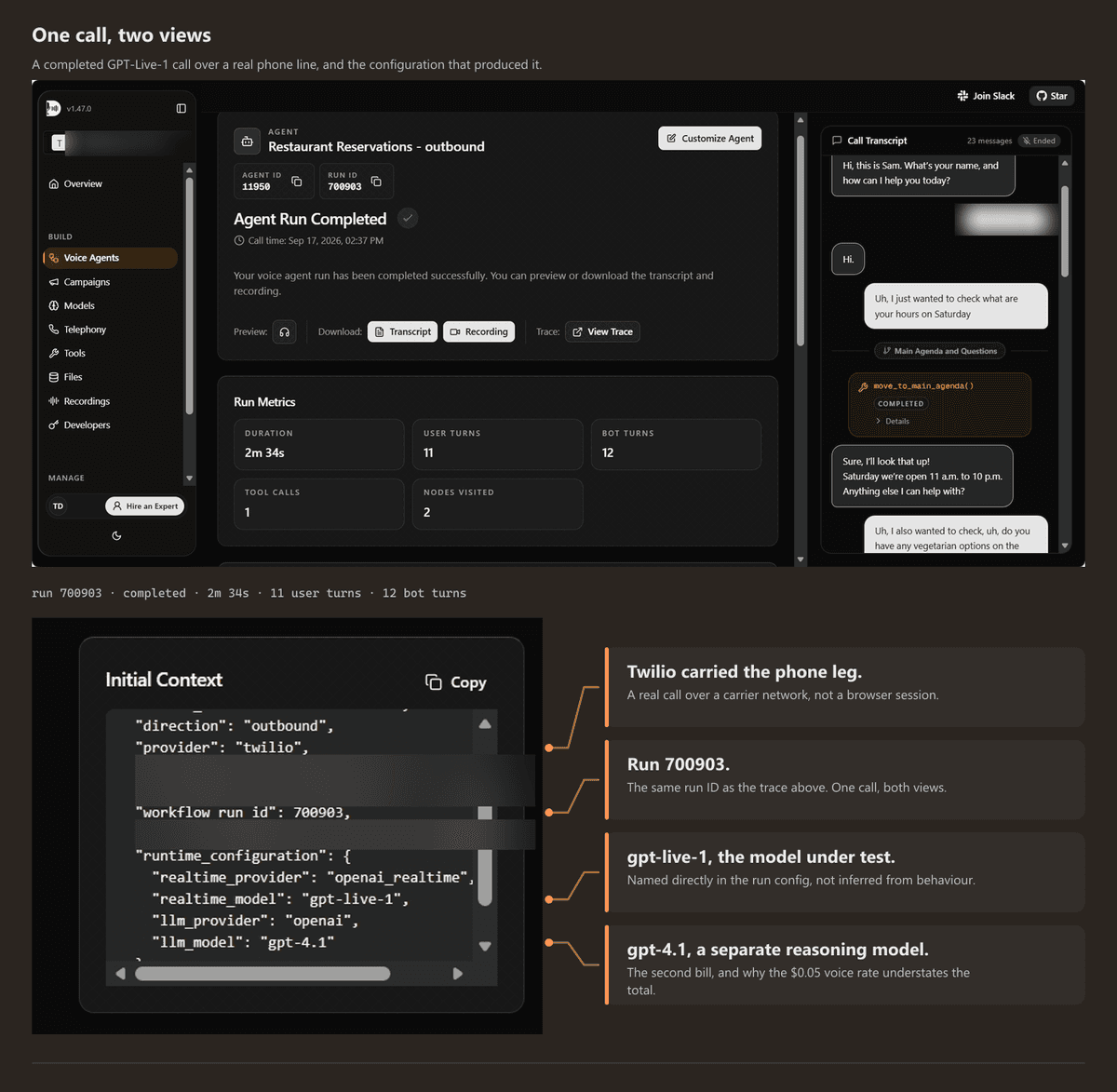
That is one call end to end: a carrier on the phone leg, gpt-live-1 on the voice, and a separate reasoning model behind it.
What each one costs, and why averaging them lies
The three vendors price on three different bases, and that is the most important thing to understand about their cost.
GPT-Live-1 charges $0.05 per minute for voice sessions, billed per second, according to OpenAI's model documentation. That covers the voice layer. Reasoning and tool use delegate to a backend agent which bills separately, so your real cost is $0.05 plus whatever that agent runs to. grok-voice-think-fast-2.0 charges $0.08 per minute, which xAI also publishes as $4.80 per hour, plus $0.004 for text input, and xAI's pricing page includes reasoning in that rate. gemini-3.8-live splits the meter, with audio input at $0.005 per minute and audio output at $0.018 per minute, and Google publishes both the per-token and the per-minute form itself.
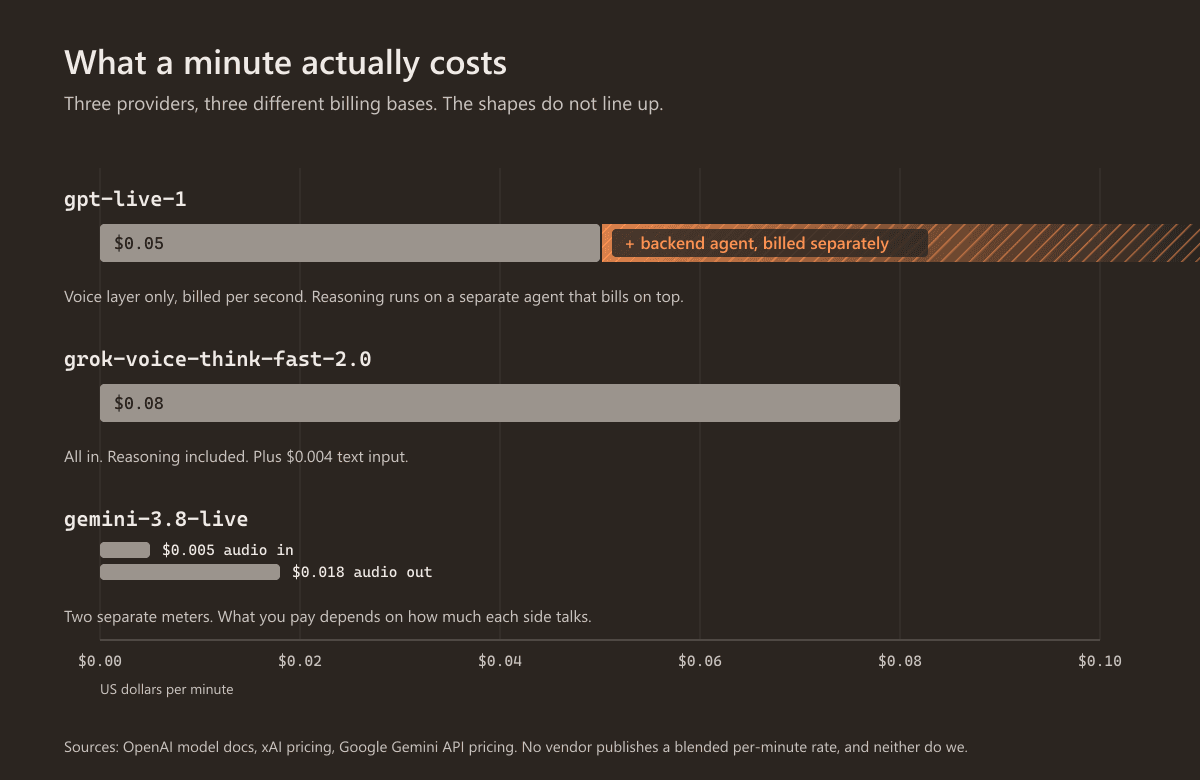
You cannot average these honestly. One covers a voice layer with reasoning billed elsewhere, one bundles reasoning in, and one bills input and output separately. A single blended per-minute figure would be a number no vendor publishes, and the headline that understates most is GPT-Live-1's, precisely because the backend agent sits outside it. That is the concrete version of the claim that GPT-Live-1 costs meaningfully more to run.
If cost is the binding constraint rather than feel, a cascade pipeline built on speech-to-text, a language model and text-to-speech still comes in well below any of these. You give up the full duplex behaviour to get there.
One more line item usually dwarfs the model. Most hosted voice platforms add a per-minute platform fee on top of whatever the model costs. Self-hosted Dograh doesn't charge a platform fee, because you're running it yourself.
Join the Dograh Community
Dograh is an OSS alternative to Vapi. Join our Slack community for queries, releases, best practices & community interactions.
Voice cloning, and the smaller differences
The clearest capability gap between these three has nothing to do with benchmarks.
Grok supports custom voice cloning, currently limited to the US. xAI's documentation describes cloning a voice from a reference clip of up to 120 seconds, producing a voice_id reusable across both text-to-speech and speech-to-speech. xAI says the process verifies consent before it will clone anything: the speaker reads a passphrase that is transcribed and matched in real time, and speaker embeddings from that passphrase and the full recording are compared to confirm they are the same person. On xAI's own account, that means you cannot clone a voice from a pre-existing recording or clone someone else's voice, though we have not tested whether the check can be defeated. If the agent has to sound like someone willing to verify live, without a sales conversation, Grok settles it.
GPT-Live-1 also supports custom voice cloning, per OpenAI's own documentation, but access is currently gated to eligible customers through a sales conversation rather than being self-serve, a meaningfully higher bar than Grok's console, which lets any user create a cloned voice for free without a sales conversation. Its backchannelling also stays basic, with short acknowledgements like "uh uh" and "okay" rather than the fuller range a human uses. It accepts audio and text, does not handle image or video, and carries a knowledge cutoff of July 31, 2025. Gemini Live works in 16-bit PCM audio at 16kHz in and 24kHz out, and Google's documentation states that users can interrupt the model at any point.
The three side by side, and where Dograh sits
Here is the whole comparison in one place, scored on the axes that decide a phone deployment rather than on general model capability.
| Model | Interaction quality | Telephony documented | Pricing basis | Voice cloning | Self-hostable |
|---|---|---|---|---|---|
| gpt-live-1 | Highest conversational dynamics (94.9 to 97.3%) | Yes, SIP connector | $0.05/min voice only, backend agent billed separately | Yes, sales-gated (not self-serve) | No |
| gemini-3.8-live | Highest aggregate index (82.6 Extended Thinking) | No, WSS only | $0.005/min in, $0.018/min out | No | No |
| grok-voice-think-fast-2.0 | Not extracted | No, WebSocket and LiveKit | $0.08/min all in, plus $0.004 text | Yes, 120s reference clip | No |
Dograh is the orchestration layer that runs any of the three models above behind a phone number, providing the telephony and SIP connection regardless of what each vendor documents natively, while holding the call logic and keeping the transcripts, with no platform fee since it's self-hosted. That self-hosting applies to the orchestration layer, not the models themselves, which is why none of the three above show as self-hostable, and it's the reason the choice in the table stays reversible.
Why the pick matters less than being able to change it
The ordering keeps changing, and anything specific in this post has a short shelf life.
That is the actual argument for bringing your own key. When the next model ships and moves the ranking again, a BYOK setup means swapping a provider rather than rebuilding an agent. You own the contract, and the switching cost stays close to zero.
Be precise about what that does and does not give you. All three of these models are closed weight, so none of them can be brought in house. BYOK moves the contract, not the data, and colocation for a closed model means choosing the same cloud region rather than running it on your own hardware. What you can genuinely self-host is the layer around the model, which is the orchestration, the call logic and the transcripts, and for regulated work that is usually the part that matters. The same reasoning drives why on-prem keeps winning enterprise voice AI.
Start with GPT-Live-1 if you are building a phone agent today. Keep the key swappable, because you will want to move.
Glossary
- Full duplex
- Both sides of a call can speak and be heard at the same time, so the model can react while the caller is still talking instead of waiting for the turn to end.
- Barge-in
- The caller interrupts mid-sentence and the agent stops speaking and starts listening. It is what separates a conversation from a voicemail greeting.
- Cascade pipeline
- The older arrangement where speech-to-text, a language model and text-to-speech run as three separate hops. Cheaper to run, with latency added at every handoff.
- SIP connector
- The signalling path that lets a model answer a real phone number over a carrier network, rather than a browser session over WebRTC or a raw WebSocket.