
Cartesia's Managed Agents platform and its Sonic and Ink models are closed, while its SDKs and Line SDK are open. Our open-source AI voice agent platform, Dograh, replaces the whole platform, keeping Sonic and Ink on your own key or swapping in open voices such as Kokoro. It runs on your own servers or on Dograh Cloud.
Key Takeaways
- Cartesia's SDKs and Line SDK are Apache-2.0, while its platform and models are closed.
- Cartesia voices inside Dograh still send speech to Cartesia under your key.
- Kokoro and Chatterbox rank far below Sonic 3.6, so test them on calls.
Cartesia does publish open code, though not the parts that actually answer your calls. We sort out what is open there, the three layers you could replace, the open voices that can stand in for Sonic, where Dograh fits and what self-hosting costs. It builds on our guide to Cartesia alternatives.
What is open at Cartesia, and what is not
Cartesia publishes real open-source code, but not the parts that run your calls. Its Python and JavaScript SDKs and the Line SDK for code-first voice agents are all under Apache-2.0. The Managed Agents platform is closed, and the Sonic and Ink model weights are not published.
Cartesia does offer a way to run its models on your own hardware. On Enterprise, its sales team arranges on-premise or private-cloud deployment of its models. That is a licensed private deployment under a contract, so the code still belongs to Cartesia and you cannot read or change it.
The Line SDK matters more than usual right now. Cartesia stops hosting Line SDK agents on December 1, 2026, and Line code you run yourself keeps working. Your agent code then runs on your servers and connects to Cartesia through a self-hosted deployment URL, so Cartesia stays part of every call.
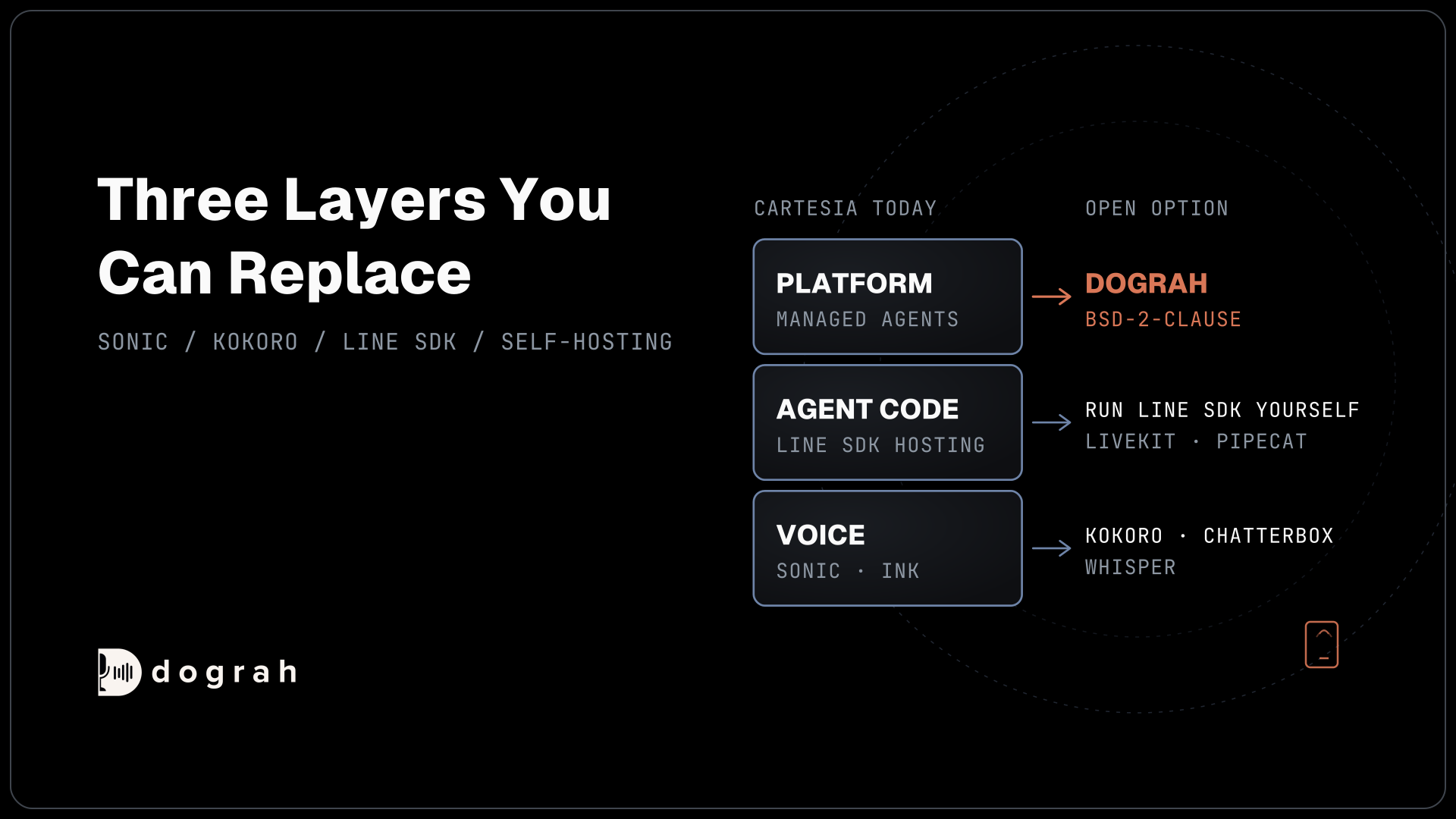
Three layers you can replace
An open-source alternative to Cartesia can mean three different things, depending on which layer you swap, and each leaves a different amount of work with your team.
| Layer | Cartesia today | Open option | What you still need |
|---|---|---|---|
| Voice and speech-to-text | Sonic 3.6 and Ink 2, closed models | Kokoro 82M (Apache-2.0) or Chatterbox (MIT) for the voice, Whisper for speech-to-text | GPUs, a speech server and quality testing |
| Agent code | Line SDK (Apache-2.0) on Cartesia's hosting, or on your servers | Line SDK run yourself, LiveKit Agents, Pipecat | Telephony, call history, QA and a dashboard, built by your developers |
| Whole platform | Managed Agents, closed, in Cartesia's cloud | Dograh (BSD-2-Clause) | Servers and upkeep, or Dograh Cloud. Voices are your choice, Cartesia's included |
Only the last row replaces Managed Agents as a product. The first two leave your team to build what Cartesia's platform does today.

Open Source Alternative to Vapi / Retell
Self-hosted voice agent platform — no per-minute fees
dograh-hq/dograh
Star on GitHub
Open voices in place of Sonic
Open voices can replace Sonic, but they rank well below it today. On the Artificial Analysis Speech Arena, where listeners vote blind, Sonic 3.6 ranks fourth, Kokoro 82M ranks 62nd and Chatterbox 80th.
Kokoro 82M is a small, fast model under Apache-2.0, with fixed voices and no cloning from a reference clip. It is the default model in Dograh's Local Models (Speaches) option, so it plugs in without extra work. Chatterbox is MIT-licensed and clones a voice from a short clip, and every output carries Resemble AI's audio watermark. The common Chatterbox servers return WAV or MP3 files, while Dograh's local voice slot expects raw 24 kHz audio, so plan for a server that returns that format.
Watch the licences on the rest of the field. Fish Speech uses the Fish Audio Community License, which is not an OSI-approved open-source license and needs a separate commercial licence for public services. F5-TTS and XTTS-v2 are licensed for non-commercial use only. Our post on Kokoro vs Chatterbox vs Coqui XTTS compares the three in depth, and our open-source ElevenLabs alternative post has the full licence table.
For the Ink slot, Whisper models run through the same Speaches connection, with faster-distil-whisper-small.en as the default.
Dograh as the open platform, Cartesia voices optional
Dograh replaces Managed Agents as a whole, under BSD-2-Clause, and leaves the voice up to you. The visual workflow builder, telephony, Campaigns, HTTP API tools, Knowledge Base, call traces and QA are all in the open repository.
Cartesia is a built-in provider, so you can keep the voice your callers already know. In the voice settings you choose Sonic 3.6, 3.5 or 3, paste any Cartesia voice ID, cloned voices included, and add your own key. For speech-to-text, Ink 2 is offered for English, and for other languages you pick ink-whisper.
The open part is the platform: Dograh runs the call flow, tools and telephony, while the speech and language models are a separate layer you pick. With your own key, Cartesia still processes the speech it voices or transcribes. Bringing your own key (BYOK) puts the contract in your name while the audio still travels to the provider.
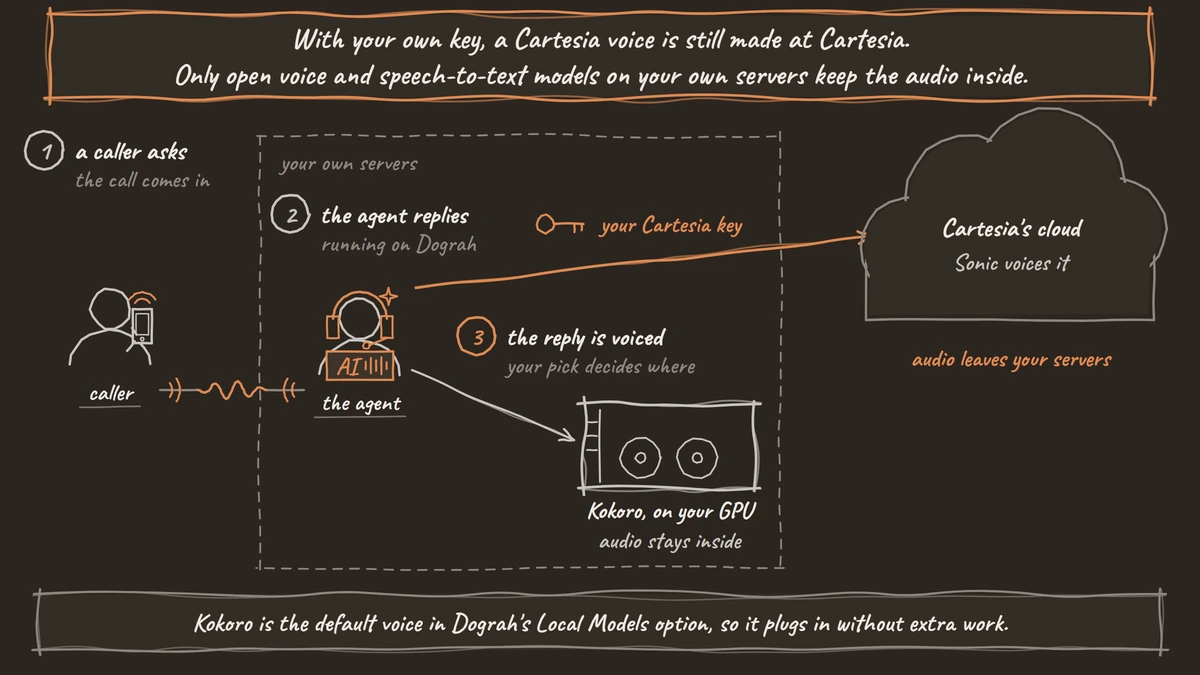
Full control of the call needs open models on your own servers. Run Dograh with Docker, point speech-to-text and the voice at Speaches, and add an open-weight model as the language model. For a fully in-house setup, also set ENABLE_TELEMETRY=false and remove POSTHOG_API_KEY, because a self-hosted install sends anonymous usage telemetry by default. Our guide to building a voice agent on fully local open-source models walks through that setup.
Join the Dograh Community
Dograh is an OSS alternative to Vapi. Join our Slack community for queries, releases, best practices & community interactions.
What self-hosting costs you
Self-hosting moves the cost from a vendor's invoice to your own servers and your team's time. Open voices need GPUs, and someone has to keep the speech servers, the database and the upgrades running. That is the honest trade, and for a small team at low volume, a hosted platform can be the better use of time.
A self-hosted install runs 10 calls at once by default, and your servers and phone carrier set the real ceiling. The open code carries no per-minute platform fee, so the spend goes to servers, model keys and phone minutes. On Dograh Cloud, you pay a 1¢-a-minute platform fee instead.
The license is the part that stays free of cost. BSD-2-Clause lets you change the code, ship it inside your own product and keep running it whatever happens to the vendor. Our post on BSD-licensed voice AI covers what that allows.
Which open route fits your team
If you only want to own your agent code, run your Line agents yourself or move them to LiveKit Agents or Pipecat, and keep building the product around them. If you only want an open voice, Kokoro is the quickest start, and Chatterbox is the one to test if you need cloning.
If you want the platform itself to be open, with the choice of keeping Sonic or going fully local, Dograh is the route that covers it. Start on Dograh Cloud to rebuild one agent with your Cartesia voice ID, then move it to your own servers when you are ready.
Glossary
- Line SDK
- Cartesia's open-source Python SDK for code-first voice agents, under Apache-2.0. Agent code you run yourself connects to Cartesia through a self-hosted deployment URL.
- Open-weight model
- A model whose weights you can download and run on your own hardware. The licence still decides what you may do with it, so open weights are not always open source.
- Licensed private deployment
- A vendor's closed software running on your servers or in your cloud under a contract. Cartesia offers this for its models on Enterprise, but the code stays the vendor's.
- Speaches
- An open-source, OpenAI-compatible speech server. Dograh's Local Models option uses it to run voices such as Kokoro and Whisper speech-to-text on your own servers.