
For a paid voice agent, Kokoro is the safe open-source voice. It is Apache-2.0 and the default local voice in Dograh, the open-source AI voice agent platform you can self-host or run on Dograh Cloud. Chatterbox is MIT and clones voices, but needs a server that returns raw 24 kHz audio. XTTS-v2 is for non-commercial use only.
Key Takeaways
- XTTS-v2's license covers its audio output too, so paid products cannot use it.
- Kokoro plugs straight in. Chatterbox needs a server that returns raw audio.
- Listen on a real phone line before you trust a leaderboard rank.
Pick a voice under a non-commercial license and you cannot use it on a paid line. We weigh Kokoro, Chatterbox and XTTS on license, how each connects to Dograh, sound and speed on a phone line, and voice cloning. It is part of our guide to self-hosted voice models.
License decides before quality does
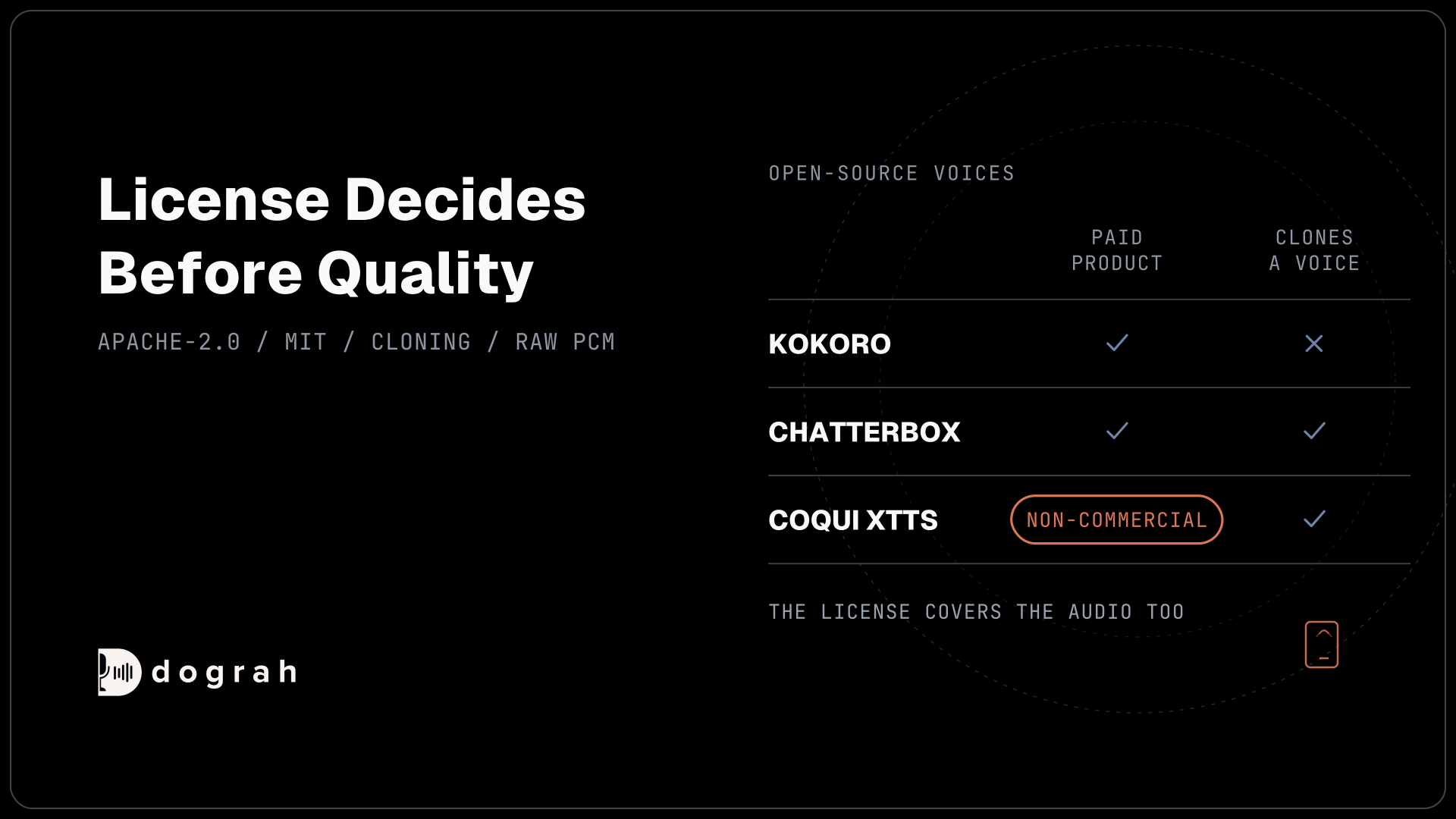
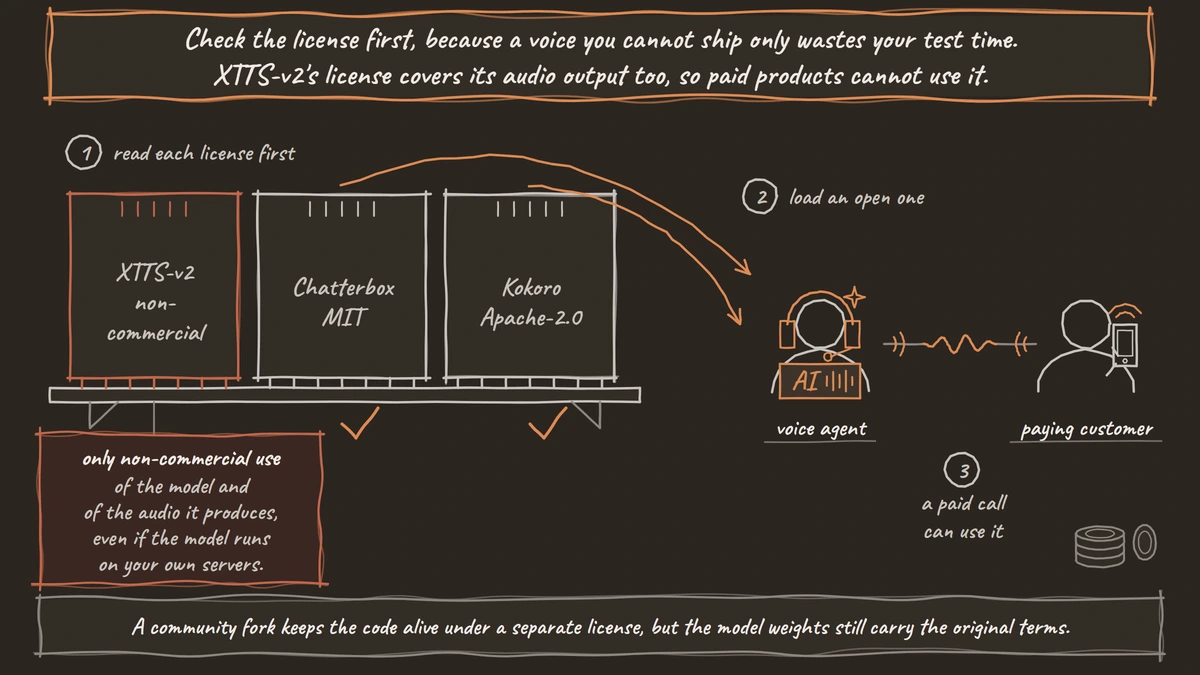
Check the license first, because a voice you cannot ship only wastes your test time. The three models sit at very different points.
Kokoro's model card puts its 82-million-parameter model under Apache-2.0, so you can use it in a paid product with no credit line. Chatterbox, from Resemble AI, is MIT, which is just as open.
XTTS-v2 is the trap. Its Coqui Public Model License allows only non-commercial use of the model and of the audio it produces. Revenue-generating activity is excluded by name, so a support line or a sales campaign is out, even if the model runs on your own servers. Companies may still test and evaluate it. Coqui, the company behind it, shut down in early 2024, so there is no one left to sell you a commercial license. A community fork keeps the code alive under a separate license, but the model weights still carry the original terms.
How each model plugs into Dograh
In Dograh, a self-hosted voice runs through the Local Models (Speaches) option in the voice settings. It sends the agent's text to an OpenAI-compatible /v1/audio/speech route on your server. Dograh asks the server for raw PCM audio and plays every chunk as 24 kHz sound, so the server must return exactly that.
Kokoro does. Its default model name in Dograh is kokoro and its default voice is af_heart. Kokoro-FastAPI, an open-source server built for the model, returns raw PCM at 24 kHz, and Speaches can serve Kokoro too. Our tutorial on how to run Kokoro TTS for a phone voice agent covers the setup step by step.
Chatterbox ships as Python code with no server of its own. The community servers built around it return WAV or MP3 files, while Dograh expects a plain stream of raw 24 kHz audio. Pick or write a server that returns raw PCM at that rate from the same route, then run a test call before you rely on it.
XTTS-v2 can technically be served the same way, but the license settles it for any paid product.

Open Source Alternative to Vapi / Retell
Self-hosted voice agent platform — no per-minute fees
dograh-hq/dograh
Star on GitHub
The three models side by side
This table puts each model's own facts next to the way it plugs into Dograh.
| Model | License | Size | Languages | Clones a voice | How it plugs into Dograh |
|---|---|---|---|---|---|
| Kokoro 82M v1.0 | Apache-2.0 | 82M parameters | 8, with 54 voices | No | Default local voice, through Kokoro-FastAPI or Speaches |
| Chatterbox | MIT | 350M (Turbo, English) to 500M (Multilingual) | Up to 23 | Yes, from a short clip | A server that returns raw 24 kHz PCM. Test call first |
| XTTS-v2 | Coqui Public Model License, non-commercial | Not stated on its card | 17 | Yes, from 6 seconds | Non-commercial tests only |
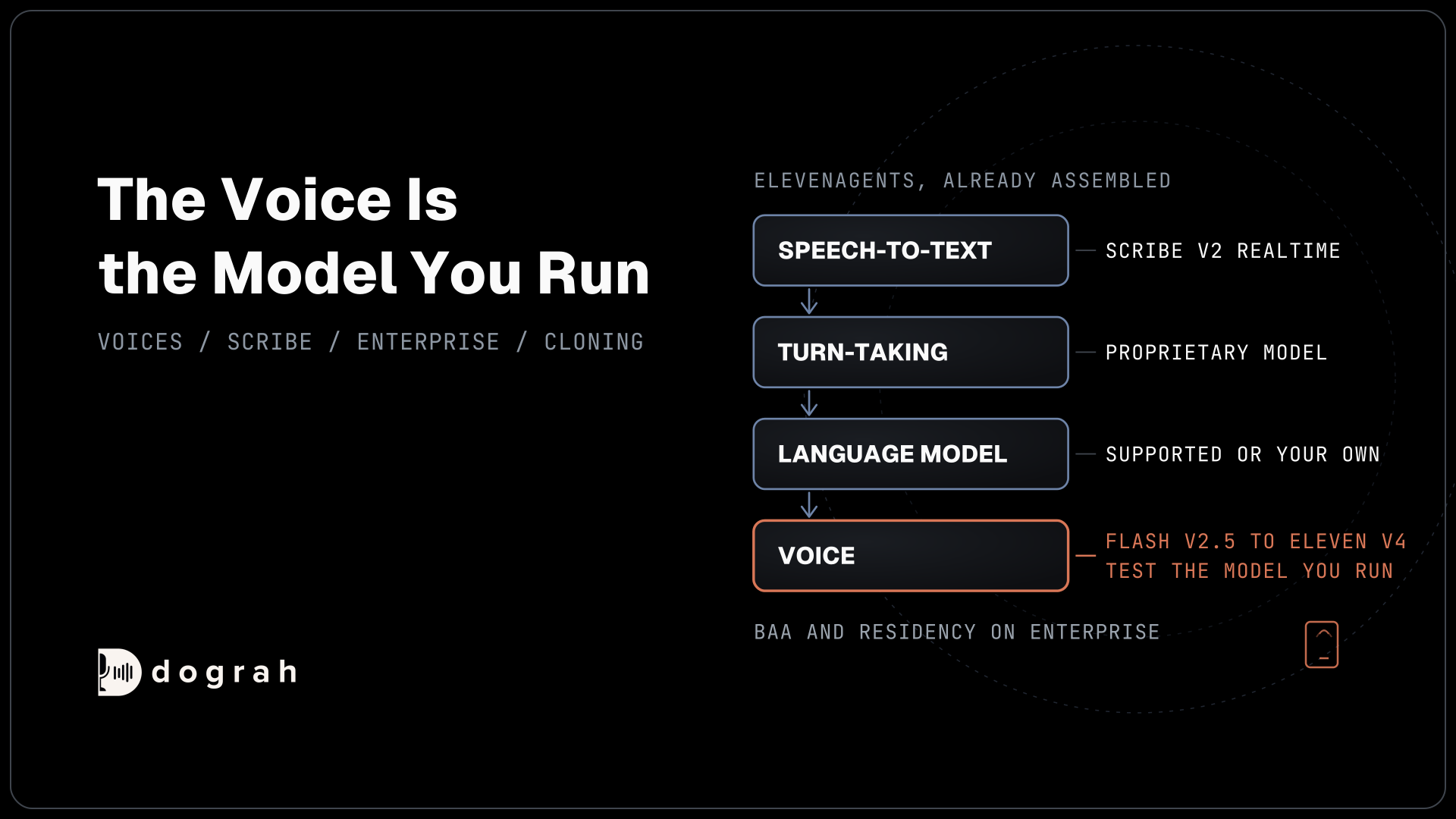
The voice is one part of a model layer you pick, and Dograh keeps running the call flow, tools and telephony around it. Moving an agent from one of these voices to another changes the model name, the voice and the server address.
Voice quality and speed on a phone line
Leaderboards rank voices on clips, and your callers hear them through a phone line. On the Artificial Analysis Speech Arena, where listeners vote blind between pairs of clips, Kokoro 82M v1.0 ranks 62nd of 100 with an Elo score of 1062. Chatterbox ranks 80th at 1024, and XTTS v2 ranks 92nd at 915. None of the three is near the top, where the hosted voices sit.
Most phone calls still carry 8 kHz audio, and every one of these models produces 24 kHz sound, so the line strips much of the detail listeners voted on. Voices often sound flatter and more robotic over a call than in the arena. Play each candidate through a real phone call before you decide. Our post on how to reduce robotic TTS in voice agents covers the settings that help once you have picked one.
Speed matters as much as sound, because silence before the first word is what callers notice. Kokoro-FastAPI reports first audio in about 300 ms on a GPU and about 3,500 ms on an older Intel i7 CPU. On a call, 3.5 seconds of silence reads as a dropped line, so run voices on a GPU.
Voice cloning in each model
Cloning is where the three split most clearly. Kokoro ships a fixed set of voices and no cloning. Kokoro-FastAPI can blend two of them into a new mix, though the mix still copies no real person.
Chatterbox clones from a short reference clip, about ten seconds in its own example. Every output carries Resemble's Perth watermark, an inaudible mark that survives MP3 compression, so the audio can later be identified as generated. How a Chatterbox server names a cloned voice depends on the server, so check what to type in Dograh's voice field.
XTTS-v2 clones from a 6-second clip, which is impressive, and its license still rules out paid use. If you need a clone in production and a local model is not a must, a hosted provider such as Cartesia or ElevenLabs gives you a voice ID you paste into Dograh. Our post on voice cloning for pre-recorded and TTS playback covers consent and matching a clone to your recorded lines.
Join the Dograh Community
Dograh is an OSS alternative to Vapi. Join our Slack community for queries, releases, best practices & community interactions.
Which voice to run
Start with Kokoro. It plugs in as is, and its license lets you ship. Try a few voices and the speed setting on a real phone call before you settle on one.
Move to Chatterbox when the agent must speak in a cloned voice from your own servers, and plan the server work that returns raw 24 kHz audio. Keep XTTS-v2 for non-commercial experiments only. If you run the voice locally to keep data in-house, also know that a self-hosted Dograh install sends anonymous usage telemetry by default. Setting ENABLE_TELEMETRY=false and removing POSTHOG_API_KEY turns it off.
Glossary
- Raw PCM
- Plain audio samples with no file header or compression. Dograh's local voice option asks for raw PCM and plays it as 24 kHz sound, so a server that wraps its output in a WAV or MP3 file does not fit as is.
- Coqui Public Model License
- The license on XTTS-v2's weights. It allows only non-commercial use of the model and of the audio it produces, and with Coqui closed there is no commercial license to buy.
- Voice cloning
- Copying a voice from a short reference clip without training the model on that speaker. Chatterbox and XTTS-v2 can do it, while Kokoro ships fixed voices only.
- Perth watermark
- An inaudible mark Resemble AI adds to every Chatterbox output that survives MP3 compression, so generated speech can be identified later.