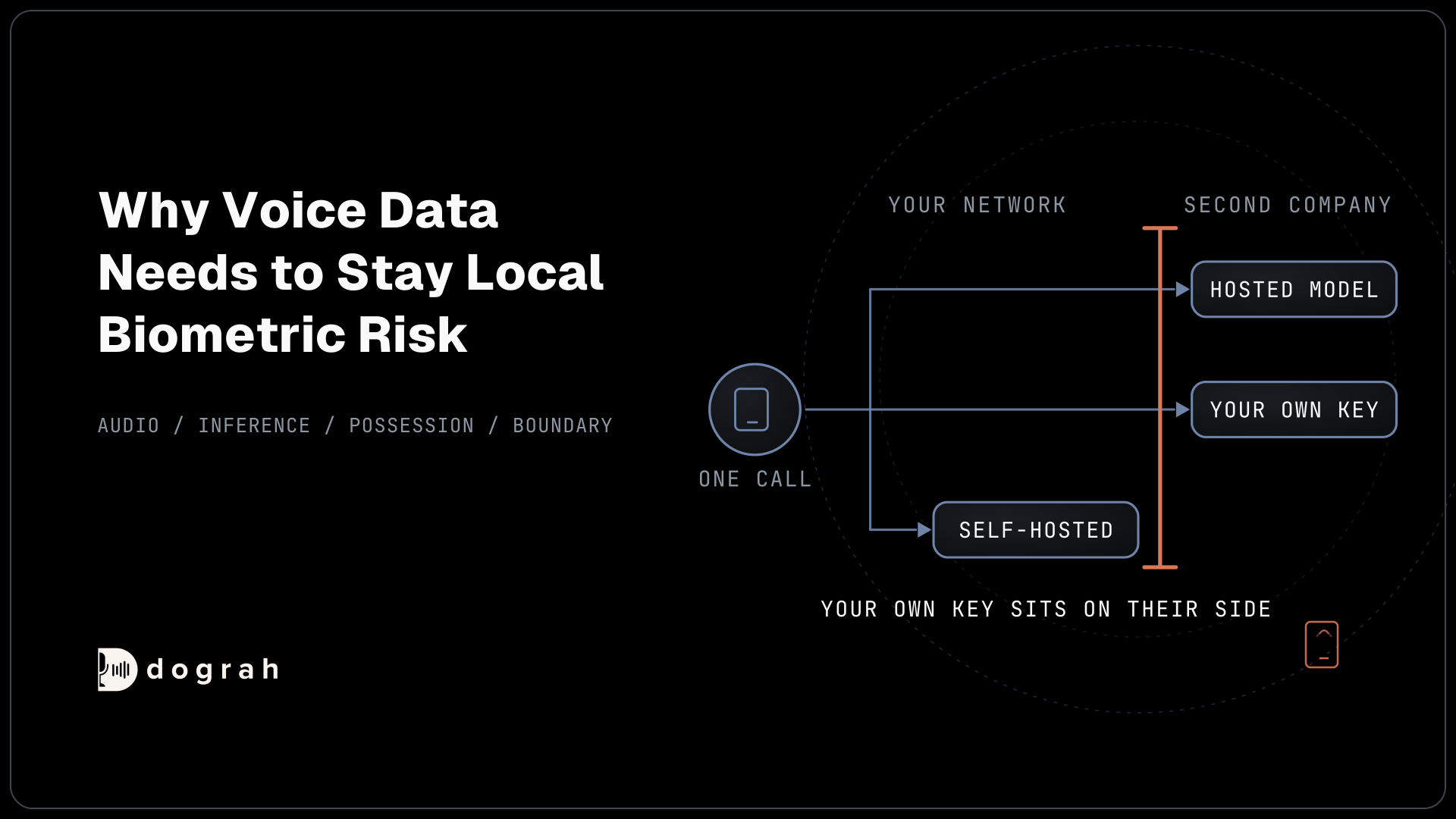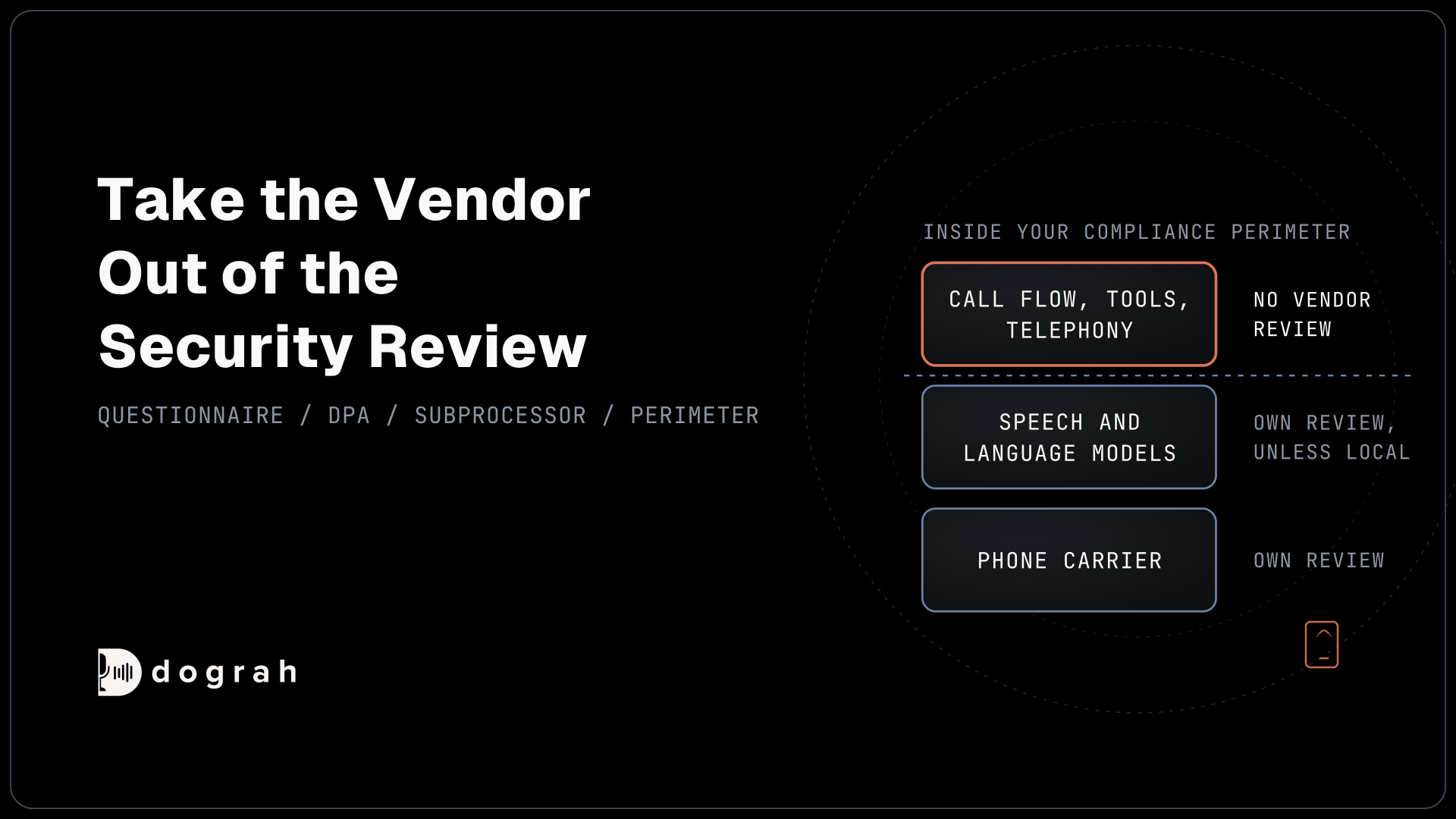

Procurement stalls on closed voice vendors because each one becomes a new party holding your call audio and transcripts. That brings a security questionnaire, a data processing agreement and a review of every subprocessor behind it. Self-hosting an open-source platform inside your compliance perimeter takes the platform vendor out of that review, though hosted model providers still need theirs.
Key Takeaways
- Security reviews were the top cause of delay in Levelpath's survey of 300 buyers.
- A self-hosted platform inside your perimeter needs no separate vendor review.
- Hosted model providers and your own deployment still get reviewed.
This post is part of our guide to compliant AI voice agents. The guide's section "Buying: why procurement stalls on closed vendors" opens with one line: "Buying a hosted voice platform adds a vendor review to the deal, and running the platform yourself takes that review away." Here is how that plays out in a real purchase, using Dograh, an open-source, self-hostable voice agent platform, as the example.
Why procurement stalls at the security review
AI purchases take longer than other software, and the security review is where most of the waiting happens. In Levelpath's survey of 300 US enterprise procurement and supply chain decision-makers, security reviews were the most-cited cause of delay, named by 58%. The same survey found that 72% of AI purchases over $10,000 take 11 weeks or more, against 57% of traditional software. For a team that wants a voice agent live this quarter, that gap is most of the quarter.
A hosted voice platform is a heavy review because of what it touches. It hears every call and stores every recording and transcript, along with the details the agent extracts. It also sends the audio on to speech and language model providers, and each of those becomes a subprocessor your team has to approve. So the security team ends up reviewing a new home for your customers' voices and words, plus every company behind it.
What a closed voice vendor has to prove
A standard AI procurement checklist asks the same questions of every vendor. The table shows how each answer changes when the platform runs on your own servers.
| Checklist question | Hosted voice platform | Self-hosted Dograh |
|---|---|---|
| Security report (SOC 2, ISO 27001) | Collect the vendor's report and review its scope | No Dograh report to collect; the install sits inside your own controls |
| Data processing agreement | Sign one with the vendor | None with Dograh; one with each hosted model provider you use |
| Subprocessor list | Approve the vendor's list and every change to it | Your own short list: model providers, the carrier, any cloud host |
| Where call data is stored | The vendor's regions | Your database and object storage, in the region you choose |
| Training on your data | Read the vendor's terms | Check only the terms of hosted model providers |
| Retention and deletion | The vendor's settings | Your own storage policy |
| Exit and data export | Negotiate an export at the end | Records already sit in your database |
Each row on the left is a claim your team has to check, and each takes a round of email. On the right, most rows become settings your own team controls. The right column still takes work, on systems your team already knows how to review.

Open Source Alternative to Vapi / Retell
Self-hosted voice agent platform — no per-minute fees
dograh-hq/dograh
Star on GitHub
What self-hosting takes off the list
Self-hosting takes the platform vendor out of the data path, which is what the long review was about. Dograh is the orchestration layer: it runs the call flow, tools and telephony, and the speech and language models are a separate layer you choose. Because you self-host Dograh inside your existing compliance perimeter, you don't need a separate vendor review for Dograh. The speech and language model providers you choose may still need their own review, unless those models run on your servers too.
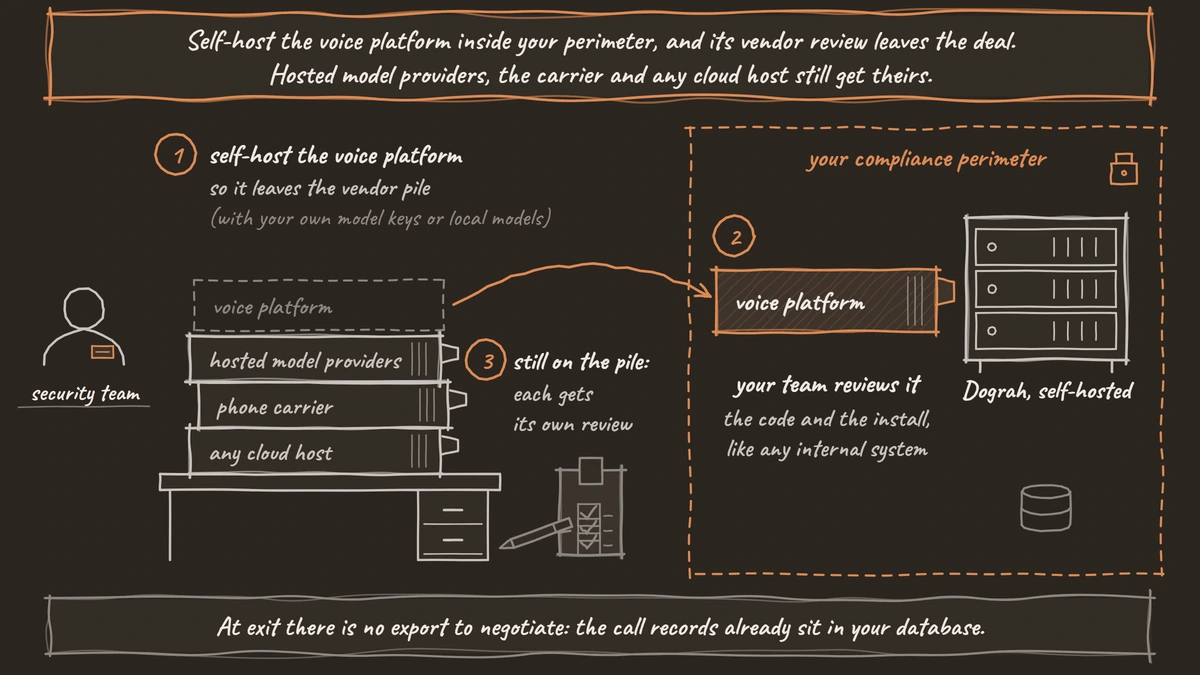
That last point decides how short the list gets. Bringing your own API keys changes whose contract covers the audio, but the audio still reaches the provider. The call audio stays in-house only when the speech and language models run on your own servers too. Running open-weight models on your own servers leaves only the phone carrier outside.
Dograh starts every account on its own managed models. To keep call audio away from Dograh, open Models, switch the Organization default to BYOK with your own speech and language providers (or local models), and check that no agent has its own model override.
Buyers already value this. In the 2026 State of Open Source Report from Perforce OpenLogic, the Open Source Initiative and the Eclipse Foundation, based on more than 700 responses, 55% named avoiding vendor lock-in as a leading reason to adopt open source. In the EU and UK, the share was 63%.
Teams that want a contract behind the install can take the Enterprise plan, which lists "On-premise / private-cloud deployment, data residency & data perimeter". With private cloud, Dograh runs the stack inside your own VPC.
What your team still has to review
Open source moves the review work to your own team. A security testing firm puts it bluntly: "There is no vendor security team to hold accountable. There is no SOC 2 report to request." That is true of any self-hosted software, so your team reviews the code and the deployment instead.
Start with the code. Dograh is released under the BSD-2-Clause licence, and the open-source plan's own description is "audit every line of source." Your engineers can read it and pen test the deployed install before a single real call.
Someone also owns updates, the same as for any other server you run, and updating a self-hosted stack becomes a planned job for your team. The same open source report found that 20% of organizations have no specific process for responding to CVEs, the public list of known software flaws. Set one up before go-live.
Then the deployment. Telemetry is on by default in the Docker setup. Set ENABLE_TELEMETRY=false, and remove POSTHOG_API_KEY from the api service in docker-compose.yaml (or set it to an empty value). Replace the quickstart's public tunnel with your own domain, and write a storage policy for recordings. If the servers run in a cloud account, that cloud provider is part of the review too.
Which controls your team then owns is covered in How to Pass a SOC 2 Review With a Self-Hosted Voice Agent, and the call records a reviewer opens are in Building an Auditable Voice AI Stack for Security Reviews.
Join the Dograh Community
Dograh is an OSS alternative to Vapi. Join our Slack community for queries, releases, best practices & community interactions.
A shorter path to the first live call
The fastest route puts the review where your team already has the skills.
- Install the open-source code in a test environment and give your security team access to the code and the install.
- Decide where the speech and language models run: on your servers, or with providers you review.
- Send only what is left through vendor review: hosted model providers, the carrier, any cloud host and any outside endpoint your tools call.
- Set the deployment controls: telemetry off, your own domain, access logging and a storage policy for recordings and transcripts.
- Add a contract only if you want one, through the Enterprise plan.
The cost model changes too. Self-hosted Dograh has no per-minute platform fee (servers, model keys and phone minutes still cost); Dograh Cloud has a 1¢-a-minute platform fee, and Dograh Cloud handles the security work for you.
Some sectors add their own rules on top. Contact centers that run calls for many clients can start with on-prem voice AI for BPOs, and firms holding client tax records with on-prem voice AI for accounting firms.
Glossary
- Data processing agreement (DPA)
- The contract a business signs with any outside company that handles personal data on its behalf. A hosted voice platform needs one. With a self-hosted platform, you sign one with each hosted model provider instead.
- Subprocessor
- A company your vendor passes your data to, such as the speech and language model providers behind a hosted voice platform. Each one is part of your review.
- Security questionnaire
- The list of questions a buyer's security team sends a vendor about its controls, data handling and reports. It is the step most often cited for delaying AI purchases.
- Compliance perimeter
- The systems your existing security controls, policies and audits already cover. Self-hosted software installed inside it is reviewed like any other internal system.