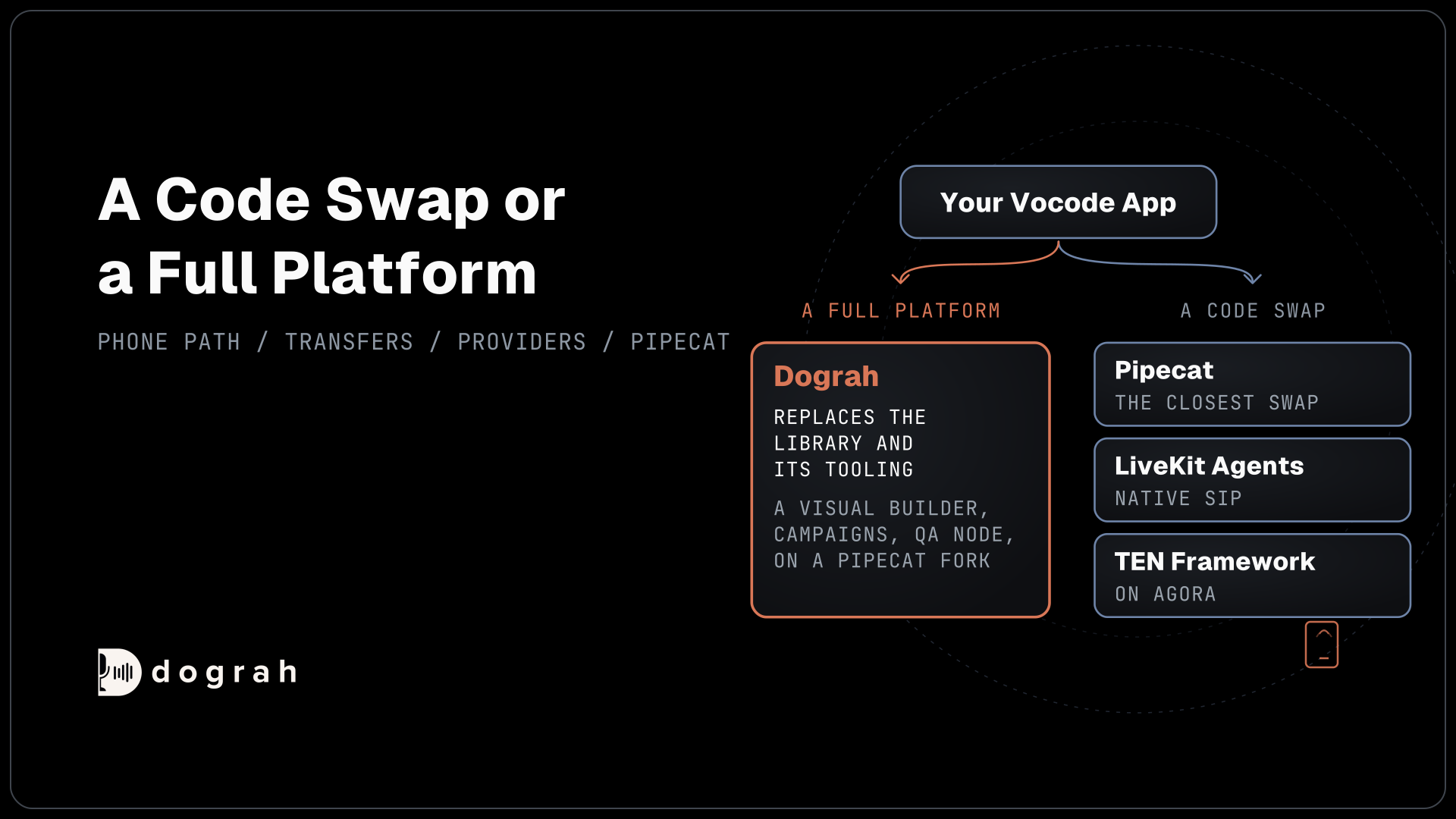

The main Vocode alternatives are Pipecat, LiveKit Agents and TEN Framework for code-level swaps, and Dograh for a full platform. It is the open-source AI voice agent platform with a visual workflow builder, phone lines, campaigns and per-call QA. You can self-host it or run it on Dograh Cloud, and it runs on a Pipecat fork.
Key Takeaways
- Pipecat is the closest code swap. Dograh replaces the library and its tooling.
- Check transfers first: Pipecat's carrier WebSocket routes cannot hand calls to people.
This post is part of our guide to open-source voice AI frameworks. We list what a Vocode codebase needs from a replacement and weigh each alternative. If you want a visual builder instead of code, Dograh comes right after the table.
What Vocode is
Vocode is an MIT Python library for voice agents. It covered streaming conversations and inbound and outbound phone calls, with integrations for many speech and voice providers.
What a Vocode codebase needs from a replacement
A replacement has to cover what your Vocode app uses today, so list that first. Vocode handled streaming conversations with a language model, inbound phone numbers and outbound calls, Zoom dial-in and an outbound call placed by a LangChain agent. It shipped integrations for speech-to-text providers such as Deepgram, AssemblyAI, Gladia and Whisper, OpenAI and Anthropic models, and voices from ElevenLabs, Cartesia, Azure and others.
Start with the phone path, because it is the part callers notice first. Note whether your calls come in or go out, and which carrier carries them. Then check provider coverage for the exact models you run.
Two needs often appear only after the move. The first is handing a caller to a person, which many Vocode apps never had. The second is a way for someone outside engineering to change a greeting or a question, which a library cannot give you.
Vocode alternatives compared
The table sets each option against those needs.
| Option | Licence | Phone calls | Transfer to a person | Who changes the agent |
|---|---|---|---|---|
| Vocode (baseline) | MIT | Inbound and outbound phone calls | Build it yourself | Developers, in Python |
| Dograh | BSD 2-Clause | Twilio, Vonage, Plivo, Telnyx, Exotel, Vobiz, Cloudonix, Asterisk ARI, WhatsApp inbound calling | Transfer Call on Twilio, Telnyx, Plivo, Cloudonix and Asterisk ARI | Anyone on the team, in a visual workflow builder |
| Pipecat | BSD-2-Clause | Carrier WebSockets for Twilio, Telnyx, Plivo and Exotel, plus Daily PSTN and SIP | On Daily PSTN or SIP, not on carrier WebSockets | Developers, in Python |
| LiveKit Agents | Apache-2.0, turn detector under the LiveKit Model License | Native SIP with inbound and outbound trunks | Cold and agent-assisted transfers | Developers, in Python or Node.js |
| TEN Framework | Apache 2.0 with conditions set by Agora | Agora RTC, with a SIP call example | Build it yourself | Developers, with the TMAN Designer graph editor |
The last two columns separate the options. Only LiveKit and Dograh carry a transfer on their main phone route, and only Dograh lets someone outside engineering change the agent.
Dograh: the full platform with a visual builder
Dograh replaces the library and everything your team built around it. It runs its call pipeline on a Pipecat fork, so the engine under it is a maintained project with frequent releases. On top sits a visual workflow builder: a Start Call node with the greeting, agent nodes with prompts, a global prompt shared by every step, tools, pathways and end-call outcomes. A support lead can change a greeting or a question without a pull request.
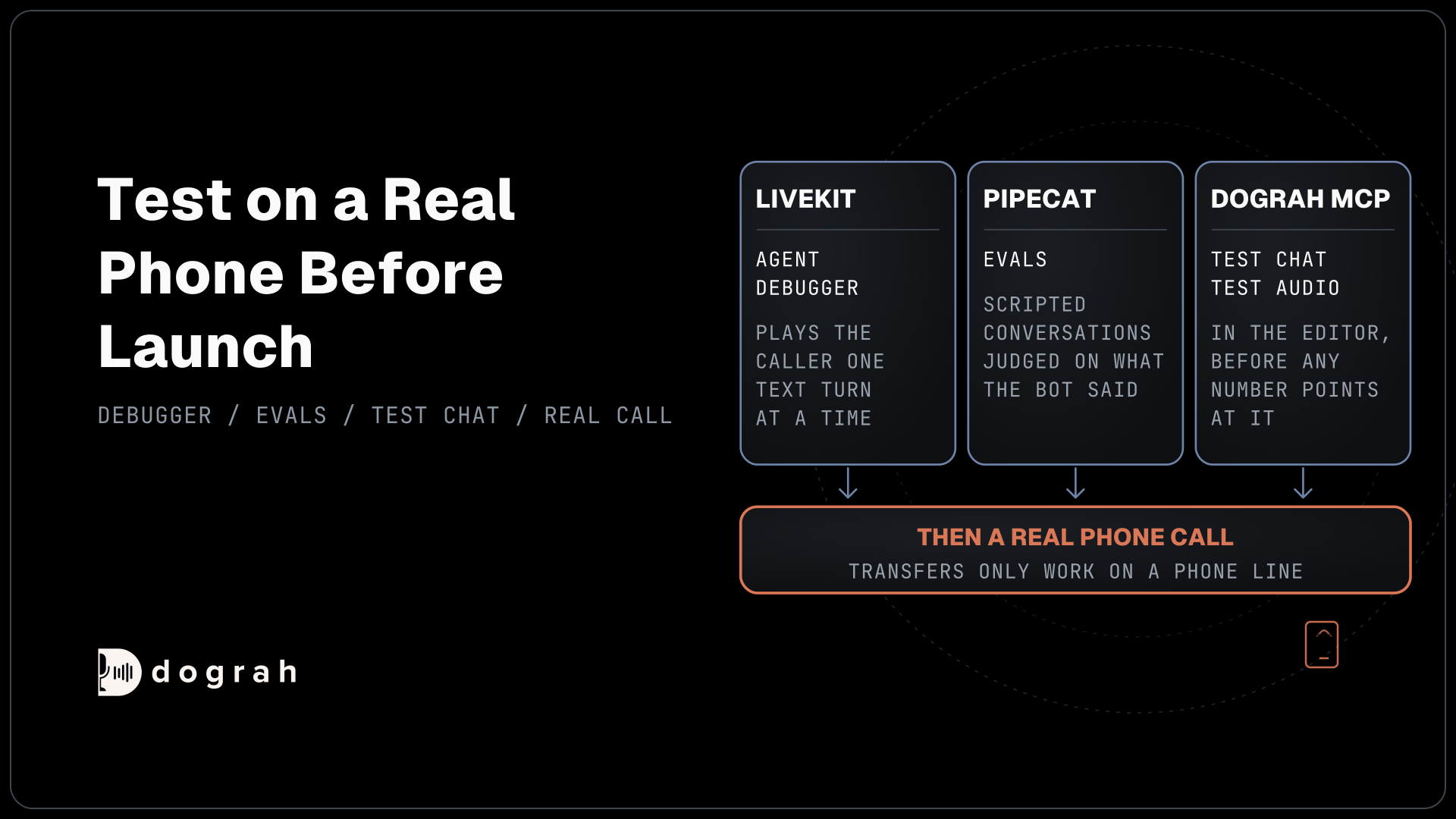
You test in the same screen, by talking to the agent in the browser with Test Audio or by typing turns in Test Chat. Phone calls run through your own carrier account, and with Transfer Call Dograh rings the destination while the caller hears hold music, then connects the two once the destination answers. If the destination does not answer, is busy, fails or times out, the agent gets transfer_failed and carries on with the caller.
Outbound lists run as Campaigns with calling hours, and you set the retries (0 to 10) and the wait between them. Each finished call keeps its transcript, recording and trace in Langfuse, and a QA node scores each step separately with tags, a 1-10 score, sentiment and a summary.
Models stay your choice, as they were on Vocode. You bring your own keys for any supported speech-to-text, language model and voice provider, or run open-weight models on your own servers. Pre-recorded clips can play your most common lines in a real voice, with text-to-speech as the fallback.
Self-hosted Dograh has no per-minute platform fee, but servers, model keys and phone minutes still cost money. Dograh Cloud charges a 1¢-a-minute platform fee. Out of the box a self-hosted install handles 10 calls at once, and that limit can be raised.
Join the Dograh Community
Dograh is an OSS alternative to Vapi. Join our Slack community for queries, releases, best practices & community interactions.
Code frameworks: Pipecat, LiveKit and TEN
Pipecat is the closest swap for a Vocode codebase. Both are Python, both chain speech-to-text, a language model and a voice into one pipeline, and Pipecat's provider list is wide. Its WebSocket routes for Twilio, Telnyx, Plivo and Exotel carry no transfers or reconnects, so a call that needs a person moves to Daily PSTN or SIP. Our post on Pipecat alternatives looks at the same choice from the other side.
LiveKit Agents suits teams that want native phone lines. Your agent joins a room on the LiveKit media server, inbound and outbound SIP trunks connect carriers, and cold and agent-assisted transfers come built in. Self-hosted, the SIP service is a separate deployment with its own open ports. Our LiveKit alternatives post covers where it fits less well.
TEN Framework builds agents as graphs and runs real-time audio on Agora, so it fits teams already using Agora. Its licence adds Agora's conditions to Apache 2.0, including no hosting on end-user devices and no deployment that competes with Agora, so read it before a product depends on it.
Bolna, also active, takes a config-first route where you describe an agent in JSON. Its core is MIT, while its hosted APIs and no-code playground are closed source, and its open setup places calls through Twilio or Plivo. Our guide to Bolna alternatives compares it with the rest of the field.

Open Source Alternative to Vapi / Retell
Self-hosted voice agent platform — no per-minute fees
dograh-hq/dograh
Star on GitHub
How to choose and move off Vocode
Pick by who will change the agent after the move. If your developers want to keep everything in Python and rewrite the pipeline, Pipecat is the shortest step, with LiveKit Agents next when you want native SIP and transfers. If support or operations staff will edit the calls, Dograh gives them a builder on the same Pipecat engine, self-hosted or on Dograh Cloud.
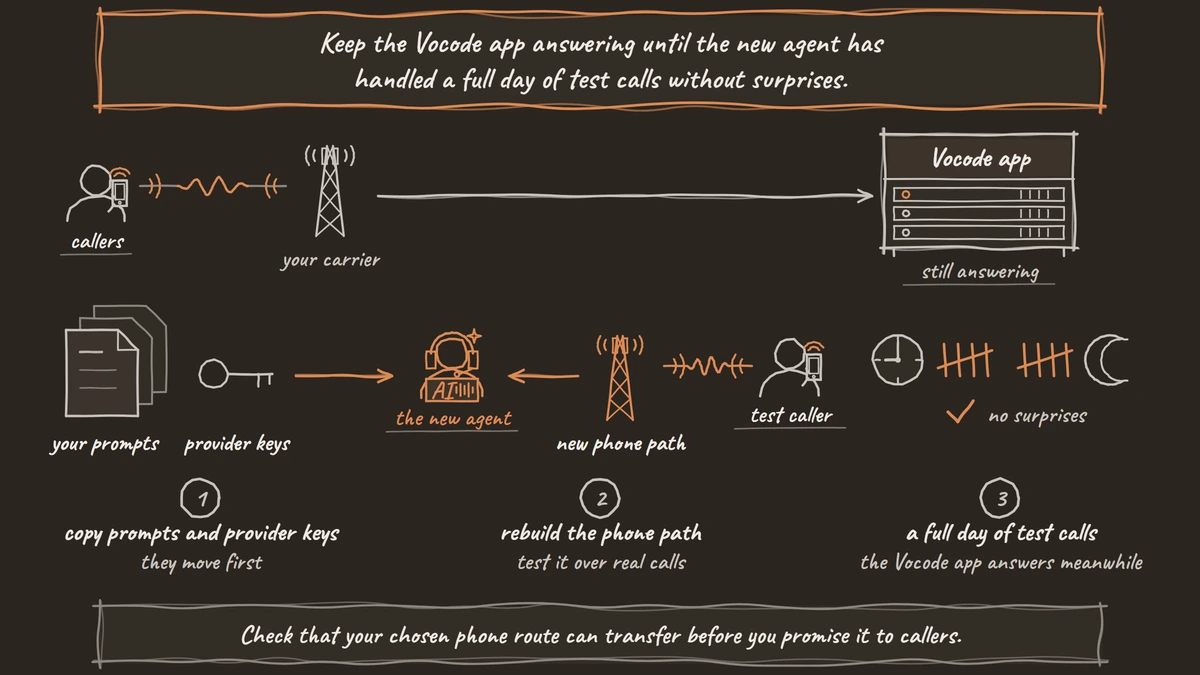
Move in a fixed order. Copy your prompts and provider keys first, then rebuild the phone path and test it over real calls, because most phone audio arrives at 8 kHz and behaves differently from a laptop microphone. Keep the Vocode app answering until the new agent has handled a full day of test calls without surprises.
Glossary
- Carrier WebSocket route
- A phone connection where the carrier streams call audio to your server over a WebSocket. Pipecat offers it for Twilio, Telnyx, Plivo and Exotel, without transfers or reconnects.
- Native SIP
- A framework that speaks the SIP calling protocol itself, as LiveKit does, so carriers connect through trunks and transfers use SIP messages such as REFER.
- Visual workflow builder
- Dograh's editor where a call flow is a graph of nodes and pathways. Prompts, greetings and tools are changed on screen, without editing code.