
A silence timer ends the turn after a fixed pause, while Smart Turn uses a small audio model to judge whether the sentence sounds finished. Timers suit short answers, and Smart Turn suits callers who pause mid-thought. Dograh, the open-source AI voice agent platform we build, offers both, self-hosted or on Dograh Cloud, with Transcription-based as the default.
Key Takeaways
- Transcription-based ends a turn about 0.8 seconds into a pause.
- Smart Turn waits up to 2 seconds, but only on turns that sound unfinished.
- Flux, ink-2 and Dograh's own speech-to-text override both modes.
This post is part of our guide to voice activity detection, where turn detection fixes most talking-over problems. Below, we put Dograh's two turn modes head to head: the timer chain in each, where each fails, the path that overrides both, and a test script to compare them.
How each mode decides the turn is over
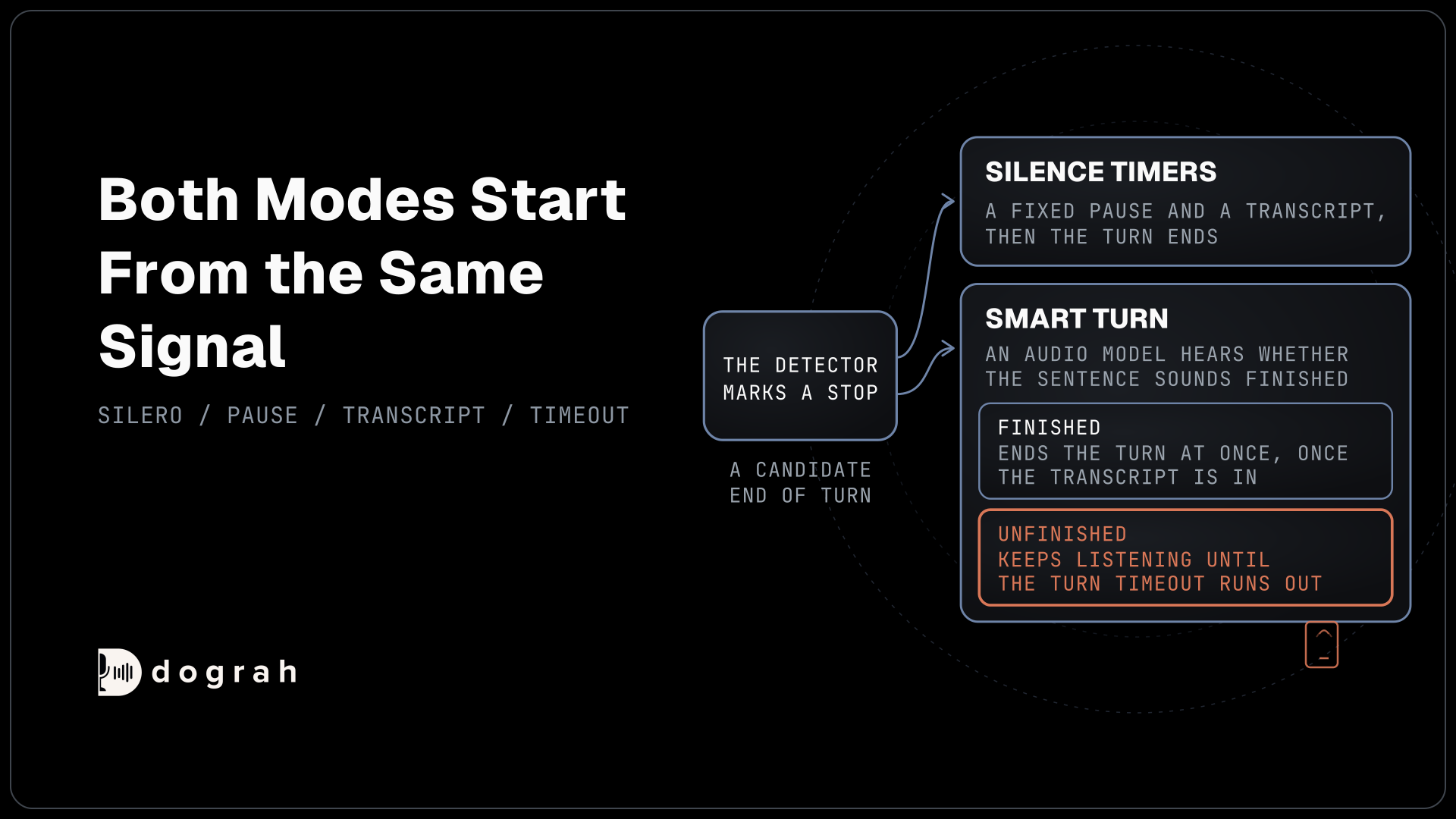
Both modes start from the same signal and differ in what happens after it. Under each one, the Silero detector marks speech as stopped after 0.2 seconds of silence. That stop is only a candidate for the end of the caller's turn.
Transcription-based, Dograh's default, then runs a silence timer. It waits 0.6 seconds and needs a transcript from the speech-to-text model before it ends the turn. In practice a pause of about 0.8 seconds hands the turn to the agent, whatever the caller was in the middle of saying.
Smart Turn Analyzer runs the open Smart Turn model at that point. It is a small classifier built on Whisper Tiny, about 8 MB as the CPU file, covering 23 languages under a BSD-2 licence. It hears up to the last 8 seconds of the turn at 16 kHz and decides whether the sentence sounds finished. A "complete" verdict ends the turn at once, once the transcript is in. An "incomplete" verdict keeps Dograh listening until the Incomplete Turn Timeout runs out, 2 seconds by default and settable from 0.5 to 10.
Dograh bundles the v3.2 model. Daily's Smart Turn v3.2 notes say it misclassifies single-word replies such as "yes" or "okay" 40% less often on Daily's benchmarks and was trained with cafe and office noise. Under both modes, a fallback ends any turn left open for 5 seconds with no activity from the caller.
Smart Turn vs silence timers side by side
The table sets the two modes next to the path that overrides them, using the values in Dograh's code. Read each row as the behaviour you will hear on a live phone call.
| Transcription-based (silence timer) | Smart Turn Analyzer | Speech-to-text ends the turn | |
|---|---|---|---|
| What decides | A fixed 0.6 s wait after the detector stop, plus a transcript | An audio model that hears whether the sentence sounds finished | The provider's own end-of-turn signal |
| Wait on a mid-sentence pause | Ends at about 0.8 s | Up to the Incomplete Turn Timeout, 2 s by default | Flux: end-of-turn score 0.7, or 3,000 ms |
| Short "yes" answers | Fast and reliable | Fast when judged complete | Up to the provider |
| Callers who pause to think | Often cut off | Given room when the pause sounds unfinished | Up to the provider |
| Where you set it | Settings, Turn Detection, Detection Strategy | Same, plus Incomplete Turn Timeout | Picking the speech-to-text model |
| Dograh default | Yes | No | Applies whenever Flux, ink-2 or Dograh's own speech-to-text is picked |

Open Source Alternative to Vapi / Retell
Self-hosted voice agent platform — no per-minute fees
dograh-hq/dograh
Star on GitHub
Where each one fails on a phone call
A silence timer fails on the caller who pauses mid-sentence. Someone reading a policy number off a card, or saying "I need to change... the address", loses the turn at the first pause of about 0.8 seconds. Making the timer longer helps that caller and slows every reply for everyone else, because each turn now waits out the full silence. Our post on turn detection for slow speakers times one of these calls on both modes.
Smart Turn fails in other places. Its README warns that it is not designed for very short audio, which is exactly what a one-word phone answer is, though v3.2 narrowed that gap. A group of digits read in a flat voice can sound complete when the caller has more to say. Phone audio usually arrives at 8 kHz and is resampled to the 16 kHz the model expects, so test it on your own lines.
The frameworks also chose different defaults. Pipecat's speech input guide makes Smart Turn its default stop strategy and calls the speech timeout a simpler alternative, and Pipecat's own Smart Turn wait is 3 seconds. Dograh runs on a fork of Pipecat, defaults to Transcription-based and sets the Smart Turn wait to 2 seconds, because many phone agents mostly hear short answers such as a name, a yes or a time slot.
When the speech-to-text model decides
A third path overrides both modes, and it covers some common speech-to-text choices. If the agent's speech-to-text is Deepgram Flux, Cartesia ink-2, or Dograh's own speech-to-text in Multilingual mode or one of its 10 single languages, Dograh follows the provider's end-of-turn signal and ignores the Detection Strategy.
In Dograh, Flux ends a turn when its end-of-turn score reaches 0.7, or after 3,000 ms of silence, and both values are fixed in code. An open turn on that path falls back after 30 seconds. To compare Smart Turn with a timer, pick a speech-to-text model that leaves the turn to Dograh, such as Deepgram Nova-3, AssemblyAI or Speechmatics. Speech-to-speech models follow their provider's turn-taking too, a topic our post on full-duplex voice AI covers.
A test script for both modes
Compare the modes on the same calls, read by the same person, over a real phone line. Set the Detection Strategy, publish the agent so the change applies, place the calls, then switch modes and repeat. Use these six lines:
- "Yes."
- "Tuesday at three."
- "My policy number is four four seven", a 1-second pause, then "two one nine".
- "I want to, um, change the address on my account."
- A one-word answer with a TV on in the room.
- A three-sentence complaint with a 1-second pause in the middle.
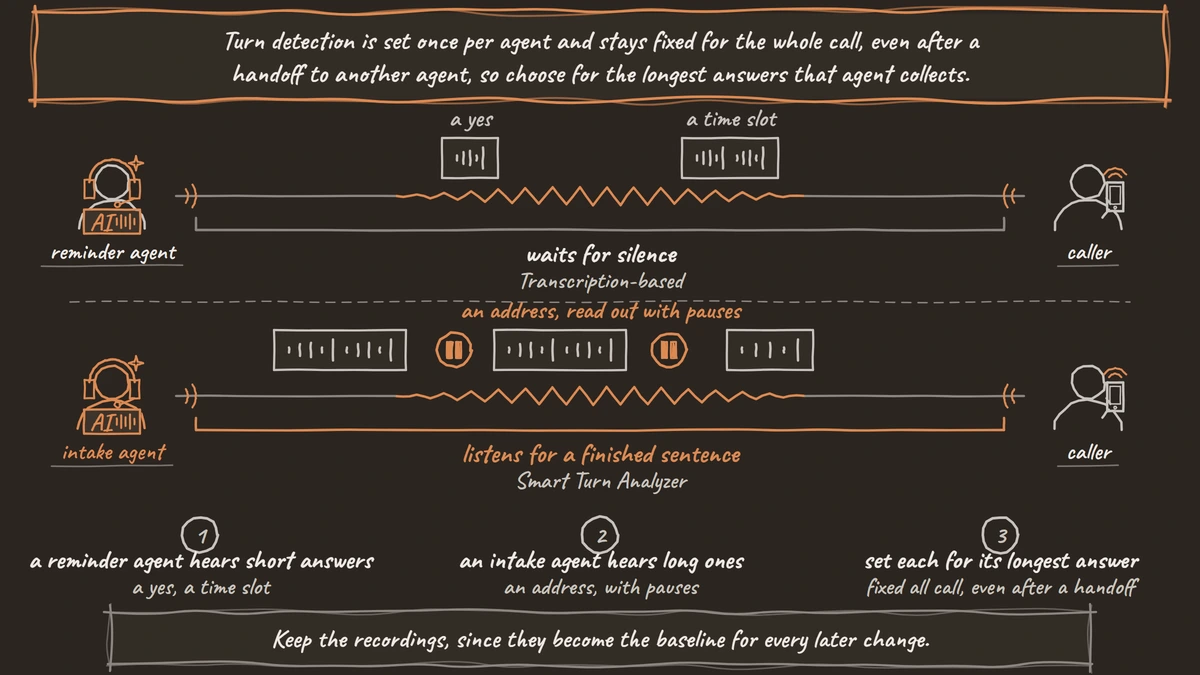
For each line, note three things: whether the turn split in two, whether the agent cut in, and the gap before the agent replied. Each call's View Trace shows the speech-to-text, AI and voice time for every turn, so you can see whether the gap came from the turn decision or a slow model. Keep the recordings, since they become the baseline for every later change. Because Dograh is open source, every timer in this post can be checked in its code.
Join the Dograh Community
Dograh is an OSS alternative to Vapi. Join our Slack community for queries, releases, best practices & community interactions.
Which one to pick
Keep Transcription-based for agents that mostly hear short answers, such as reminders, confirmations and booking slots. Switch to Smart Turn Analyzer for agents that collect long answers, such as intake, complaints, addresses and numbers read off a card, and raise the Incomplete Turn Timeout only if callers still get cut off.
Turn detection is set once per agent and stays fixed for the whole call, even after a handoff to another agent, so choose for the longest answers that agent collects. Interruption is a separate setting, and our post on barge-in, endpointing and turn-taking explains how the two work together. Our page on turn-taking controls in an open-source voice agent maps each setting to the symptom it fixes.
Glossary
- Speech timeout
- A fixed wait after the speech detector marks a stop, before the turn ends. In Dograh's Transcription-based mode it is 0.6 seconds and also needs a transcript, so a pause of about 0.8 seconds ends the turn.
- Smart Turn
- An open, BSD-2-licensed audio model that hears up to 8 seconds of a turn and judges whether the sentence sounds finished. Dograh bundles the v3.2 CPU file and runs it as the Smart Turn Analyzer.
- Incomplete Turn Timeout
- How long Dograh keeps listening after Smart Turn judges a sentence unfinished, 2 seconds by default and settable from 0.5 to 10. It only applies to turns the model calls incomplete.
- Open-turn fallback
- A last-resort end to a turn left open with no activity from the caller, 5 seconds under both of Dograh's modes and 30 seconds when the speech-to-text provider ends turns.