
Slow speakers get cut off when the turn ends at the first long pause. Switch to a turn model that hears unfinished sentences, give it a longer wait, and ask for long numbers in groups. Dograh, the open-source AI voice agent platform we build, has each setting, and you can self-host it or run it on Dograh Cloud.
Key Takeaways
- On the default setting, a pause of about 0.8 seconds ends the caller's turn.
- Smart Turn waits up to 2 seconds, but only when a sentence sounds unfinished.
- Ask for numbers in groups, and allow more idle time for card hunts.
This post is part of our guide to voice activity detection, where a mid-sentence pause gets one row in the symptom table. Below, we cover callers who pause to think and callers reading a number off a card, then the settings that stop the cut-in and how to test them.
Why slow speakers get cut off
A slow speaker gets cut off because the turn ends at the first long pause, well before the thought does. In Dograh's default mode, Transcription-based, the Silero detector marks speech as stopped after 0.2 seconds of silence. A speech timeout of 0.6 seconds then runs, and once the transcript is in, the turn is over. Any pause of about 0.8 seconds closes the caller's turn.
That is short for many real callers. Coval's guide to testing turn detection, from a company that sells voice agent testing, says deliberate speakers routinely pause for 500 ms or more between phrases without being finished. It suggests elderly callers in healthcare may need 800 to 1,200 ms of silence before the agent replies, and it tests gaps of 1 to 2 seconds between sentences. These figures come from testing practice, so treat them as a starting point for your own calls.
The obvious fix has a cost. A longer silence timer protects the slow caller and slows every reply for everyone else, since each turn now waits out the full silence before the agent answers. Our post on barge-in, endpointing and turn-taking explains why one threshold cannot suit a hesitant caller and a hurried one at the same time. The better first move is a check that waits only when the sentence sounds unfinished.
A policy number read off a card, an example
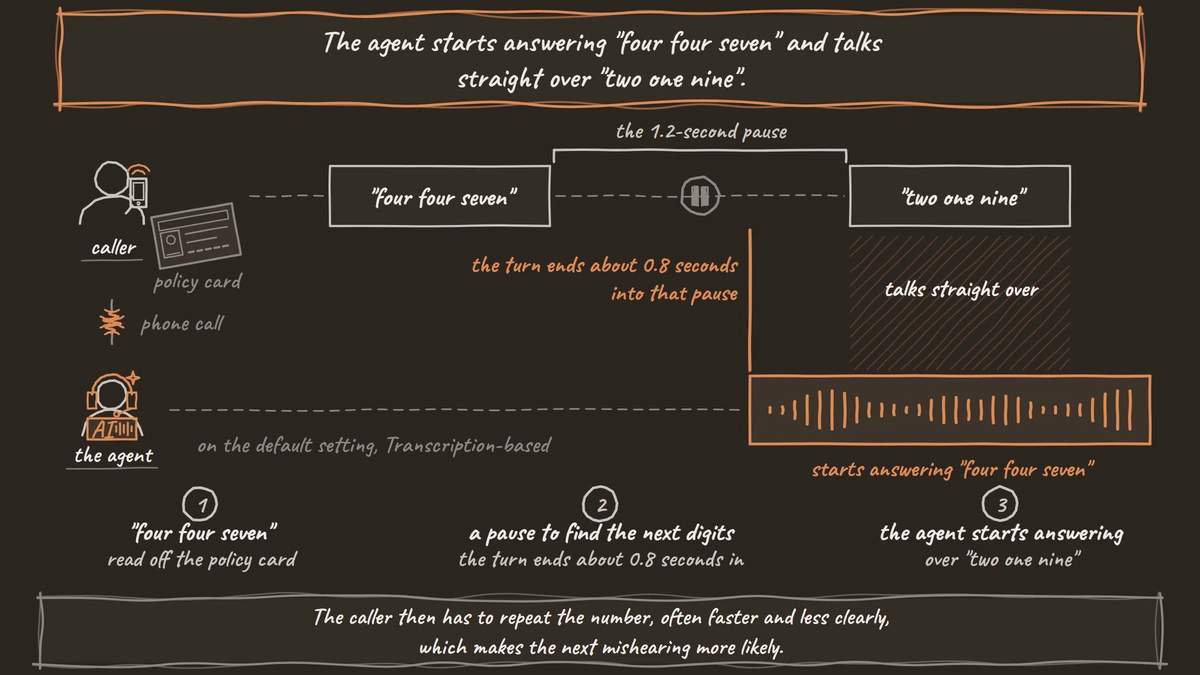
Take one call as an example, timed with the values in Dograh's code. The caller says "My policy number is four four seven", stops for 1.2 seconds to find the next digits on the card, then says "two one nine".
On Transcription-based, the turn ends about 0.8 seconds into that pause. The agent starts answering "four four seven" and talks straight over "two one nine". The caller then has to repeat the number, often faster and less clearly, which makes the next mishearing more likely.
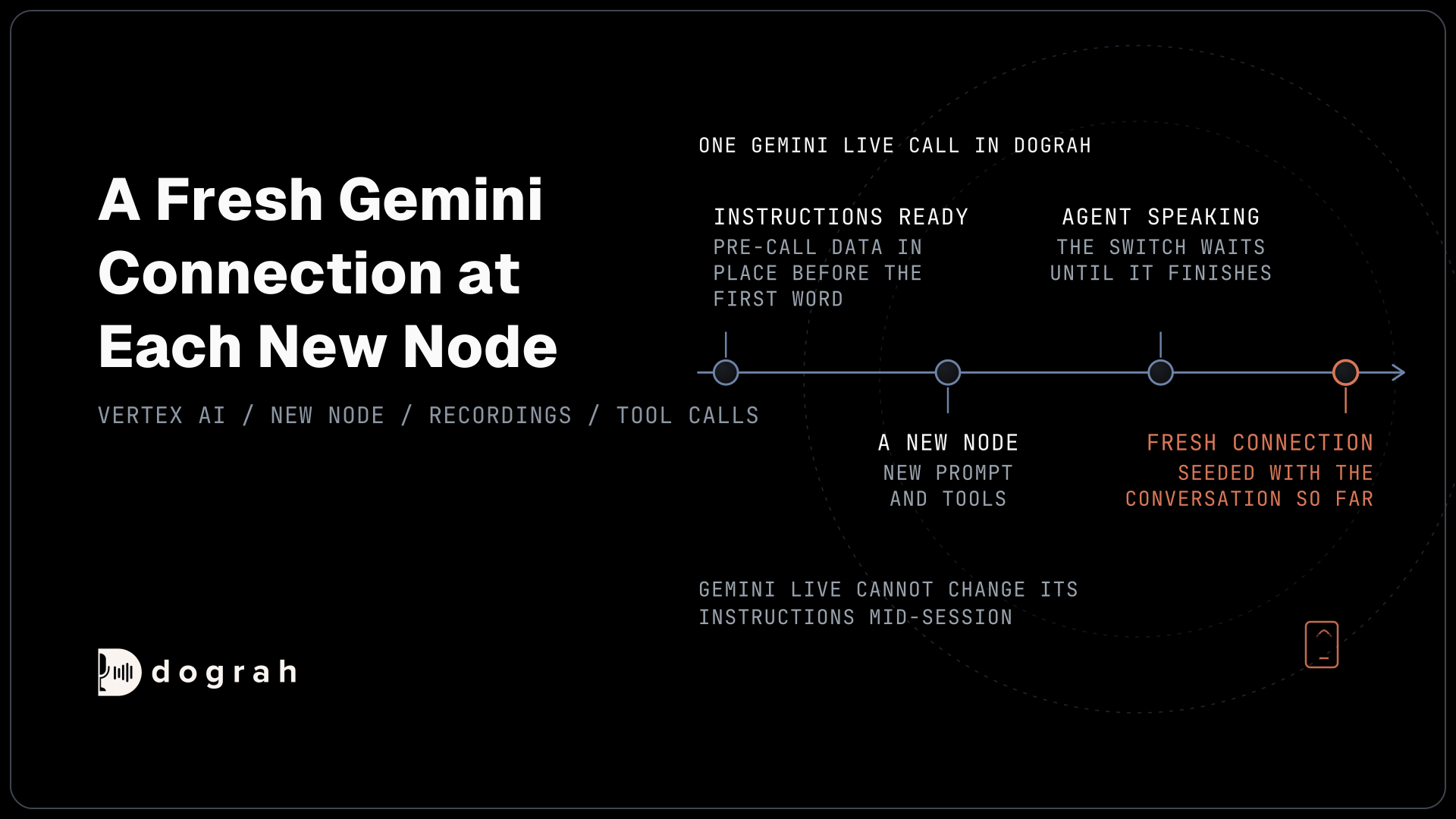
On Smart Turn Analyzer, the open Smart Turn model listens to the last stretch of the turn, up to 8 seconds of audio, and judges whether it sounds finished. If it hears "four four seven" as unfinished, Dograh keeps listening until the Incomplete Turn Timeout runs out, 2 seconds by default, so the 1.2-second pause survives. If the digits come out flat and complete-sounding, the model can still call the turn finished. Test it with your own callers before you rely on it.

Open Source Alternative to Vapi / Retell
Self-hosted voice agent platform — no per-minute fees
dograh-hq/dograh
Star on GitHub
Four settings that stop the cut-in
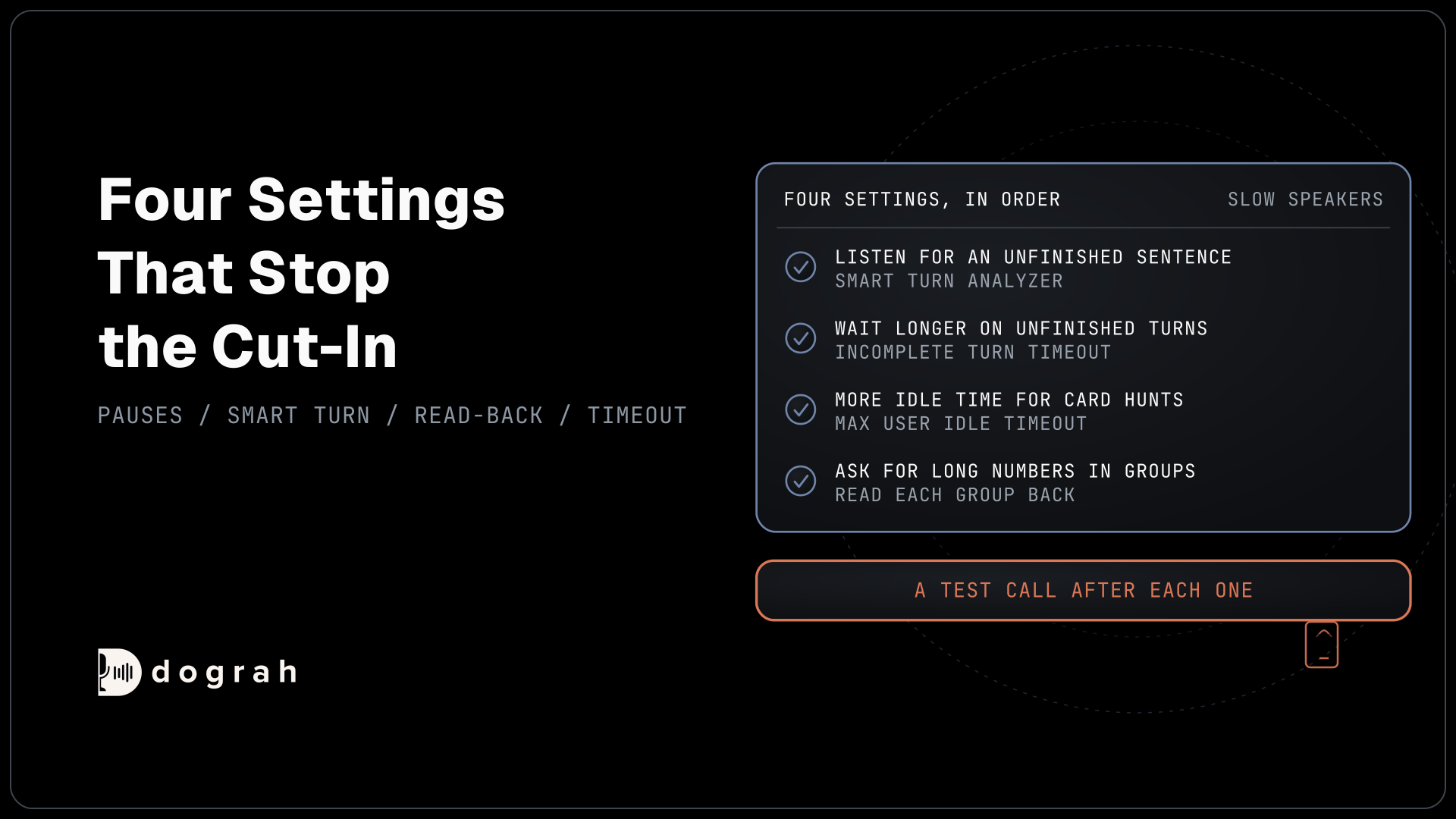
Work through four settings in order, with a test call after each one. All of them sit in the agent's Settings, and a change takes effect once you publish the agent.
First, set the Detection Strategy under Turn Detection to Smart Turn Analyzer. The help text in the editor says it suits longer responses with natural pauses, while Transcription-based suits one- or two-word answers. Turn detection is set once per agent and holds for the whole call, so choose it for the calls where people read things out.
Second, raise the Incomplete Turn Timeout if callers still get cut off. It runs from 0.5 to 10 seconds. A value of 3 gives a caller reading a long number more room, and the extra wait only applies to turns the model judges unfinished, so a quick "yes" keeps its speed.
Third, check the Max User Idle Timeout under Call Management, 10 seconds by default. When the caller says nothing for that long, the agent asks briefly whether they are still there, and after a second idle timeout it says goodbye and ends the call. An agent that asks callers to fetch a card or a letter should allow more, such as 20 or 30 seconds. Right after the greeting, before the caller has spoken, Dograh caps that wait at 3 seconds.
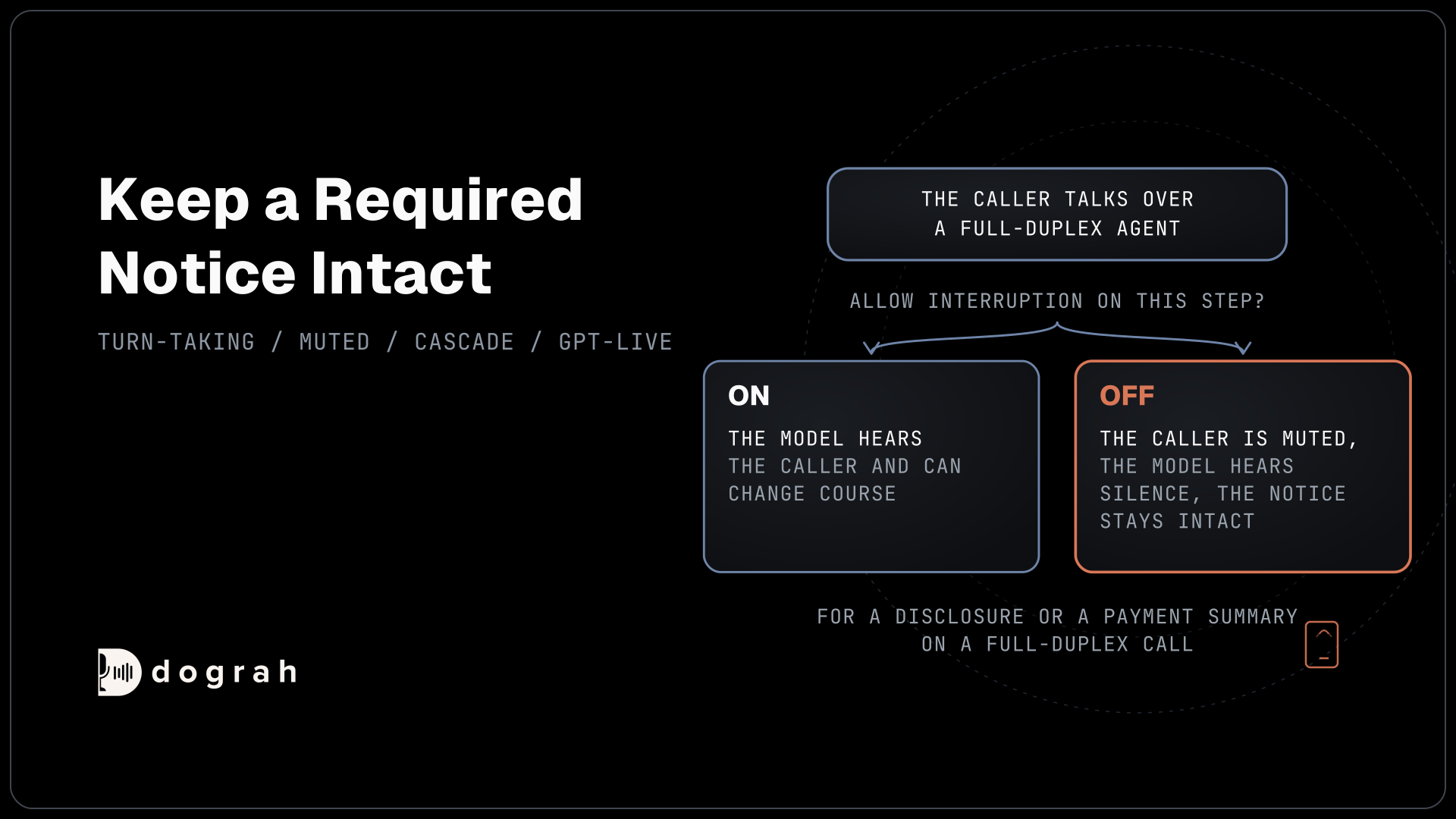
Fourth, change the question. Ask for long numbers in groups, such as "Read me the first four digits", and have the agent read each group back. Short groups give the caller natural stopping points, so the agent replies when a group is really done. Switch Allow Interruption off on the read-back step, so a caller's "mm-hm" does not stop it halfway. Our post on getting names, numbers and emails right covers read-back and spelling in depth.
The same steps apply to member, account and order numbers. Payment card numbers should never be taken on a voice call at all. One more detail helps callers who start with "um". The Minimum words count, 2 by default, applies only while the agent is speaking, so once the agent is silent a single word starts the caller's turn.
When the speech-to-text model ends the turn
Some speech-to-text choices take the turn decision away from these settings. If the agent's speech-to-text is Deepgram Flux, Cartesia ink-2, or Dograh's own speech-to-text in Multilingual mode or one of its 10 single languages, Dograh follows the provider's turn endings. The Detection Strategy and the Incomplete Turn Timeout then change nothing.
Flux works differently in Dograh: it ends a turn at an end-of-turn score of 0.7 or after 3,000 ms of silence, and neither value can be changed in settings. For slow speakers on that path, the levers left are the question, the read-back and the idle timeout. To use Smart Turn instead, pick a speech-to-text model that leaves the turn to Dograh, such as Deepgram Nova-3, AssemblyAI or Speechmatics.
Join the Dograh Community
Dograh is an OSS alternative to Vapi. Join our Slack community for queries, releases, best practices & community interactions.
Test lines for slow speakers
Test over a real phone call, since a browser test hides how callers pause. The editor's Phone Call button rings your own phone through a telephony configuration you pick, so you hear the agent as callers do. Ask a colleague who speaks slowly to read these lines on each setup:
- A member number read off a card in four groups, with 1 to 2 seconds between groups.
- "I need to change... the address... on my policy", with a pause at each break.
- "Hmm, let me think", then 2 seconds of silence before the answer.
- "Let me find it", then 12 seconds of silence while they look.
Count two things on every call. A split turn is the caller's sentence broken across two turns, with the agent answering the first half. A cut-in is the agent speaking while the caller is still mid-number. Each call's View Trace shows the speech-to-text, AI and voice time for every turn, so you can tell a long turn wait from a slow model. Our guide to reading call traces walks through it step by step.
Once the agent is live, sample real calls with Dograh's built-in QA to catch split turns you never scripted. Every timer in this post can be read in Dograh's open code, so you always know which wait you changed. If you are still choosing a mode, our comparison of Smart Turn and silence timers sets the two side by side.
Glossary
- Speech timeout
- The wait after the speech detector marks a stop and before the turn ends. In Dograh's Transcription-based mode it is 0.6 seconds on top of a 0.2-second detector stop, so a pause of about 0.8 seconds ends the turn.
- Incomplete Turn Timeout
- How long Dograh keeps listening when the Smart Turn model judges a sentence unfinished, 2 seconds by default and settable from 0.5 to 10. It adds wait time only to turns that sound incomplete.
- Max User Idle Timeout
- The silence after which the agent checks whether the caller is still there, 10 seconds by default in Dograh. A second idle timeout ends the call, so agents that send callers to fetch a card need a longer value.
- Split turn
- One sentence from the caller broken into two turns because a pause ended the first too early. The agent answers the first half, and the transcript shows the sentence spread over two caller turns.