
Full-duplex voice AI listens and speaks at the same time, the way people do on a phone call, so it can react to an "mm-hm" or an interruption mid-sentence. OpenAI's GPT-Live is the main hosted full-duplex model, and Moshi, PersonaPlex and NemotronLabs VoiceChat are open ones. Full duplex fixes turn-taking, while understanding still depends on the model.
Key Takeaways
- Full duplex fixes turn-taking. Comprehension and tool use still depend on the model.
- GPT-Live is the main hosted full-duplex model, and three open ones exist.
- A cascade still wins when exact words or several tools matter.
This post is part of our guide to speech-to-speech voice AI, where full duplex is one of two kinds of speech-to-speech model. Below, we explain it, list which models are full duplex and show where a cascade still wins, using Dograh, the open-source AI voice agent platform we build.
What full duplex means on a phone call
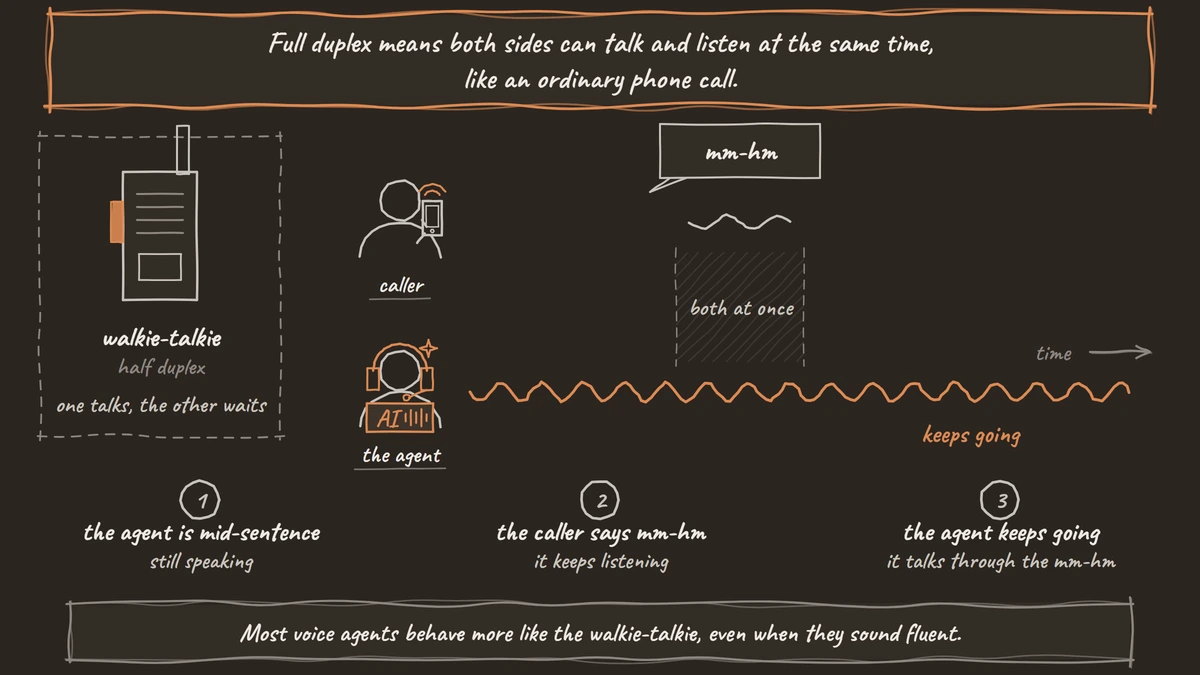
Full duplex means both sides can talk and listen at the same time, like an ordinary phone call. A walkie-talkie is half duplex: one side presses the button to talk and the other waits. Most voice agents behave more like the walkie-talkie, even when they sound fluent.
A turn-based model waits for the caller to stop, then answers. Something has to decide when the caller has stopped, and that is usually a silence timer or a turn detection model. Google's Gemini Live, for example, waits about 800 ms of silence by default before it replies. If the caller pauses to think, the agent may jump in, and if the caller says "wait" while the agent talks, the agent has to notice and stop.
A full-duplex model keeps listening while it speaks. It can hear a short "mm-hm" and keep going, or hear "no, the other account" and change course mid-sentence. On a phone line, where people overlap all the time, that makes the agent feel less like a menu and more like a person.
Which models are full duplex today
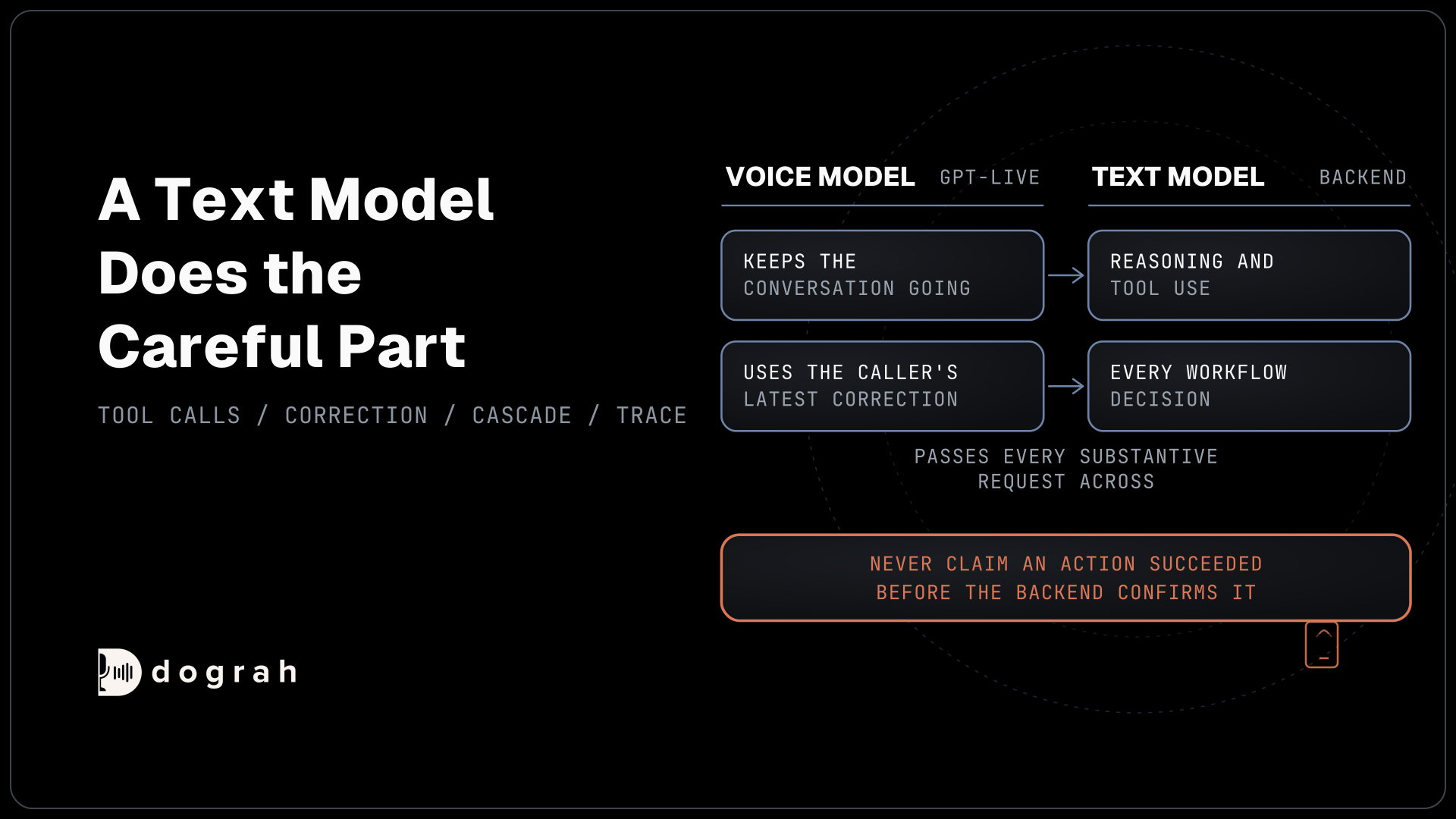
OpenAI's GPT-Live is the main hosted full-duplex model. The GPT-Live model page describes it as a model that "can listen and speak at the same time, and delegate reasoning and tool use to a backend agent." The voice handles the conversation while a text model does the thinking.
Three open models are full duplex. Kyutai's Moshi was the first widely used one, and NVIDIA built PersonaPlex 7B on top of it, with a persona set from a voice sample and a text prompt. NVIDIA's NemotronLabs VoiceChat paper describes the third as an open full-duplex model with tool calling. Our comparison of open-source speech-to-speech models covers their licences and GPU needs.
Most other realtime models take turns. OpenAI's gpt-realtime models run voice activity detection by default, and Google describes Gemini Live the same way: it waits for silence and cancels its reply when the caller interrupts. Those are fast, well-tuned turn-takers, and on a short call the difference can be hard to hear.
What full duplex fixes
Full duplex fixes the rhythm of a call. Artificial Analysis scores this as conversational dynamics, a mix of pause handling, turn-taking, interruptions and backchannels drawn from Full-Duplex-Bench. On its speech-to-speech leaderboard, GPT-Live-1 (Sol, low) scores 97.3%, Grok Voice 3.0 97.0% and Gemini 3.8 Live 96.1%. Among open models, PersonaPlex scores 91.0%, Moshi 61.0% and Nemotron Voicechat 52.9%.
Two points stand out. The top turn-based models score within two points of GPT-Live, so good turn detection gets most of the way there. And the open full-duplex models vary widely, so duplex alone does not guarantee smooth turns.
Where duplex does work, the gains are concrete. NemotronLabs VoiceChat keeps talking after a listener's backchannel in 93% of cases and yields to real interruptions every time, on the paper's Full-Duplex-Bench tests. Our post on barge-in, endpointing and turn-taking covers how those moments work in any voice agent.

Open Source Alternative to Vapi / Retell
Self-hosted voice agent platform — no per-minute fees
dograh-hq/dograh
Star on GitHub
Where a cascade still wins
Good turn-taking and understanding are separate skills. On Artificial Analysis's Big Bench Audio, a set of spoken reasoning questions, PersonaPlex scores 19.1%, Nemotron Voicechat 27.0% and Moshi 4.4%, against 91.7% for Gemini 3.8 Live and 90.1% for GPT-Live-1 (Astra, medium). An open full-duplex agent can sound natural and still give the wrong answer.
Our view is that cascades are better at reasoning, tool calling and voice cloning, and suit complex calls. Full-Duplex-Bench v3 shows the tradeoff from the other side. Its cascade took its turn in 100% of examples, more than any speech-to-speech system, but answered after 10.12 seconds on chained tool tasks. The speech-to-speech systems answered in 4.25 to 8.40 seconds.
So pick a cascade when the call depends on exact words, several tools or a cloned voice, and tune its turn-taking instead. Our post on Smart Turn vs silence timers covers those settings, and our comparison of Cascade vs Speech-to-Speech covers tone, latency and cost.
Full duplex in Dograh
Dograh runs GPT-Live as a full-duplex option, with your own OpenAI key. You create a Realtime model configuration, pick the OpenAI connection and choose gpt-live-1, then select it in the agent's Settings. Each agent picks its own configuration, so a reminder line can run full duplex while a claims line runs on a cascade.
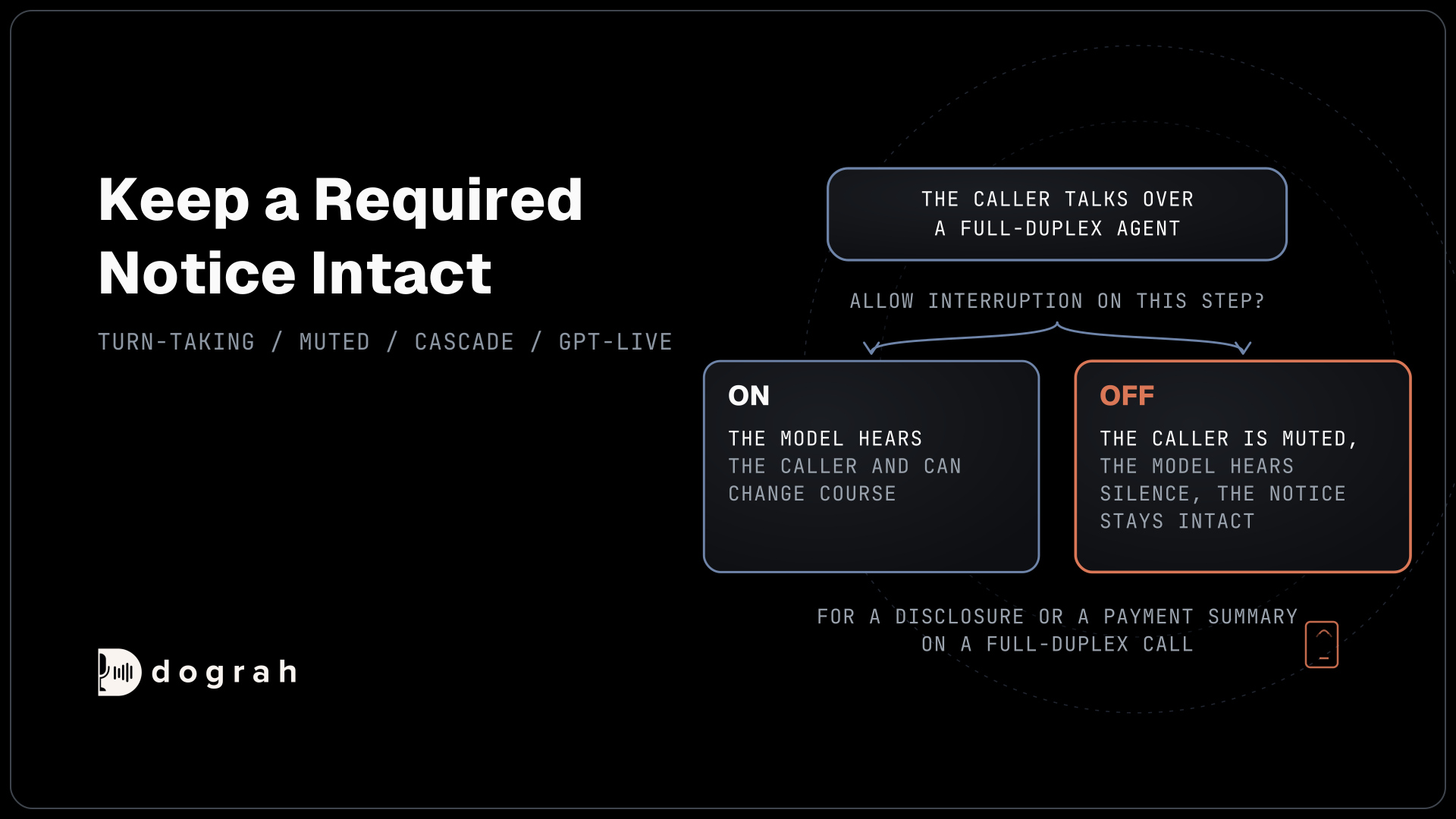
Full duplex does not mean the caller can talk over everything. Each step has an Allow Interruption setting. When a step has it switched off, Dograh sends the model silence while the caller is muted, so words spoken over a required notice never reach the model's history. That keeps a disclosure or a payment summary intact on a full-duplex call.
Self-hosted Dograh has no per-minute platform fee, but servers, model keys and phone minutes still cost money. Dograh Cloud charges a 1¢-a-minute platform fee. Either way, every call keeps its trace, so you can see what the model heard.
OpenAI's realtime models, Azure OpenAI Realtime and Grok Voice bring their own voice activity detection, so Dograh's local detector steps aside on those calls. With gpt-live-1, every workflow decision goes to a backend text model, gpt-5.4-mini by default, which OpenAI bills apart from the voice minutes.
Join the Dograh Community
Dograh is an OSS alternative to Vapi. Join our Slack community for queries, releases, best practices & community interactions.
Glossary
- Half duplex
- A link where only one side talks at a time, like a walkie-talkie. Turn-based voice agents work this way, waiting for silence or a turn detector before they answer.
- Backchannel
- A short listener sound such as "mm-hm" or "right" that is not a request to speak. A full-duplex agent should keep talking through it, and NemotronLabs VoiceChat does so in 93% of cases.
- Conversational dynamics
- Artificial Analysis's score for pause handling, turn-taking, interruptions and backchannels, drawn from Full-Duplex-Bench. GPT-Live-1 (Sol, low) leads at 97.3%.
- Voice activity detection
- The model that decides whether the caller is speaking. Turn-based agents use it to end a turn, and OpenAI's realtime models, Azure OpenAI Realtime and Grok Voice bring their own.