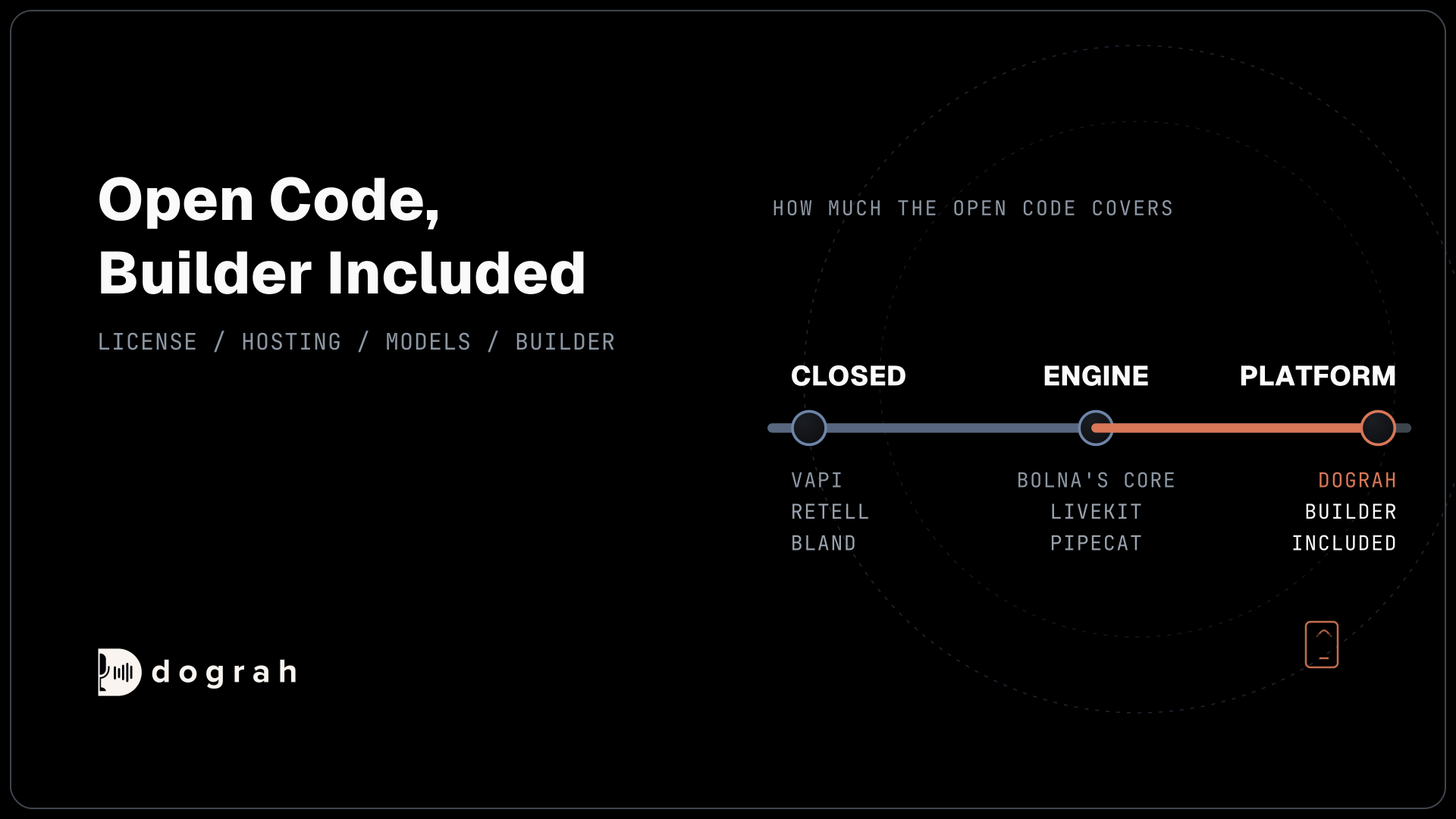

Teams leaving Bolna choose between hosted and open-source options. Vapi, Retell AI, Bland AI, ElevenLabs Agents, Synthflow and Smallest AI are hosted. Dograh and the frameworks LiveKit Agents and Pipecat are open source. Dograh, an open-source AI voice agent platform you can self-host or run on Dograh Cloud, opens its visual builder. Bolna opens only its orchestration core.
Key Takeaways
- Dograh's open-source code holds the whole platform, visual builder included.
- Bolna's core is MIT, but its hosted APIs and no-code dashboard are closed.
- Bolna's 6¢ rate includes its preferred models, so compare what each price covers.
This guide starts with what Bolna sells and why teams look past it. One table compares the alternatives on license, hosting, models, builder and price. Then we cover what Bolna costs and when staying is the better call. If you want the whole platform open, the Dograh section covers it.
What Bolna sells, and why teams look elsewhere
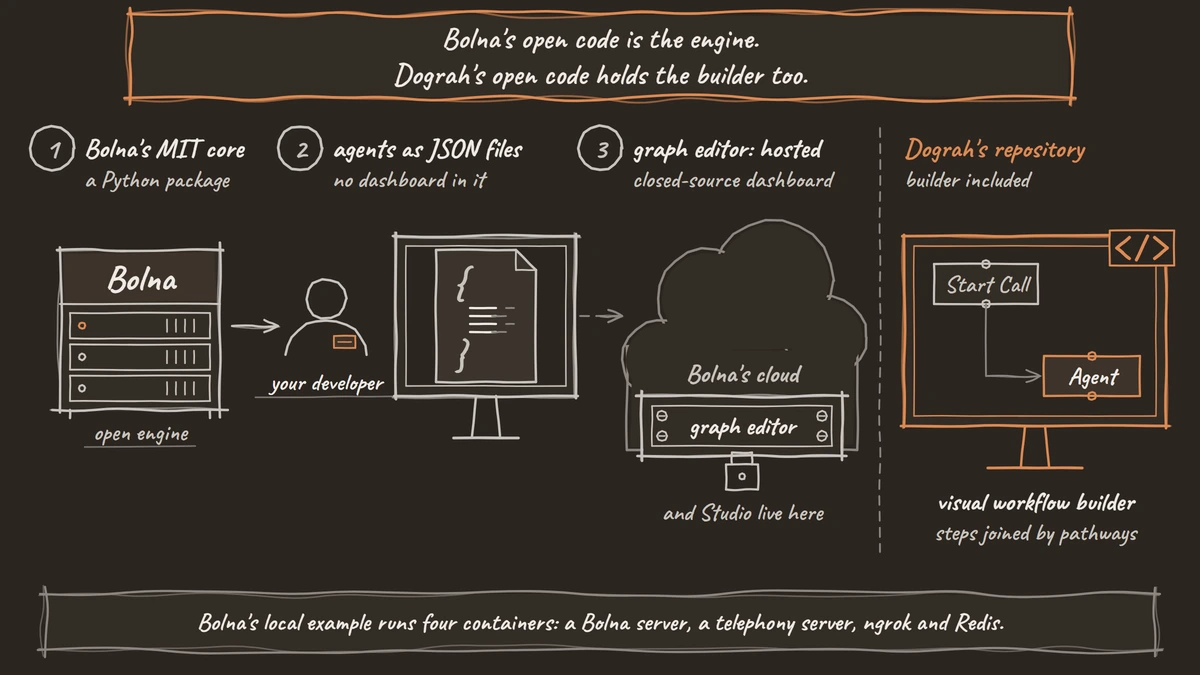
Bolna is an India-first voice AI company that sells two things built on one engine. Its orchestration core is open source under the MIT license on GitHub. On top of it, Bolna runs hosted APIs and a no-code dashboard, and Bolna's README marks both of those "currently closed source".
In January 2026 the Y Combinator-backed company raised a $6.3 million seed round led by General Catalyst, and the same release reports more than 1,050 paying customers.
Teams look at Bolna alternatives for concrete reasons, and the first is that the parts most people use day to day are closed. The graph agents' visual editor and Studio, which drafts an agent from a brief, both live in the hosted dashboard, while the open-source repository gives you a Python framework where agents are written as JSON, with no UI.
Hosting is the second reason. Hosted Bolna runs in the US by default. India data residency, other regions and on-prem containers come with its Enterprise plan.
Data location matters more for Indian teams from 2027. The rules under India's Digital Personal Data Protection Act were notified on 13 November 2025, and most obligations start on 13 May 2027, including the rules on sending personal data abroad, according to Hogan Lovells' summary. If your calls carry personal data, decide early where call audio and transcripts will sit, and confirm your own position with counsel. There is also a page on running voice agents on servers in India, with Sarvam or local models and Exotel or Vobiz numbers.
What Bolna does well
Bolna is strong where an Indian contact centre needs it most. Its homepage lists more than 10 Indian languages, including Hinglish, Hindi, Tamil and Telugu, and 20+ languages in all. The hosted product connects to Indian carriers such as Exotel, Vobiz, Airtel and Acefone, as well as Twilio, Plivo, Telnyx and your own SIP trunk. You top up a prepaid wallet in rupees or dollars.
The builder has grown quickly in 2026. Next to its conversation agents, Bolna offers IVR agents that take keypad input and graph agents built as connected steps, which got a visual editor in the dashboard in June. In August Bolna added an MCP server in beta and speech-to-speech agents on OpenAI Realtime or Gemini Live.
The model list is wide, with Sarvam, Smallest, Soniox, Anthropic and Gemini among the providers. Paid accounts start at 10 concurrent outbound calls and scale with monthly usage, and inbound calls have no concurrency limit.
How we compared the alternatives
Five questions sort the field. License decides whether you can read the code, change it and keep running it if the vendor changes course, and how much of the product that code covers. Where it runs means your own servers in your own country, or the vendor's cloud. Models covers bringing your own key (BYOK), the vendor's bundled models and open-weight models on your own servers. Builder asks whether a non-developer can change a flow. Last comes how you pay.
Each price sits in the sections below with what it covers. Latency is left out, because it depends on your models and phone path more than on the platform, so measure it on your own calls. Indian shortlists also name local platforms such as Ringg AI and Gnani.ai.
Bolna alternatives in one table
| Platform | Open source | Self-host or on-prem | Models you can use | Builder, and how you pay |
|---|---|---|---|---|
| Bolna (baseline) | MIT orchestration core; hosted APIs and no-code dashboard closed | Bolna's cloud, US by default; India residency and on-prem containers on Enterprise; the MIT core can be self-hosted | Bundled preferred models, your own keys, or your own OpenAI-compatible LLM | Dashboard with graph, conversation and IVR agents. A prepaid per-minute rate with preferred models included; telephony and platform fee added |
| Dograh | Yes, BSD-2-Clause, the whole platform | Your own servers with Docker, in any country; Dograh Cloud; on-prem or private cloud on Enterprise | Any supported provider with your own keys, Sarvam and Smallest AI included; Dograh's models; open-weight models on your own servers | Visual workflow builder in the open code, plus an MCP server. Free to self-host; Dograh Cloud bills a platform fee, with models separate |
| Vapi | No | Vapi's cloud | Your own keys or a custom LLM, or models passed through at cost | Assistants and Squads; visual Workflows retired in August 2026. $0.05 a minute hosting, models and phone on top |
| Retell AI | No | Retell's cloud; dedicated server add-on | A choice of language models, including OpenAI's realtime speech-to-speech | Visual Conversation Flow. $0.055 a minute voice infrastructure, $0.07 to $0.31 in total |
| Bland AI | No | Bland's cloud; on-prem or VPC on Enterprise | Bland's own models, included in the rate | $0.14 a minute on Start with 100 calls a day, phone on top |
| ElevenLabs Agents | No | ElevenLabs' cloud; India, EU or Singapore residency and private deployment in your AWS or GCP account on Enterprise | ElevenLabs' speech models; a hosted LLM list or your own | Visual Workflows. $0.08 a minute for the speech engine, LLM on top |
| Synthflow | No | Its own cloud, in a US or EU region | Synthflow's models; GPT models on Enterprise | Flow Designer. Sold as an annual enterprise agreement, priced by call volume and setup, with no free plan or per-minute rate |
| Smallest AI | No, public SDKs only | Smallest's cloud; on-premise on Enterprise | Smallest's Pulse and Lightning in the agent | Conversational Flow. $0.09 to $0.21 a minute on Pay as you go |
| LiveKit Agents | Yes, Apache-2.0 | Yes, or LiveKit Cloud | Any model you wire in | Framework in code; your developers build the product |
| Pipecat | Yes, BSD-2-Clause | Yes, or Pipecat Cloud | Any model you wire in | Python framework; phone wiring, call history, QA and the call lifecycle are yours to build |
Several rows have open-source code, but only Dograh's covers the whole product, builder included. Bolna's covers the engine, and LiveKit Agents and Pipecat are frameworks.
Dograh: the whole platform open, builder included
Dograh's code is open under BSD-2-Clause, and its GitHub repository holds the whole platform, the same one that runs as Dograh Cloud. That covers the visual workflow builder, telephony, campaigns for outbound lists, call traces and QA.
You can self-host it with Docker on servers in any country, or start on Dograh Cloud with nothing to run. For Indian teams, data stays in India by running Dograh on servers in India, either yourself or through Dograh's managed on-prem plan.
Dograh is the orchestration layer that runs the call flow, tools and telephony, and the speech and language models are a separate layer you choose. That can be Dograh's own models, any supported provider with your own keys, or open-weight models on your own servers through Ollama, vLLM or Speaches. Sarvam and Smallest AI are built-in providers, so if you use their Indian-language voices and speech models on Bolna, they can come with you. With your own keys, the call audio still reaches each provider. It stays in-house only when the models run on your own servers too.
Agents are built in the visual workflow builder, as steps joined by pathways. Describe whether the agent is inbound or outbound and what it is for, and a language model drafts a starting workflow. An AI assistant can also create and edit agents through Dograh's MCP server. Numbers come from your own carrier, such as Twilio, Plivo, Telnyx, Vonage, Cloudonix, Exotel, Vobiz or Asterisk ARI.
Transfer Call hands a call to a person on Twilio, Telnyx, Plivo, Cloudonix and Asterisk ARI, but not on Exotel, Vobiz or Vonage. Dograh calls the destination first and connects the caller only when someone answers. On Twilio, it can play a short spoken introduction to both people before connecting them. No summary goes across by default, so the agent writes the caller's details to your system first.
QA runs on editor test calls and on live calls and scores each step of the call separately. For every row side by side, see Dograh vs Bolna.
The limits are just as concrete. There is no keypad (DTMF) tool, so callers answer by voice, and there is no built-in SMS. CRMs are reached through HTTP API tools and webhooks. Dograh supports 70+ languages, depending on the speech-to-text and voice providers you choose, and Hindi is one of its Language Hints with Dograh's models or Deepgram Flux. Self-hosting puts the servers and their upkeep on your team, and telemetry is on by default, so run ENABLE_TELEMETRY=false ./start_docker.sh and delete POSTHOG_API_KEY from docker-compose.yaml to switch it off. Self-hosted Dograh has no per-minute platform fee (servers, model keys and phone minutes still cost). Dograh Cloud has a 1¢-a-minute platform fee, and Dograh's own models are about $0.07 a minute for most models.

Open Source Alternative to Vapi / Retell
Self-hosted voice agent platform — no per-minute fees
dograh-hq/dograh
Star on GitHub
Open-source routes: Bolna's core, LiveKit, Pipecat
Bolna's own repository is the first open-source route, and it is a real one. It is a Python package where agents are defined in JSON or Python. The local example runs four containers: a Bolna server, a telephony server for Twilio or Plivo, ngrok and Redis. Its code also has telephony handlers for Exotel, Vobiz, FreeSWITCH and SIP trunks, and it reaches self-hosted language models through LiteLLM or a vLLM server. There is no dashboard in it, so your developers write and change every agent in code.
Bolna's Enterprise on-prem is a different thing. Bolna's on-prem page describes containers that run in your own cloud or data centre on Docker or Kubernetes, with audio, logs and transcripts kept there. Performance and usage metrics still go to Bolna's cloud for billing.
LiveKit Agents (Apache-2.0) and Pipecat (BSD-2-Clause) are the two open-source frameworks teams weigh most. Pipecat is a Python framework from Daily, and Dograh is built on a fork of it. In our experience it is an excellent base, but production needs phone integrations, call history, QA on live calls and the call lifecycle, which is the part Dograh ships. LiveKit Agents runs on the LiveKit media server, and both have managed clouds.
These licenses are all permissive, so the real difference is what each repository holds. Our comparison of the best open-source voice AI platforms covers the frameworks in depth, and our post on the open-source alternative to Bolna compares what you get from Bolna's repository and from Dograh's.
Hosted alternatives to Bolna
Six hosted platforms come up most often as Bolna competitors. Each runs on the vendor's cloud with closed code, and each price below covers something different.
Vapi
Vapi is a developer platform that bills $0.05 a minute for hosting, with models passed through at cost and the phone line on top. Vapi retired its visual Workflows on 18 August 2026, so agents are built as Assistants and Squads. Our guide to Vapi alternatives covers its side of the field.
Retell AI
Retell AI charges $0.055 a minute for its voice infrastructure and $0.07 to $0.31 a minute in total, depending on the models. It has a visual Conversation Flow builder and OpenAI's realtime speech-to-speech models. See our guide to Retell AI alternatives.
Bland AI
Bland AI bundles its own speech and language models into one rate, $0.14 a minute on Start or $0.12 plus $299 a month on Build, with telephony billed separately. Start allows 100 calls a day and 10 at once. On-prem or VPC deployment comes on Enterprise.
ElevenLabs Agents
ElevenLabs Agents charges $0.08 a minute for its speech engine, with the language model billed on top and no ElevenLabs fee for telephony. It is one of the few hosted options with India data residency, which comes on Enterprise along with EU and Singapore. Our guide to ElevenLabs alternatives goes further.
Synthflow and Smallest AI
Synthflow is sold as an annual enterprise agreement, priced by call volume and setup, with no free plan or per-minute rate. Its Flow Designer and launch support come inside. Smallest AI's Atoms runs on Smallest's own Pulse and Lightning speech models at $0.09 to $0.21 a minute on Pay as you go, with 20 calls at once and on-premise deployment on Enterprise. Our guide to Smallest AI alternatives covers that platform.
What Bolna costs
Bolna sells a prepaid minute with the models already inside it. Bolna's pricing page lists a standard rate of 6¢ (₹5.52) a minute. With the preferred models, that rate covers speech to text, the language model and the voice. Telephony and Bolna's platform fee are added per minute, and larger top-ups bring the rate down to about 4.5¢ (₹4.15).
Pilot plans are one-time purchases, $300 for 6,500 minutes or $500 for 12,000 minutes, billed in 30-second pulses. A Pilot allows up to 25 concurrent calls and includes a month of support over WhatsApp and 1:1 calls. New accounts get $5 in free credits, and Enterprise pricing is custom.
Bolna supports BYOK for language, voice and speech-to-text models. With your own keys you pay those providers directly, plus Bolna's platform fee. So when you set Bolna against a platform that bills models separately, compare the whole minute, with the same models on both sides.
When staying on Bolna makes sense
Bolna is the better fit for some teams, and the reasons are concrete. Stay if you want one prepaid per-minute price with the models included, billed in rupees. Stay if you need more than 10 Indian languages ready to use, or a vendor that hosts your data in India as part of its Enterprise plan.
Stay too if your calls run on Exotel or Vobiz and must transfer to a person, because Dograh's Transfer Call does not work on those two carriers. Bolna's IVR agents take keypad input, which Dograh does not. And a Pilot with a month of WhatsApp support suits a team that wants a vendor close at hand while it launches.
Join the Dograh Community
Dograh is an OSS alternative to Vapi. Join our Slack community for queries, releases, best practices & community interactions.
Picking your Bolna alternative
Teams that want to write agents in code can stay on Bolna's own core, or start with LiveKit Agents or Pipecat. On a hosted plan, Vapi suits developers who want an API and their own keys, and Retell AI suits teams that want a visual builder without a contract. Bland AI fits teams happy for the vendor to pick the models, and ElevenLabs Agents fits teams that want hosted India residency with ElevenLabs' own voices.
If you want the platform's code, builder included, and your own choice of models and hosting country, Dograh answers the reasons most of these searches start with. There is no Bolna importer in Dograh, so rebuild each agent from its prompt and flow in the builder, or through the MCP server with an AI assistant. To try it, run it from GitHub with Docker, or start on Dograh Cloud.
Whichever you shortlist, run the same call script on a real phone line. Most phone calls still reach the agent as 8 kHz audio, while a browser demo runs at 16 kHz, and Indian names and addresses can sound different to the speech model on each.
Each part of this guide has its own deep dive:
Glossary
- Orchestration core
- Bolna's MIT-licensed framework that runs the call: telephony, speech, the language model and the agent's steps, with agents written in JSON or Python. It is open source, while the hosted APIs and dashboard built on it are not.
- Graph agent
- A Bolna agent built as connected steps rather than one prompt. Graph agents have a visual editor in Bolna's hosted dashboard, which sits outside the open-source repository.
- Platform fee
- A per-minute charge for running the call on a platform, separate from the models and the phone line. Bolna adds one to its rate, and Dograh Cloud charges one while self-hosted Dograh does not.
- Data residency
- Keeping call audio, transcripts and records in a chosen country. Bolna offers India residency on Enterprise, and a self-hosted platform gets it by running on servers in that country, with the models there too.