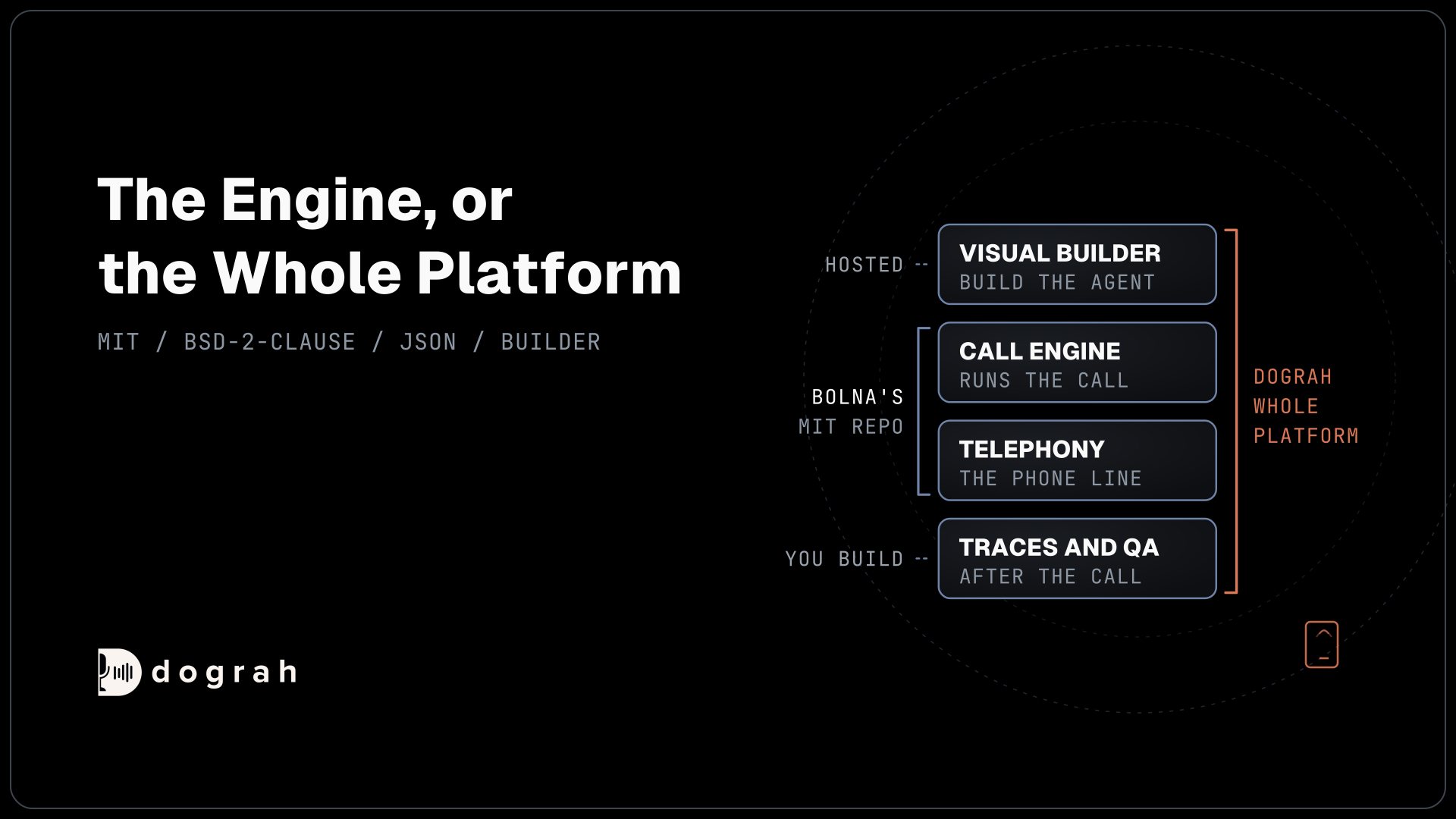

An open-source alternative to Bolna that includes the builder is Dograh, an AI voice agent platform under the BSD-2-Clause license that you can self-host or run on Dograh Cloud. Bolna is partly open source. Its MIT repository holds the orchestration core, while its hosted APIs and no-code dashboard stay closed.
Key Takeaways
- Bolna's MIT repository holds the engine, while its dashboard and graph editor stay hosted.
- Dograh's BSD-2-Clause repository holds the whole platform, visual builder included.
- Self-host the models too, or call audio still reaches a provider.
This post is part of our guide to Bolna alternatives, where Bolna's own repository counts as one of the open-source routes. Here we compare what Bolna's repository and Dograh's each contain, and what running each one yourself gives a team and takes from it, using Dograh as the worked example.
What Bolna's open-source repository contains
Bolna's repository is its orchestration core, a framework for developers, and it is genuinely open source. Bolna's repository is released under the MIT license, and Bolna's own docs call the core "MIT-licensed and self-hostable". It is actively maintained, with new releases shipping.
What you install is a Python package. Agents are defined in JSON or in Python, with the prompt, the models and the call settings in one configuration. The local example runs four containers: a Bolna server that creates and handles agents, a telephony server for Twilio or Plivo, ngrok for tunnelling and Redis to store agents.
The code goes further than that example. It has telephony handlers for Exotel, Vobiz, FreeSWITCH and SIP trunks as well as Twilio and Plivo. Language models connect through LiteLLM or a vLLM server, and a self-hosted speech-to-text server can plug in too. So on day one a team gets a capable engine and no UI. Every agent change is a change to a JSON or Python file, made by a developer.
What stays in Bolna's hosted product
The parts a non-developer would use live in Bolna's hosted product. The README marks the hosted APIs and the no-code playground "currently closed source". The graph agents' visual editor, added in June 2026, sits in that dashboard, as do Studio, which drafts an agent from a brief, and the IVR agents that take keypad input.
Bolna also sells on-prem, which is a separate thing from the MIT repository. Bolna's on-prem page describes containers that run in your own cloud or data centre on Docker or Kubernetes, with audio, logs and transcripts kept there. Performance and usage metrics still go to Bolna's cloud for billing. It is arranged through Bolna's enterprise team.
Dograh: the whole platform in one repository
Dograh's repository holds the product as well as the engine. Dograh's code is open under BSD-2-Clause, and it includes the web app next to the voice pipeline. You self-host it with Docker on servers in any country, and the same platform also runs as Dograh Cloud.
Agents are built in the visual workflow builder, as steps joined by pathways, so a support lead can change a flow without touching code. An AI assistant can also create and edit agents through Dograh's MCP server.
Telephony ships in the same repository, connecting Twilio, Plivo, Telnyx, Vonage, Cloudonix, Exotel, Vobiz or Asterisk ARI. Campaigns run outbound lists, and every call has a trace you can open turn by turn. QA runs on editor test calls and on live calls, and scores each step of the call separately with its own tags, a 1-10 score, sentiment and a summary.
MIT and BSD-2-Clause are both permissive licenses, so the difference here is what each repository holds. Our post on BSD-licensed voice AI covers what the license allows.

Open Source Alternative to Vapi / Retell
Self-hosted voice agent platform — no per-minute fees
dograh-hq/dograh
Star on GitHub
Engine and platform side by side
Bolna's repository gives you the engine, and Dograh's gives you the product around it too.
| Row | Bolna's repository | Dograh's repository |
|---|---|---|
| License | MIT | BSD-2-Clause |
| What it holds | The orchestration framework, as a Python package | The whole platform: web app, voice pipeline, telephony, campaigns and QA |
| How you build agents | JSON or Python files | Visual workflow builder, or an AI assistant through the MCP server |
| Phone in the code | Twilio, Plivo, Exotel, Vobiz, FreeSWITCH and SIP trunks | Twilio, Plivo, Telnyx, Vonage, Cloudonix, Exotel, Vobiz and Asterisk ARI |
| Local models | LLMs through LiteLLM or vLLM; a self-hosted speech-to-text server | LLMs through Ollama or vLLM; speech-to-text and voices through Speaches |
| Hosted version | Bolna's hosted APIs and dashboard, closed source | Dograh Cloud, the same platform |
| Vendor-run on-prem | Enterprise containers, with usage metrics sent to Bolna for billing | Enterprise on-prem or private cloud, managed by Dograh |
| What your team builds | The UI, call history and any QA you want | The agents |
LiveKit Agents (Apache-2.0) and Pipecat (BSD-2-Clause) sit with Bolna's repository in the framework group, and Dograh itself is built on a fork of Pipecat. Our comparison of the best open-source voice AI platforms covers each framework.
Where the call audio goes
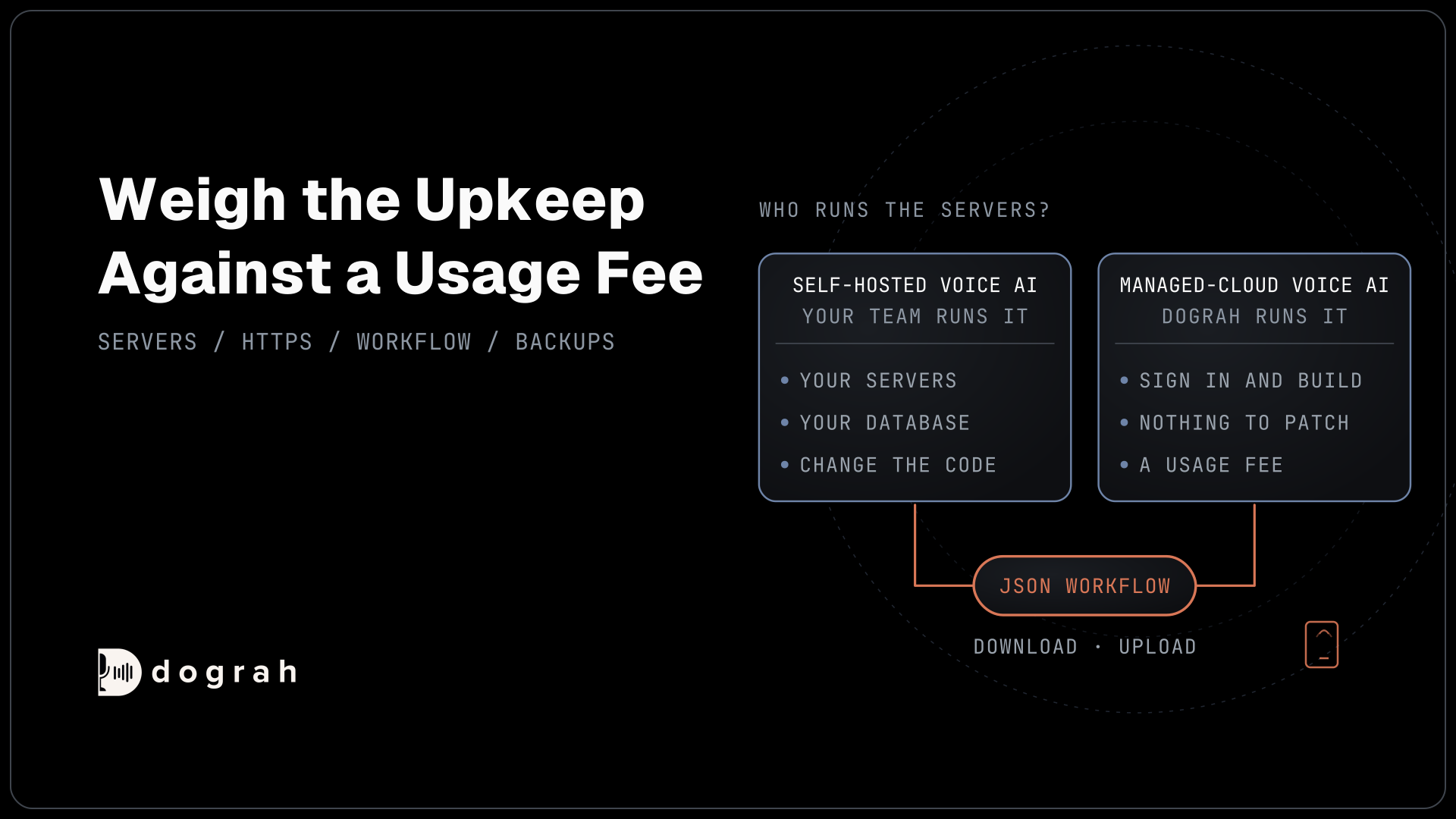
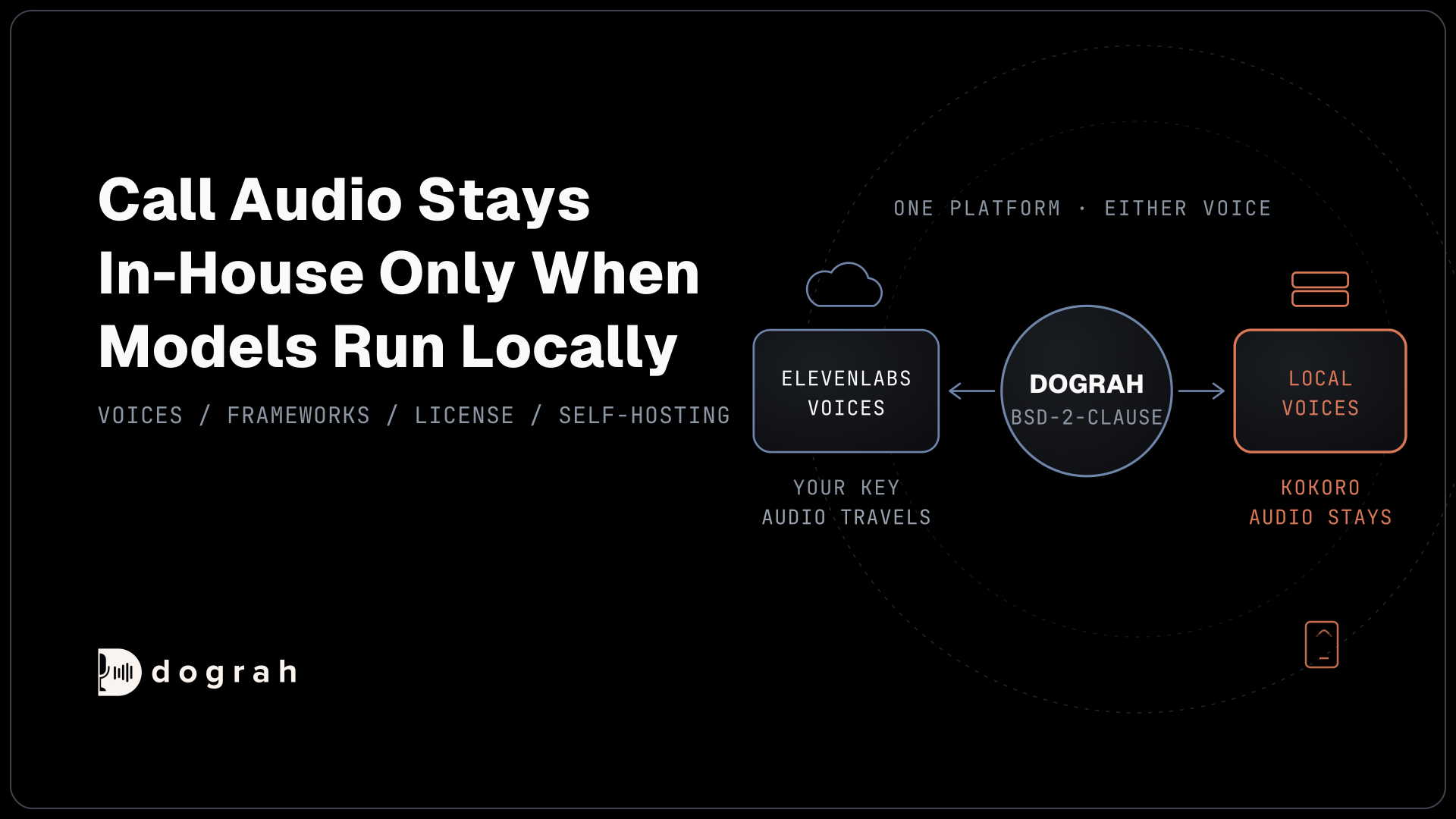
Self-hosting the platform keeps recordings and transcripts on your servers, but the caller's voice goes wherever the models run. Dograh is the orchestration layer that runs the call flow, tools and telephony, and the speech and language models are a separate layer you choose.
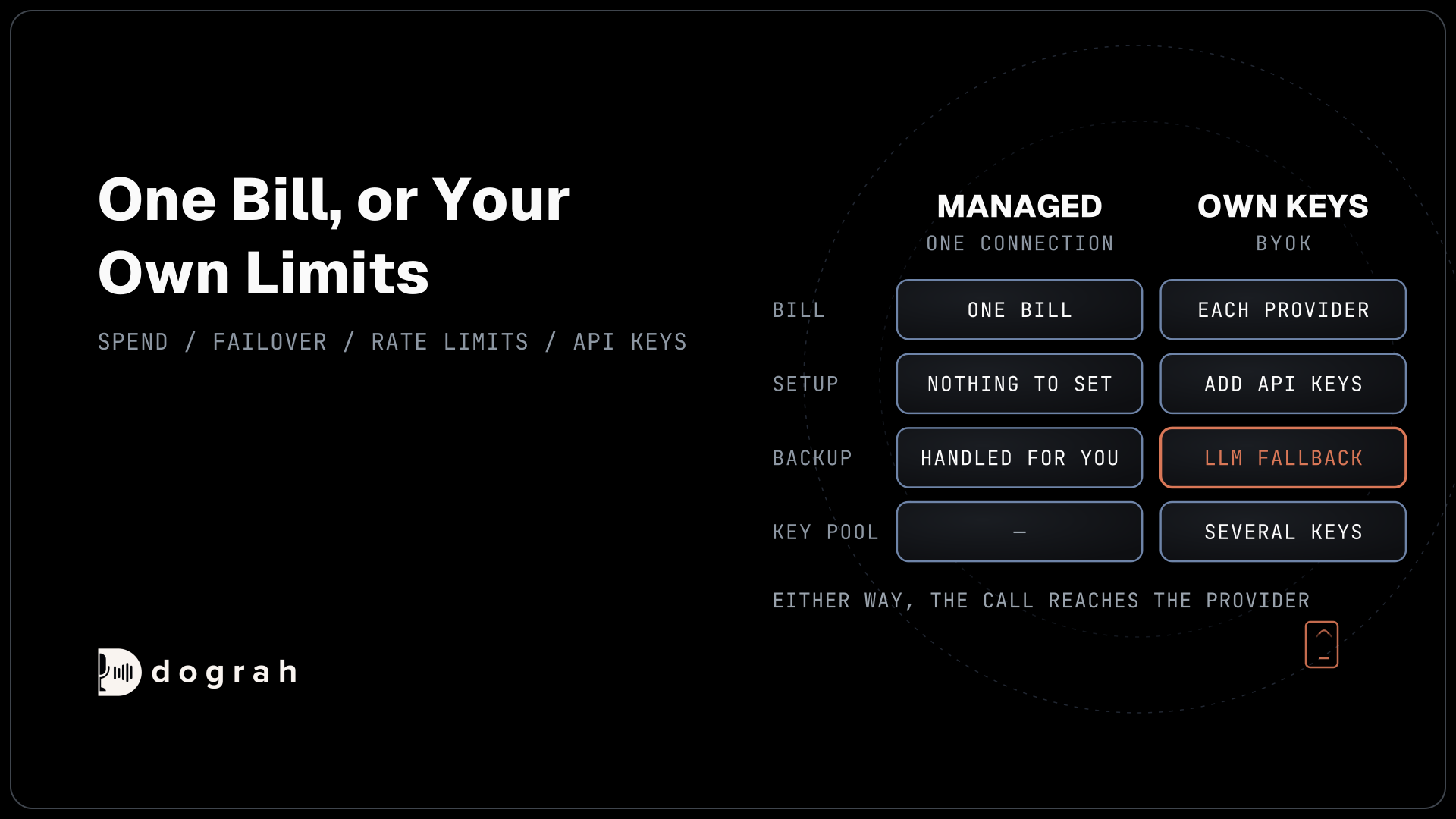
With your own keys for a hosted provider, you hold the contract, and the audio still reaches that provider. The audio stays in-house only when open-weight models run on your own servers too. In Dograh you point the model configuration at a language model served by Ollama or vLLM, at Whisper models through Speaches for speech to text, and at Kokoro through Speaches for the voice. Our guide on how to build a voice agent on fully local open-source models walks through that setup.
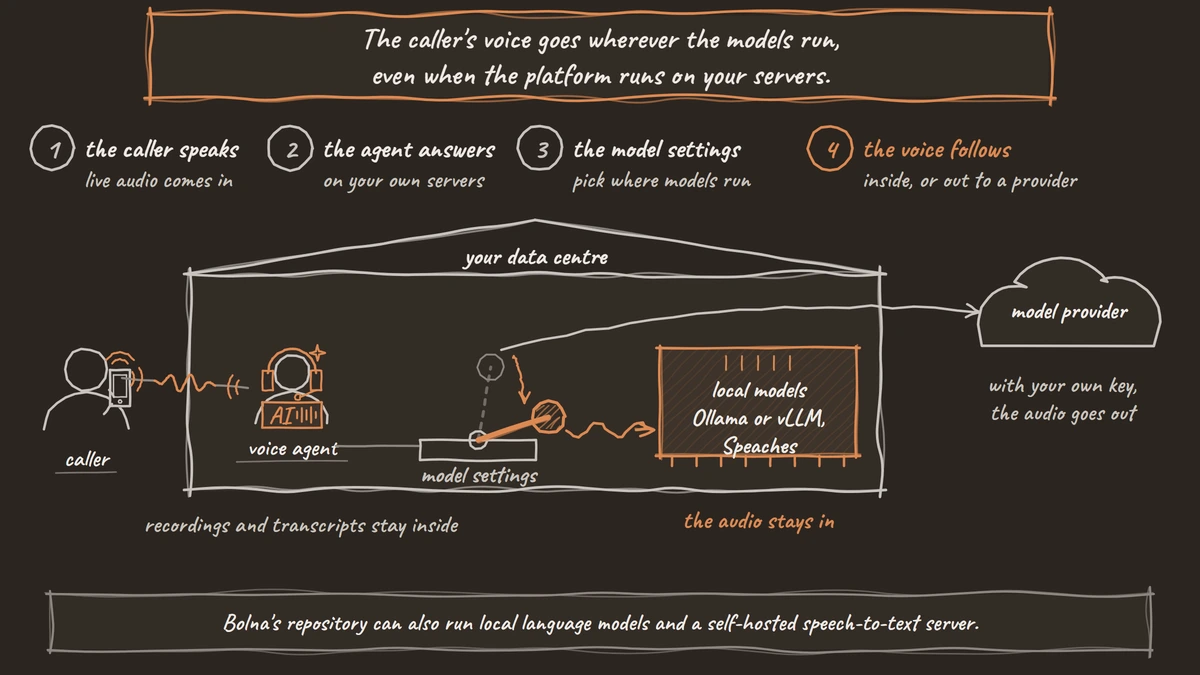
Bolna's repository can also run local language models and a self-hosted speech-to-text server, so either route can keep the audio inside. The difference is how much of the product you build around it.
What self-hosting costs, and which route fits
Open source is not free to run, whichever repository you pick. You pay for servers, model usage, phone minutes and the engineers who run and update the system. Self-hosted Dograh runs 10 calls at once by default. You can raise that limit, though your servers and phone carrier set the real ceiling. Telemetry is on by default, so run ENABLE_TELEMETRY=false ./start_docker.sh and delete POSTHOG_API_KEY from docker-compose.yaml to switch it off. Self-hosted Dograh has no per-minute platform fee (servers, model keys and phone minutes still cost). Dograh Cloud has a 1¢-a-minute platform fee, for teams that want the same platform without running servers.
Two Bolna features have no match in Dograh. There is no keypad (DTMF) tool, so callers answer by voice, and Transfer Call does not work on Exotel or Vobiz numbers. It works on Twilio, Telnyx, Plivo, Cloudonix and Asterisk ARI.
Choose Bolna's repository if your developers want an engine to build their own product on, with agents kept in code. Choose Dograh if you want the builder and the rest of the platform open, running on your own servers or on Dograh Cloud. For every row with prices, see Dograh vs Bolna. To start, run Dograh from GitHub with Docker.
Join the Dograh Community
Dograh is an OSS alternative to Vapi. Join our Slack community for queries, releases, best practices & community interactions.
Glossary
- Orchestration core
- Bolna's MIT-licensed framework that runs the call, with agents written in JSON or Python. It is open source, while the hosted APIs and dashboard built on it are not.
- Open-weight model
- A model whose weights you can download and run on your own servers, for example a language model served by Ollama or vLLM. Only these keep the caller's audio fully in-house.
- Telemetry
- Usage and error data a self-hosted install sends back to its maker. In self-hosted Dograh it is on by default and can be switched off in the server settings.