
A voice agent should say it is an AI on every call, because callers who find out later stop trusting you, and a notice costs one sentence. The EU AI Act, from 2 August 2026, and Maine's law require a notice in the situations they name. In Dograh, our open-source voice agent platform, it goes in the greeting.
Key Takeaways
- Callers trust AI service more when a person is one sentence away.
- The EU, Maine and Utah set disclosure rules, and most US states set none.
- Put the notice in fixed Greeting Text with greeting interruption switched off.
This post is part of our guide to compliant AI voice agents, where recording consent and AI disclosure meet in a call's first seconds. Below, we argue for saying it every time, then cover where the law asks for it and the opening lines to set up in Dograh.
The case for saying it on every call
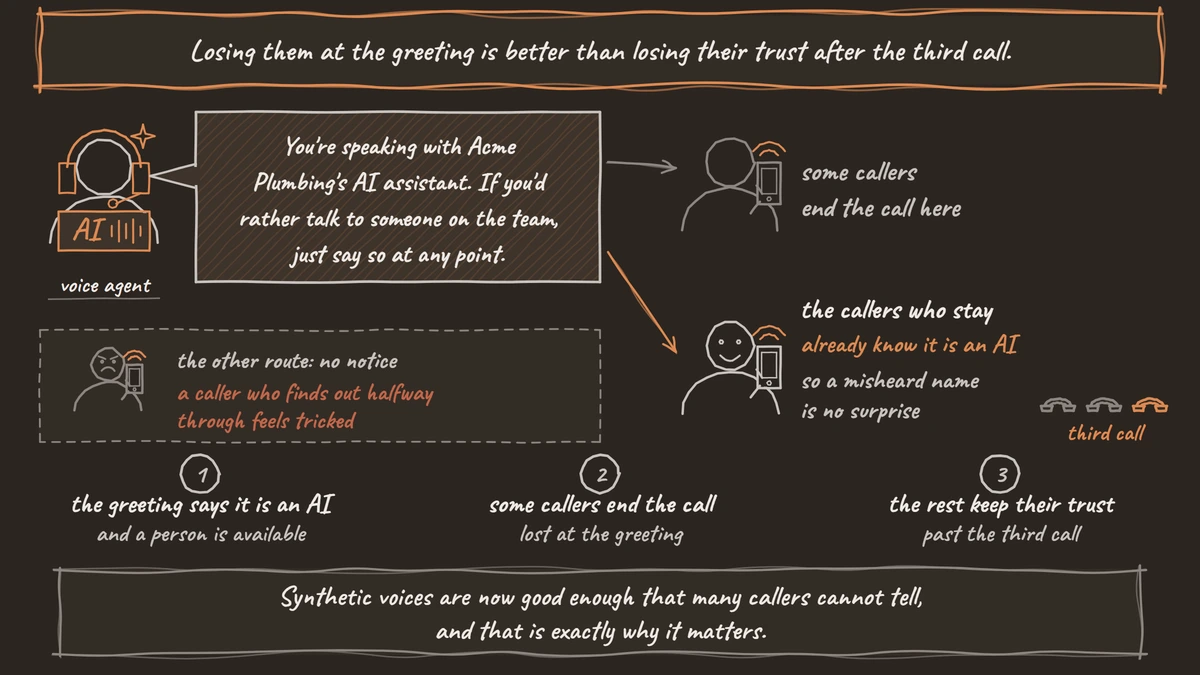
Our view is simple: every call your agent makes or answers should say early on that it is an AI. Synthetic voices are now good enough that many callers cannot tell, and that is exactly why it matters. A caller who discovers halfway through a call that the "person" was software feels tricked, and that feeling lands on your business.
The numbers point the same way. In a Five9 survey of 3,000 consumers, 55% said they trust AI customer service when they have a clear path to a person, against about a quarter when there is no human option. In the same survey, 41% said they are less likely to use a company that uses AI for service, rising to 53% when there is no way to reach a person. Saying it is an AI, and saying a person is available, answers both concerns in one breath.
There is a cost, and we accept it. Some callers will end the call when they hear an AI, and some outbound calls will finish less often. Those callers would have found out anyway, usually at a worse moment, such as when the agent misheard a name or could not answer a question a person would. Losing them at the greeting is better than losing their trust after the third call.
Where the law already requires it
In the EU, the EU Artificial Intelligence Act has required AI systems that talk with people to tell them so since 2 August 2026, unless it is obvious. Our post on what a voice agent must tell callers under Article 50 covers how that notice should sound. Breaching it sits in the Act's middle fine level, set out in our post on EU AI Act penalties.
In the US, the federal rules ask for something narrower. A Federal Communications Commission (FCC) ruling treats AI-generated voices as artificial voices under the Telephone Consumer Protection Act (TCPA). Outbound calls of that kind need the called person's prior express consent, and they must name the business responsible at the start. That identifies the caller, but nothing in it requires the words "I am an AI".
A few states go further. Maine's law on AI chatbots bars using an AI chatbot, by text or by voice, in a way that may lead a reasonable consumer to think they are talking to a person, unless the business gives clear and conspicuous notice that they are not. Utah's Artificial Intelligence Policy Act requires a business using generative AI with consumers to say so when a consumer clearly asks, and licensed professions must say it up front in high-risk interactions.
California's bot disclosure law makes it unlawful to use a bot online to mislead people about its artificial identity to sell something or sway a vote, and disclosing that it is a bot avoids liability. Whether a phone call counts as "online" is unsettled, so confirm that point, and your position in any state you call, with counsel. Most US states have no law that requires a voice agent to say it is an AI, which is why this post argues for doing it anyway.

Open Source Alternative to Vapi / Retell
Self-hosted voice agent platform — no per-minute fees
dograh-hq/dograh
Star on GitHub
A notice does not excuse what comes next
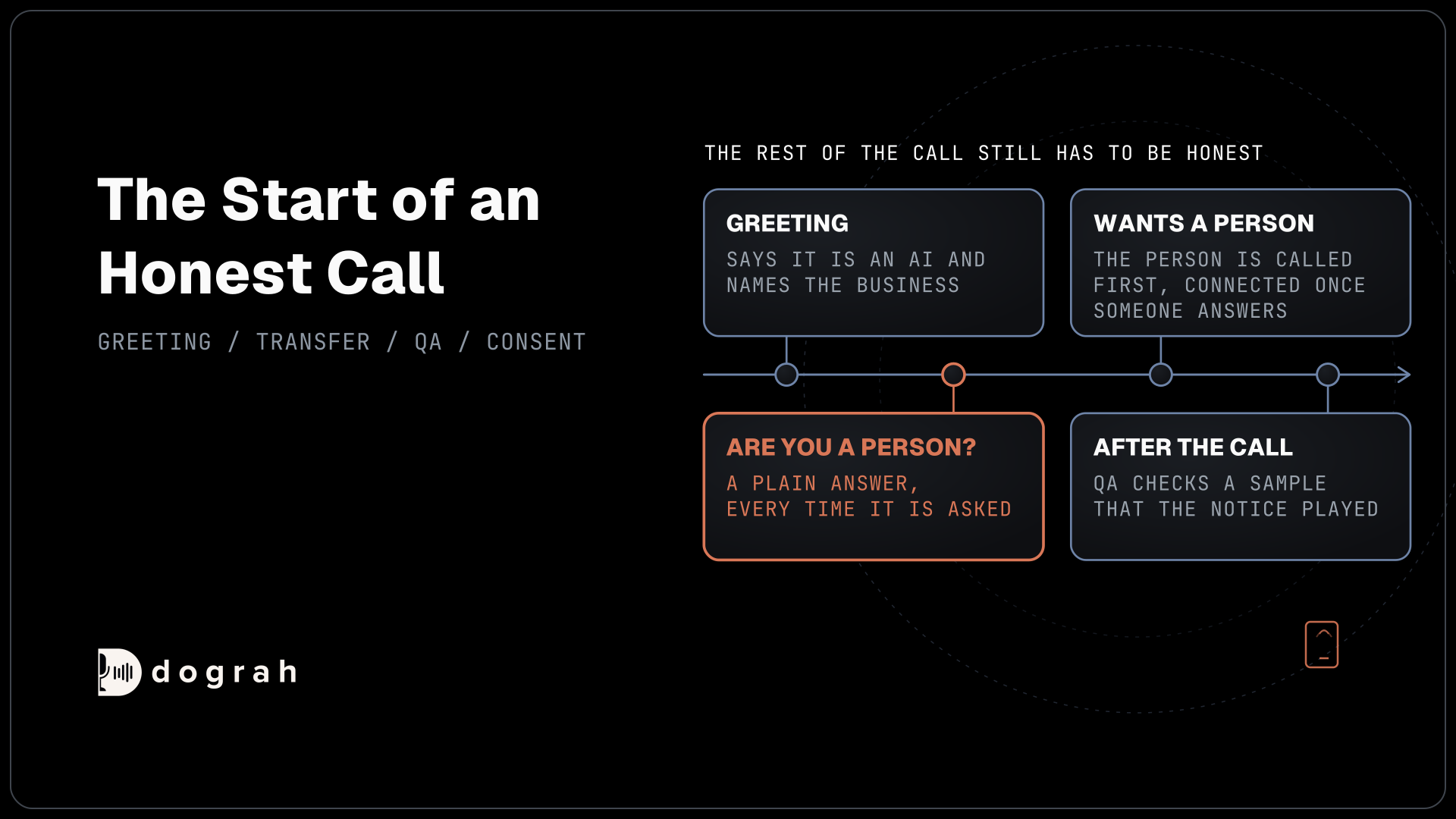
Saying it is an AI is the start of an honest call, and the rest of the call still has to be honest. Under the EU's ban on manipulative AI, the Commission's guidelines treat a notice as lowering the risk of deception, while a script that pressures or misleads callers into harm can still be banned. Our post on prohibited practices for voice agents covers where that line sits.
In the US, the notice sits beside the consent and opt-out rules for outbound calls without replacing any of them. A disclosed AI that calls a mobile number without consent is still a call made without consent.
Opening lines to adapt
A good opening names the business and says in plain words that the caller is talking to an AI. Name the business in every greeting, whether or not you add the AI sentence. These lines are examples to adapt, and each one keeps the AI sentence before the first question.
- Inbound, example: "Thanks for calling Acme Dental. I'm the practice's AI assistant, and I can book or move appointments. What do you need today?"
- Outbound to a customer who agreed to calls, example: "Hi {{customer_name | there}}, this is Acme Insurance's automated assistant, calling about your renewal."
- With a route to a person, example: "You're speaking with Acme Plumbing's AI assistant. If you'd rather talk to someone on the team, just say so at any point."
- When a caller asks "Am I talking to a real person?", example: "No, I'm an AI assistant for Acme. I can keep helping, or I can connect you with someone on the team."
Recording is a separate notice under separate laws. If you record calls, add that sentence after the AI line, as our post on call-recording consent laws explains.
Join the Dograh Community
Dograh is an OSS alternative to Vapi. Join our Slack community for queries, releases, best practices & community interactions.
Setting the notice up in Dograh
The opening belongs where Dograh speaks fixed words. The Greeting Text on the Start Call node plays word for word, and Greeting Type can play a pre-recorded clip instead. A real person recording "I'm an AI assistant" is honest and sounds the same on every call. Variables need a fallback, such as {{customer_name | there}}, or an empty value is spoken as nothing.
Allow Greeting Interruption is on by default, so a caller who talks over the greeting can cut the notice short. Switch it off on the Start Call node and the caller's speech is held until the greeting ends. Then add a prompt rule that the agent always answers plainly when asked if it is a person, and a Transfer Call tool for callers who want one. It works on Twilio, Telnyx, Plivo, Cloudonix and Asterisk ARI. Dograh dials the person first, the caller hears hold music, and the two are connected once someone answers.
Built-in QA reads each call's transcript afterwards, so add a check on a sample of calls that the notice played and that every "are you real?" got a straight answer. Self-hosted Dograh has no per-minute platform fee, but servers, model keys and phone minutes still cost money. Dograh Cloud charges a 1¢-a-minute platform fee.
Laws on AI disclosure will keep changing state by state. An agent that already says it on every call will not need rewriting when they do.
Glossary
- AI disclosure
- Telling a caller, in plain words, that they are speaking with an AI rather than a person. Some laws require it, and we recommend it on every call.
- Artificial voice
- A voice not spoken live by a person. The FCC treats AI-generated voices this way under the TCPA, so outbound calls need consent and must name the business at the start.
- Greeting interruption
- Letting a caller cut into the opening greeting by speaking. In Dograh, Allow Greeting Interruption is on by default, and switching it off holds the caller's speech until the greeting finishes.
- Clear and conspicuous notice
- A notice the caller cannot reasonably miss, given early and in plain words. Maine's chatbot law uses this standard for telling consumers they are not talking to a person.