
Neither side owns the voice agent or the call data by default. The franchise agreement decides, so settle five things in writing before rollout: who runs the install, whose model keys, whose carrier account, where recordings sit and what a departing franchisee takes. With Dograh, an open-source AI voice agent platform, recordings can stay on servers you choose.
Key Takeaways
- The franchise agreement decides who owns recordings. Privacy law only sets duties.
- Everyone in a Dograh organization can open its calls, so split by organization.
- Write down what a departing franchisee keeps before the first call.
This post is part of our guide to AI voice agents for franchises and multi-location businesses, where ownership is settled before rollout. Below are the questions to agree on, the ways to run one Dograh agent across a network, the rules that apply, reports and what happens at exit.
Five things to settle before the first call
"Who owns the call data" is really five separate questions, and each has its own answer. The first is who runs the install, the franchisor or each franchisee, on its own servers or on Dograh Cloud. The second is whose model keys the calls run on, because the key holder's contract covers the audio sent to that provider. Bringing your own key decides whose contract applies, while the audio still travels to the provider. Only open models on your own servers keep it in-house.
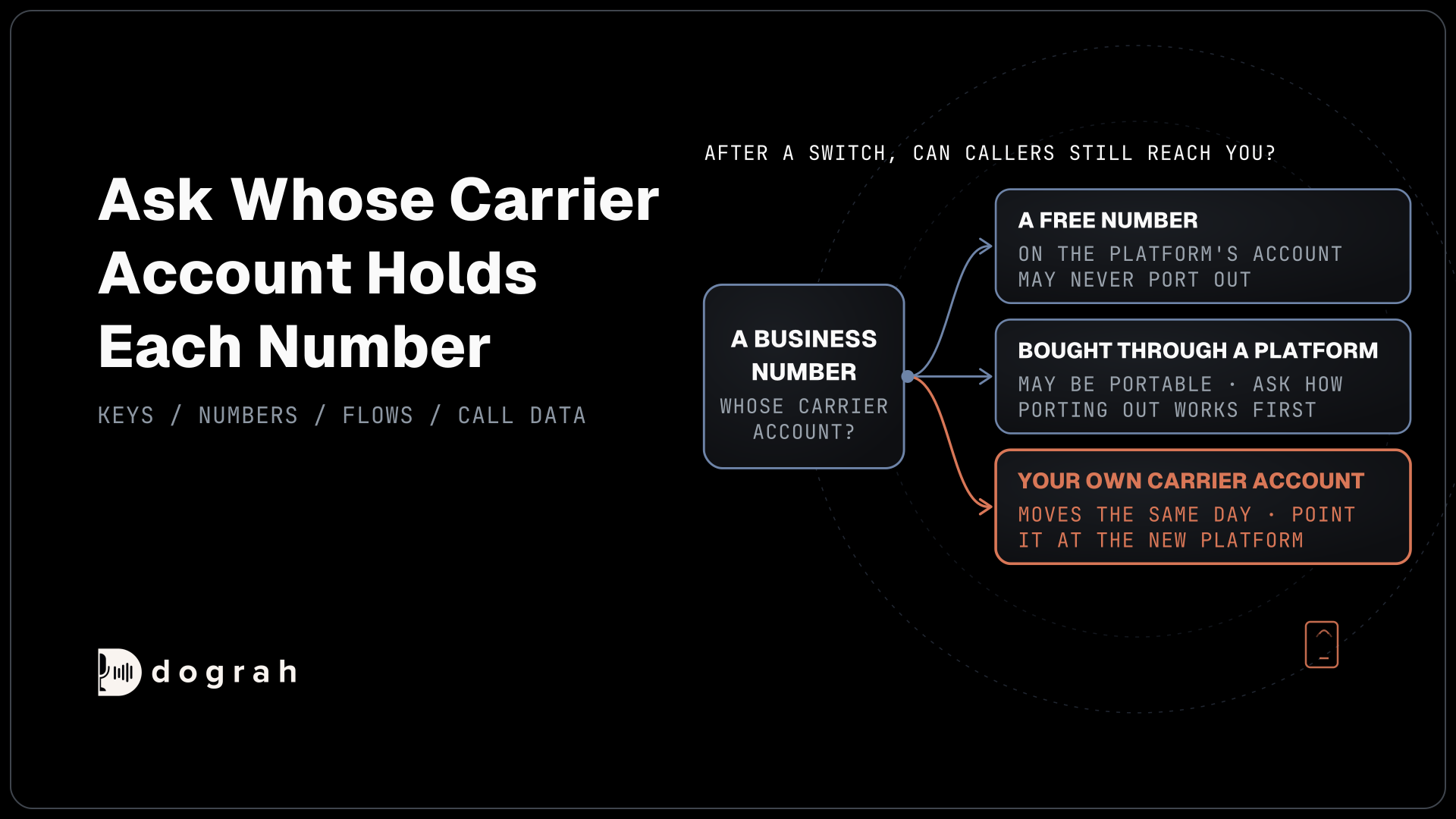
The third is whose carrier account holds each number. A number stays with the account holder when it moves, which our post on white-label AI receptionists covers under who holds the phone numbers. The fourth is where recordings sit. A self-hosted install keeps call records in its own Postgres database and recordings in MinIO or an Amazon S3 bucket, so whoever runs the install holds them.
The fifth is exit, what a franchisee takes when it leaves. Never assume the franchisor owns everything by default. The franchise agreement and the facts of who runs what decide, and a voice agent adds parts that most agreements never mention.
Three ways to run one agent across a network
Most networks pick one of three setups, and each one decides who can open which calls. In the first, the franchisor runs one organization for the whole network and holds every recording. In the second, the franchisor hosts a separate organization for each franchisee. On Dograh Cloud, one option is to give each franchisee its own team and add the franchisor's support staff to every team, as agreed. In the third, each franchisee runs its own copy and the franchisor supplies a template agent.
The organization is the line that matters. Everyone in an organization can open its calls in the app, and there are no per-member roles inside it. So each franchisee that must not hear the recordings of the site next door gets an organization of its own, whichever company pays the server bill.
Large operators often want the third setup. In FRANdata's count, the 19.3% of franchisees with more than one unit hold 58.8% of franchised locations. An operator with twenty sites may prefer its own install and its own keys to the franchisor's. The open-source code makes that possible on either side, and our post on who owns your calls on open-source and hosted voice AI covers the code and terms side.

Open Source Alternative to Vapi / Retell
Self-hosted voice agent platform — no per-minute fees
dograh-hq/dograh
Star on GitHub
What the franchise agreement and FDD say
US franchise law already asks the franchisor to disclose its access to franchisee data. Under the FTC Franchise Rule, the Franchise Disclosure Document (FDD) must describe the franchisee's computer systems, including the types of data they generate or store. It must also say whether the franchisor will have independent access to that information, and any contractual limits on that access.
Ownership itself is set by the franchise agreement, and clauses vary. In its 2025 FDD, Burney's Sweets & More states that "The Customer List shall be the property of Franchisor" and that the franchisor is the exclusive owner of franchised business data. Other systems split ownership or leave call recordings out entirely. Read your own disclosure and agreement, and if neither names call recordings or an AI agent, add them before rollout.
Privacy roles under the CCPA and GDPR
Privacy law does not say who owns the calls. It sets duties for each role. Under the California Consumer Privacy Act (CCPA), another company counts as part of the same business only when it controls or is controlled by that business (through more than half the votes, the board or a controlling influence over management), shares its common branding and receives personal information from it. An independently owned franchisee is usually not controlled by its franchisor, so it is generally its own business under the CCPA, with its own duties to callers.
A franchisor that runs the agent for a franchisee fits the CCPA's service provider role only with a written contract that limits how it uses the callers' information. Under the GDPR, two companies that decide together why and how calls are processed are joint controllers and must set out their responsibilities between them. A company acting only on the other's instructions is a processor under a written contract. Which role each side plays turns on what each one actually does, so confirm your position with counsel before the agreement is signed. Our post on GDPR and voice AI covers controllers and processors on a call in more depth.
Reports for head office without the recordings
Head office usually wants each call's outcome, and the agent can send exactly that without any audio. A Webhook node at the end of the call posts the fields you choose to the franchisor's system, such as the call's outcome, whether a booking was made and the reason for the call, all taken from what the agent gathered.
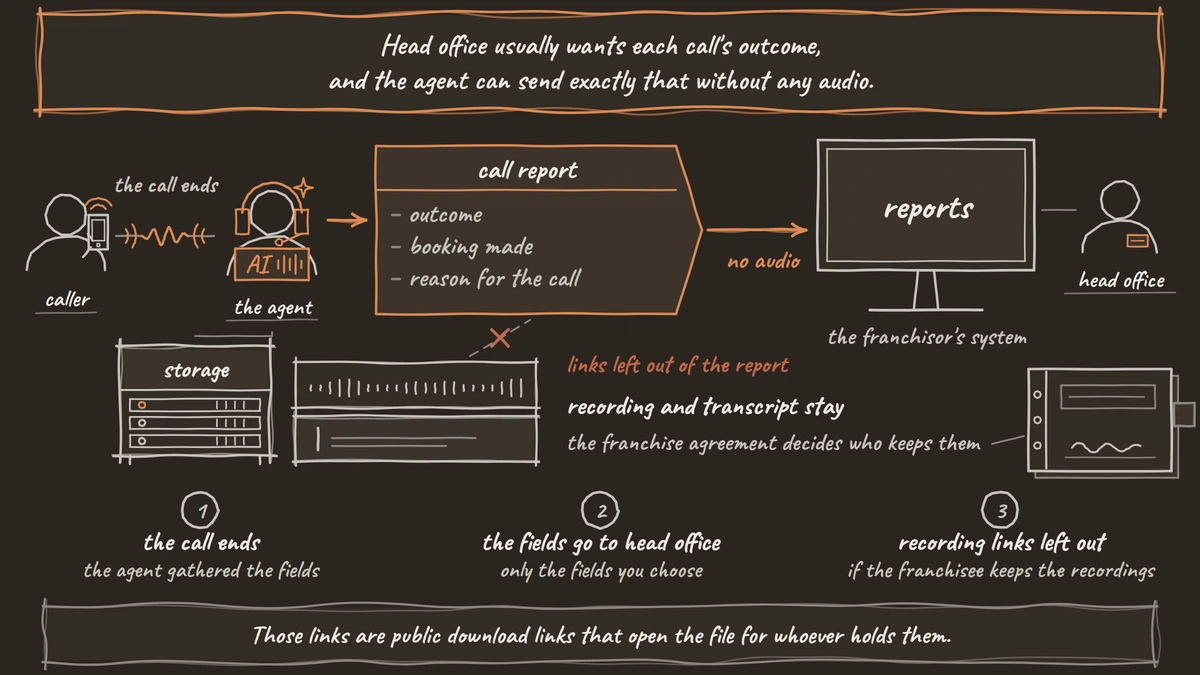
Leave the recording and transcript links out of that payload if the franchisee keeps the recordings. Those links are public download links that open the file for whoever holds them, as our post on where voice agent call data goes explains, so any system that stores them holds the recording too.
Quality can be reviewed the same way. Built-in QA scores each step of a call on a sample of calls you choose, and the franchisor can ask for those scores per site, while full call traces stay with whoever runs the install.
Join the Dograh Community
Dograh is an OSS alternative to Vapi. Join our Slack community for queries, releases, best practices & community interactions.
When a franchisee leaves the network
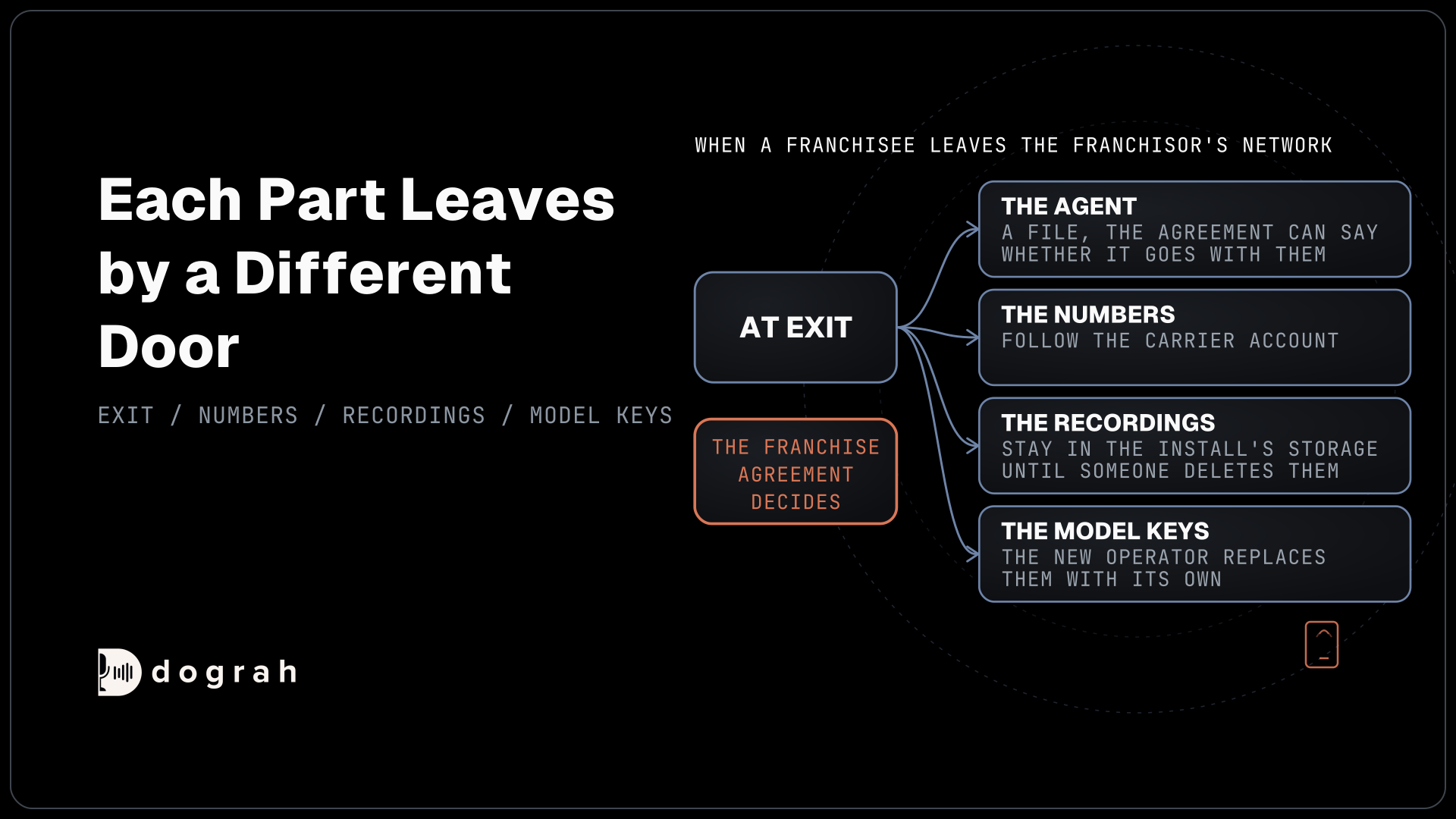
Plan the exit before the first call, because the agent, the numbers and the recordings each leave by a different door. The agent is a file. Download Workflow saves its definition and Upload Agent Definition loads it into another install, so the agreement can say whether a departing franchisee may take the prompt it paid to tune.
Running costs follow whoever runs each organization. Self-hosted Dograh has no per-minute platform fee, but servers, model keys and phone minutes still cost money. Dograh Cloud charges a 1¢-a-minute platform fee. Write into the agreement which side pays for each organization.
The numbers follow the carrier account, as above. Recordings stay in the storage of whoever ran the install until someone deletes them, so the agreement should say who deletes them or hands them over, and by when. Keys are the easy part. Each organization's model keys sit in its own model configuration, and the new operator replaces them with its own.
Glossary
- Common branding
- Under the CCPA, a shared name, service mark or trademark that an average consumer would take to mean two companies are commonly owned. It counts towards treating them as one business only when control and shared personal information are also present.
- Joint controllers
- Under the GDPR, two or more companies that together decide why and how personal data is processed. They must set out their respective responsibilities in an arrangement between them.
- Service provider
- Under the CCPA, a company that processes personal information on behalf of a business under a written contract that limits how it may use that information.
- Organization
- The unit in Dograh that holds agents, numbers, model keys and calls. Everyone in an organization can open its calls, so separate franchisees need separate organizations.