
A white-label AI receptionist answers a client's calls in the client's name while the agency runs it. Keep the client's number in the client's carrier account and its call data where you can return it. Dograh, the open-source AI voice agent platform we build, can be self-hosted under your brand or run on Dograh Cloud.
Key Takeaways
- Callers hear the client's greeting, voice and number, never the platform's name.
- Keep each number in the client's own carrier account so it moves with them.
- Price setup and monthly care on top of the per-minute cost floor.
This post is part of our guide to starting an AI voice agent agency, which covers the stack, one client's bill, pricing and client separation. Below, we cover what callers and clients see, who holds the numbers and call data, and how to price a branded receptionist on Dograh.
What callers hear and what the client sees
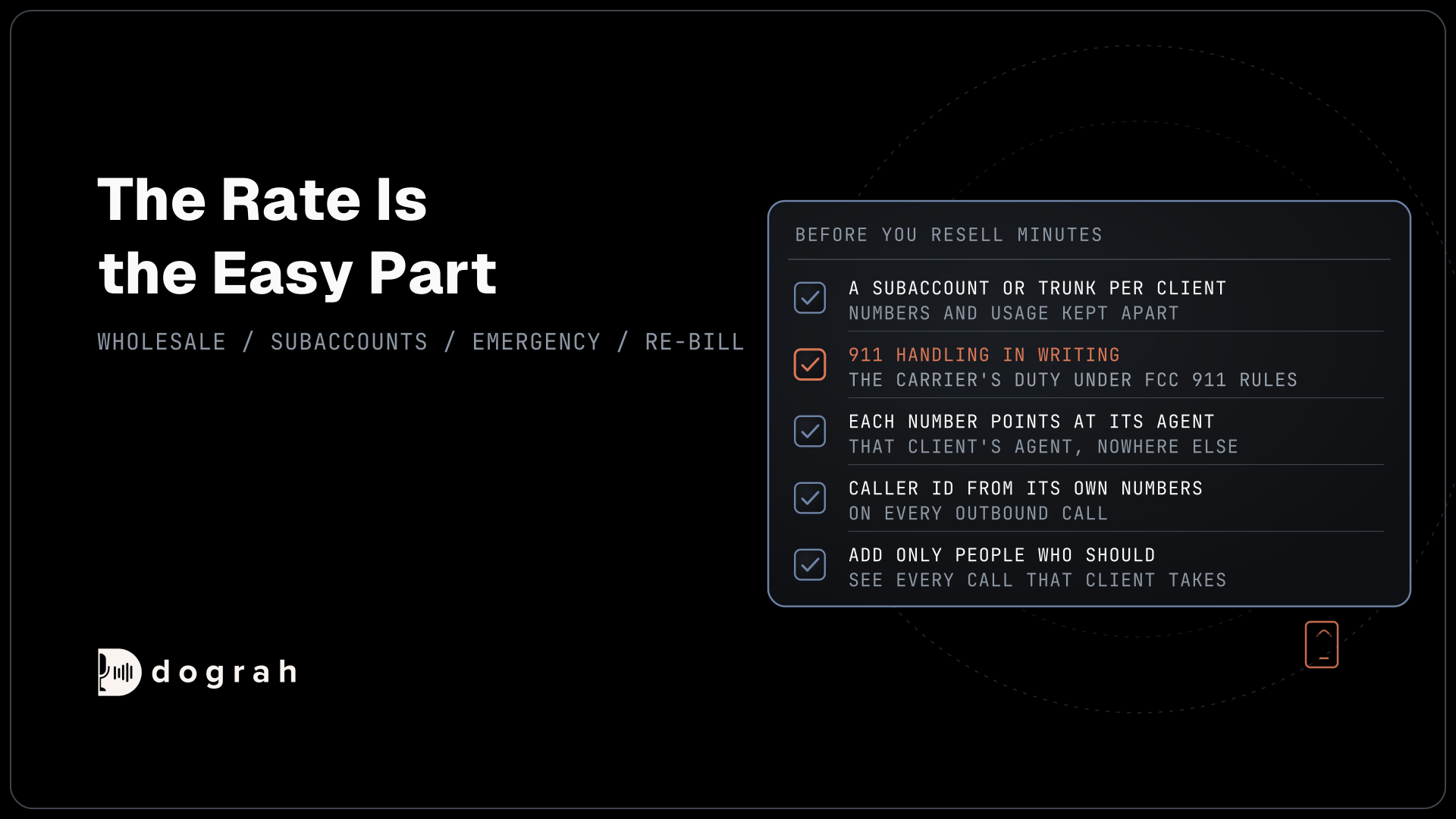
A white-label receptionist has two audiences, and only one of them hears the agent. Callers hear the greeting, the voice and, on outbound calls, the client's own number as caller ID. Nothing in the call names the platform it runs on, so to the caller the receptionist belongs to the dental office or law firm it answers for.
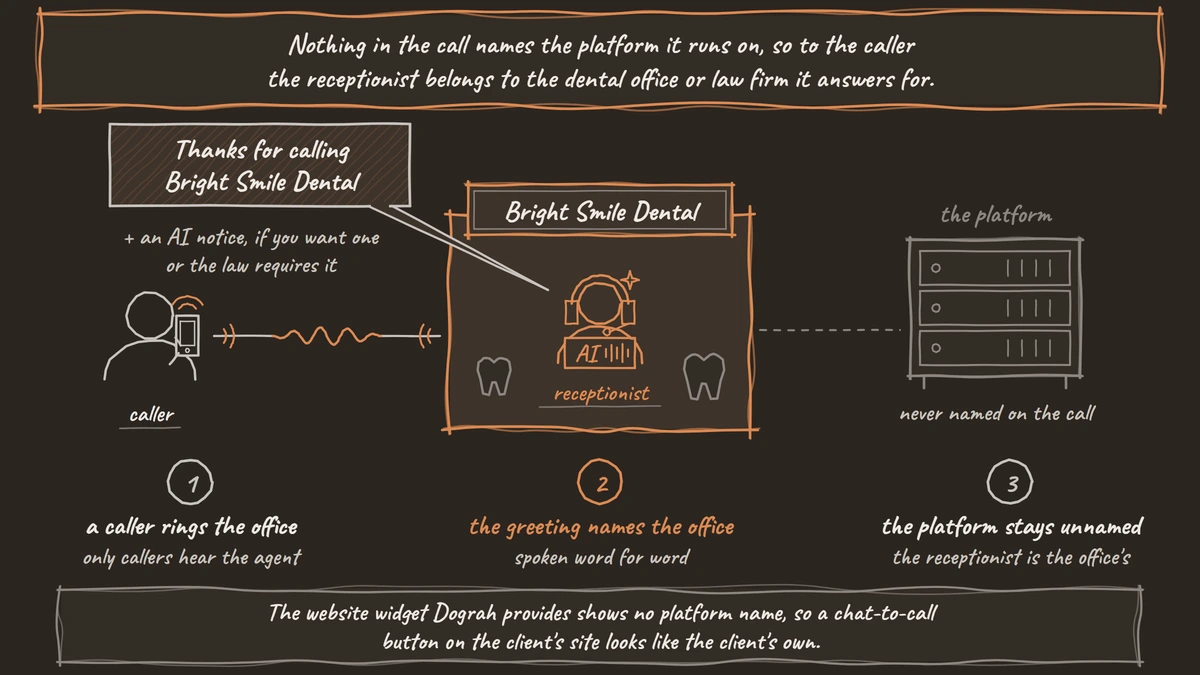
The greeting is where the client's name goes. In Dograh, the Start Call node's Greeting Text is spoken word for word, so "Thanks for calling Bright Smile Dental" comes out exactly as written. If you want to tell callers they are speaking with an automated assistant, or your location requires it by law, write that in the Greeting Text along with the business name. Then switch off Allow Greeting Interruption on the Start Call node, which is on by default, so the full notice plays.
The client, meaning the business owner, sees what you choose to show. Some agencies send a weekly call report and never give out a login. Others give the client a login to a dashboard with the agency's name on it. The website widget Dograh provides shows no platform name, so a chat-to-call button on the client's site looks like the client's own. The receptionist itself, from handover rules to after-hours calls, is covered in our guide to AI receptionists.
Your brand on your own copy, or a Cloud team
Dograh is open source, so an agency can run its own copy under its own brand. Self-hosted Dograh is released under the BSD 2-Clause licence, which lets you run it on your own domain with your own name and logo, as long as the licence notice stays. Our logos stay ours, so the copy carries your logo in their place.
On Dograh Cloud you get speed instead of a rebrand. Each client sits in its own team, which you switch between from the sidebar, and callers hear only the agent you built. Your team works in the Dograh dashboard. If a client wants a login, remember that everyone in a team has full access to it, so invite only people who should see every setting and every call.

Open Source Alternative to Vapi / Retell
Self-hosted voice agent platform — no per-minute fees
dograh-hq/dograh
Star on GitHub
Who holds the phone numbers
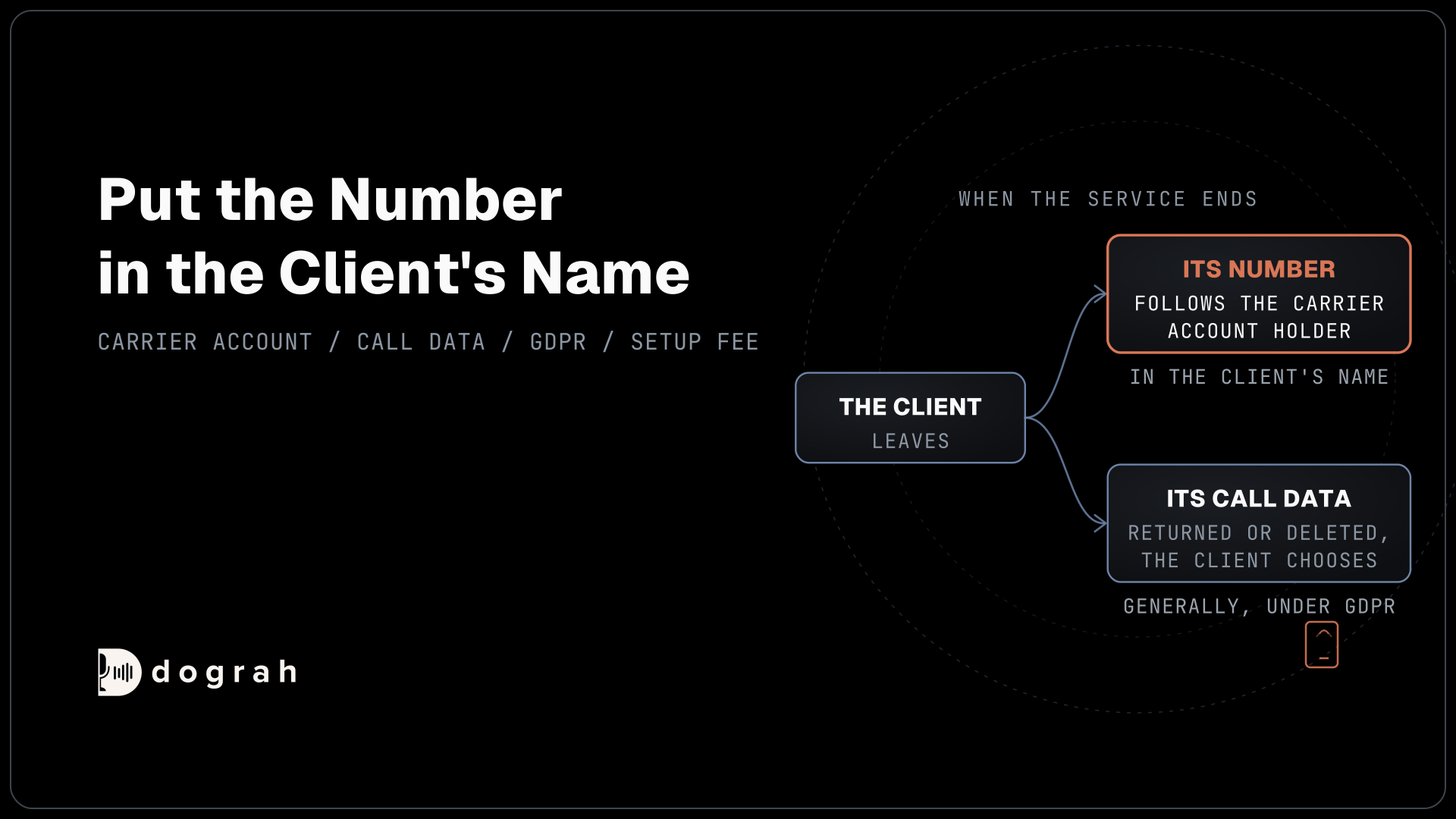
The number belongs to whoever holds the carrier account, so put it in the client's name. Dograh saves the carrier's credentials in a telephony configuration and points each number at an agent, while the number itself stays in the carrier account.
The rule behind this is number portability. In the US, the Federal Communications Commission's number portability rules let a subscriber keep its number when it switches from one carrier to another, so the number follows the account holder. If the agency's carrier account holds the client's main line, the client has to ask the agency to release it when it leaves.
The cleanest setup is a carrier account opened in the client's name, at Twilio or Telnyx for example, with the agency added as a user. A client that already has a SIP trunk or a phone system can bring it instead. If you hold the numbers for convenience, write in the contract that each number moves to the client when the service ends. Our page on running an AI receptionist on your own phone lines shows how a client keeps the numbers it already has.
Who holds the call data
Recordings and transcripts sit wherever the platform stores them, so decide that before the first call. Self-hosted, they land in the agency's own storage, an S3-compatible bucket you choose. There is no retention setting and no automatic deletion, so your team sets the deletion routine. On Dograh Cloud, each client's records stay inside that client's team.
For clients with callers in the EU, the General Data Protection Regulation (GDPR) applies to the recordings. Under the GDPR, an agency handling a client's caller data is usually a processor and needs a written contract with the client. It may not bring in another processor, such as a hosted model provider, without the client's written authorisation. At the end of the service, the agency deletes the client's personal data or returns it, whichever the client chooses. Confirm your own position with counsel before you sign the first EU client.
Model keys move part of this. When a client's calls run on the client's own model keys, the provider contract sits with the client, though the audio still reaches that provider. Medical clients add one more layer, and our post on which parts of a voice AI stack need a BAA walks through it.
How to price a branded receptionist
Price the receptionist in two parts: a setup fee for the build and a monthly fee for running it. The setup covers the greeting, the knowledge file of hours, prices and FAQs, the transfer rules, the number setup and test calls on a real phone line. The monthly fee covers the cost floor plus your time reading calls and updating the knowledge file when the client's hours or prices change.
The cost floor is the per-minute lines added up. Our agency guide's worked example puts a 1,200-minute dental office at about $64 a month in platform, phone and model costs, with the platform on the Cloud plan. Self-hosted Dograh has no per-minute platform fee, but servers, model keys and phone minutes still cost money. Dograh Cloud charges a 1¢-a-minute platform fee. Transfers add minutes too, because the call to the client's staff runs on the same carrier.
Two features make the monthly fee easier to set. The first is pre-recorded clips, which let the greeting play in the voice of the client's real front desk person, with a cloned voice for everything else, so fewer characters go to the voice provider.
The second is billing. If you charge for usage instead of a flat fee, the Paygent integration invoices each client from your own rate cards. Running ten of these side by side is covered in managing multiple clients on one voice AI platform.
Join the Dograh Community
Dograh is an OSS alternative to Vapi. Join our Slack community for queries, releases, best practices & community interactions.
Glossary
- White-label
- Selling a product under your own brand while someone else builds the software underneath. For a receptionist, callers hear the client's name, and a self-hosted copy of Dograh can carry the agency's own name and logo.
- Number portability
- The right of a US subscriber to keep its phone number when it moves to another carrier. The number follows whoever holds the carrier account, which is why the client should hold it.
- Processor (GDPR)
- A business that handles personal data on behalf of another, the controller. An agency running a client's receptionist is usually the processor, so it needs a written contract with the client.
- Caller ID
- The number shown to the person who receives a call. A white-label receptionist calls out from the client's own number, so the client's customers see a number they already know.