
A voice AI agency buys carrier minutes in bulk, gives each client its own subaccount or trunk so numbers and usage stay apart, then re-bills each client its share. In Dograh, the open-source AI voice agent platform we build, each client gets its own team on Dograh Cloud, or its own agent and phone setup when self-hosted.
Key Takeaways
- Twilio and Plivo subaccounts split usage, but every charge lands on your bill.
- Telnyx managed accounts can carry their own invoices, on commit plans only.
- One Dograh Cloud team per client keeps agents and numbers apart.
This post is part of our guide to SIP trunk providers, where agencies keep clients apart with carrier subaccounts and a team per client. Here we cover wholesale and resold minutes, how each carrier splits an account, how Dograh routes each client's numbers and one worked bill.
Wholesale minutes and reselling
Wholesale means buying minutes at carrier rates in volume, and reselling means passing them on to clients under your own name. Most voice AI agencies do a bit of both. They hold one carrier account, buy the minutes, and charge each client for its calls inside a monthly fee.
Wholesale carriers sell close to cost with few extras. IDT Express's AI trunk page, for example, lists US outbound calls at $0.004 a minute billed per second, inbound numbers at $0.99 a month and no minimum spend, with volume discounts above 100,000 minutes a month. Larger carriers get there through commit plans instead, where a monthly minimum spend buys better rates.
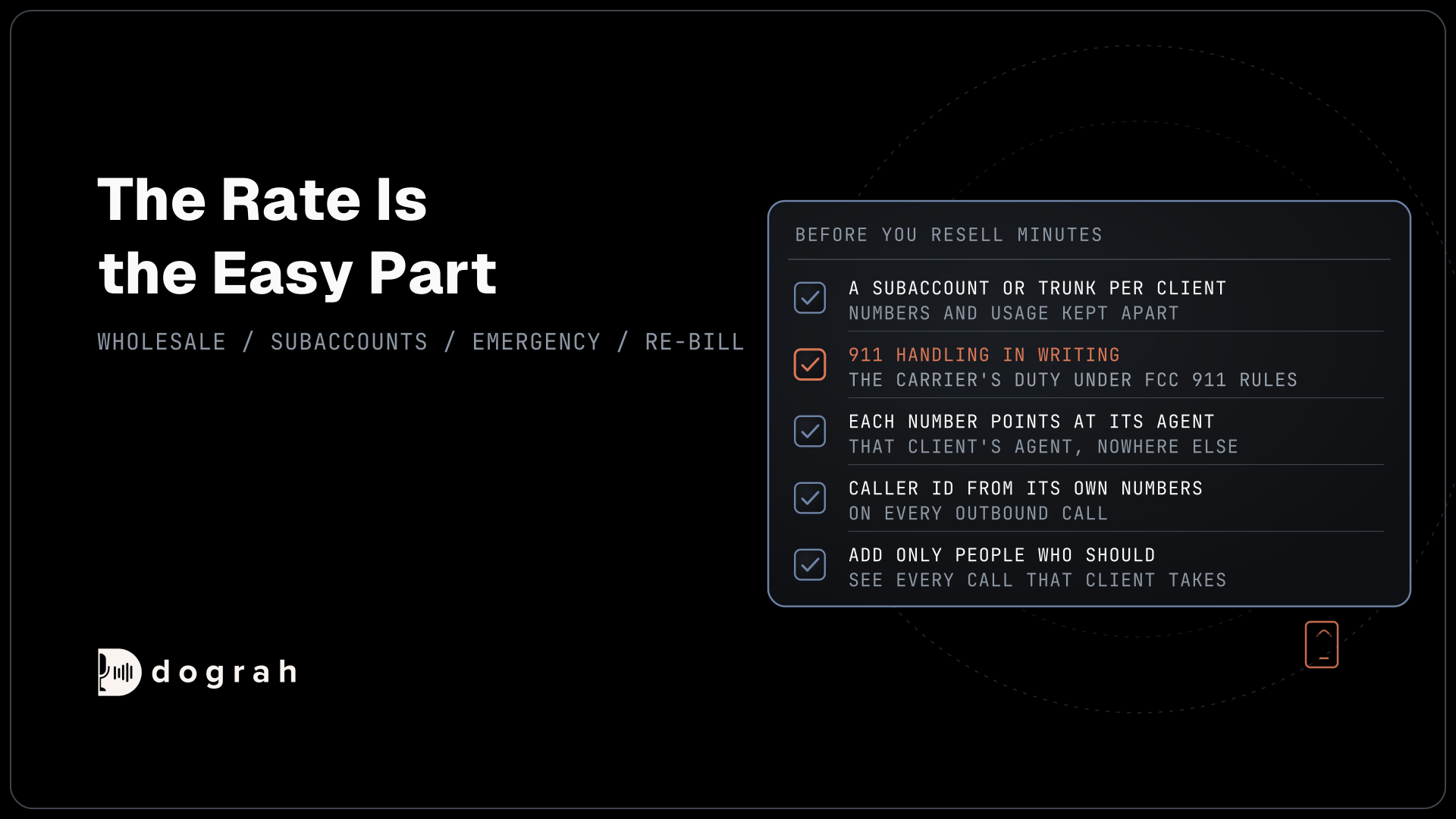
The rate is the easy part. The hard part is keeping each client's numbers, minutes and bill apart once ten clients share one carrier account, because one mixed bill is a month-end puzzle and one shared login lets any client's staff see the others' numbers.
Splitting one carrier account per client
Carriers split an account with subaccounts, and each one handles billing differently. Twilio's subaccount docs let you segment each customer's use and keep it separate, with up to 1,000 subaccounts by default. Twilio bills all subaccount usage to your main account, and suspending the main account suspends every subaccount under it.
Plivo works the same way. Each subaccount has its own credentials, so a client's setup can use its own keys, while the charges come out of the main account. With both carriers, you see each client's usage on its own, and you send one payment.
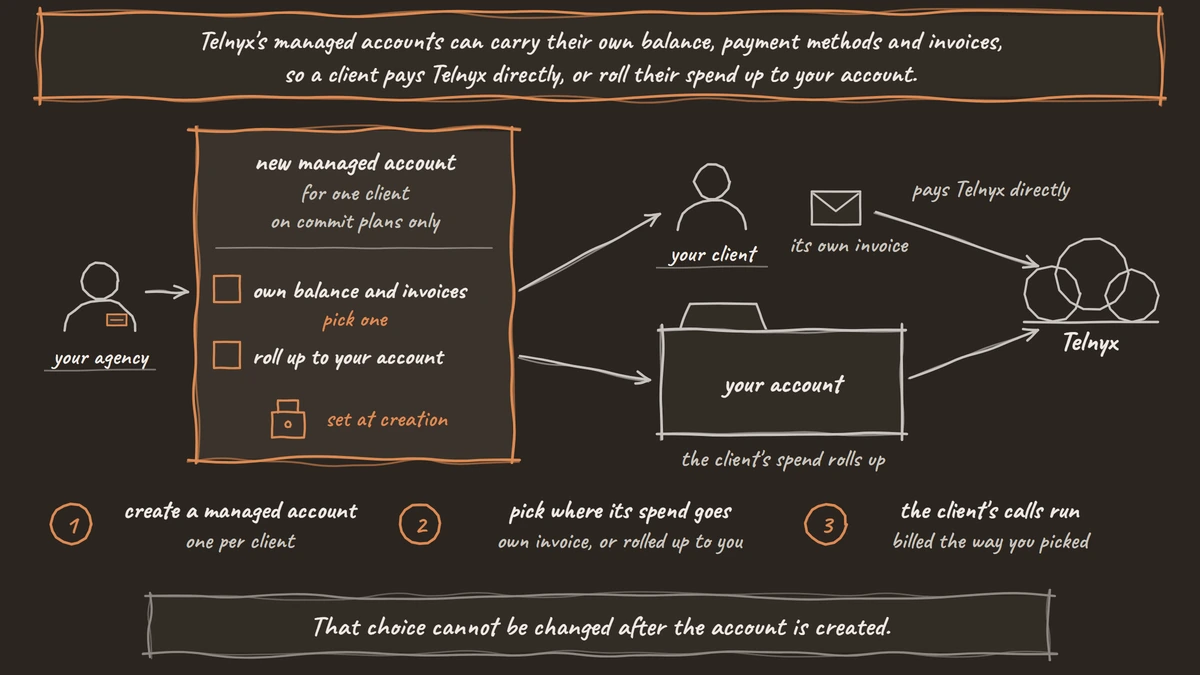
Telnyx goes further. Telnyx's managed accounts can carry their own balance, payment methods and invoices, so a client pays Telnyx directly, or roll their spend up to your account. That choice cannot be changed after the account is created. Managed accounts come only on commit plans, starting at $1,000 a month of minimum spend, not on pay as you go.
Whichever carrier you use, emergency calling stays the carrier's duty under the FCC's 911 rules, so if you resell, get your wholesaler's 911 handling in writing and register an address for every client number.
Each client's numbers in Dograh
The agent side has to match the carrier split, so a client's call always reaches that client's agent. On Dograh Cloud, each client sits in its own team, switched from the sidebar. Switching reloads the app inside the chosen team, with its own agents, numbers, keys and billing, so you only ever see one client's calls at a time.
Self-hosted, each client gets its own agent and its own phone setup. One organization can hold several telephony configurations, for example a Twilio subaccount per client, each with its own numbers. On a SIP trunk, the Managed SIP configuration can hold several outbound trunks, each with its own region and the numbers that dial out over it.
Routing is the last step. Each number has an Inbound workflow setting, the agent that answers it, so client A's number points at client A's agent and nowhere else. Outbound calls present a caller ID from the client's own numbers. Our guide to managing multiple clients on one voice AI platform covers the rest of the split, from knowledge files to model keys.

Open Source Alternative to Vapi / Retell
Self-hosted voice agent platform — no per-minute fees
dograh-hq/dograh
Star on GitHub
Billing each client for its share
Here is one worked example. An agency runs three clients on one Twilio main account, with a subaccount and an Elastic SIP trunk for each, at Twilio's US trunk rates of $0.0034 a minute inbound, $0.0100 outbound and $1.15 a month per local number.
A dental clinic takes 4,000 inbound minutes, which comes to $13.60 plus $1.15 for its number, $14.75 in all. A roofer's outbound follow-up agent makes 6,000 minutes of calls, $60.00 plus $1.15, so $61.15. A law office takes 2,000 inbound minutes, $6.80 plus $1.15, so $7.95. Twilio sends one bill of $83.85, and the subaccounts show which client used what.
The agency then re-bills each client its own line, plus whatever margin its contract sets. The platform side splits the same way. On Dograh Cloud, each team has its own Billing page, so client A's platform fee never lands on client B. The Paygent integration exports each call's usage so you can apply your own rate card and invoice clients from it.
Your brand and your clients' access
Clients often want to see their own calls without seeing yours. On Dograh Cloud, invite their people into their team. Everyone in a team has full access to it, so add only people who should see every call that client takes.
Self-hosted, the code is released under the BSD 2-Clause licence, so an agency can run its own copy on its own domain under its own name and logo, as long as the licence notice stays. Model keys sit in your own database there, so protect database access and backups.
Hosting is the cost trade-off. Self-hosted Dograh has no per-minute platform fee, but servers, model keys and phone minutes still cost money. Dograh Cloud charges a 1¢-a-minute platform fee. Either way, the carrier minutes stay on your own carrier account.
For the rest of the agency stack, from pricing to client onboarding, see how to start an AI voice agent agency. If the brand on the dashboard is the deciding factor, our list of the best white-label voice AI platforms compares the options.
Join the Dograh Community
Dograh is an OSS alternative to Vapi. Join our Slack community for queries, releases, best practices & community interactions.
Glossary
- Subaccount
- A separate account under a carrier's main account, with its own numbers, usage and credentials. Twilio and Plivo bill every subaccount's charges to the main account, so an agency pays one bill and sees each client's share.
- Rollup billing
- A Telnyx managed-account setting that writes a client's spend to the agency's account instead of the client's own invoice. It is chosen when the managed account is created and cannot be changed later.
- Wholesale minutes
- Outbound minutes bought close to carrier cost, usually with fewer extras and sometimes a volume commitment. IDT Express, for example, lists US termination at $0.004 a minute billed per second.
- Inbound workflow
- The setting on each phone number in Dograh that picks the agent that answers it. Pointing each client's numbers at that client's agent is what keeps calls from crossing between clients.