
A SIP trunk provider carries calls between the phone network and your system over the internet, billed per minute and per number. For AI voice agents, compare regions, number types, audio and setup. Dograh, the open-source AI voice agent platform, connects Twilio, Telnyx, Plivo or any carrier's SIP trunk, self-hosted or on Dograh Cloud.
Key Takeaways
- A trunk bills per minute and per number. Business phone plans bill per user.
- Most phone routes deliver 8 kHz audio, so test agents on real calls.
- Any carrier's trunk reaches Dograh through Managed SIP or Asterisk ARI.
Picking a trunk gets easier once you know what an AI voice agent asks of one and where the big providers part ways on coverage and audio. Each section shows the setting it touches in Dograh, the open-source voice agent platform we build, self-hosted or in the cloud.
What a SIP trunk is
A SIP trunk is a connection to a carrier that carries many phone calls over the internet at once. SIP, the Session Initiation Protocol, is the standard that sets up and ends internet phone calls, defined in RFC 3261. The carrier joins your trunk to the public phone network, so a call from any mobile or landline can reach your system, and your system can dial out.
Carriers use two words for the two directions. Origination is an inbound call that starts on the phone network and arrives at your system. Termination is an outbound call your system sends out to a phone. The numbers on the trunk, often called DIDs, belong to the carrier, which is why moving carriers means moving numbers.
In our experience, SIP trunking is the most reliable route for production phone traffic, while WebRTC belongs in the browser, where most builder test calls run. Know which one your callers will use before you choose a stack. If you have no carrier yet, a provider account is the quicker start, and our Telephony 101 for voice AI explains when that is enough and when your own trunk makes sense.
A trunk or a business phone plan
Business phone plans and SIP trunks are different purchases. A business phone plan bills per user and bundles desk phones, mobile apps, voicemail and a dial-by-name directory, so each employee gets a working phone. Calling is part of a seat you already pay for.
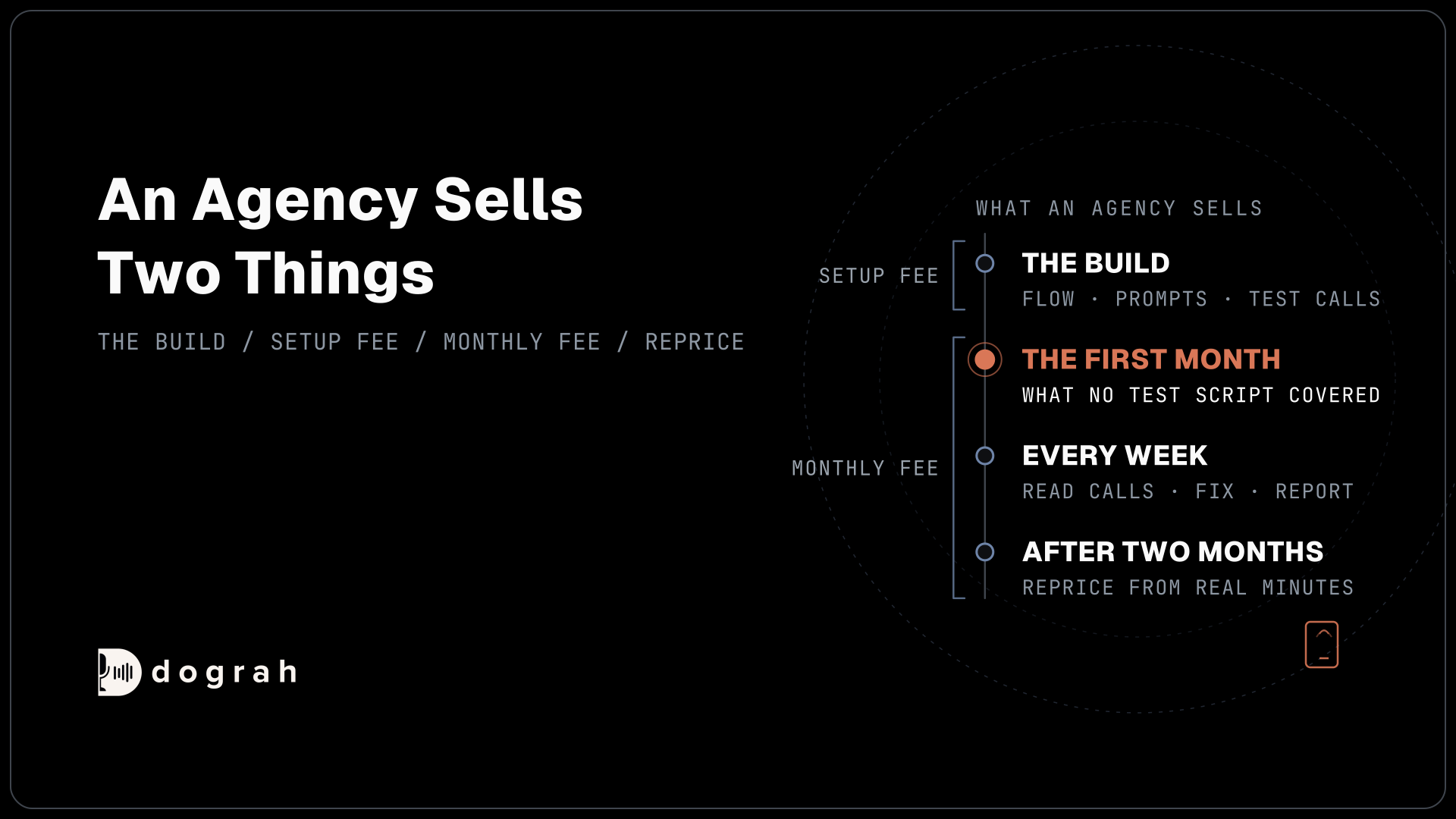
A trunk bills for the line itself. It charges so much a minute, so much a month per number, and sometimes so much per channel, meaning per call that can run at once. Nothing in the bill is tied to a person. That is what an AI voice agent needs, since the agent is software that may take 3 calls at 2 a.m. and 40 at 9 a.m., with no seat behind any of them.
The two can live side by side. A company can keep its business phone system for staff, point a trunk at the agent for the main number, and have the agent hand callers to staff extensions. This guide compares per-minute trunks and the carriers behind them.
What an AI voice agent needs from a trunk
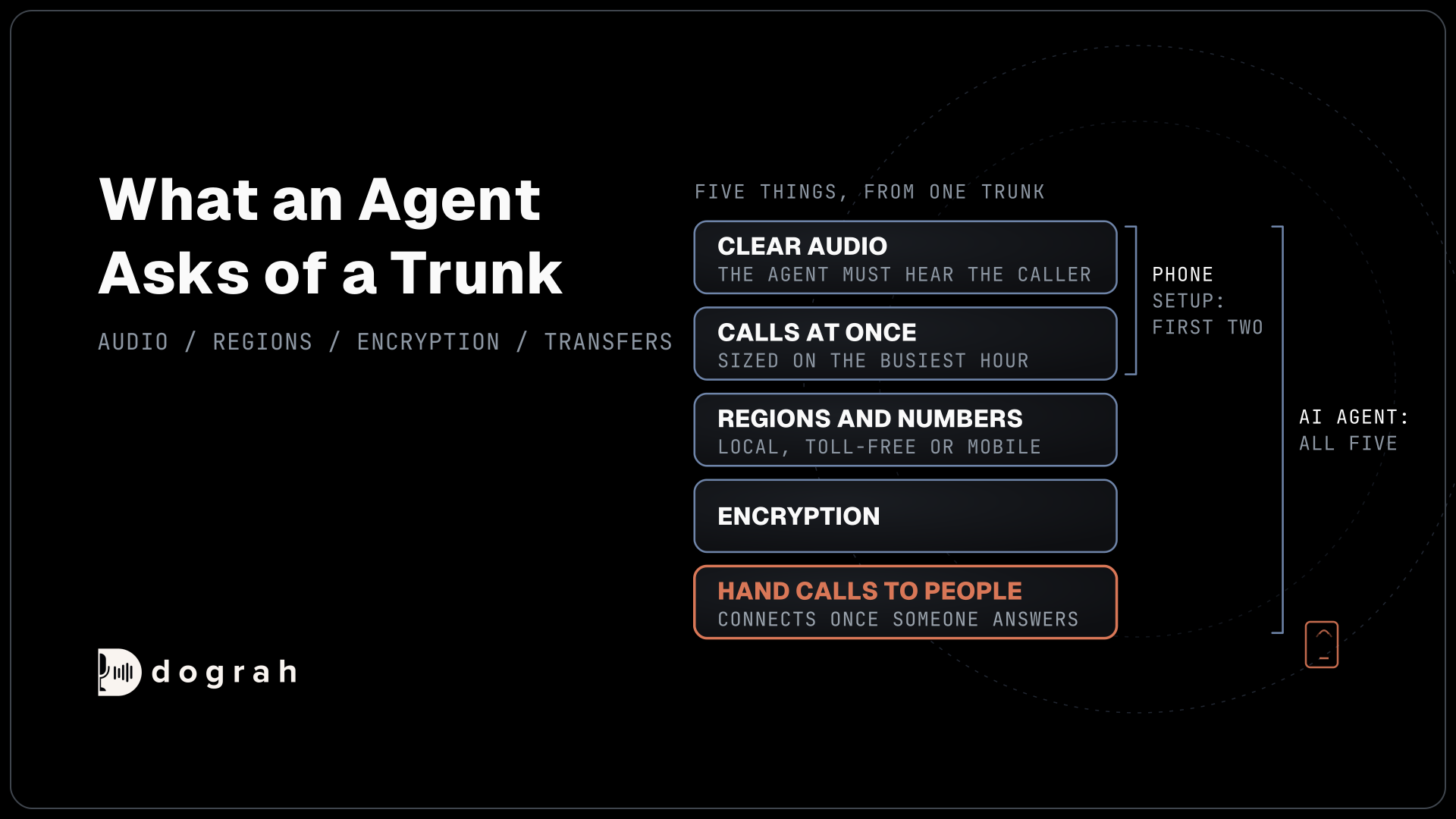
An AI voice agent asks five things of a trunk, which are clear audio, enough calls at once, the right regions and numbers, encryption and a way to hand calls to people. A business phone setup can get by on the first two. An agent that takes real customer calls needs all five.
Audio comes first because the agent has to hear the caller. Most trunks carry G.711, sent as PCMU or PCMA, and Twilio's trunk codec list makes those two generally available while Opus, G.729 and AMR-NB go through its sales team. Most phone calls still reach the agent as 8 kHz audio, while a browser demo runs at 16 kHz, so an agent that sounds sharp in the browser can mishear words on a phone line. How much depends on the speech-to-text model and the phone path, so test on real calls.
Concurrent calls decide how big the trunk must be. Twilio's SIP trunking docs size a trunk at 100 kbps of bandwidth per call at peak, so 20 calls at once need about 2 Mbps. Some carriers sell capacity per channel, others include it. On the platform side, self-hosted Dograh runs 10 calls at once by default, a limit you can raise, and Dograh Cloud pay as you go includes 10.
Regions and numbers come next. The carrier must sell numbers in your callers' countries, of the type they expect, such as local, toll-free or mobile. Encryption is TLS for the call setup and SRTP for the audio, and Twilio, Telnyx and Plivo include it on their trunks at no charge. One exception applies here. Keep Twilio's Secure Trunking off on a trunk that carries Dograh's outbound calls, because that leg is not set up for TLS.
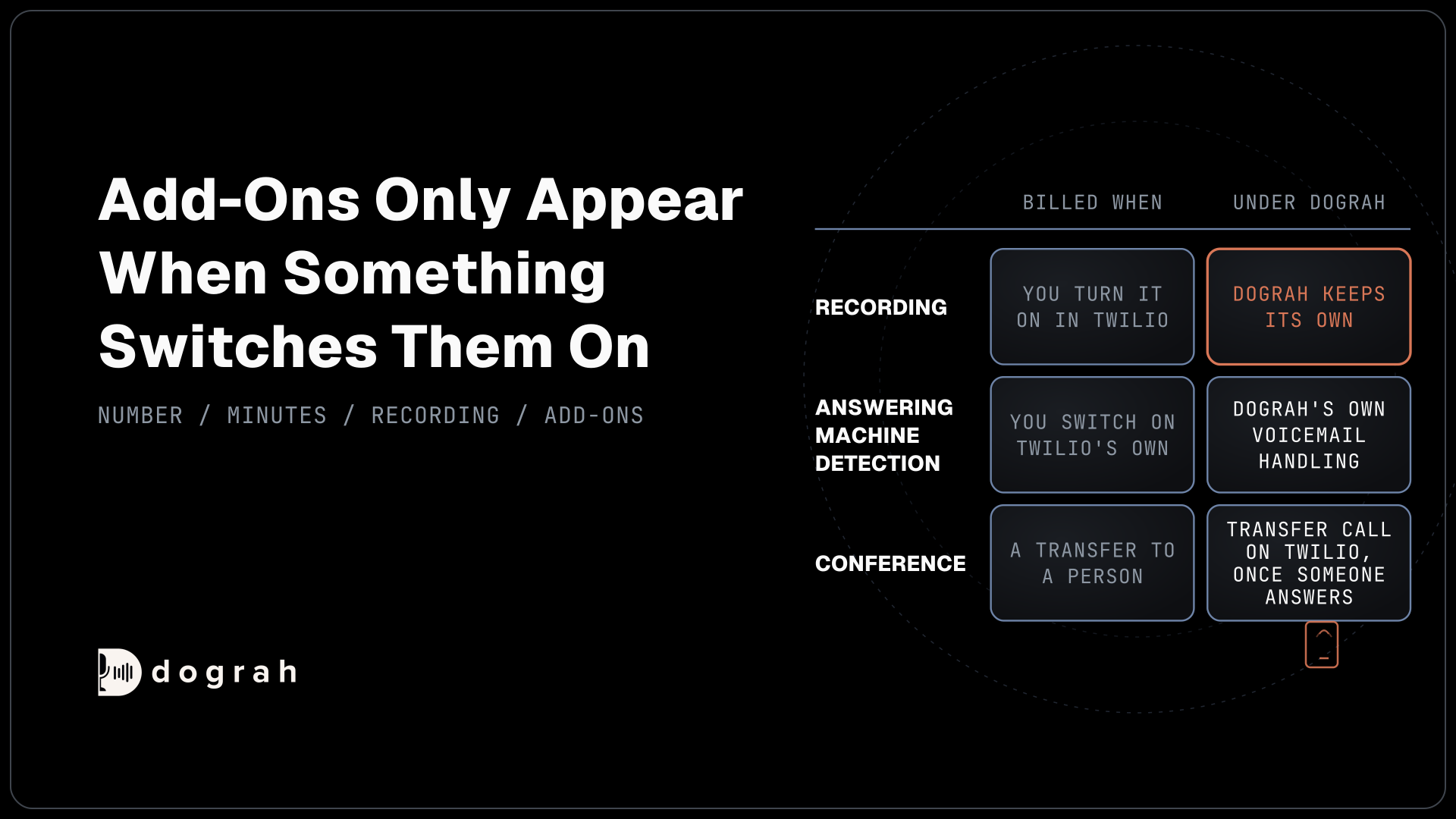
Transfers matter for any agent that hands callers to staff. In Dograh, the Transfer Call tool works on Twilio, Telnyx, Plivo, Cloudonix and Asterisk ARI. It dials the destination while the caller hears hold music and connects them once someone answers. If nobody picks up, the line is busy or the call fails, the agent is told the transfer failed and the call carries on. Every number also needs a registered emergency address, which carriers charge for separately.

Open Source Alternative to Vapi / Retell
Self-hosted voice agent platform — no per-minute fees
dograh-hq/dograh
Star on GitHub
SIP trunk providers compared
The table lists every route a trunk or phone account can take into Dograh. Coverage and number types come from each provider's own pages, and the audio and setup columns from Dograh's code. Where a provider's page could not be read, the cell says to ask.
| Route | Coverage | Number types | Audio into the agent | Setup in Dograh | Transfer Call |
|---|---|---|---|---|---|
| Twilio | Numbers in 100+ countries | 10DLC (local), toll-free, national, short codes | 8 kHz | Account SID and Auth Token, or its Elastic SIP trunk through Managed SIP | Yes |
| Telnyx | Inbound numbers in 130+ countries and territories, own carrier licences in 30+ | Local, national, toll-free, short codes | 8 kHz | API key, Dograh creates the call application | Yes |
| Plivo | Numbers in 50+ countries | Local, mobile, toll-free, short codes | 8 kHz | Direct provider account | Yes |
| Vonage | Ask Vonage for your countries | Ask Vonage | 16 kHz | Direct provider account | No |
| Exotel | India-focused cloud telephony | Ask Exotel | 8 kHz | Direct provider account | No |
| Vobiz | Per-country rates for 225 countries | US local and toll-free listed | 8 kHz | Direct provider account | No |
| Any carrier's SIP trunk | Managed SIP edges in Global, India and UAE regions | Whatever the carrier sells | 8 kHz | Point the trunk at your Managed SIP domain | Yes |
| Your own Asterisk PBX | Wherever the PBX runs | Whatever its trunks carry | 8 kHz | Asterisk ARI, Asterisk 22+ or 20 LTS with chan_websocket | Yes |
Twilio, Telnyx and Plivo cover the most ground for a team starting out. Telnyx lists the widest inbound reach of the three, with numbers in more than 130 countries and territories. Twilio can also reach Dograh through its Elastic SIP trunk instead of a provider account, and our Twilio Elastic SIP Trunking setup guide walks through that trunk click by click.
Vonage is the only phone provider in the table that sends 16 kHz audio, the same rate as a browser call. Exotel and Vobiz suit teams calling in India. Carriers that are not in the table, such as Bandwidth, DIDWW, SIP.US or IDT, reach an agent the same way as any trunk, through Managed SIP or your own Asterisk. For a ranked short list with a verdict on each, see the best SIP trunk providers for AI voice agents.
Three ways a trunk reaches Dograh
Dograh sells no phone numbers and no minutes, so the carrier relationship is always yours. A line reaches your agents in one of three ways, and you can use more than one at the same time.
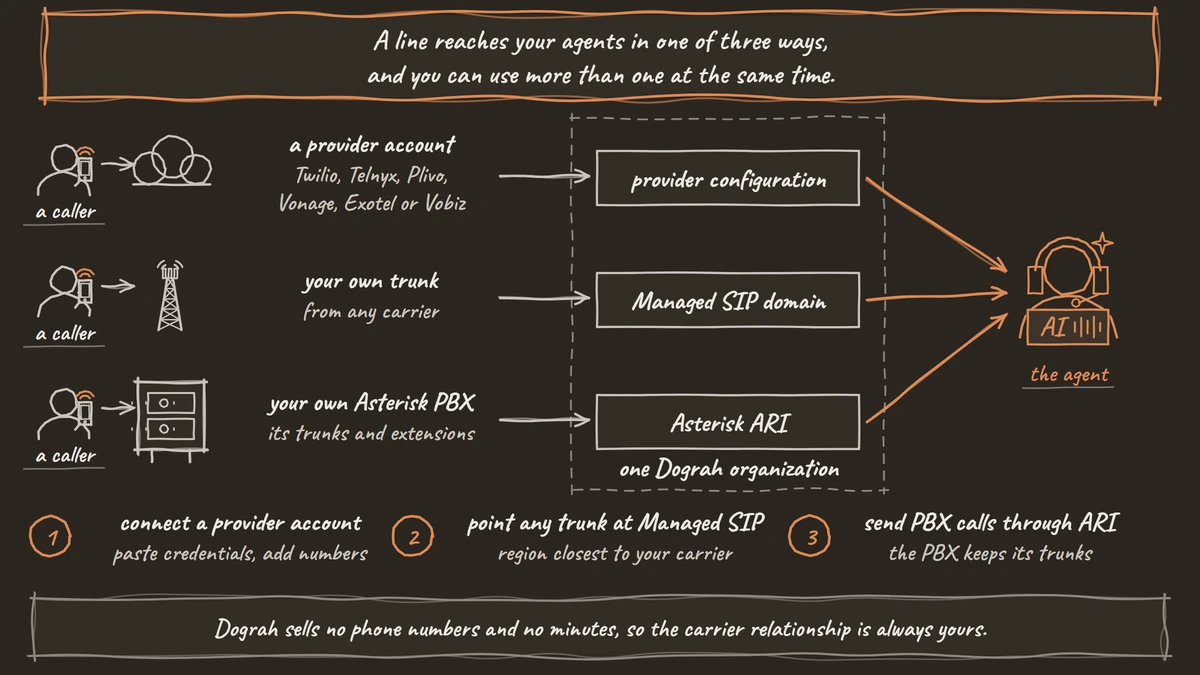
The first is a direct provider account. You open Telephony in the sidebar, add a configuration for Twilio, Telnyx, Plivo, Vonage, Exotel or Vobiz, paste its credentials and add your numbers. The telephony overview lists what each one asks for. This is the quickest path and needs no SIP setup at all.
The second is your own trunk from any carrier. Every organization gets a configuration called Dograh Cloudonix SIP, a Managed SIP domain already connected to your agents, with no Cloudonix account and nothing to pay on the Cloudonix side. You pick the region closest to your carrier, point your numbers at the inbound hostname, allow Dograh's outbound IP address on your trunk and add each number with a default caller ID. Our Cloudonix review covers the layer underneath.
The third is your own Asterisk PBX. Asterisk ARI connects an existing Asterisk server to Dograh, so the PBX keeps its trunks and extensions and sends chosen calls to an agent through a Stasis application in its dialplan. It needs Asterisk 22 or later, or Asterisk 20 LTS with the chan_websocket and res_websocket_client modules.
One organization can hold several of these configurations at once. Buyers tend to miss this part. The agent, its prompts, call traces and QA stay the same when the carrier changes, so a better rate or a new region only means changing a phone setting.
What a SIP trunk costs
A SIP trunk bills per minute in each direction and per month for each number, and the US rates are small. Twilio charges $0.0034 a minute for inbound calls to a local number and $0.0100 a minute for outbound calls to the 48 states, as our post on Twilio SIP trunking pricing lays out. Telnyx's SIP trunking prices start from $0.0032 inbound and $0.005 outbound.
Plivo's US SIP trunking prices are $0.0028 a minute inbound, from $0.0046 outbound and $0.50 a month for a local number. Some carriers also sell capacity per channel instead of per minute. Telnyx, for example, offers inbound channels at $12 a month each for the first 10, which only pays off on a line that stays busy most of the day.
The rate is one line of several. Emergency addresses cost a monthly fee per number, and US carriers add a regulatory recovery line because they pay into the Universal Service Fund. Our post on SIP trunk pricing works through a full month of AI calls on three carriers, and low-cost SIP trunk providers lists what to check before you move for a lower rate.
The trunk is also only one of three bills. The models are the second, and the platform is the third. Self-hosted Dograh has no per-minute platform fee, but servers, model keys and phone minutes still cost money. Dograh Cloud charges a 1¢-a-minute platform fee. Free trunk offers exist too, and free SIP trunks sorts out which are trial credit and which are a free trunk with paid minutes.
Join the Dograh Community
Dograh is an OSS alternative to Vapi. Join our Slack community for queries, releases, best practices & community interactions.
Agencies with many clients
An agency running agents for many clients needs each client's numbers and minutes kept apart. Carriers handle this with subaccounts. Twilio and Plivo both let you create a subaccount per client, with its own numbers and usage, while every charge lands on the agency's main bill. Telnyx offers managed accounts with their own balance and invoices, but only on its commit plans, not pay as you go.
The agent side has to match. On Dograh Cloud, each client sits in its own team, switched from the sidebar, with its own agents, numbers and billing. Self-hosted, each client gets its own agent and its own phone setup, and one organization can hold a separate telephony configuration or outbound trunk for each.
Our post on wholesale and reseller SIP trunks for voice AI agencies covers buying minutes in bulk and billing each client for its share.
Moving off a PRI line
A PRI line is the older digital phone circuit many offices still run, and an AI agent cannot take a call from it directly. A US PRI runs on a T1 circuit with 23 voice channels, so it holds at most 23 calls at once, and it speaks a circuit-switched protocol, not SIP. To reach an agent, the call first passes through a gateway that converts it to SIP, or through a PBX with a T1 card.
If that PBX runs Asterisk, the path is short. Asterisk takes the PRI, and Dograh takes the call from Asterisk through ARI, while the agent can still transfer callers back to staff extensions. Moving the numbers to a SIP trunk removes the gateway step and the fixed 23-call ceiling.
Our post on SIP trunk vs PRI explains when the move is worth it and when a PRI still fits.
How to pick a provider
Start from where your calls already are, and come to the rate later. For a first agent with no carrier, open a Twilio, Telnyx or Plivo account and connect it directly, since there is no SIP to configure. If your business numbers already sit on a carrier's trunk, keep that carrier and point the trunk at Managed SIP, so your numbers and your bill stay where they are. Our page on bringing your own SIP trunk to a voice agent shows that setup in order, from the regional hostname to the agent each number reaches.
If an Asterisk PBX runs your office, connect it through ARI and send only the calls you want the agent to take. If callers are in India, look at Exotel, Vobiz or a carrier through the India region of Managed SIP. If the agent must hand callers to staff, choose a route with Transfer Call. Those routes are Twilio, Telnyx, Plivo, any trunk through Cloudonix and Asterisk.
Then place real calls before launch. Call from a mobile and a landline, transfer at least one call to a colleague and listen to the agent on the handset, not only in the browser.
Each part of choosing a SIP trunk above has its own deep dive.
- SIP Trunk Pricing in 2026: What a Line Really Costs
- Best SIP Trunk Providers for AI Voice Agents
- Free SIP Trunks: What Is Real and What Is a Trial
- Low-Cost SIP Trunk Providers: What to Check Before You Switch
- Wholesale and Reseller SIP Trunks for Voice AI Agencies
- SIP Trunk vs PRI: Which One Works With AI Voice Agents
Glossary
- Origination
- Carrier words for the two directions of a call. Origination is an inbound call that starts on the phone network and reaches your system, and termination is an outbound call your system sends to a phone. Many trunks price them differently.
- G.711
- The standard phone codec, sent as PCMU in North America and Japan and PCMA elsewhere. It carries 8 kHz audio, and Twilio makes these two codecs generally available on its trunks.
- Concurrent calls
- The number of calls running at the same moment. A trunk is sized on the busiest hour, about 100 kbps of bandwidth per call by Twilio's rule, and self-hosted Dograh runs 10 at once by default, a limit you can raise.
- Managed SIP
- The SIP domain every Dograh organization gets, named Dograh Cloudonix SIP in the app. You point any carrier's trunk at it, in the Global, India or UAE region, and there is nothing to pay on the Cloudonix side.