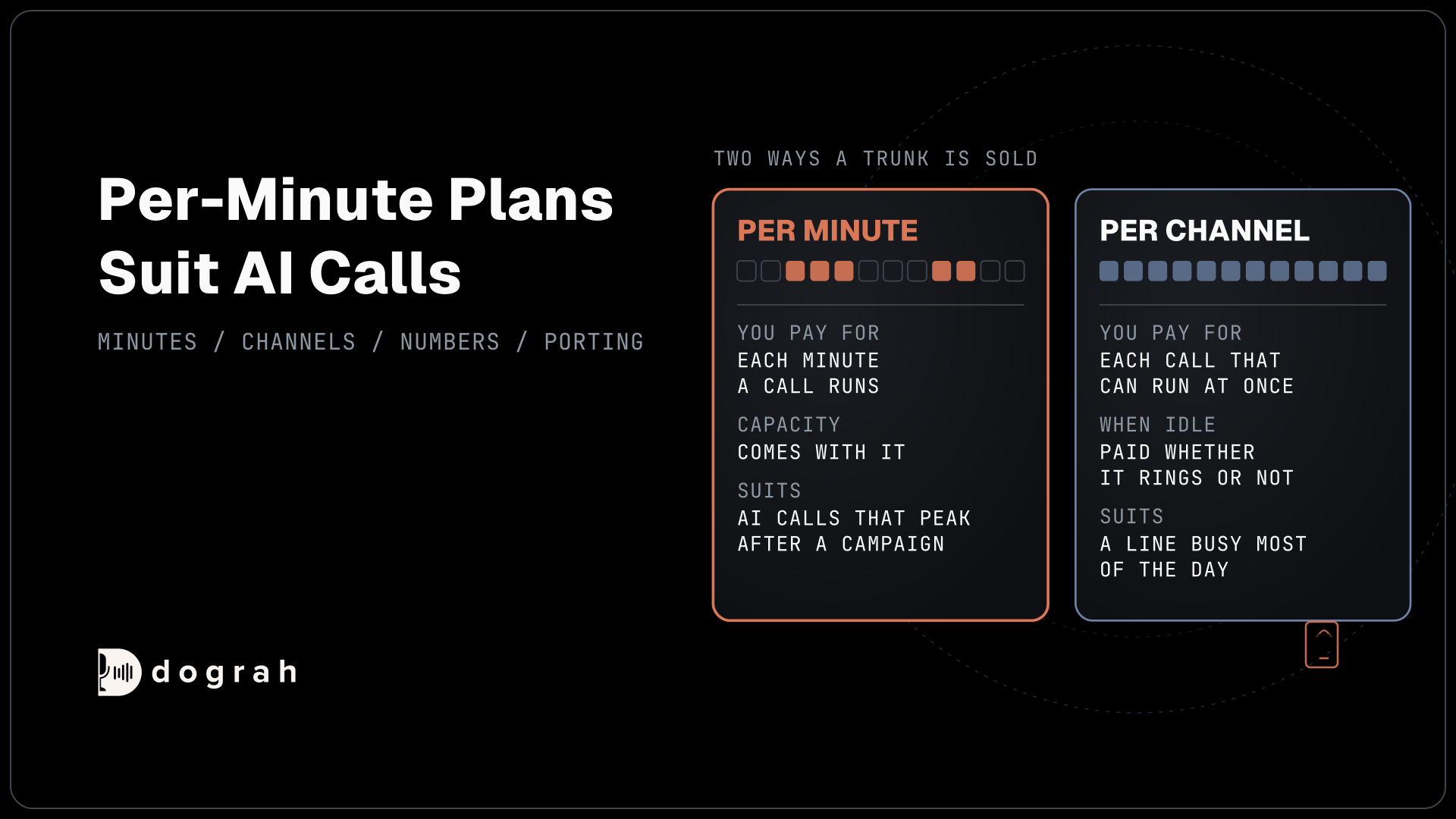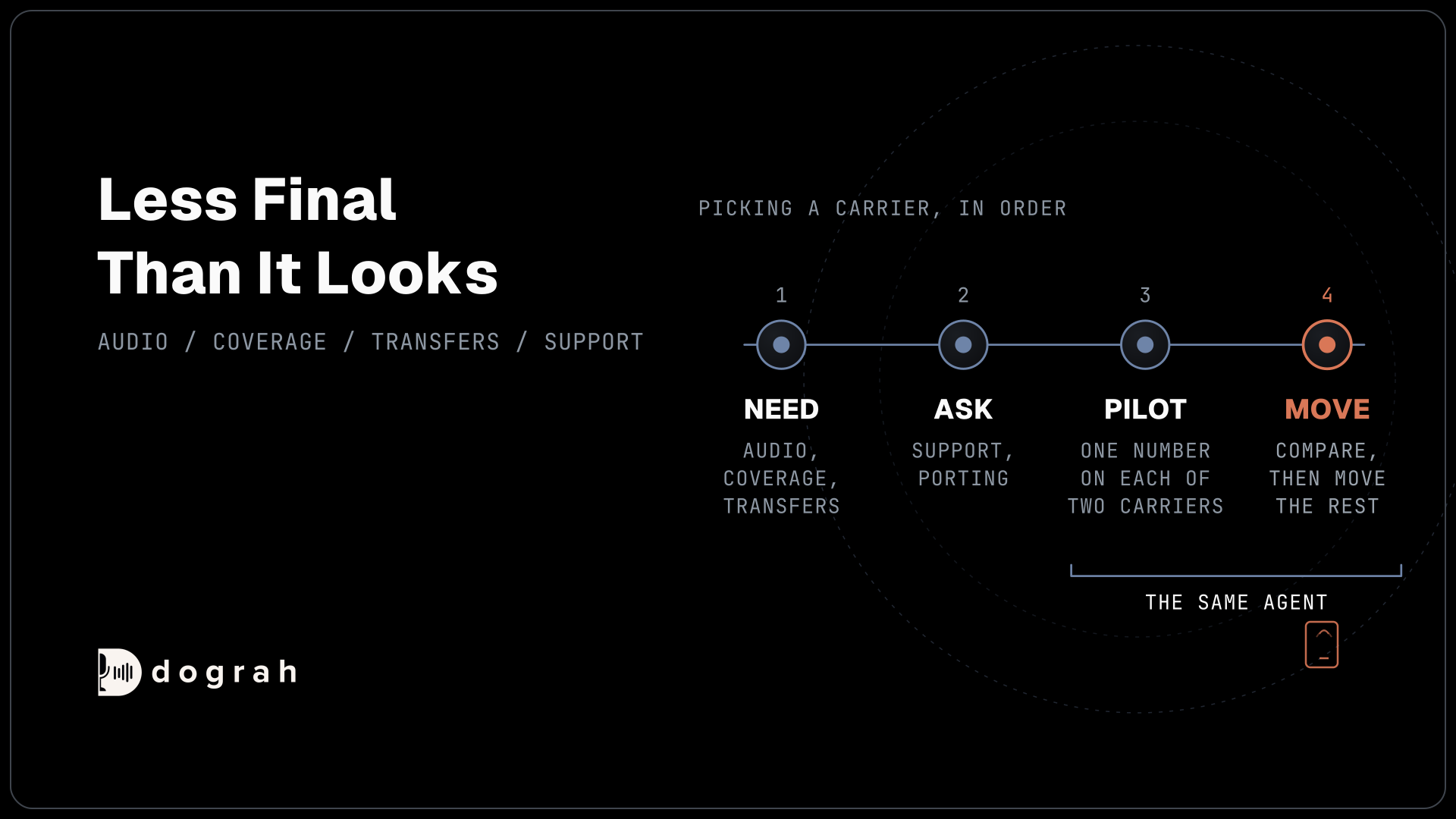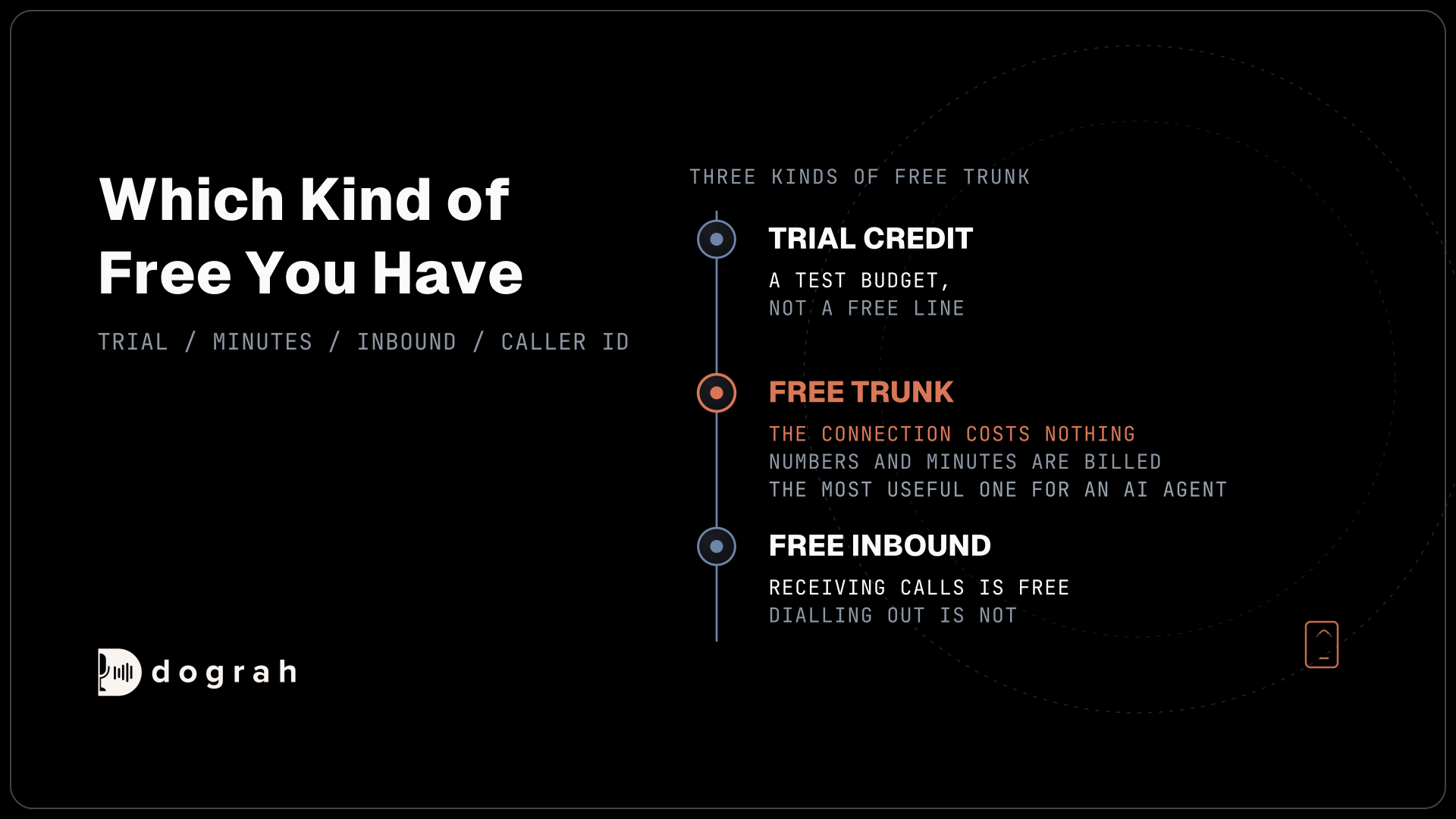

Twilio's Elastic SIP Trunking charges $0.0034 a minute for inbound calls to a US local number and $0.0100 a minute for outbound calls to the 48 states, with unlimited concurrent calls and no Media Streams fee. Dograh, the open-source AI voice agent platform we build, accepts SIP trunks. You can self-host it or run it on Dograh Cloud.
Key Takeaways
- A trunk cuts 1,000 five-minute inbound calls from $64.50 to $17.00.
- Twilio includes unlimited concurrent calls on the trunk, with no channel fee.
- Programmable Voice stays the quicker start for a first agent.
This post is part of our guide to Twilio pricing, where one 5-minute AI call is priced line by line and a trunk changes the maths most. Here we cover the trunk's rates and extras, 1,000 calls both ways, when to switch, and connecting it to Dograh.
Twilio's Elastic SIP Trunking rates
A SIP trunk prices calls by direction and destination, and both rates sit below Programmable Voice. The table shows Twilio Elastic SIP Trunking rates in the US.
| Line | Rate |
|---|---|
| Origination (inbound), local number | $0.0034 a minute |
| Origination (inbound), toll-free number | $0.0130 a minute |
| Termination (outbound), 48 states and Hawaii | $0.0100 a minute |
| Termination (outbound), Alaska | $0.0862 a minute |
| Termination (outbound), high-cost areas | $0.0620 a minute |
| Termination (outbound), toll-free destinations | from $0.0011 a minute |
| Local number | $1.15 a month |
| Toll-free number | $2.15 a month |
Twilio calls inbound "origination" and outbound "termination", from the phone network's point of view. The number fees match Programmable Voice, so the saving is all in the minutes.
What the trunk includes and what it adds
Several things that other carriers charge for come with the trunk. Twilio lists unlimited concurrent calls, so there is no per-channel fee to size, and an AI campaign can run as many calls at once as your platform handles. Secure trunking with SRTP and TLS is included, and so is calls-per-second capacity on pay-as-you-go.
The extras are few. Emergency calling costs $0.75 a month per number, and Twilio charges $75 for any 911 call placed from a number with no registered emergency address, so register addresses before you turn it on. Recording on the trunk costs $0.0025 a minute plus $0.0005 a minute per month in storage, and new trunks start set to "Do Not Record". SIP Insights, Twilio's advanced call-quality reporting, is $0.0024 a minute if you want it.
Setup is where the trunk asks for more. Twilio's SIP trunking docs require at least an IP access control list or a credential list before a trunk can send calls out, and recommend credentials. Inbound calls go to an origination address that points at your SIP endpoint.
Trunk vs Programmable Voice on 1,000 AI calls
Here is a worked example on 1,000 five-minute calls, which is 5,000 minutes on one local number. The Programmable Voice column uses Twilio's US voice rates, including Media Streams at $0.0044 a minute, which an agent needs on that route to receive the audio.
| Calls | Programmable Voice with Media Streams | Elastic SIP trunk |
|---|---|---|
| 1,000 inbound | 5,000 x ($0.0085 + $0.0044) = $64.50 | 5,000 x $0.0034 = $17.00 |
| 1,000 outbound | 5,000 x ($0.0140 + $0.0044) = $92.00 | 5,000 x $0.0100 = $50.00 |
| Local number | $1.15 a month | $1.15 a month |
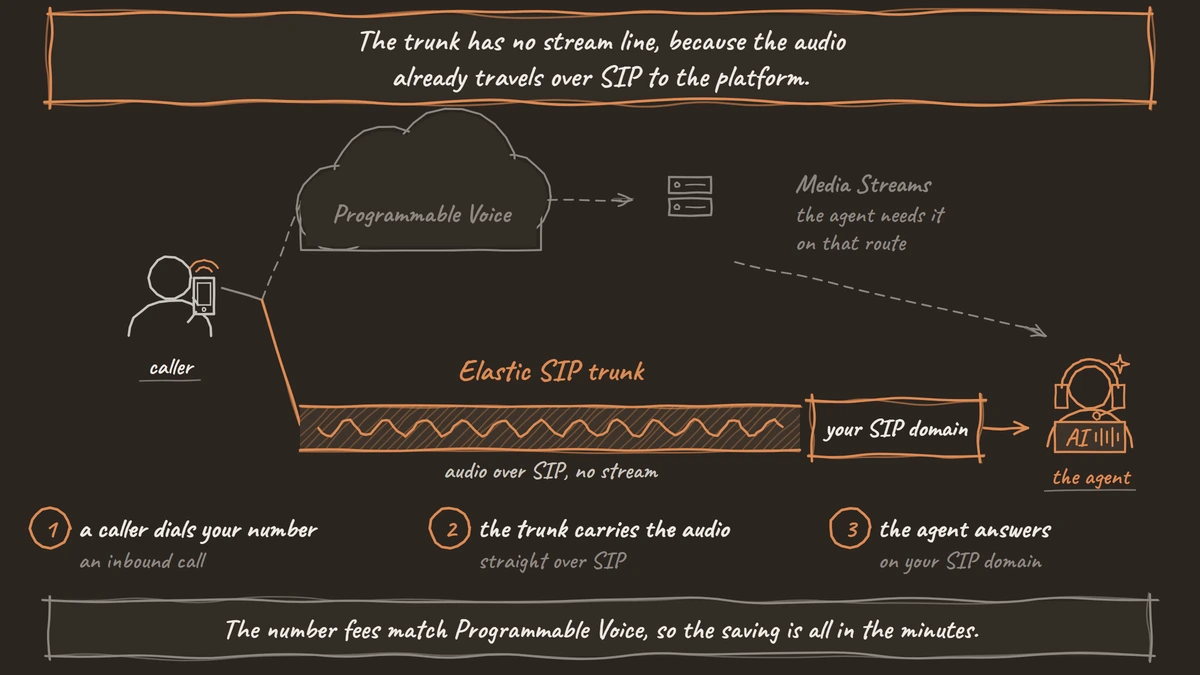
The trunk has no stream line, because the audio already travels over SIP to the platform. On inbound calls that takes the Twilio minutes down by about three quarters, and on outbound by a little under half. At 1,000 calls the gap is $47.50 or $42.00 a month, and it grows in step with volume.

Open Source Alternative to Vapi / Retell
Self-hosted voice agent platform — no per-minute fees
dograh-hq/dograh
Star on GitHub
When the trunk is worth the setup
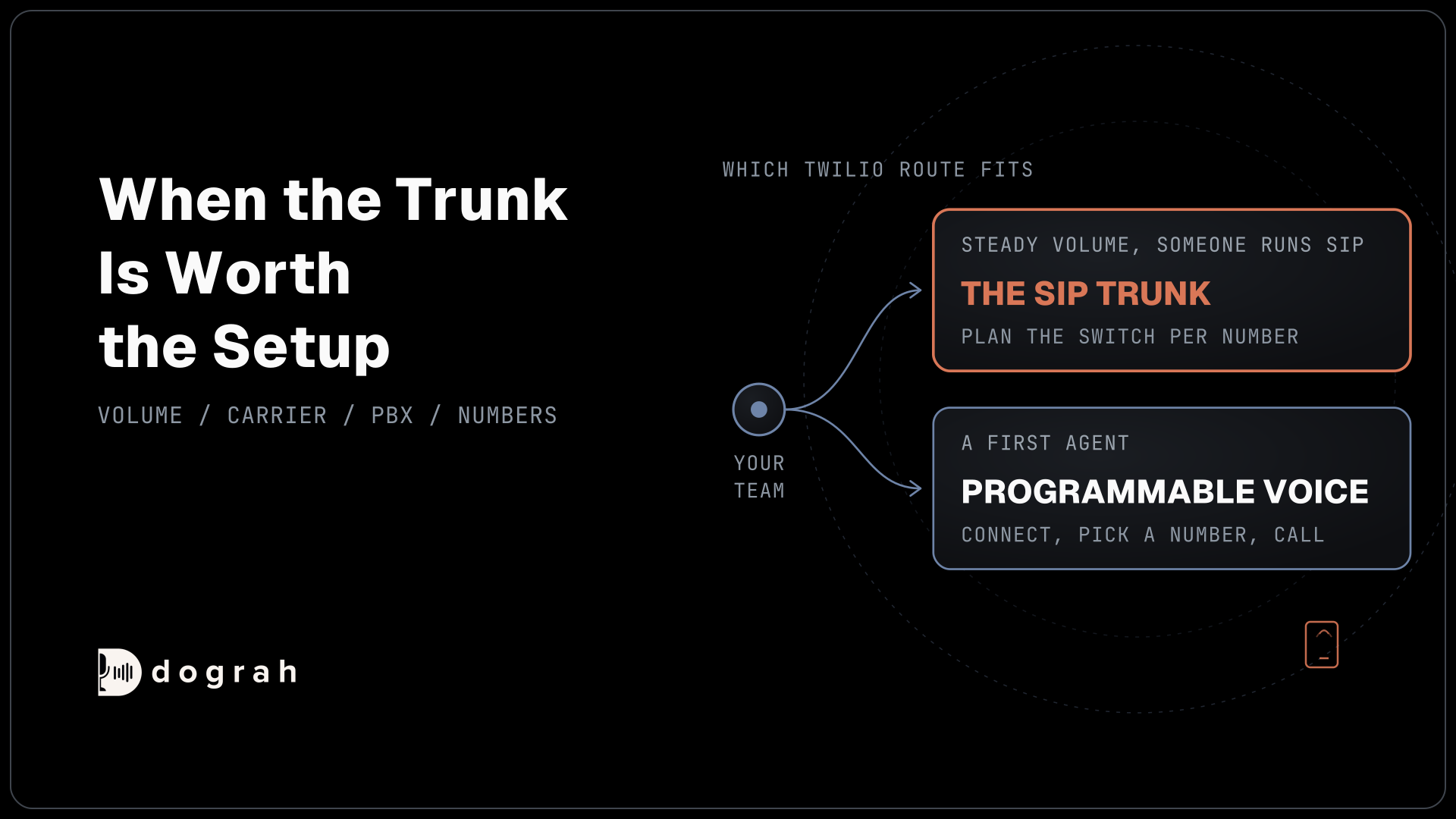
The trunk pays off when volume is steady and someone on the team can run SIP. In our experience, SIP trunking is the most reliable choice for production calling, and it fits teams that already have a carrier, a PBX or numbers sitting on a trunk. At a few hundred calls a month the saving is small and the setup time is not.
Programmable Voice is the better start for a first agent. You connect an account, pick a number and call, with nothing to configure on the SIP side. It also has one feature a trunk doesn't: Twilio's spoken transfer introduction, a short line both people hear before a transfer connects.
Moving a number onto a trunk changes how it routes. While a number sits on a trunk, Twilio ignores its voice URL, so it can't answer through Programmable Voice at the same time. Plan the switch per number, not per account. For the wider choice between a provider account and your own trunk, see Telephony 101 for voice AI.
Connecting a Twilio trunk to Dograh
On Dograh Cloud, the trunk points at Managed SIP, a SIP domain your organisation gets that is already connected to your agents. There is nothing extra to sign up for, and you bring the trunk and the numbers while Twilio bills you for the minutes. For inbound calls, set the trunk's origination address to that domain.
Outbound calls from Dograh reach your trunk unauthenticated and are identified by their source address. That fits Twilio's rule well: put Dograh's origin IP in an IP access control list on the trunk, and every outbound call needs a caller ID from your own numbers. Transfer Call works on this route, joining the caller and the person through a conference once someone answers.
On a self-hosted install, the same trunk can reach your own Asterisk server, connected to your agents through Asterisk ARI. Self-hosted Dograh has no per-minute platform fee, but servers, model keys and phone minutes still cost money. Dograh Cloud charges a 1¢-a-minute platform fee. The fee is the same on a trunk as on Programmable Voice.
Join the Dograh Community
Dograh is an OSS alternative to Vapi. Join our Slack community for queries, releases, best practices & community interactions.
Glossary
- Origination
- SIP trunking's word for an inbound call, one that starts on the phone network and arrives at your system. Twilio charges $0.0034 a minute for it on a US local number.
- Termination
- SIP trunking's word for an outbound call, one your system sends out to a phone. Twilio charges $0.0100 a minute for calls to the 48 states, with higher zones for Alaska and high-cost areas.
- IP access control list
- A list of addresses a Twilio trunk accepts outbound calls from. Twilio needs this or a credential list before a trunk can send calls, and a platform that sends unauthenticated calls, such as Dograh, is allowed by its address.
- Media Streams
- Twilio's fee of $0.0044 a minute for sending a Programmable Voice call's audio to an agent. A SIP trunk carries the audio directly, so trunk calls have no stream line.