
SIP trunks are priced per minute in each direction plus a monthly fee per number, or per channel. US inbound runs about a third of a cent a minute, outbound half a cent to a cent. Dograh, the open-source AI voice agent platform we build, connects to any trunk, self-hosted or on Dograh Cloud.
Key Takeaways
- Per-minute plans suit AI calls. Channels pay off only on all-day busy lines.
- Emergency addresses, number rental and regulatory recovery sit under the rate.
- The trunk is one bill of three, beside the models and the platform.
This post is part of our guide to SIP trunk providers, where cost is one bill of three beside the models and the platform. Below, we compare per-minute and per-channel plans, the fees under the rate and one worked month of AI calls on three carriers.
Per-minute or per-channel plans
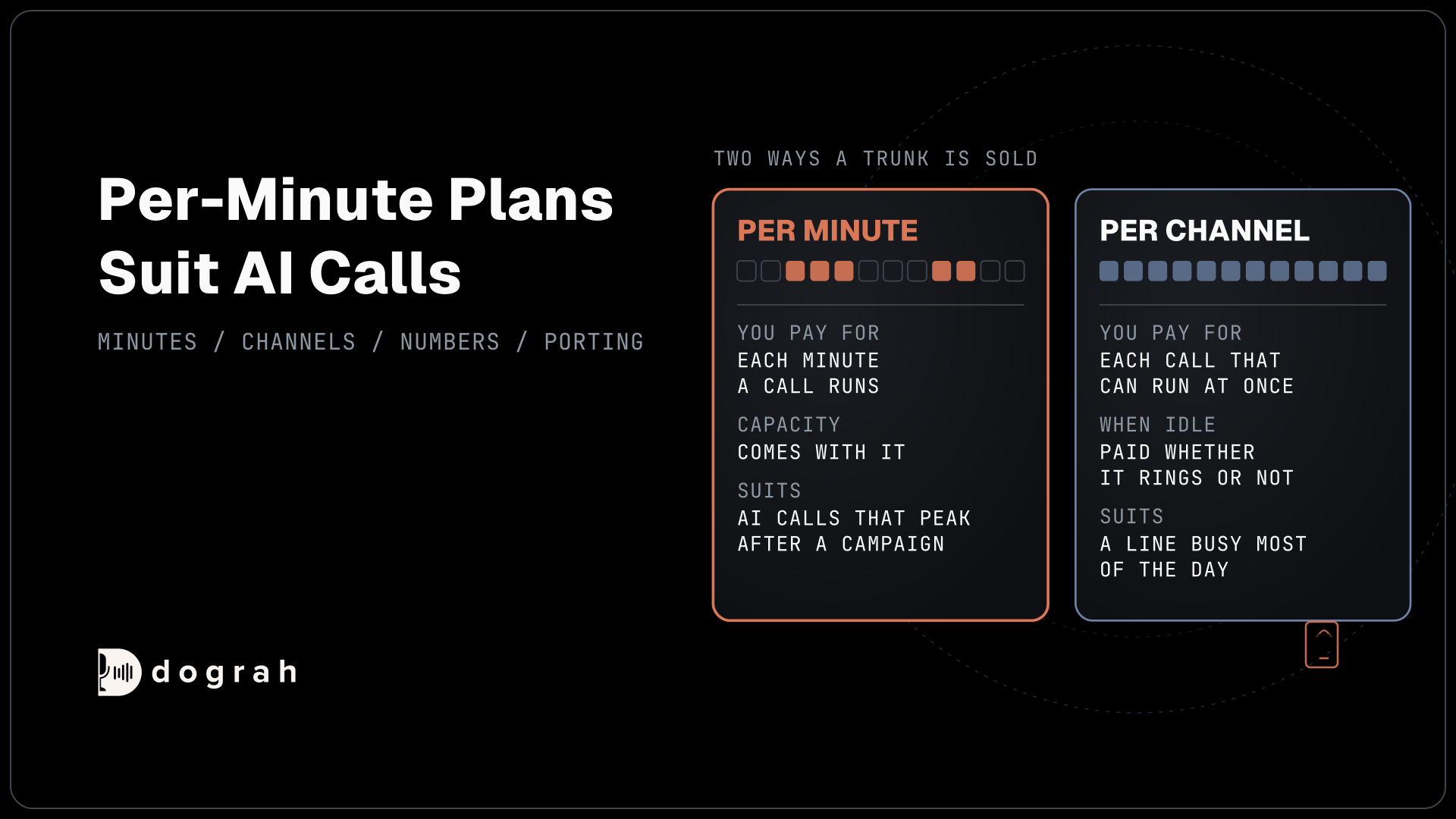
Trunks are sold in two ways, and AI calls fit the per-minute one best. On a per-minute plan you pay for each minute a call runs, in each direction, plus a monthly fee for each number. Capacity comes with it. Twilio's Elastic SIP Trunking lists unlimited call concurrency as included, so an outbound campaign can run as many calls at once as your platform allows.
On a per-channel plan you pay a monthly fee for each call that can run at the same time, whether it rings or not. Telnyx's SIP trunking prices show both options. Its inbound channels cost $12 a month each for the first 10, $11 for the next 40, $9 for the next 200 and $8 beyond that.
A small sum shows where the line falls. Five Telnyx inbound channels cost $60 a month. The same month's 8,000 inbound minutes in the example below cost $25.60 at its per-minute rate. Channels only win when the line stays busy for most of the working day, which suits a contact centre with steady queues more than an AI agent that peaks after a campaign email.
US rates from three carriers
All three carriers publish their US trunk rates, and the gap between them is a fraction of a cent. The table lists the lines an AI agent uses most.
| Line | Twilio Elastic SIP | Telnyx Elastic SIP | Plivo SIP trunking |
|---|---|---|---|
| Inbound, local number | $0.0034 a minute | from $0.0032 a minute | $0.0028 a minute |
| Inbound, toll-free number | $0.0130 a minute | from $0.015 a minute | $0.0120 a minute |
| Outbound, local | $0.0100 a minute | from $0.005 a minute | from $0.0046 a minute |
| Local number | $1.15 a month | $1.00 a month | $0.50 a month |
| Emergency address | $0.75 a month per number | $1.50 a month per number | Ask Plivo |
| Capacity | Unlimited concurrency included | Per minute, or channels from $12 | Per minute |
Telnyx prices are "from" rates that change by destination, and its numbers sit in a separate Numbers product. Plivo's US SIP trunking prices are the only ones of the three that print a billing increment. Plivo's is 6/6, meaning a call is billed in 6-second steps after a 6-second minimum. For Twilio's full trunk table, including Alaska and high-cost zones, see our post on Twilio SIP trunking pricing.
The fees under the rate
The per-minute rate is the biggest line, but four others sit under it. Number rental is the plainest, a monthly fee per number that stays the same whether the number takes one call or a thousand.
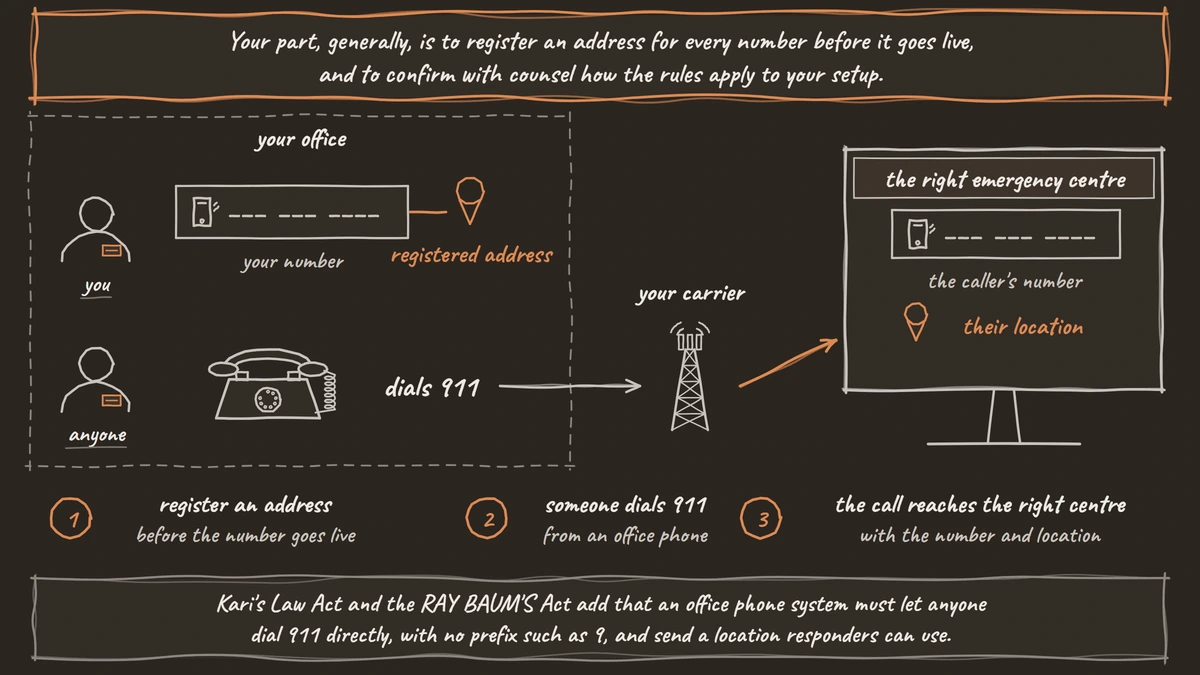
Emergency calling is the second, and it comes from law. Under the Federal Communications Commission's (FCC) 911 rules, an internet phone provider must send every 911 call to the right emergency centre with the caller's number and location, and must tell customers plainly when 911 may not work. Kari's Law Act of 2017 and the RAY BAUM'S Act of 2018 add that an office phone system must let anyone dial 911 directly, with no prefix such as 9, and send a location responders can use. Carriers pass the cost on as a fee per number with an address, and Twilio charges $75 for a 911 call from a number with no registered address. Your part, generally, is to register an address for every number before it goes live, and to confirm with counsel how the rules apply to your setup.
Porting is the third. Under the FCC's number porting rules, a simple port must be finished within one business day unless you or the new carrier ask for longer. None of the three carriers prints a porting fee beside its trunk rates, so ask for any charge in writing before you move.
Regulatory recovery is the fourth. US carriers pay into the Universal Service Fund on their interstate and international revenue, and many pass part of it to customers as a separate line. USAC's contribution factor is reset by the FCC every quarter, and it reached 42% in late 2026. That percentage applies to the carrier's revenue, not to your bill, so the line you see varies by carrier. State and local taxes come on top.

Open Source Alternative to Vapi / Retell
Self-hosted voice agent platform — no per-minute fees
dograh-hq/dograh
Star on GitHub
One month of AI calls, an example
Here is one worked month, built only from the rates in the table. An AI agent takes 2,000 inbound calls and makes 1,000 outbound calls, each lasting 4 minutes. That is 8,000 inbound minutes and 4,000 outbound minutes, on one local number with an emergency address.
On Twilio, 8,000 inbound minutes at $0.0034 come to $27.20 and 4,000 outbound minutes at $0.0100 to $40.00. The number adds $1.15 and the emergency address $0.75, for $69.10. On Telnyx, the same minutes come to $25.60 and $20.00, the number $1.00 and emergency calling $1.50, for $48.10, using its "from" rates.
On Plivo, the minutes come to $22.40 and $18.40 and the number $0.50, for $41.30, plus an emergency address fee you would ask Plivo for. All three totals are before taxes and regulatory recovery, and before the 6-second rounding on Plivo.
The gap between the three is about $28 on 12,000 minutes. That grows with volume and is worth comparing, but check call quality and support before you move for the rate alone.
The platform and model lines
A trunk carries the call, and two more bills sit on every AI minute. The platform runs the agent, and the models hear, think and speak. Self-hosted Dograh has no per-minute platform fee, but servers, model keys and phone minutes still cost money. Dograh Cloud charges a 1¢-a-minute platform fee. On Cloud, the 12,000 minutes in the example add $120.00.
The model line depends on what you pick. With your own keys, your speech-to-text, language model and voice providers bill you at their own rates, or open-weight models on your own servers turn that line into a GPU bill. Our breakdown of what an AI voice agent costs per minute prices each part.
The voice line is the easiest to cut. Recorded clips play for the lines your agent says most, with a cloned voice for the rest, as our guide to mixing pre-recorded audio with TTS shows.
Join the Dograh Community
Dograh is an OSS alternative to Vapi. Join our Slack community for queries, releases, best practices & community interactions.
Glossary
- Per-channel plan
- A monthly fee for each call that can run at the same time, paid whether the line is busy or not. Telnyx sells inbound channels from $12 a month each, and it beats per-minute pricing only on a line that stays busy most of the day.
- Billing increment
- The step a carrier rounds each call up to. Plivo prints 6/6 for the US and Canada, a 6-second minimum and then 6-second steps, so short calls cost a little more than their exact length.
- Emergency address
- The registered location a carrier sends with a 911 call from a number. Twilio charges $0.75 a month per number for it and $75 for a 911 call from a number without one.
- Contribution factor
- The percentage of a US carrier's interstate and international revenue it pays into the Universal Service Fund, reset by the FCC every quarter. Carriers often recover it from customers as a separate regulatory line.