
At Twilio's US rates, a 5-minute AI voice call to a local number costs $0.0645 and a 5-minute outbound call costs $0.0920. Each total is the minute rate plus Media Streams at $0.0044 a minute, the fee for sending live audio to your agent. The $1.15 monthly number, recording and AI models are separate lines.
Key Takeaways
- Agent platforms on Twilio pay Media Streams, $0.0044 a minute, on top of minutes.
- ConversationRelay costs $0.07 a minute but also runs Twilio's speech-to-text and voice.
- An Elastic SIP trunk removes the stream fee and lowers the minute rate.
This guide prices each Twilio line under an AI agent, from the number and minutes to the stream and add-ons, then one whole call. We show how each part works in Dograh, the open-source AI voice agent platform we build. You can self-host it or run it on Dograh Cloud.
The phone number: local or toll-free
Every Twilio bill starts with a number, and in the US you choose between two types. Twilio charges $1.15 a month for a local number and $2.15 a month for a toll-free number. It sells no mobile numbers in the US. Twilio also charges $0.75 a month per number for emergency calling, if you turn it on.
The number is a fixed cost, so it shrinks as calls grow. At 1,000 calls a month, a local number adds about a tenth of a cent to each call. At 50 calls, it adds 2.3 cents each, more than half of what a 5-minute inbound call costs in minutes.
The type matters more for minutes than for the monthly fee. Callers reach a toll-free number for free, but Twilio charges you more per inbound minute on it, as the next section shows. For outbound AI calls, a local number is enough, because outbound minutes cost the same from either type.
In Dograh, several numbers can point at the same agent, and each one's Inbound workflow setting decides which agent answers. Dograh doesn't sell numbers, so they stay on your own Twilio account and bill. Our post on Twilio phone number pricing compares the types, mobile numbers outside the US included.
Inbound and outbound minutes
Minutes are the line that grows with every call, and Twilio prices them by direction. Receiving a call on a local number costs $0.0085 a minute, and on a toll-free number $0.0220 a minute. Making a call to US and Canada numbers costs $0.0140 a minute, Hawaii included. Alaska is the outlier at $0.0945 a minute.
Twilio rounds each call up to the next full minute. A 4 minute 10 second call bills as 5 minutes, and Twilio's note on billed minutes tells you to round call-log durations the same way to match your usage. Calls that fail or come back busy are not billed.
Each call leg is billed on its own. A plain inbound call to your agent is one leg. When the agent hands the caller to a person, Twilio dials that person as a new outbound leg at $0.0140 a minute, so a transfer adds a second minute line for as long as the two people talk.
For short calls, rounding is the bigger effect. A 40-second confirmation call still bills a full minute, so a campaign of very short calls costs more per spoken second than the rate suggests. The full rules, with one inbound and one outbound call priced side by side, are in our post on Twilio voice pricing per minute.
Media Streams vs ConversationRelay
An AI agent needs the caller's audio, and Twilio sells two ways to get it. The choice decides who runs speech-to-text and the voice, and it changes the per-minute price by a factor of about 16.
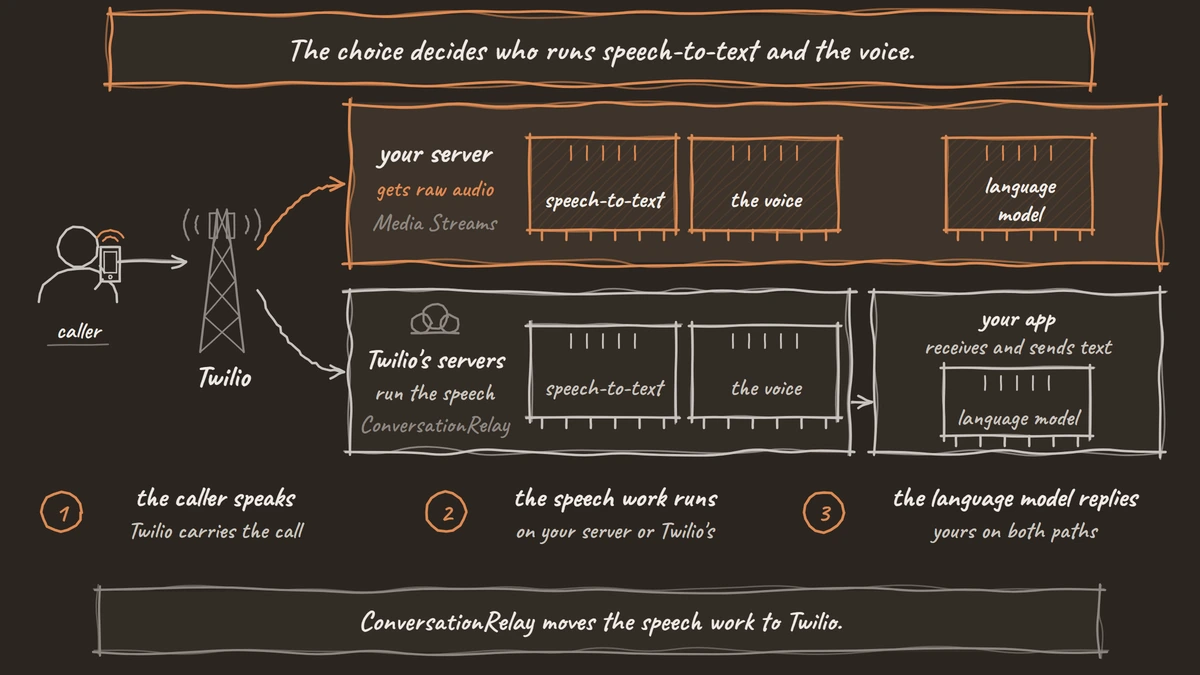
Media Streams sends the raw call audio to your server over a WebSocket and plays back the audio your server sends. Twilio charges $0.0044 a minute for it. Everything else happens on your side: your platform turns speech into text, asks the language model, and turns the reply into a voice.
ConversationRelay moves the speech work to Twilio. Twilio runs speech-to-text and text-to-speech with the providers it supports, such as Deepgram for speech recognition and ElevenLabs or Amazon Polly for the voice, and your app only receives and sends text. You still bring the language model. It costs $0.07 a minute.
Over a 5-minute call, that is $0.022 for the stream against $0.35 for ConversationRelay. The $0.35 also replaces your own speech-to-text and voice bills, so weigh it against those two lines plus the stream. What you give up is the choice of provider and model for those two layers, and the ability to run them on your own servers. Our post on Twilio ConversationRelay covers every setting it gives you and what your own app still has to build.
Dograh's Twilio connection uses Media Streams on every call, with a two-way stream that sends and receives 8 kHz phone audio. ConversationRelay never comes into it, so the Twilio line is minutes plus the stream. The speech, language and voice models are a separate layer you choose and pay for directly. We also cover running a voice agent on your own Twilio account, with your numbers and billing kept where they are.
Recording, transcription and other add-ons
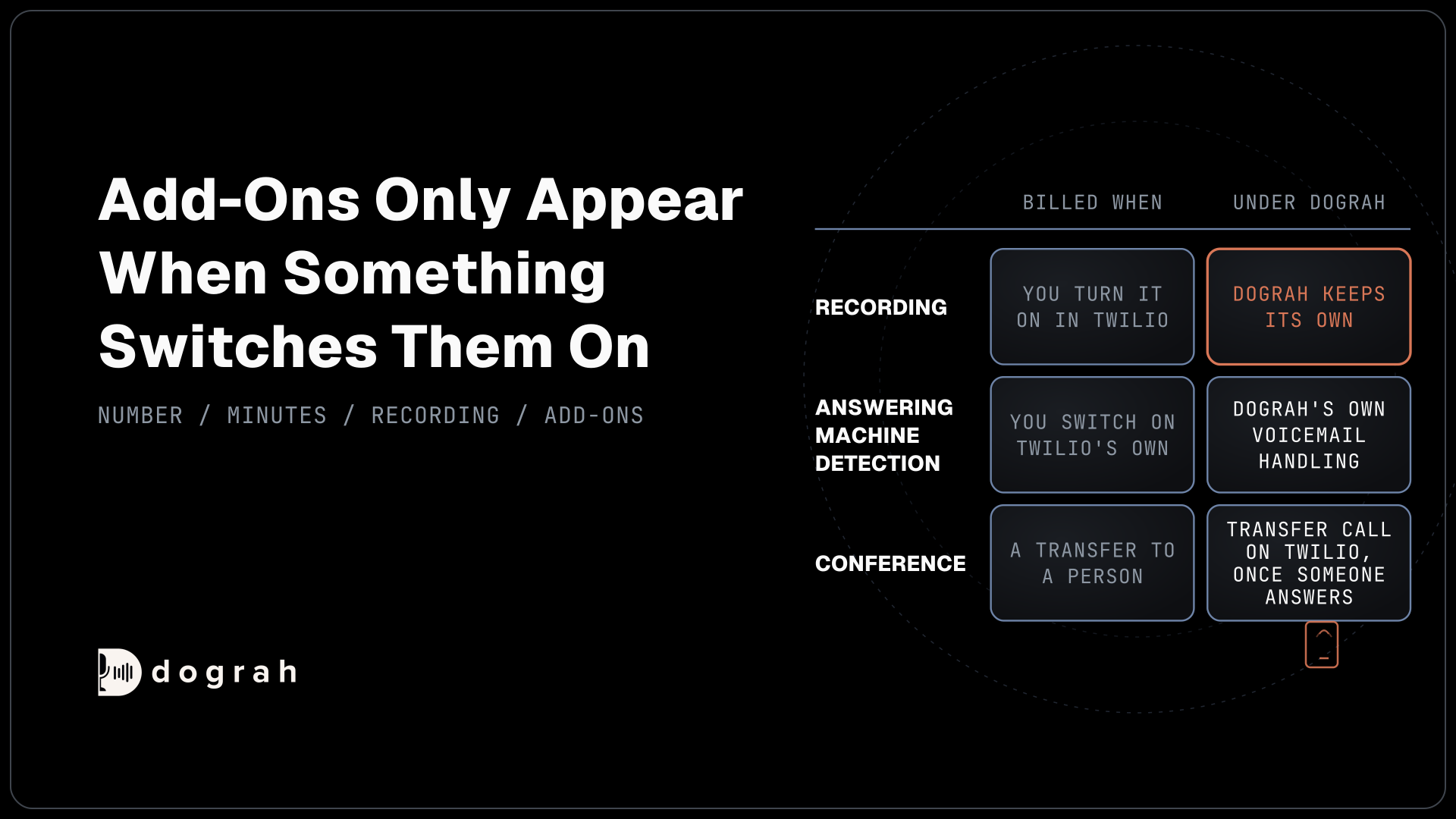
Add-ons only appear on the bill when something switches them on, so check which ones your setup uses. Twilio charges $0.0025 a minute to record a call, $0.0005 a minute per month to store the recording, and $0.0500 a minute to transcribe it.
Dograh's Twilio connection does not ask Twilio to record. Dograh keeps its own recording and transcript of each call, so Twilio's recording fee only shows up if you turn recording on in your Twilio account as well.
Transfers bring in conference minutes. When the agent hands a caller to a person with Transfer Call, Dograh dials the destination while the caller hears hold music, then joins the two once someone answers. On Twilio that join runs through a conference, which starts at $0.0018 per participant per minute, on top of the new outbound leg. If nobody answers, or the line is busy, the agent gets a transfer_failed result and the call carries on with the agent. On Twilio, you can also play a short spoken introduction to both people before they connect.
Two other add-ons are easy to skip. Twilio's own answering machine detection costs $0.0075 a call, but Dograh has its own voicemail handling, so you don't need Twilio's. Branded calling, which shows your business name on the recipient's screen, costs $0.12 a call and only matters for outbound campaigns.

Open Source Alternative to Vapi / Retell
Self-hosted voice agent platform — no per-minute fees
dograh-hq/dograh
Star on GitHub
One 5-minute AI call, line by line
Here is one worked example, built only from Twilio's US rates. It prices a 5-minute call to a local number and a 5-minute outbound call to a US mobile, both with Media Streams, which is how an agent platform such as Dograh receives the audio.
| Line | Inbound, local number | Outbound, US number |
|---|---|---|
| Minutes | 5 x $0.0085 = $0.0425 | 5 x $0.0140 = $0.0700 |
| Media Streams | 5 x $0.0044 = $0.0220 | 5 x $0.0044 = $0.0220 |
| Twilio total for the call | $0.0645 | $0.0920 |
| Number | $1.15 a month, shared by every call | $1.15 a month, shared by every call |
| Recording in Twilio | Not used under Dograh | Not used under Dograh |
| Models (speech-to-text, LLM, voice) | Your providers' own rates | Your providers' own rates |
Two changes move these totals a lot. The same inbound call to a toll-free number costs $0.1320, because the inbound minute rate jumps to $0.0220. If you swapped Media Streams for ConversationRelay, the $0.0220 stream line would become $0.35, while your own speech-to-text and voice lines would drop away.
The models are left as a line of their own on purpose. They depend on which providers you choose, and on most AI calls they cost more than the phone line, so set them next to this table rather than inside it.
When an Elastic SIP trunk changes the maths
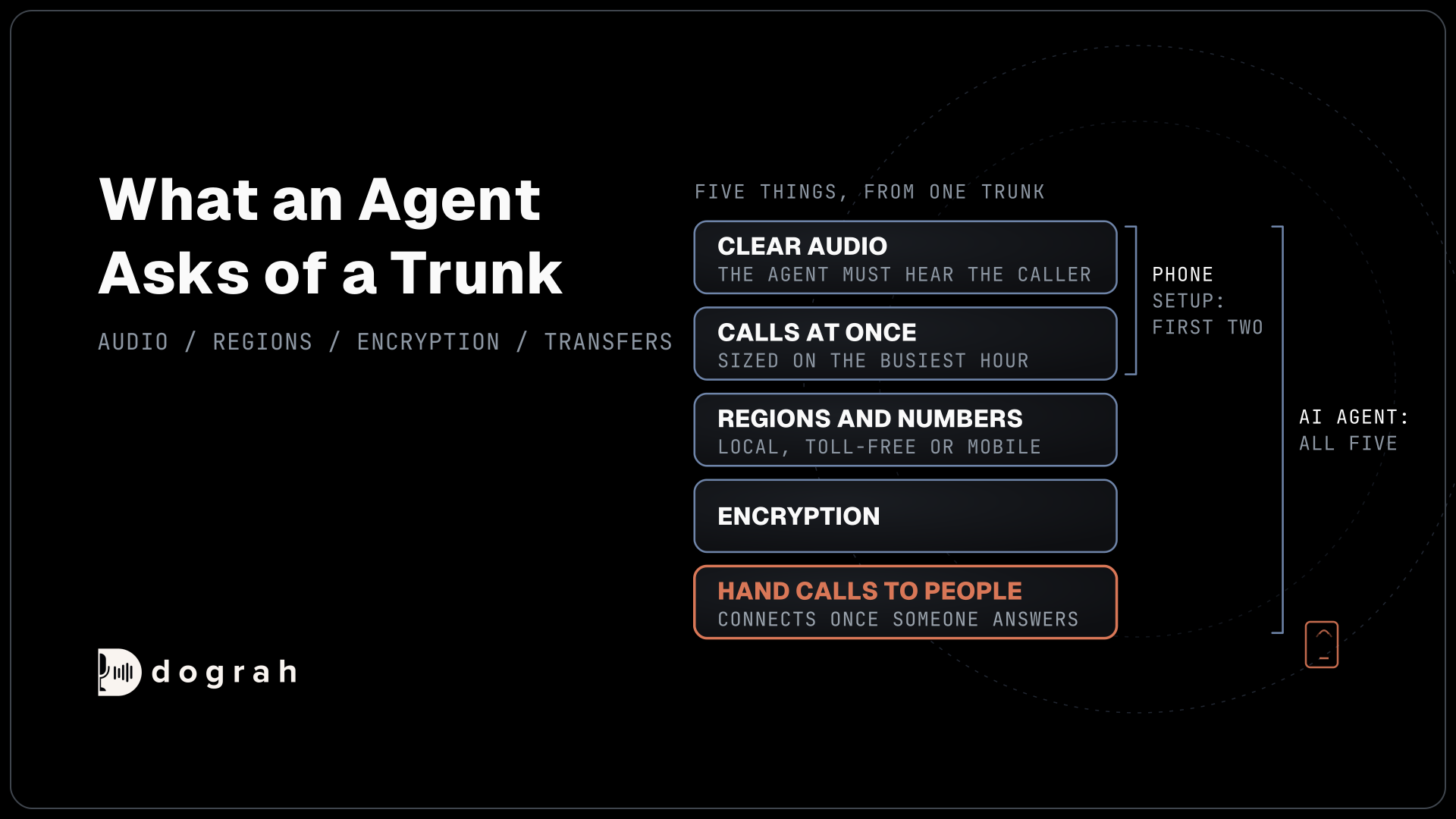
A SIP trunk carries calls between Twilio and a system that speaks SIP, and it prices the call differently. On Twilio Elastic SIP Trunking, inbound calls (origination) to a local number cost $0.0034 a minute and outbound calls (termination) to the 48 states cost $0.0100 a minute, with unlimited concurrent calls included.
There is no Media Streams line on a trunk, because the audio travels over SIP straight to the platform. The same 5-minute inbound call costs $0.0170 on the trunk, against $0.0645 on Programmable Voice with the stream. The outbound call costs $0.0500, against $0.0920. The number still costs $1.15 a month.
The trunk asks more of you in return. You set up SIP on both sides and allow the platform's address on the trunk. Twilio's spoken transfer introduction also belongs to Programmable Voice, so it is not there on a trunk. In our experience, SIP trunking is the most reliable choice for production calling, and Programmable Voice is the quicker path for a first agent.
On Dograh Cloud, Managed SIP gives your organisation a SIP domain that is already connected to your agents, so a Twilio trunk can point straight at it. Our post on Twilio SIP trunking pricing runs the numbers on 1,000 calls and covers the setup.
Twilio under Dograh with your own model keys
Under Dograh, Twilio is only the carrier, and the rest of the call is billed by providers you pick. You connect Twilio with your Account SID and Auth Token, and saving an inbound workflow on a number points that number at your agent straight away.
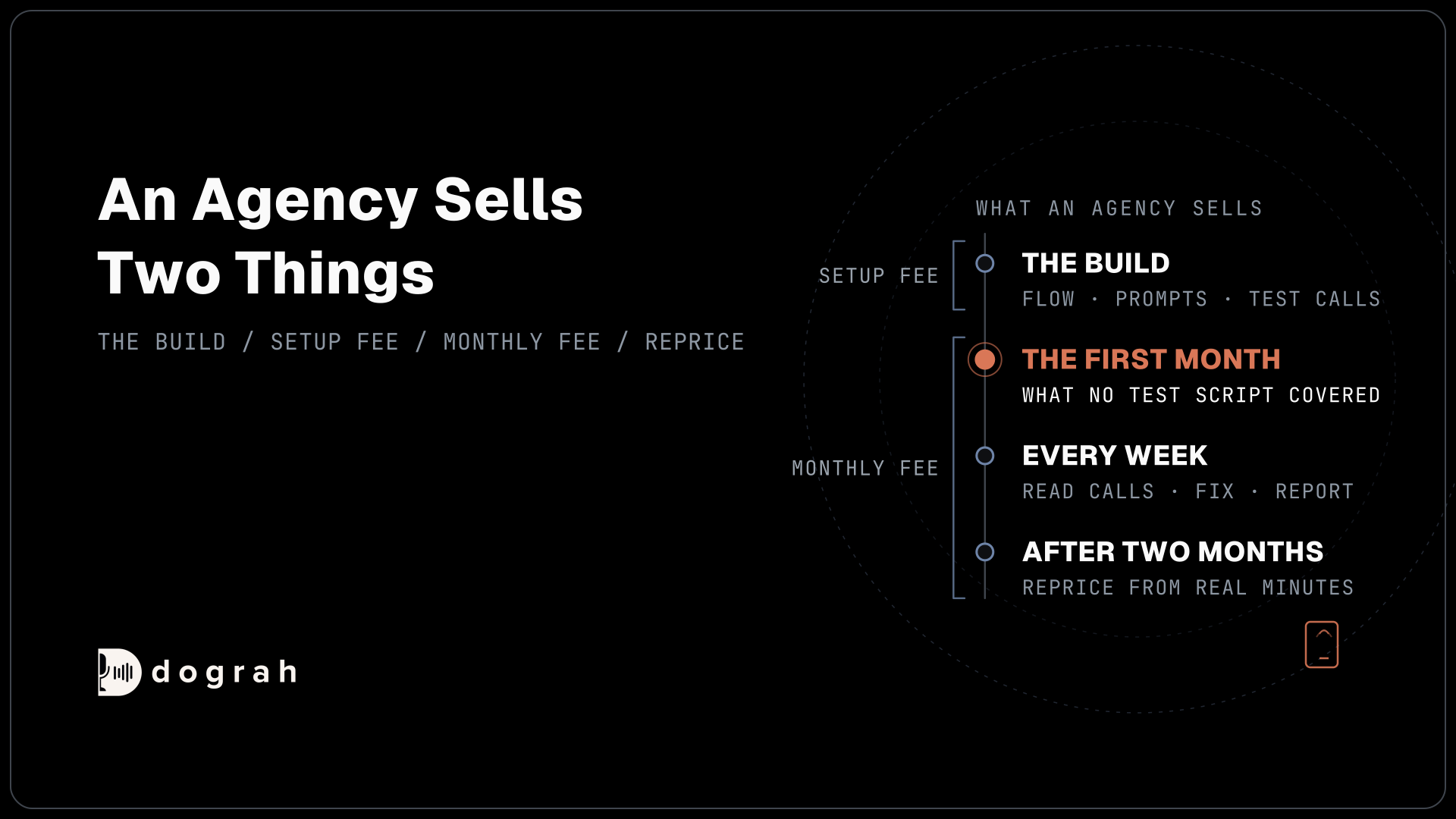
The bill then has three lines. The Twilio line is the minutes and stream from the table above. Self-hosted Dograh has no per-minute platform fee, but servers, model keys and phone minutes still cost money. Dograh Cloud charges a 1¢-a-minute platform fee. That is $0.05 for the 5-minute call.
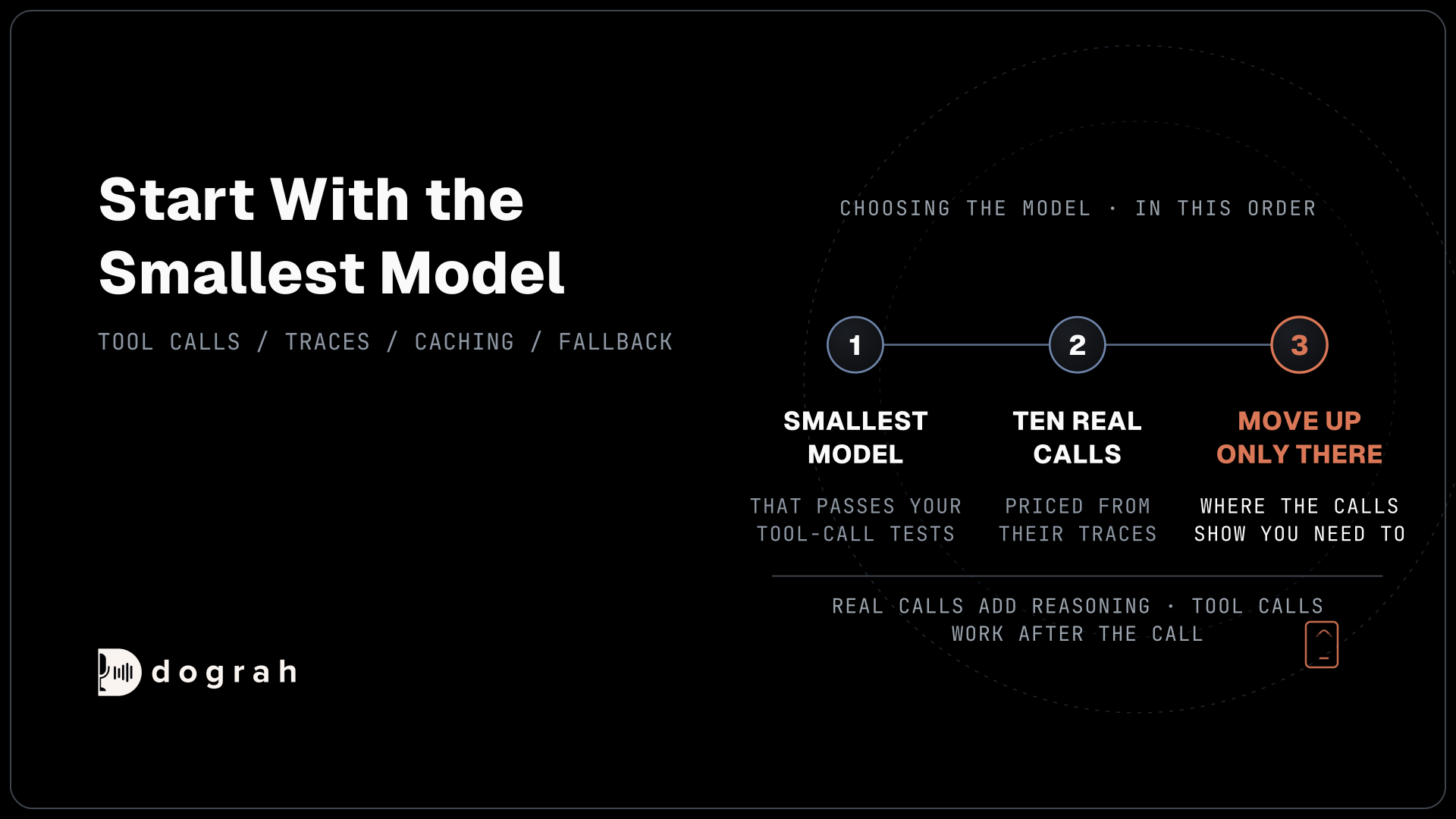
The third line is the models. Dograh lets you bring your own keys for any speech-to-text, language model and voice provider, or run open models on your own servers, so each one bills you at its own published rate. Our breakdown of what an AI voice agent costs per minute prices that line provider by provider.
The voice line is the easiest of the three to cut. Pre-recorded audio plays a recorded clip for the lines the agent says most and falls back to a generated voice for the rest. Each call's trace and the built-in QA then show where the minutes went, which helps you find calls that run long. For how numbers, carriers and SIP fit together, see Telephony 101 for voice AI.
From one call to a month of calls
A monthly bill is the per-call figure times your volume, plus the fixed lines. As an example, 1,000 five-minute inbound calls on one local number come to $42.50 in minutes, $22.00 in Media Streams and $1.15 for the number, so $65.65 from Twilio. The same 1,000 calls made outbound come to $93.15. A carrier with lower list rates changes that total, and our Twilio vs Plivo comparison prices one 5-minute call on both, with Plivo's streaming included at no charge.
Twilio says volume discounts apply automatically as usage grows, and committed-use pricing comes through its sales team. Budget at list price and treat any discount as a bonus. Our Twilio pricing calculator sets out the formula so you can put in your own call count, call length and number mix.
Join the Dograh Community
Dograh is an OSS alternative to Vapi. Join our Slack community for queries, releases, best practices & community interactions.
Twilio or Telnyx as the carrier
Twilio is not the only carrier that streams audio to an agent, and the per-minute gap is worth a look at volume. At Telnyx's US rates, the same 5-minute inbound call comes to $0.0435 and the outbound call to $0.0525, counting its Voice API fee, its SIP trunking fee and media streaming. Telnyx's SIP fees are "from" prices that vary by destination.
Both carriers connect to Dograh, and both support Transfer Call, so the choice comes down to price, regions and which features you need. Our Twilio vs Telnyx comparison puts the two side by side, and Telnyx voice AI pricing covers Telnyx's own voice agent product.
Each line item above has its own deep dive:
- Twilio Voice Pricing per Minute: Inbound and Outbound Calls
- Twilio Phone Number Pricing: Local, Toll-Free and Mobile
- Twilio Pricing Calculator: What 1,000 AI Calls Cost
- Twilio SIP Trunking Pricing: Rates for AI Voice Calls
- Twilio vs Telnyx for AI Voice Agents: Price and Setup
- Twilio vs Plivo for AI Voice Agents: Price, Numbers and Setup
- Twilio ConversationRelay Explained: What It Does and Costs
Glossary
- Media Streams
- Twilio's feature that sends a call's raw audio to your server over a WebSocket and plays back the audio your server returns. It costs $0.0044 a minute, and it is how an agent platform such as Dograh hears and speaks on a Twilio call.
- ConversationRelay
- Twilio's own voice AI layer. Twilio runs speech-to-text and text-to-speech and exchanges text with your app, which supplies the language model. It costs $0.07 a minute and replaces your own speech and voice providers.
- Call leg
- One connection between Twilio and a phone. A plain call has one leg, and a transfer to a person adds a second, outbound leg. Twilio bills each leg separately and rounds each one up to the next full minute.
- Origination and termination
- SIP trunking terms for direction. Origination is a call coming in from the phone network to your system, and termination is a call going out from your system to a phone. Twilio prices them at $0.0034 and $0.0100 a minute in the US.