
Plivo's US list rates are lower and include audio streaming, but its pay-as-you-go plan covers only the US and India. Twilio costs more per minute and rents numbers in over 100 countries. Dograh, the open-source AI voice agent platform we build, works with both carriers. You can self-host it or run it on Dograh Cloud.
Key Takeaways
- Plivo includes streaming. Twilio adds $0.0044 a minute on every agent call.
- Plivo's self-serve plan covers the US and India, up to $2,500 monthly.
- Both carriers connect to Dograh, and both support Transfer Call.
This post is part of our guide to Twilio pricing, which prices each Twilio line under one AI call. Here we set Plivo beside it and cover who each carrier suits, the rates line by line, one call on both, regions and numbers, then setup and transfers in Dograh.
Who each carrier suits
The choice comes down to where your callers are and how much the per-minute rate matters. Plivo suits a team calling in the US or India that wants the lowest list rate with the extras included. Its US rates are lower on every line an AI call uses, and streaming, recording, conferences and answering machine detection are listed at no charge.
Twilio suits a team that needs numbers in many countries, or that already keeps its numbers and billing there. It rents numbers in more than 100 countries. The short spoken introduction Dograh can play before a transfer connects also works on Twilio only. You pay for that reach per minute, and the stream fee sits on every call.
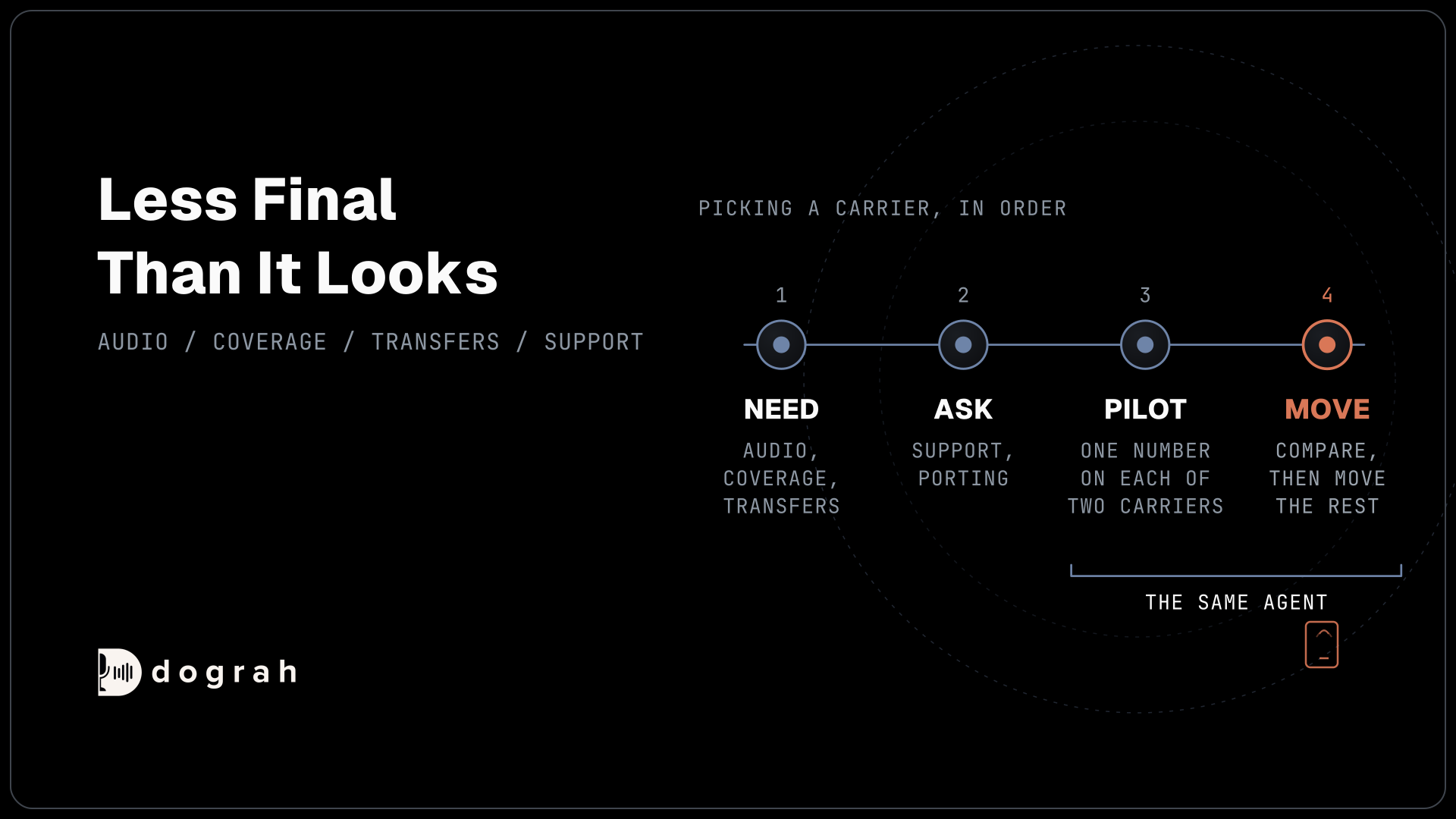
Price is not the only test. Rhumb, an independent API scoring site, rates Twilio's API as easier for agents to use than Plivo's, mostly for clearer error messages and longer webhook retries. Its scores were built around messaging rather than voice streaming, so place real calls on both carriers before you move your numbers.
Twilio vs Plivo, line by line
The table puts the US list rates side by side for the lines an AI agent call uses, from Twilio's US voice prices and Plivo's US voice prices. The last two rows show how each carrier works under Dograh.
| Line | Twilio | Plivo |
|---|---|---|
| Inbound, local number | $0.0085 a minute | $0.0055 a minute |
| Inbound, toll-free number | $0.0220 a minute | $0.0180 a minute |
| Outbound, from a local number | $0.0140 a minute | $0.0115 a minute |
| Audio streaming to the agent | $0.0044 a minute | Included |
| Local number | $1.15 a month | $0.50 a month |
| Toll-free number | $2.15 a month | $1.00 a month |
| Conference, used by transfers | From $0.0018 per participant per minute | $0.0000 |
| Recording | $0.0025 a minute | $0.0000, storage free for 90 days |
| Answering machine detection | $0.0075 a call | $0.0000 |
| Connects to Dograh with | Account SID and Auth Token | Auth ID and Auth Token |
| Transfer Call in Dograh | Yes, with an optional spoken introduction | Yes |
Two of those rows rarely reach the bill under Dograh. Dograh asks neither carrier to record the call, because it keeps its own recording and transcript, and its own voicemail handling replaces the carrier's answering machine detection. The lines that matter are minutes, streaming, the number and, when a caller needs a person, the transfer.

Open Source Alternative to Vapi / Retell
Self-hosted voice agent platform — no per-minute fees
dograh-hq/dograh
Star on GitHub
One 5-minute AI call on each carrier
Here is one worked example, with the same 5-minute call to a US local number, then the same length outbound. Streaming is counted on Twilio because an AI agent needs the audio, and on Plivo it adds nothing.
| Call | Twilio | Plivo |
|---|---|---|
| Inbound, 5 minutes | 5 x ($0.0085 + $0.0044) = $0.0645 | 5 x $0.0055 = $0.0275 |
| Outbound, 5 minutes | 5 x ($0.0140 + $0.0044) = $0.0920 | 5 x $0.0115 = $0.0575 |
| Local number | $1.15 a month | $0.50 a month |
On these list rates, Plivo comes out at well under half of Twilio inbound and more than a third lower outbound. Most of the inbound gap is the stream fee, which is why a minute-rate comparison alone understates it. Over a month of 1,000 such inbound calls on one number, the example comes to $65.65 on Twilio and $28.00 on Plivo.
Transfers add a line on both. When the agent hands a caller to a person who then talks for 2 minutes, both carriers dial that person as a new outbound leg, 2 x $0.0140 = $0.028 on Twilio and 2 x $0.0115 = $0.023 on Plivo. Twilio also bills conference minutes while the two people talk, and Plivo lists conferences at $0.0000. For how numbers, carriers and SIP trunks fit together, see Telephony 101 for voice AI.
Regions, numbers and self-serve limits
Reach is where the two carriers differ most. Twilio rents five types of phone number across more than 100 countries. Its default Region, US1, sits in the eastern US, and Twilio's Regions guide says not every product runs outside US1 and that it does not guarantee all data stays in the Region you pick.
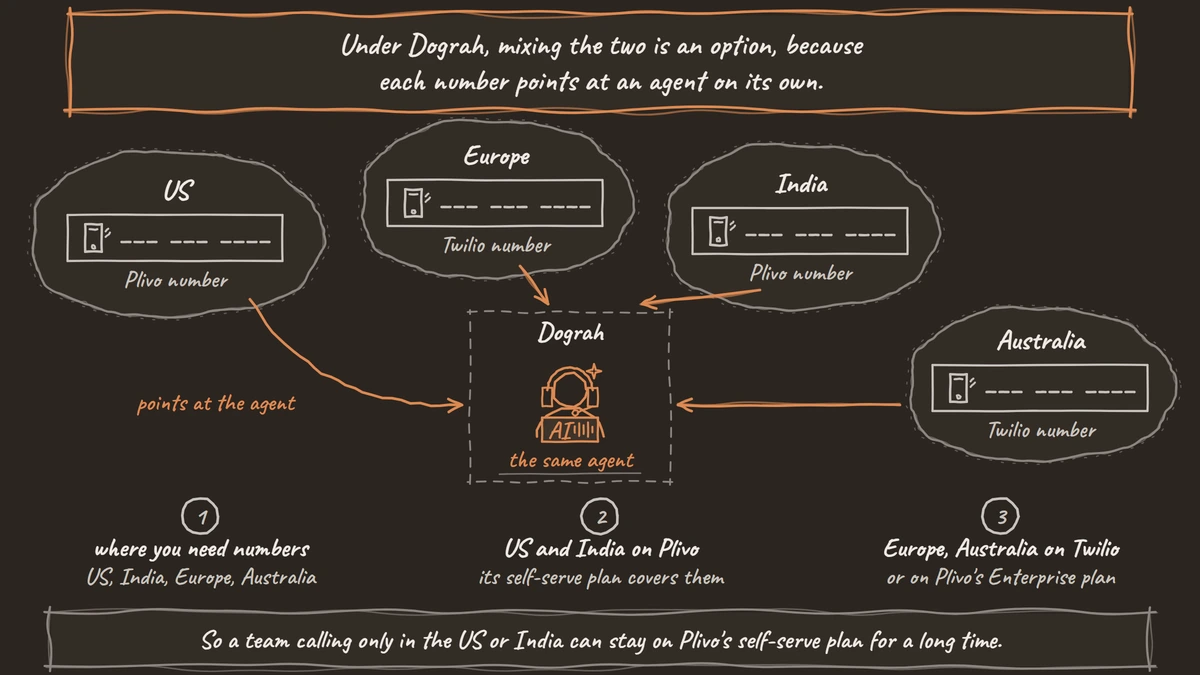
Plivo offers local, mobile and toll-free numbers in more than 50 countries, with address and identity checks done through its API. Its self-serve limits are tighter. Plivo's plans page limits pay as you go to the United States and India, with at most $2,500 of usage a month, 2 requests a second and 50 simultaneous calls. The 190-plus country footprint needs the Enterprise plan, from $1,000 a month.
So a team calling only in the US or India can stay on Plivo's self-serve plan for a long time. A team that also needs numbers in Europe or Australia either signs Plivo's Enterprise plan or uses Twilio for those countries. Under Dograh, mixing the two is an option, because each number points at an agent on its own.
Setup and transfers in Dograh
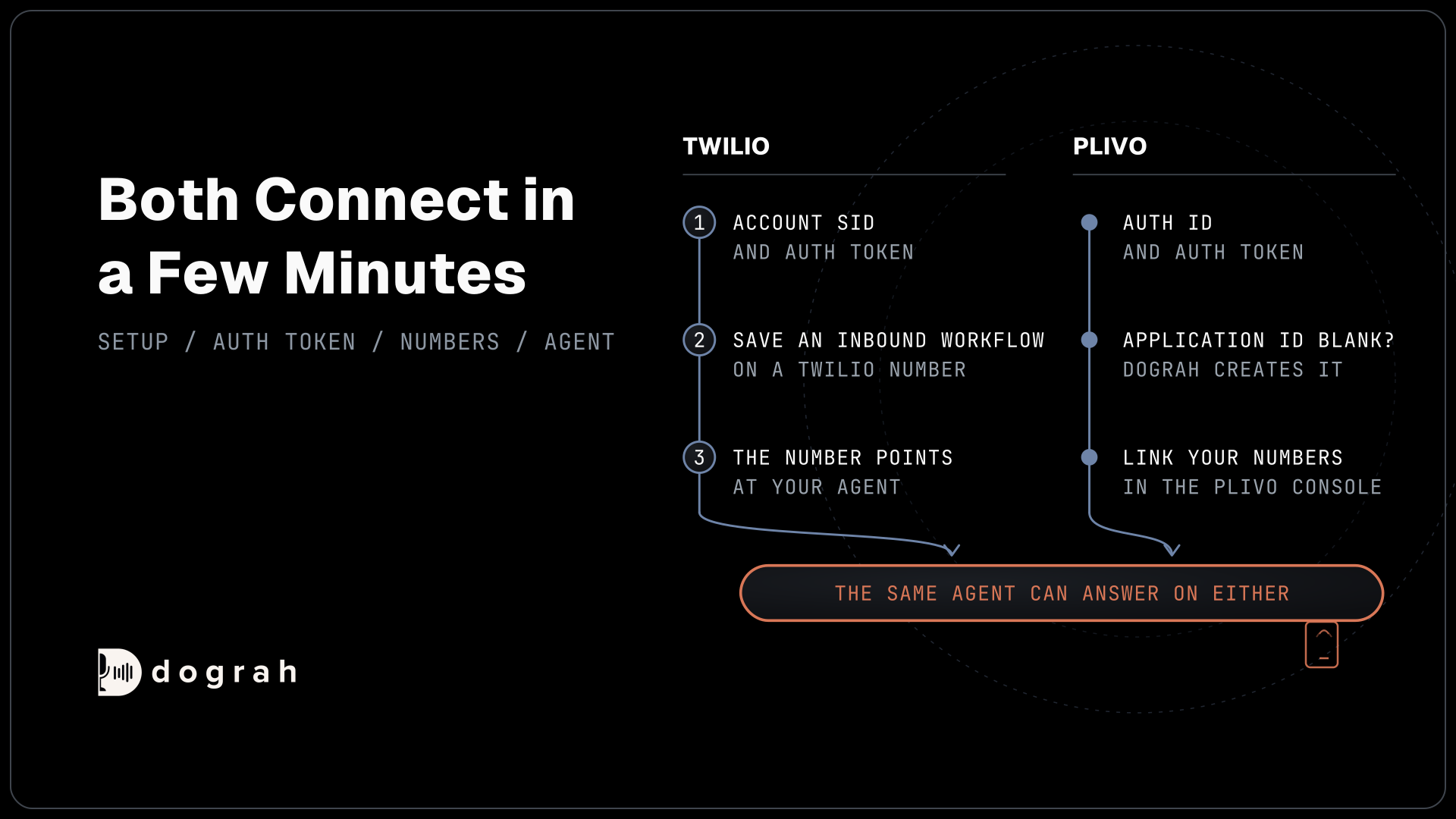
Both carriers connect to Dograh in a few minutes, and the same agent can answer on either. You add Twilio as a telephony configuration with your Account SID and Auth Token. Saving an inbound workflow on a Twilio number then points that number at your agent straight away.
Plivo connects with your Auth ID and Auth Token. If you leave the Application ID blank, Dograh creates a Plivo Application for you on save, with its answer URL already set. You then link your Plivo numbers to that application in the Plivo Console, under Phone Numbers and then Your Numbers. Both carriers send the agent 8 kHz phone audio.
Transfer Call works on both. Dograh dials the destination while the caller hears hold music and connects once the destination answers, joining the two through a conference. If nobody picks up, or the line is busy, the agent gets a transfer_failed result and the call carries on with the agent. On Twilio you can also play a short spoken introduction that both people hear before they connect.
The platform line is the same on either carrier. Self-hosted Dograh has no per-minute platform fee, but servers, model keys and phone minutes still cost money. Dograh Cloud charges a 1¢-a-minute platform fee. Your speech-to-text, language model and voice run on your own keys, and our breakdown of what an AI voice agent costs per minute prices those lines. Pre-recorded clips with a voice fallback and full call traces work the same whichever carrier carries the call.
If you are weighing a third carrier, our Twilio vs Telnyx comparison and Telnyx vs Plivo comparison use the same 5-minute call.
Join the Dograh Community
Dograh is an OSS alternative to Vapi. Join our Slack community for queries, releases, best practices & community interactions.
Glossary
- Audio streaming
- Sending a call's live audio to the agent's server and playing its replies back. Twilio bills its Media Streams at $0.0044 a minute, and Plivo lists audio streaming as included.
- Telephony configuration
- A carrier account connected to Dograh, such as Twilio or Plivo. An organisation can hold several, so different numbers can sit on different carriers and still point at the same agent.
- Plivo Application
- The object in Plivo that holds the answer URL for a call. Plivo numbers are linked to an application rather than carrying a URL themselves, and Dograh can create one for you when you save the configuration.
- Concurrent calls
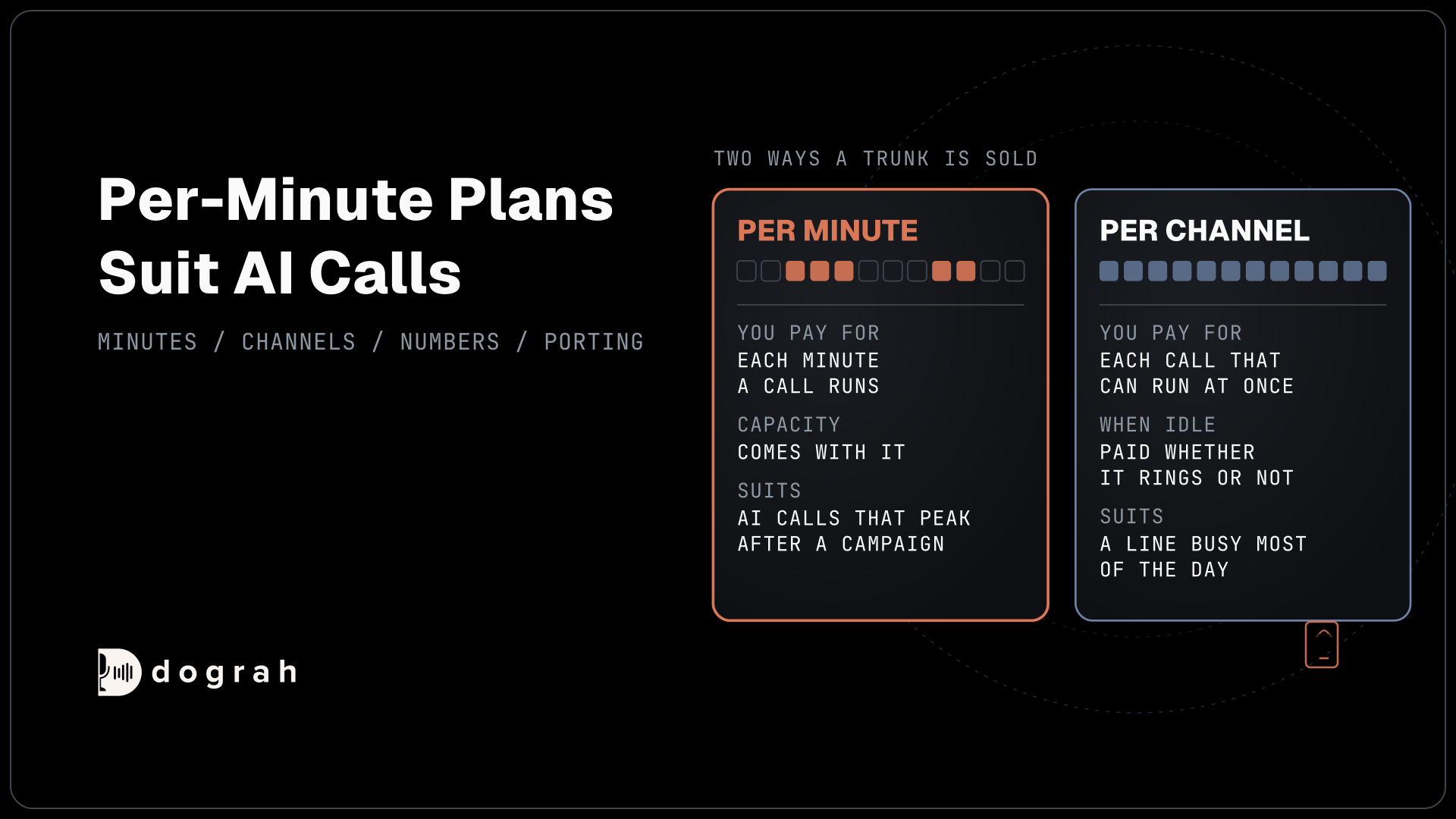
- How many calls run at the same moment. Plivo's pay-as-you-go plan allows 50 at once, which caps how fast a campaign or a busy inbound line can grow on that plan.